Recommended compliance check services for commercial properties.
# Recommended Compliance Check Services: Commercial Guide
Essential Compliance Checks Every UK Commercial Property Needs

Electrical Safety: EICR and PAT Testing Explained
An Electrical Installation Condition Report (EICR) inspects your fixed wiring, distribution boards, and circuits. Commercial properties require an EICR at least every five years--every three years in higher-risk environments like hospitality or healthcare. Portable Appliance Testing (PAT) covers movable equipment and runs annually.
The Electricity at Work Regulations 1989 aren't suggestions. A faulty circuit that causes injury leads to prosecution, substantial fines, and in serious cases, custodial sentences. To ensure ongoing compliance, our building fabric repairs and maintenance services address building integrity issues that might impact electrical systems.
Gas Safety, Fire Risk Assessments, and Legionella Controls
Gas safety inspections under the Gas Safety (Installation and Use) Regulations 1998 are annual. Full stop. They must be completed by a Gas Safe registered engineer. Appliances, flues, and pipework get checked, and certification must be available immediately when an enforcing authority requests it.
Fire risk assessments under the Regulatory Reform (Fire Safety) Order 2005 require regular review--typically annual, sooner if your building layout, occupancy, or fire precautions change. Legionella risk assessments follow HSG274 guidance, with monitoring and sampling frequencies determined by risk level and system type.
Lift Inspections, Asbestos Surveys, and Accessibility
Lifts need six-monthly thorough examinations under LOLER (Lifting Operations and Lifting Equipment Regulations) 1998. Asbestos management surveys are mandatory for buildings constructed before 2000, with periodic re-inspection as part of an asbestos management plan. Accessibility obligations fall under the Equality Act 2010, supported by practical access audits.
Frequency and Scheduling: What SFG20 Demands
SFG20 provides industry-standard maintenance schedules for building services and specifies task frequencies by asset type. Boilers? Annual servicing. Air handling units? Quarterly filter changes. Emergency lighting? Monthly functional checks plus periodic full-duration tests.
At MEMS, we build compliance into every PPM schedule using SFG20 as the baseline. You don't track multiple inspection dates. We manage the compliance calendar as part of your maintenance contract. Our commercial HVAC installation and maintenance services keep your air conditioning systems efficient and compliant year-round.
| Compliance Check | Legal Requirement | Typical Frequency | Risk of Non-Compliance |
|---|---|---|---|
| EICR | Electricity at Work Regulations 1989 | Every 5 years (often 3 for higher-risk sites) | Enforcement action, fines, prosecution |
| Gas Safety | Gas Safety (Installation and Use) Regulations 1998 | Annual | Enforcement action, fines, prosecution |
| Fire Risk Assessment | Regulatory Reform (Fire Safety) Order 2005 | Regular review (often annual) | Enforcement action, fines, prosecution |
| Legionella Control | HSG274 (HSE guidance) | Risk-based monitoring and sampling | Prosecution and civil liability |
Penalties for Non-Compliance: Fines, Closures, and Legal Exposure
HSE Fines and Prosecution Risks Under Current Laws
The Health and Safety Executive issues prohibition notices, improvement notices, and prosecution referrals. Fines under the Health and Safety at Work etc. Act 1974 can be substantial. Serious breaches can lead to custodial sentences. In 2023, the average fine for a health and safety breach in commercial property hit £87,000. That doesn't include legal costs--add another £40,000 to £60,000.
The Building Safety Act 2022 introduced stricter accountability for duty holders in higher-risk settings and strengthened expectations around building safety management. Where serious breaches lead to injury, individuals can face personal liability depending on circumstances and role.
Case Studies of Commercial Properties Hit Hard
A Birmingham hotel got slapped with £120,000 in fines after an HSE inspection found no legionella risk assessment for three years. The property had 200 rooms and a spa. The fine reflected the scale of the risk.
A West Midlands office block received a prohibition notice after an expired EICR. Closed for six weeks while emergency electrical works were completed. The landlord lost rent and faced tenant challenges. The original EICR would have cost a fraction of the commercial impact.
The Commercial Reality: Proactive compliance routinely costs 10-15% of what reactive enforcement costs. Not a cost centre. Protection against severe financial loss.
How Preventative Checks Avoid These Costs
Planned Preventative Maintenance (PPM) with integrated compliance monitoring shifts your risk profile entirely. We track certificate expiry dates, inspection windows, and guidance changes. You get alerts ahead of deadlines. Our engineers complete the work, upload certification to your portal, and update your compliance calendar.
This creates an audit trail that supports your position if an incident occurs. A defensible compliance regime rests on three things: competence, documentation, and consistent follow-through. Miss one, and the whole structure collapses.
How to Choose Recommended Compliance Check Services for Your Estate
Key Questions to Ask Potential Providers
Start with qualifications. Demand proof of Gas Safe registration, NICEIC approval, and REFCOM certification where relevant. Ask to see current cards and registration numbers. Every engineer on site must hold the appropriate, in-date accreditations for the task. No exceptions.
Ask about response times. Compliance issues don't keep office hours. A gas leak at 02:00 requires immediate attendance. If a provider can't provide 24/7/365 cover, the risk sits with you. At MEMS, our helpdesk is staffed around the clock because breakdowns don't respect your sleep schedule.
Finally, assess record-keeping. You need digital, traceable certificates that your team can access in seconds. If records live across paper files and email chains, gaps appear during audits. Modern compliance management requires a portal with expiry tracking and renewal prompts.
Red Flags: Spotting Unreliable FM Firms
Watch for "a different engineer every visit". Compliance requires continuity. An engineer who knows your building's quirks spots problems early. Constant new faces signal high turnover or poor planning. Consistency suffers.
Vague pricing is another warning sign. Clear scopes and transparent costs should be standard. If a provider can't outline what's included and what triggers additional charges, expect variation later. Lots of it.
| Provider Characteristic | Reliable Service | Poor Service |
|---|---|---|
| Engineer Continuity | Same team, building-specific knowledge | Different people at each visit |
| Certificate Delivery | Digital portal, prompt turnaround | Email-only records, slow updates |
| Emergency Response | 24/7 helpdesk, defined attendance targets | Office hours only, delayed call-backs |
| Compliance Tracking | Expiry alerts and planned renewals | Client tracks deadlines alone |
Integration with HVAC and M&E Maintenance for Full Coverage
Your compliance checks shouldn't exist in isolation from mechanical and electrical maintenance. A gas safety inspection that ignores boiler condition misses early warning signs. An EICR that doesn't consider recurring HVAC electrical load issues overlooks the operational cause of repeated defects.
At MEMS, we fold compliance checks into your PPM schedule. When we service heating plant, we verify the related gas safety requirements. When we maintain air handling units, we check electrical safety items relevant to the plant. This catches problems early and closes administrative gaps. Our commercial ventilation repair services and comprehensive HVAC maintenance solutions support this integration for complete asset care.
Building Long-Term Compliance with MEMS: Your Partner in Asset Protection
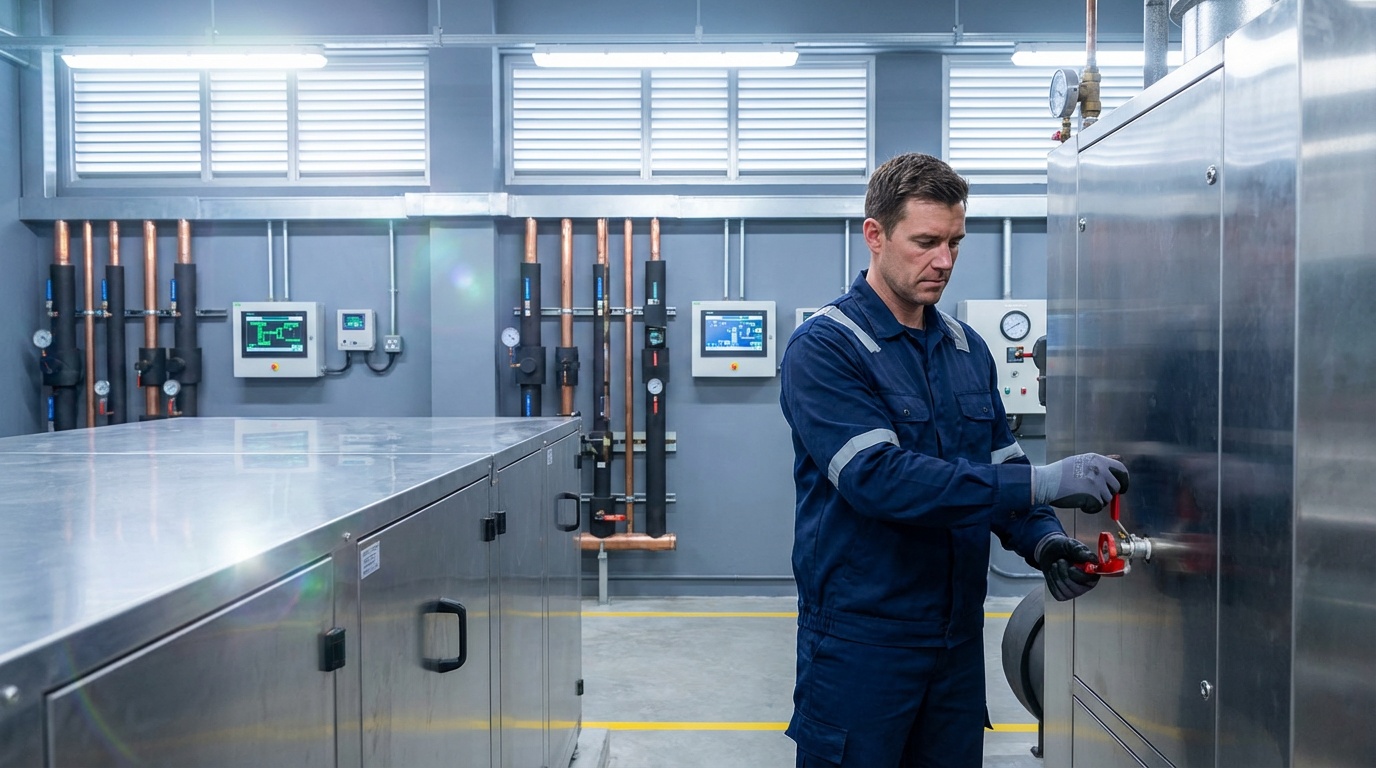
Compliance Meets Future-Proofing: Sustainable Upgrades
Compliance isn't static. The Building Safety Act 2022 and the push towards net-zero carbon by 2050 mean organizations now link compliance planning with energy and carbon objectives. When we complete a gas safety inspection, we advise on plant condition and replacement options--including heat pumps where suitable. When we test an electrical installation, we assess capacity for solar PV and EV charging, subject to design and budget.
This saves time by cutting duplicate site visits. It also supports forward planning as standards evolve. Energy Performance Certificate (EPC) minimum standards are tightening. By 2030, commercial properties below EPC Band B may face letting restrictions. Your compliance program should include forward planning, not just retrospective audits.
At MEMS, each compliance visit includes a brief asset condition note. If we spot inefficiency or obsolescence, we flag it immediately. You get a practical roadmap that supports compliance, controls energy costs, and protects asset value.
Client Success Stories from Birmingham and Beyond
We took over facilities management for a Birmingham retail park in 2021. The previous provider managed compliance reactively--issuing certificates only when tenants requested them. Within our first quarter, we implemented a full PPM schedule with integrated compliance tracking. Gas appliances, electrical distribution, fire systems, and water services were mapped, inspected, and brought up to date.
The result? Zero enforcement action over three years. A 22% reduction in energy costs through identified inefficiencies. A 40% drop in emergency call-outs. The landlord now uses the compliance record in tenant marketing.
Another client--a West Midlands office complex--faced lease break clauses tied to compliance failures. Their previous FM firm missed a legionella testing window by four months. We stepped in, completed urgent testing within 48 hours, addressed the identified risks, and rebuilt their compliance calendar. The tenants withdrew their break notices. The landlord avoided significant income loss.
The MEMS Difference: We don't just fix problems. We prevent them. Our engineers are vetted, trained to SFG20 standards, and accountable to you. We operate an open-door policy--you can visit our offices in Aldridge and speak to the person managing your contract.
Next Steps: Book Your Free Compliance Health Check
If you're uncertain about your current compliance status, we offer a no-obligation site survey. Our engineers audit existing certificates, inspect key systems, and provide a written report identifying gaps, risks, and recommended actions. No sales pressure. Straight engineering advice from someone who's spent 24 years in plant rooms and boardrooms.
Your compliance program should give you peace of mind, not paperwork anxiety. It should work with your maintenance strategy, not sit apart as an administrative burden. It should protect people, property, and profitability.
At MEMS Facilities Maintenance, we built our business on a simple principle: do the job properly, every time. Whether you manage a single commercial unit in Birmingham or a portfolio across the West Midlands, we're big enough to cope with demand and small enough to care about the details. Contact our 24/7 helpdesk on 0121 380 5630 or email [email protected] to book your compliance health check and see what proactive partnership looks like.
Frequently Asked Questions
What essential compliance checks should I look for in a commercial property?
When inspecting a commercial property, you need to verify essential compliance checks like Electrical Installation Condition Reports (EICR), gas safety certificates, and up-to-date fire risk assessments. Also, look for current legionella testing records, lift inspection reports, and asbestos management surveys if the building was built before 2000. These checks are fundamental for safety, legal standing, and operational continuity.
How frequently are compliance checks required for commercial properties?
The frequency of compliance checks for commercial properties varies by asset type and usage, guided by standards like SFG20 and HSE guidance. For example, gas safety inspections are annual, while Electrical Installation Condition Reports (EICR) are typically every five years, or three years for higher-risk sites. Lift inspections are required every six months under LOLER.
How do compliance checks fit into commercial property due diligence?
Compliance checks are a critical part of commercial property due diligence, going beyond simple paperwork. They confirm that a property meets statutory requirements, protecting against legal penalties, voided insurance, and costly operational downtime. Verifying these checks ensures the property is safe and legally sound for its intended use.
Can you list the main compliance checks for commercial properties?
The main compliance checks for commercial properties include Electrical Installation Condition Reports (EICR) for fixed wiring, annual gas safety inspections, and regular fire risk assessments. You also need legionella risk assessments and testing, six-monthly lift inspections, and asbestos management surveys for older buildings. These cover key safety and operational aspects.
What are the risks of skipping compliance checks for commercial properties?
Skipping compliance checks can lead to severe consequences, including significant fines and HSE prohibition notices that halt operations and cause substantial lost revenue. It can also void your insurance policies, impact lease agreements, and compromise the safety of occupants and staff. The initial "savings" quickly disappear when enforcement action follows.
Why should compliance checks be integrated with planned preventative maintenance?
Compliance checks should be integrated with your Planned Preventative Maintenance (PPM) schedule because your legal obligations and asset performance are inseparable. A certificate only proves a point-in-time inspection; ongoing maintenance ensures systems remain compliant and prevents issues from escalating. At MEMS, we build compliance monitoring into every PPM visit to flag potential failures early.
What regulations govern electrical safety in commercial properties?
Electrical safety in commercial properties is primarily governed by the Electricity at Work Regulations 1989, which place a duty on duty holders to maintain safe electrical systems. This involves regular Electrical Installation Condition Reports (EICR) for fixed wiring and Portable Appliance Testing (PAT) for movable equipment. Failing these checks can lead to prosecution and serious penalties.