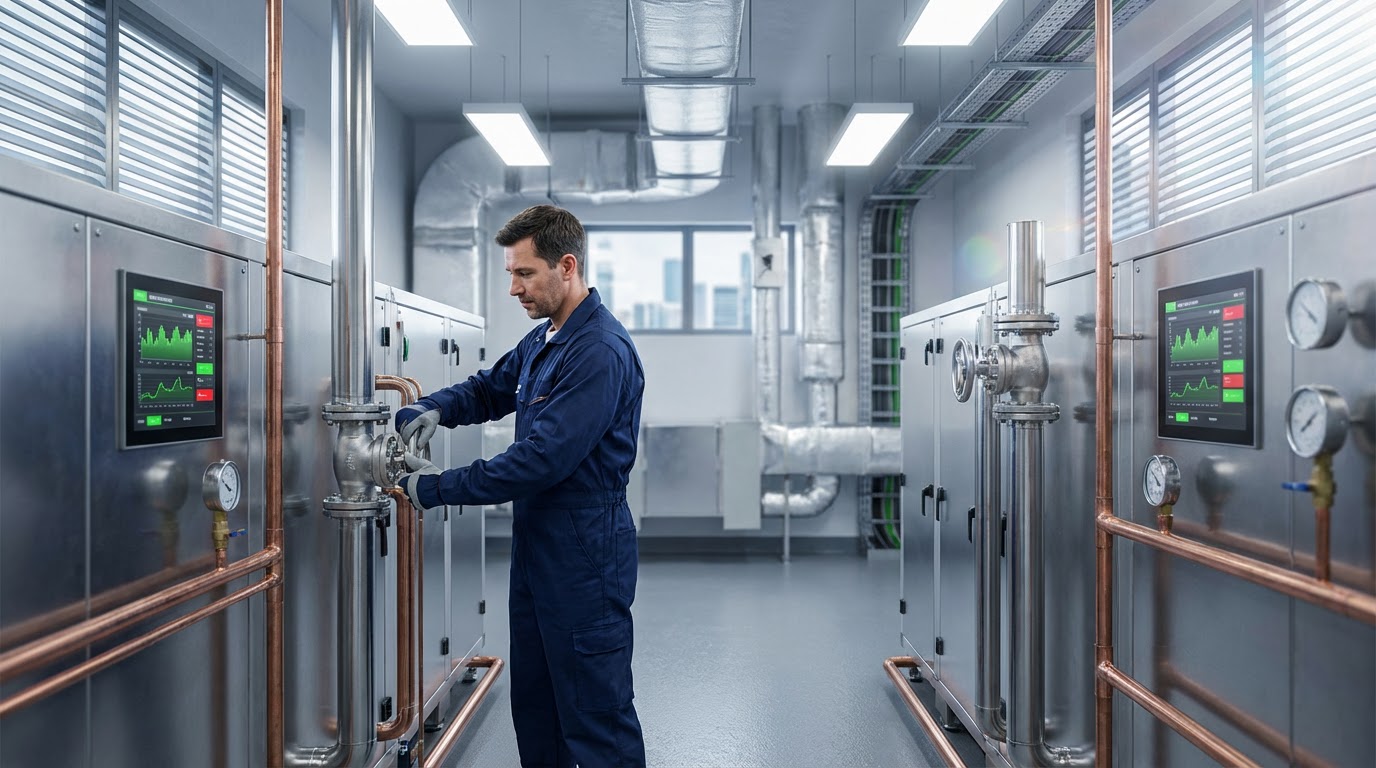
Best emergency HVAC response teams in UK.
Best Emergency HVAC Response Teams in UK Compared
The Hidden Costs of HVAC Breakdowns in Commercial Buildings
A failed HVAC system in July doesn't just create discomfort--it shuts down operations. Staff go home. Your commercial property becomes a liability. The most expensive decision you'll make is waiting for systems to fail before you act.
When air conditioning fails during peak trading hours, you're not just paying for an emergency call-out. Retail spaces lose footfall. Office productivity drops by 20% when temperatures exceed 24°C. Warehouses face stock damage. The repair bill? That's the small cost. Business interruption is where the real damage happens.
The True Cost of Poor Emergency Response

Last winter, a Birmingham office block lost heating on a Monday morning. Their FM provider promised a four-hour response. The engineer arrived six hours later without the replacement pump. The building stayed cold for three days while parts were ordered. Staff worked from home. Client meetings were cancelled.
The "cheap" maintenance contract cost them £15,000 in lost productivity.
Now compare that to proper emergency response: specialists who maintain stock, understand SFG20 compliance standards, and deploy engineers who know your building's quirks. Breakdowns become manageable incidents rather than business disasters.
Why Emergency Calls Mean Your Maintenance Strategy Failed
Emergency call-outs are symptoms, not the disease. When 80% of your spend goes on reactive fixes, you're managing failure instead of preventing it.
I've spent 24 years in this industry--from apprentice combustion engineer to managing complex sites across the Midlands. The pattern never changes: organisations that treat maintenance as discretionary spending end up paying triple on emergency repairs.
Planned Preventative Maintenance isn't an expense. It's insurance. Regular servicing catches the £50 filter that prevents the £5,000 compressor burnout. It identifies scale build-up before the boiler fails mid-winter. It keeps your Gas Safe and F-Gas compliance certificates current, protecting you from legal exposure.
The best emergency response teams don't just react to breakdowns. They prevent them through structured PPM programmes aligned with SFG20 standards. That's the difference between a vendor that fixes problems and a partner that stops them happening.
What Separates Professional Emergency Teams from Cowboys

When your HVAC system fails at 3 am on a Saturday, you discover the real difference between a provider that claims coverage and one that delivers. Professional teams share three non-negotiable characteristics: verifiable compliance credentials, genuine round-the-clock availability, and engineer continuity.
Compliance: More Than Just Paperwork
Every legitimate emergency HVAC team must hold Gas Safe registration and REFCOM F-Gas certification as baseline legal requirements. The real test? Adherence to SFG20 standards, which dictate the frequency and depth of maintenance tasks.
Ask your provider for its SFG20 maintenance schedules. If they hesitate or offer vague assurances, you're dealing with an organisation that treats compliance as an afterthought. At M&E Maintenance Solutions Limited, we maintain NQA ISO 9001 certification alongside Gas Safe and REFCOM credentials because quality management systems aren't optional extras--they're the framework that prevents shortcuts.
Real Availability vs Call Centre Theatre
Many large facilities management firms advertise round-the-clock availability but route your emergency call through offshore call centres, third-party subcontractors, or automated ticketing systems. Each layer adds hours to response times.
Professional teams run a continuously staffed helpdesk with direct access to qualified engineers who can diagnose issues by telephone and dispatch immediately. Our helpdesk is staffed by people who understand the difference between a pressure fault and a control failure--which means the right engineer arrives with the correct parts the first time.
The Value of Familiarity
The "different face" problem affects many large FM providers. You get a rotating cast of subcontractors who don't know your building's quirks, your plant room layout, or the modifications made last winter. Time gets wasted. Misdiagnosis increases.
Effective emergency response depends on familiarity. When our engineers attend your site repeatedly for planned maintenance, they spot warning signs before they become emergencies. They know which valve sticks, which sensor drifts, and which control panel behaves unpredictably.
| Provider Type | Compliance Visibility | Engineer Familiarity | Response Coordination |
|---|---|---|---|
| Large national FM | Generic certificates | Rotating subcontractors | Call centre ticketing |
| Regional specialists | Transparent, site-specific | Consistent team assignment | Direct engineer dispatch |
| MEMS standard | Digital certificates within 24 hours | Same building services technicians | Continuously staffed helpdesk |
HVAC failures often reveal underlying building fabric issues: condensation damage from poor insulation, structural movement affecting pipework, or water ingress compromising electrical systems. Providers that only fix the mechanical symptom leave you exposed to recurring failures. We address the root cause through our Building Fabric Repairs & Maintenance service because we understand how buildings function as complete systems.
Audit Your Current Provider: 7 Questions Every Facility Manager Must Ask
When a facility manager contacts us after a breakdown, I ask one question first: "When did you last see your PPM schedule?" The silence tells me everything. Most commercial properties operate on what I call "crisis maintenance"--they wait for the call from reception that the air conditioning has died in July or the heating has packed in during a cold snap.
That's not maintenance. It's damage control.
Seven questions that separate professional emergency HVAC response teams from reactive cowboys:
1. Response Time Guarantees vs Real Delivery
Ask your provider: "What is your average emergency response time in the past six months?" Not the promise in the contract. The actual data. At M&E Maintenance Solutions Limited, we track every call-out through our helpdesk. We know our Birmingham response averages 90 minutes because we measure it.
2. Parts Availability and First-Time Fixes
Do they arrive with stock, or arrive to diagnose and leave? Professional teams carry common failure parts. Our engineers stock filters, contactors, and refrigerant because we know what fails most often in commercial systems.
3. Post-Repair Reporting and Compliance Proof
You should receive a digital compliance certificate within 24 hours: Gas Safe, F-Gas, and evidence of SFG20 adherence. If your current provider hands you a scribbled worksheet three weeks later, you're legally exposed.
4. Reactive vs Proactive Spend Ratio
Pull your last 12 months of invoices. If more than 60% is emergency work, your strategy is broken. Planned maintenance should dominate your spend, not crisis fixes.
5. Energy Performance Tracking
Are your utility bills creeping upwards? Poorly maintained HVAC systems lose efficiency quietly. We tune systems during PPM visits to keep energy costs flat. Employers have a duty to manage temperature at work; more details can be found on the health and safety executive website regarding temperature requirements in workplaces.
6. Digital Compliance Tracking
Can you access your compliance certificates online within 60 seconds? Modern providers use digital systems that protect you during audits and inspections.
7. Root Cause Analysis
Do they explain why the failure happened, or just fix the symptom? Our Building Fabric Repairs & Maintenance team investigates underlying causes--condensation, structural issues, electrical faults--to prevent recurrence.
Why M&E Maintenance Solutions Limited Sets the Standard
I built MEMS because I was tired of watching facility managers get burned by faceless FM corporations that treat every site like a transaction. After 24 years holding the tools, I know what commercial buildings need: engineers who understand the building as a working system, not a collection of isolated components.
Our 24/7 Helpdesk and Proven West Midlands Response
We don't outsource our emergency line to an answering service. Our helpdesk is staffed by people who understand the difference between a chiller fault and a condenser issue. When you call at 2 am, you speak to someone who can dispatch the right engineer with the right parts.
Internal Testing of Sustainable Systems
We're not just reactive. We test emerging technologies internally before we recommend them to clients. Our team evaluates heat pump performance in real commercial environments so we can advise facility managers with evidence, not sales brochures. For those new to the concepts, HVAC systems and their technology can be further explored on Wikipedia's HVAC article.
Case Study: 87-Minute Response in Birmingham City Centre
A 12-storey office block in Birmingham lost HVAC on a Monday morning in August. Their previous provider promised a four-hour response. We arrived in 87 minutes, diagnosed a failed compressor, and had a replacement unit operational by 3 pm.
The building never closed. That's the difference between corporate promises and engineer-led delivery.
We're big enough to cope with complex commercial demands across the UK, but small enough to care about the details that keep your building running. If you're tired of being treated like a number by massive FM firms, contact our helpdesk for a site survey. We'll audit your current maintenance strategy and show you where your risks lie.
Frequently Asked Questions
What is the principle behind the '£5000 rule' for AC maintenance in commercial settings?
While there isn't a single '£5000 rule,' the principle highlights that ignoring small issues can lead to catastrophic costs. For example, a £50 filter replacement can prevent a £5,000 compressor burnout. Proactive maintenance is always cheaper than reacting to a major system failure, which can also cause significant business interruption.
Are qualified HVAC technicians in demand in the UK for commercial buildings?
Absolutely. The demand is high for qualified and certified HVAC engineers who understand commercial systems and compliance standards like SFG20. Businesses need teams that can respond quickly, diagnose accurately, and fix issues properly the first time to protect their operations and bottom line.
What are typical costs for emergency HVAC call-outs in the UK?
Emergency HVAC call-out costs are generally higher than planned maintenance visits due to the urgency and unscheduled nature. However, the real cost to a commercial business is often the lost revenue and productivity from downtime, which can far exceed the repair bill itself. That's why planned preventative maintenance is so valuable, reducing the need for these expensive emergency interventions.
What is the UK equivalent of HVAC?
HVAC, which stands for Heating, Ventilation, and Air Conditioning, is the widely accepted and understood term in the UK. It encompasses all systems that control the temperature, humidity, and air quality within commercial buildings. There isn't a different common equivalent term.
What is the '3 minute rule' for air conditioners and why is it important?
The '3 minute rule' for air conditioners refers to waiting at least three minutes before restarting a unit after it has been turned off. This allows the pressures within the compressor to equalize, preventing damage and extending the lifespan of the equipment. It's a simple step in proper operation that helps avoid costly repairs.