M&E Maintenance Solutions HVAC Services review
Beyond the Breakdown: Why Proactive HVAC Maintenance is Your Commercial Asset's Best Friend
In this M&E Maintenance Solutions HVAC Services review, I want to give facility managers and estate managers across the UK a straight answer: M&E Maintenance Solutions Limited, founded in 2007, delivers Planned Preventative Maintenance, full regulatory compliance, and innovative HVAC technology to commercial buildings across the UK. The verdict: a genuinely proactive partner, not another reactive contractor with a glossy brochure.
The True Cost of 'If It Ain't Broke'
Skipping a quarterly PPM visit looks like a budget saving for roughly three months. Then a compressor burns out because a £50 filter wasn't replaced, and you're paying emergency call-out rates, premium parts pricing, and absorbing the cost of closed premises. Silence in a plant room isn't reassurance. It's a countdown.
From Boiler Room to Boardroom: The Commercial Impact of HVAC Failure
A failed air handling unit in August doesn't just make your staff uncomfortable. It triggers productivity loss, potential stock damage, and reputational risk if clients walk into a sweltering office. For retail and hospitality operators, HVAC failure directly suppresses footfall and revenue. Uptime isn't a technical metric -- it's a commercial one.
M&E Maintenance Solutions' Philosophy: Preventing Problems Before They Start
M&E Maintenance Solutions Limited operates on a single principle: identify the fault before the fault finds you. Every contract is structured around scheduled inspection cycles aligned to SFG20 standards, so wear, drift, and compliance gaps are caught during a planned visit -- not at 11 pm on a Friday. Their 24/7/365 availability means that when something unexpected does occur, a qualified engineer responds. Not an answering service.
Understanding Your Building's 'Health': It's More Than Just Temperature
HVAC performance connects directly to air quality, humidity control, energy consumption, and occupant wellbeing. A building running on a poorly maintained system is burning excess energy, shortening asset lifespan, and potentially breaching F-Gas and Gas Safe obligations simultaneously. Clients who move to a structured PPM programme typically report real reductions in reactive spend over time. That shift -- from firefighting to forward planning -- is exactly what separates asset management from asset neglect.
The M&E Maintenance Solutions HVAC Difference: Customer-First Service and Open-Door Innovation

Putting You First: How the Customer-First Approach Translates to Your Bottom Line
Most large FM contractors assign you an account number and a call centre. M&E Maintenance Solutions Limited built its reputation on referrals -- which tells you everything about how it operates. When a contract renewal depends on a satisfied client recommending the service to a peer, every single visit matters. That accountability drives response times, engineer continuity, and documentation quality in ways no corporate KPI dashboard can replicate.
The Open-Door Policy: Vetted Technologies for Real-World Gains
M&E maintains an open-door policy towards new HVAC technologies. Air-to-air heat pumps, air-to-water heat pumps, Solar PV, Solar Thermal, and LED lighting are all available -- but only after internal trials confirm reliability. You're not a test subject for unproven kit. Any technology recommendation carries genuine performance data behind it, not just a manufacturer's sell sheet.
Tailored Solutions: No One-Size-Fits-All Approach
A multi-tenanted office block in Birmingham has entirely different HVAC demands from a distribution warehouse in the West Midlands. M&E structures every contract around the specific asset register, occupancy patterns, and compliance obligations of each site. That specificity is what separates a genuine maintenance partner from a contractor who turns up with the same checklist regardless of what's actually in front of them.
More Than Just a Service Call: M&E's Comprehensive HVAC Maintenance Framework
Planned Preventative Maintenance: The Cornerstone of Uptime
PPM isn't a luxury. It's the financial baseline for any serious commercial building operator. M&E structures PPM schedules to SFG20 standards, ensuring every inspection interval, task frequency, and sign-off requirement meets the industry benchmark. The result: a predictable maintenance spend that replaces the unpredictable cost of reactive failures.
- Filter inspection and replacement at scheduled intervals to prevent energy drift
- Refrigerant leak checks in compliance with REFCOM F-Gas certification requirements
- Gas Safe registered engineers on all combustion equipment inspections
- ISO 9001 quality management applied to every documented service visit
- SafeContractor accreditation confirming safe working practices on your site
Compliance Confidence: SFG20, F-Gas, and Beyond
Regulatory exposure is a silent liability. If your current provider can't produce traceable compliance certificates within 24 hours of a completed job, you're carrying legal risk you may not even know about. M&E holds Gas Safe, REFCOM F-Gas, BES, SafeContractor, and ISO 9001 accreditations. Ask your current provider the same question. If they hesitate, that hesitation is your answer.
24/7/365 Availability: Breakdowns Don't Work Office Hours
When a chiller fails at 2 am before a critical business day, the value of genuine round-the-clock cover becomes immediately clear. M&E provides 24/7/365 engineer response -- not a voicemail. For facility managers accountable to board-level stakeholders, that single commitment changes the risk profile of every building under their management.
Beyond HVAC: The Integrated Advantage of M&E's Building Services Expertise
Why Siloed Services Cost You More
Managing three separate contractors for HVAC, electrical, and plumbing creates coordination gaps that cost money. Scheduling conflicts, duplicated call-out fees, and contradictory advice from competing providers are avoidable inefficiencies. M&E works with strategic partners and sister companies to deliver complementary services under a single accountable relationship -- removing the friction that fragmented arrangements consistently produce.
One Partner, Total Building Health
When your HVAC provider also understands how electrical load and pipework interact with your heating and cooling systems, fault diagnosis is faster and recommendations are more accurate. Think of it like a GP who knows your full medical history versus four separate specialists who've each only seen one scan. One point of contact who understands your complete asset register is worth considerably more than four contractors, each seeing only their own slice of the building.
| Factor | Integrated Partner (M&E) | Multiple Separate Contractors |
|---|---|---|
| Fault Diagnosis Speed | Single engineer, full system view | Multiple visits, competing assessments |
| Compliance Documentation | Consolidated, traceable records | Distributed across multiple providers, requiring active coordination |
| Emergency Response | One call, coordinated response | Requires coordination across separate providers |
| Energy Efficiency Advice | Whole-building perspective | Limited to an individual discipline |
Making the Right Choice: Questions to Ask Your HVAC Provider
Are They Truly Proactive, or Simply Reactive with Better Marketing?
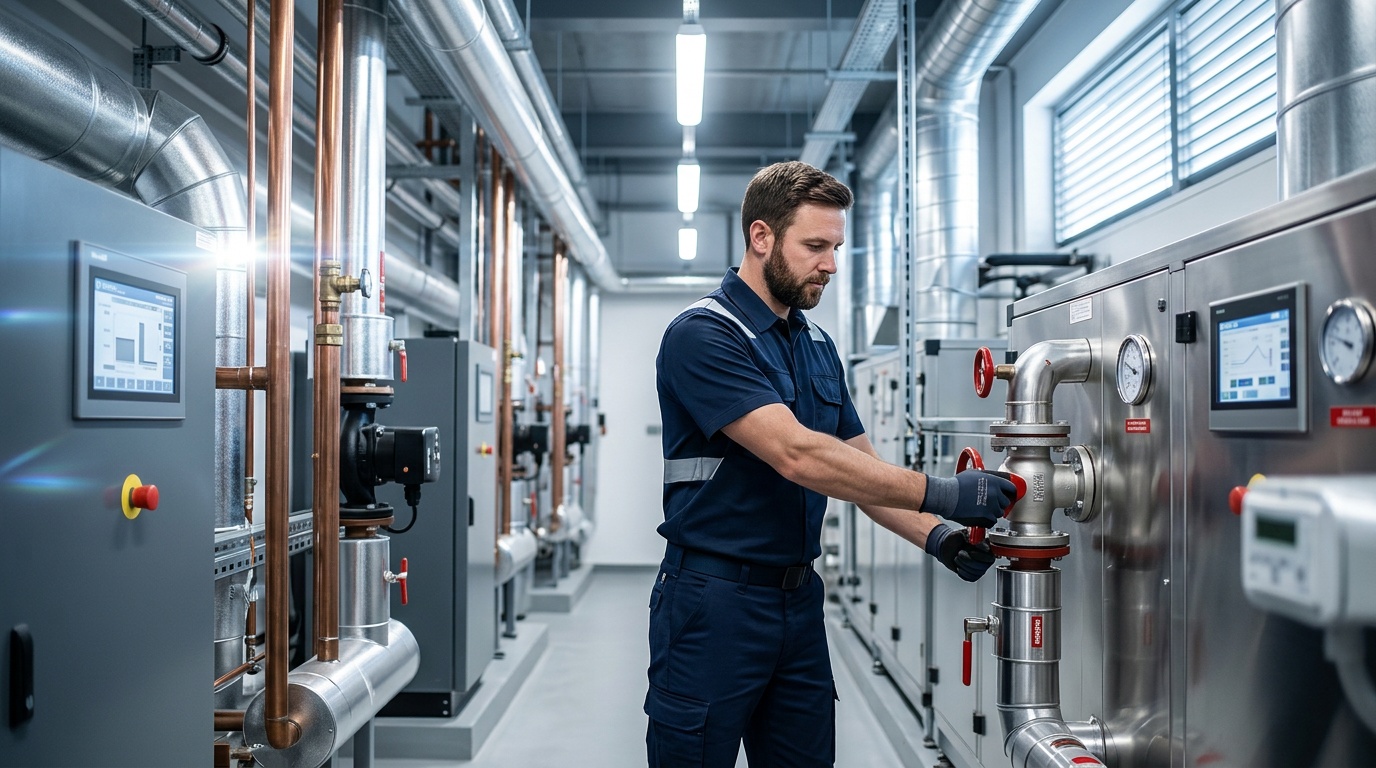
Ask your current provider what percentage of its completed jobs last quarter were emergency call-outs versus scheduled PPM visits. If it can't answer -- or if reactive call-outs consistently outnumber scheduled visits -- its strategy isn't protecting your assets. A well-structured PPM programme should make emergency call-outs the exception. Not the operating model.
What Is Their Approach to Compliance and Documentation?
Demand traceable certificates within 24 hours of every completed job. Gas Safe records, REFCOM F-Gas documentation, and SFG20-aligned service reports are non-negotiable. If your provider treats paperwork as secondary to the technical work, you're carrying a liability it hasn't disclosed to you.
Your Provider Evaluation Checklist
- PPM ratio: Confirm scheduled visits outnumber reactive call-outs
- Accreditations: Verify Gas Safe, REFCOM F-Gas, SafeContractor, and ISO 9001 as a minimum
- Engineer continuity: Establish whether the same engineer attends your site consistently
- Technology vetting: Ask how new products are trialled before being recommended to clients
- 24/7 response: Confirm direct engineer access, not a call centre, out of hours
M&E Maintenance Solutions Limited answers every one of these questions with evidence, not assurances. Founded in 2007 and built on client referrals, its track record reflects what happens when engineering standards and commercial accountability operate as a single standard -- not competing priorities.
Frequently Asked Questions
Is HVAC part of M&E?
From my perspective, HVAC is a fundamental part of M&E, or Mechanical and Electrical, services in commercial buildings. It's about ensuring your heating, ventilation, and air conditioning systems are running efficiently and reliably. At M&E Maintenance Solutions, our focus is squarely on HVAC to keep your commercial assets performing.
What is M&E maintenance?
M&E maintenance, particularly for HVAC, is about keeping your commercial building's critical systems in top condition through planned preventative measures. It involves scheduled inspections, servicing, and compliance checks to prevent breakdowns before they happen. This proactive approach saves you money and protects your assets in the long run.
What is the difference between HVAC service and maintenance?
Think of it this way: HVAC service often refers to a reactive response when something has already gone wrong, like a repair or an emergency call-out. Maintenance, especially planned preventative maintenance (PPM), is about proactive care, catching issues before they escalate. It's the regular, scheduled work that keeps your systems running smoothly and prevents costly failures.
What's the best HVAC maintenance schedule?
The best HVAC maintenance schedule is always tailored to your specific commercial building's needs, asset register, and usage patterns. We structure our Planned Preventative Maintenance (PPM) schedules to SFG20 standards, ensuring every inspection and task meets industry benchmarks. This specific approach prevents energy drift, accelerates component wear, and ensures compliance.
What is the $5000 rule for HVAC?
The "$5000 rule" is a general guideline often used to help decide whether to repair or replace an HVAC system, suggesting replacement if repairs exceed $5,000 or 50% of a new unit's cost. For commercial assets, however, the decision is more complex, considering factors like asset lifespan, energy efficiency gains, and long-term operational costs. Proactive maintenance helps extend system life and makes these decisions less urgent.