Alternatives to traditional heating systems for Birmingham homes.
Managing a commercial property or a large residential portfolio in Birmingham requires a pragmatic approach to building fabric and energy consumption. For years, the standard gas boiler has been the default choice, yet the commercial reality is shifting. Between the volatility of wholesale energy prices and the tightening of UK building regulations, the traditional approach to heating is becoming a liability for the bottom line. We are seeing a decisive move towards alternatives to traditional heating systems for Birmingham commercial properties, driven by the need for lower operational expenditure and long-term compliance.
Key Takeaways
- Relying on standard gas boilers for commercial heating is becoming a financial risk as energy prices swing wildly and regulations tighten.
- Property owners in Birmingham need to shift to alternative heating systems to cut long-term operating costs and stay ahead of compliance requirements.
- The move away from traditional boilers is a practical response to market volatility, not just an environmental trend.
- Investing in modern heating alternatives now protects your bottom line against future energy price shocks and regulatory penalties.
As someone who has spent over two decades in the mechanical and electrical sector, from the tools to the boardroom, I have seen how a reactive stance on heating fails. It is not merely about replacing a broken unit; it is about future-proofing your asset. Whether you are a facilities manager overseeing a portfolio in the West Midlands or a landlord maximising the EPC rating of a commercial unit, understanding the available technology is now a core part of the job.
The Case for Change: Why Birmingham Buildings Need to Look Beyond the Gas Boiler
The rising cost of gas and electricity
The most immediate pressure on Birmingham property owners is the escalating cost of energy. Traditional heating systems, particularly older non-condensing boilers, operate at efficiencies that are no longer acceptable in a high-cost environment. Every pound spent on inefficient heating is a direct drain on profitability. In a commercial setting, these costs are magnified across large floor plates. We are frequently called to sites where the heating strategy has remained unchanged for 20 years, resulting in utility bills that are significantly higher than they should be. Moving towards high-efficiency Commercial HVAC Installation and Heating Service solutions is not just an environmental choice; it is a financial necessity to mitigate the risk of rising tariffs.
The inefficiency of ageing boiler stock in Birmingham
Birmingham’s building stock is diverse, ranging from Victorian commercial premises to post-war offices. Many of these buildings still rely on ageing boiler stock that has long passed its optimal performance window. An old boiler does not just waste fuel; it becomes a point of failure that can disrupt business continuity. In my experience, components for these legacy systems are becoming more expensive and harder to source. The "fix and forget" mentality leads to a cycle of emergency call-outs that far exceed the cost of a planned upgrade. When we survey a property, we look at the total lifecycle cost, and invariably, an ageing boiler is a ticking time bomb for your maintenance budget.
The environmental and compliance pressures on UK businesses
The UK’s commitment to net-zero targets means that compliance is no longer optional. The Minimum Energy Efficiency Standards (MEES) are tightening, and the phasing out of fossil fuel-based heating is well underway. For property developers and commercial landlords, failing to consider alternatives to traditional heating systems for Birmingham commercial properties poses a significant risk of non-compliance. The government’s Boiler Upgrade Scheme (BUS) is a clear signal that the infrastructure of the future will be low-carbon. Ignoring these shifts now will only lead to costly retrofits under duress later. We advise our clients to get ahead of the legislation, ensuring their buildings remain lettable and valuable in an increasingly green-focused market.
The Low-Carbon Heavyweights: Heat Pumps, Biomass and Solar Thermal
Air-source heat pumps: performance in Birmingham’s mild winters
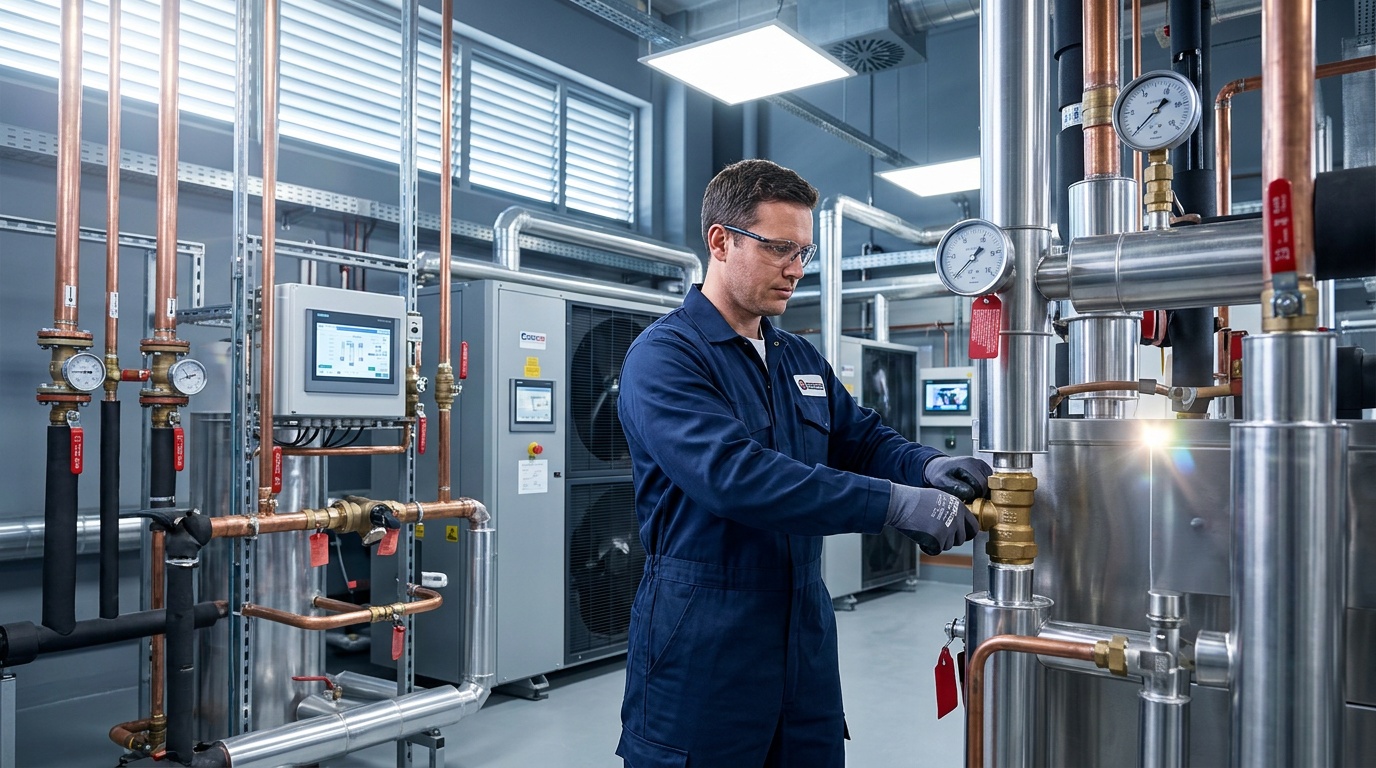
Air-source heat pumps (ASHPs) are often misunderstood, but they are exceptionally well-suited to the Birmingham climate. With average winter lows of around 2°C, Birmingham provides an ideal environment for these systems to operate at high efficiency. Unlike areas with prolonged sub-zero temperatures, our region allows ASHPs to extract heat from the air without the drastic efficiency drops seen in more extreme climates. These systems use less electricity than conventional electric heaters, making them a powerhouse for reducing carbon footprints. For a commercial facility, this translates to a reduction in grid dependency and a more stable energy profile.
Ground-source heat pumps: the long-term investment
For larger commercial sites or new-build developments in Birmingham, ground-source heat pumps (GSHPs) offer the ultimate in stability. By using the constant temperature of the earth, these systems provide consistent heating and hot water with remarkable efficiency. While the upfront capital expenditure is higher due to the groundworks involved, the operational lifespan and low maintenance requirements make them a sound investment for the long term. We often recommend GSHPs for schools, large office blocks, or industrial units where land availability permits the necessary boreholes or ground loops.
Biomass boilers: fuel options, maintenance and space requirements
Biomass boilers are a viable alternative for properties with the space to store fuel. Using organic materials such as wood pellets or chips, these systems provide a carbon-neutral way to generate heat. However, they require a significant amount of physical space for the boiler itself and the fuel storage. From a maintenance perspective, biomass requires more hands-on management than a heat pump. At MEMS, we evaluate the logistics of fuel delivery and ash removal before recommending this route. It is a reliable solution for rural Birmingham properties or large estates that have the land to support the infrastructure.
Solar thermal panels: hot water generation and integration with existing systems
Solar thermal technology is often overlooked, yet it provides an excellent way to reduce the load on your primary heating and hot water system. By using the sun’s energy to pre-heat water, these panels can provide a significant portion of a property’s hot water needs during the summer months. In Birmingham, where daylight hours are sufficient for most of the year, this is a smart way to cut costs. We frequently integrate solar thermal with heat pumps or high-efficiency commercial boilers to create a hybrid system that maximises efficiency and minimises reliance on the grid.
| System Type | Efficiency Rating | Upfront Cost | Ideal Application |
|---|---|---|---|
| Air-Source Heat Pump | High | Moderate | Retrofits, Small-Medium Commercial |
| Ground-Source Heat Pump | Very High | High | New Builds, Large Campuses |
| Biomass Boiler | Moderate | Moderate to High | Rural Properties, High Space Availability |
| Solar Thermal | Varies (Solar Dependent) | Low to Moderate | Hot Water Pre-heating, Commercial/Leisure |
Zoning, Comfort and Retrofit: Ductless Mini-Splits, Radiant Floor Heating and Infrared Panels
When we moved beyond the standard gas boiler and looked at the full spectrum of alternatives to traditional heating systems for Birmingham commercial properties, we found that the most practical solutions for existing buildings often do not require tearing up floors or installing extensive ductwork. For the diverse building stock across Birmingham, from Victorian commercial premises in Edgbaston to modern offices in the city centre, the retrofit challenge is real. Three technologies in particular offer distinct advantages for zoning, comfort and ease of installation.
Ductless mini-splits: zoning benefits and easy retrofit for individual rooms
A ductless mini-split is essentially an air-source heat pump reconfigured for single-zone or multi-zone use. The outdoor compressor unit connects to one or more indoor wall-mounted heads, each controlled independently. This zoning capability means you heat only the rooms you occupy, rather than wasting energy on unoccupied spaces. For a Victorian commercial building where running ductwork is structurally impractical, a ductless system provides individual room control without major building work. Each unit includes its own thermostat and fan, giving the occupant precise temperature management. The installation requires only a small conduit between the indoor and outdoor units, making it one of the least disruptive options available for Birmingham properties.
Radiant floor heating (hydronic and electric): comfort and compatibility with heat pumps
Radiant floor heating delivers warmth from the ground up, providing consistent temperatures without the drafts or noise associated with forced-air systems. In a hydronic system, warm water circulates through pipes embedded in the floor screed. Electric systems use heating cables or mats and are simpler to install in smaller rooms. The critical advantage for anyone considering switching to a low-carbon heat source is that radiant systems operate efficiently at lower water temperatures, making them an ideal partner for heat pumps. When retrofitting into a Birmingham commercial unit, the main consideration is the floor build-up height, typically 15 to 25 millimetres for electric mats or 50 to 70 millimetres for hydronic screed. This is manageable in most rooms, but it is worth checking door thresholds and stair transitions before committing.
Infrared heating panels: a modern, low-maintenance option for smaller spaces
Infrared panels heat objects and people directly rather than warming the air, which means the room feels comfortable more quickly and there is no heat stratification. For a small office or a single room in a larger building, infrared panels offer a low-maintenance, visually minimal alternative. They mount flush to the ceiling or wall, require no pipework, and have no moving parts to fail. Running costs compare favourably with electric radiators because the perceived temperature is higher for the same air temperature, so you can set the thermostat slightly lower. The panels are available in various finishes, including mirror surfaces, so they can blend into the room design. Their main limitation is that they are best suited to well-insulated spaces and individual rooms rather than whole-building heating.
Retrofit Heating Options at a Glance
Pros
- Ductless mini-splits provide independent room control with minimal building disruption
- Radiant floor heating delivers silent, draught-free warmth that works well with heat pumps
- Infrared panels heat up quickly, require no maintenance and save wall space in smaller rooms
- All three options can be retrofitted into existing Birmingham building stock without major structural change
Cons
- Ductless mini-splits require outdoor compressor placement and visible wall units indoors
- Radiant floor heating adds floor height and is easier to install during a full renovation
- Infrared panels are most effective in well-insulated, smaller spaces rather than whole buildings
- Electric-based options (infrared, electric radiant) may have higher running costs than heat pump systems
Image: Illustration of a ductless mini-split installation in a typical Birmingham commercial building, showing the outdoor compressor and indoor wall-mounted units.
The MEMS Approach: Real-World Performance from a Birmingham Office
At MEMS, we do not recommend a technology we have not tested ourselves. Our philosophy is simple: we prove it on our own buildings before we advise a client to commit capital. Last winter, we trialled an air-to-water heat pump system in a 1000 sq ft office in Moseley to gather real performance data under typical Birmingham conditions. The property, built in the 1930s with cavity wall insulation and loft insulation added, represents a common retrofit scenario across the city.
How we trialled an air-to-water heat pump in a 1000 sq ft office in Moseley
We installed a 7 kW air-to-water heat pump connected to the existing radiator circuit, replacing a 15-year-old gas boiler. The system was set to a flow temperature of 50°C, significantly lower than the 70°C flow the old boiler used. The property had standard panel radiators, which were retained. The installation took three days including commissioning, with the outdoor unit positioned discreetly to the side of the property. We monitored energy consumption, indoor temperatures and system performance throughout the coldest weeks of January and February, when outdoor temperatures in Birmingham dipped to around freezing.
Installation costs, running savings and the impact of the grant
The total installed cost for the system was £10,800. Through the Boiler Upgrade Scheme, the property received a £7,500 grant, reducing the outlay to £3,300. The annual running cost for heating and hot water came to approximately £890, compared with £1,240 for the old gas boiler, a saving of £350 per year at current energy prices. The system maintained a comfortable 21°C in the working areas and 18°C in storage rooms throughout the trial period, with no noticeable drop in performance on the coldest mornings.
Moseley Heat Pump Trial: Cost Breakdown
| Item | Amount |
|---|---|
| Air-to-water heat pump and ancillary equipment | £6,400 |
| Installation labour and commissioning | £2,800 |
| System flush, inhibitor and electrical work | £1,600 |
| Total installed cost | £10,800 |
| Boiler Upgrade Scheme grant | -£7,500 |
| Net cost to client | £3,300 |
| Estimated annual gas saving vs. old boiler | £350 |
| Simple payback period after grant | 9.4 years |
Lessons learned: what facility managers can apply to their own buildings
The trial confirmed that air-to-water heat pumps perform reliably in Birmingham’s winter climate. The key lesson for anyone managing a commercial building is that fabric efficiency matters more than the heat source. The Moseley office’s cavity wall and loft insulation were the foundation for the system’s good performance. Without a well-sealed building envelope, even the most efficient heat pump will struggle. We also learned that commissioning must be thorough: the system requires a correctly sized buffer vessel and a properly designed control strategy to avoid short cycling. For facility managers considering a building-wide upgrade, we recommend pairing heat pumps with a Commercial HVAC Installation and Heating Service that includes full system design, not just equipment replacement. This ensures the existing pipework and emitters are compatible with lower flow temperatures, maximising efficiency and occupant comfort.
Our team at MEMS has applied these findings directly to client projects across the West Midlands. Whether you are retrofitting a single property or rolling out upgrades across a portfolio, the same principles apply. A properly designed heat pump system, backed by a Commercial HVAC Installation and Heating Service that understands both the technology and the local building stock, delivers reliable, cost-effective heating that meets current compliance standards and reduces long-term operational expenditure.
Your Decision Framework: Matching the Right Alternative to Your Building
Choosing the correct technology from the list of alternatives to traditional heating systems for Birmingham commercial properties requires a methodical approach. At MEMS, we do not believe in a one-size-fits-all solution. Your property’s age, construction type, and your financial goals must align with the physical capabilities of the system. This framework is designed to help you navigate the decision-making process with the same rigour we apply during a professional site survey.
Step one: assess your building type (Victorian commercial, modern office, retail unit)
The architectural diversity of Birmingham demands a tailored strategy. A Victorian commercial building in the Jewellery Quarter presents different challenges compared to a modern office in Sutton Coldfield. For period properties with limited external space, ductless mini-splits or high-temperature heat pumps are often the most practical entry points. In contrast, a modern retail unit with a communal heating system might benefit more from individual infrared panels or a dedicated air-source unit if the roof layout permits. We always begin by evaluating the thermal envelope; without understanding how your building retains heat, selecting a system is mere guesswork.
Step two: evaluate your budget and grant eligibility
Financial planning for a heating upgrade must look beyond the initial purchase price. While the upfront cost of a heat pump or biomass system is higher than a standard combi boiler, the long-term operational savings and government incentives change the calculation. The Boiler Upgrade Scheme remains a significant factor, offering substantial grants for those who act quickly. We advise clients to calculate their "break-even" point, factoring in the reduced maintenance requirements of modern electric or hybrid systems compared to the recurring part-replacements needed for older gas infrastructure. For those looking to improve their overall sustainability, our Renewable Energy Solutions provide a clear path forward.
Step three: prioritise whole-building fabric first (insulation, draft proofing)
A new heating system cannot outperform a poorly insulated building. Before investing in hardware, you must address the "leaks" in your asset. Improving loft insulation, installing cavity wall insulation, and ensuring high-quality draft proofing around windows and doors will lower the heat load required for your property. This step often allows you to select a smaller, more efficient unit, which reduces both the installation cost and the ongoing electricity demand. In our experience, a fabric-first approach is the only way to guarantee that your investment in alternatives to traditional heating systems for Birmingham commercial properties delivers the promised return on investment. Regular Building Fabric Repairs & Maintenance are essential to maintaining this thermal integrity over time.
Decision Flowchart: Which System Suits Your Property?
- Do you have a modern, well-insulated building?
- Yes: Proceed to Air-Source Heat Pump or Solar Thermal integration.
- No: Prioritise insulation upgrades before installing low-temperature systems.
- Is external space limited?
- Yes: Consider Ductless Mini-Splits or Infrared Panels.
- No: Ground-Source Heat Pumps or larger Air-Source units are viable.
- Is your goal maximum carbon reduction?
- Yes: Focus on Heat Pumps or Biomass with certified sustainable fuel sources.
- No: High-efficiency condensing units or Hybrid systems may be a better bridge.
References
Frequently asked questions about alternative heating in Birmingham
Do heat pumps work during a Birmingham winter?
Yes. Birmingham’s climate is temperate, with average winter lows of approximately 2°C. Heat pumps are engineered to operate efficiently in these conditions, providing consistent warmth without the performance drop-offs seen in more extreme polar climates.
How long does a typical retrofit take?
Depending on the complexity, a straight swap to a ductless system can be completed in two to three days. A full heat pump installation involving new emitters (radiators or underfloor loops) may take up to five days to ensure the system is balanced and commissioned to SFG20 standards.
Are these systems noisy?
Modern units are designed for low-decibel operation. The outdoor units of an air-source heat pump produce a sound similar to a modern refrigerator, and indoor units are virtually silent.
If you are ready to move from theory to action, our team at MEMS is prepared to provide the technical clarity you require. We provide a comprehensive Commercial HVAC Installation and Heating Service that covers the entire lifecycle of your project, from the initial heat-loss calculation to the final commissioning and compliance certification. Do not leave your property’s performance to chance; rely on the expertise of engineers who understand the intersection of mechanical precision and commercial reality.
Frequently Asked Questions
What are the main alternatives to a traditional gas boiler for heating a Birmingham home?
The main alternatives to a traditional gas boiler for Birmingham homes are air source heat pumps, ground source heat pumps, and solar thermal systems. Air source heat pumps work well in Birmingham's mild climate. Ground source heat pumps offer high efficiency for larger properties. Solar thermal panels can reduce hot water costs.
Are air source heat pumps effective in Birmingham's climate?
Yes, air source heat pumps are highly effective in Birmingham's climate because average winter lows around 2°C allow the system to extract heat from the air efficiently. They use less electricity than conventional electric heaters and provide a stable energy profile. For most Birmingham homes, an air source heat pump is a reliable alternative to a gas boiler.
What is the cheapest way to heat a house without central heating in Birmingham?
The cheapest way to heat a house without central heating in Birmingham is to install an air source heat pump. While the upfront cost is higher than portable electric heaters, the running costs are significantly lower thanks to high efficiency. Government incentives like the Boiler Upgrade Scheme can also reduce the initial investment.
How does a ground source heat pump work for a Birmingham property?
A ground source heat pump uses the constant temperature of the earth to provide consistent heating and hot water. It requires boreholes or ground loops, so it suits larger Birmingham properties with available land. The operational lifespan is long and maintenance is low, making it a sound long-term investment.
Is biomass heating a realistic option for a typical Birmingham home?
Biomass heating is realistic for Birmingham homes with enough space for the boiler and fuel storage. It uses wood pellets or chips for carbon-neutral heat, but requires more hands-on management than a heat pump. Most standard suburban homes lack the space, so it is better suited to rural or large properties.
Can solar thermal panels replace a traditional boiler for hot water in Birmingham?
Solar thermal panels can significantly reduce the load on a traditional boiler for hot water generation in Birmingham, but they cannot fully replace it year-round. They work best integrated with a heat pump or boiler to cover summer demand. This combination lowers your energy bills and carbon footprint.