tea factory birmingham
The redevelopment of the historic Typhoo Tea building into what is now known as the Tea Factory Birmingham marks a significant chapter in the city's regeneration story. This project transforms a long-unused industrial site into an advanced broadcast centre while honouring its rich heritage. For facility managers and commercial landlords in Birmingham and the West Midlands, understanding the technical and operational details behind such a retrofit is essential for appreciating how traditional structures can meet modern sustainability and compliance demands.
Key Takeaways
- Converting a historic industrial site like the Typhoo Tea building into a modern broadcast centre requires careful balancing of heritage preservation with contemporary mechanical and electrical system upgrades.
- Facility managers across Birmingham and the West Midlands can learn valuable lessons from retrofit projects that bring unused industrial structures back into productive commercial use.
- Modern sustainability standards and regulatory compliance requirements must be integrated into the engineering design when repurposing older buildings for new operational purposes.
- Successful regeneration projects demonstrate how mechanical and electrical retrofits can transform legacy properties into high-performance facilities without losing their historical character.
This guide begins by exploring the origins and location of the Tea Factory, the reasons behind the BBC's move to Digbeth, and the key players driving the project. Following that, we will decode the integrated net-zero building services that power the site, focusing on the engineering behind this ambitious retrofit.
The Tea Factory Birmingham: From Typhoo Tea to BBC Digbeth
What is the Tea Factory and where is it located?
The Tea Factory Birmingham is a purpose-built broadcast centre occupying the historic Typhoo Tea building in Digbeth, a district just southeast of Birmingham city centre. The original Typhoo building, dating back more than 100 years, had remained unused for approximately four decades before this redevelopment began. The project covers an 84,001 square foot (7,804 m²) site, reimagining the industrial structure into a modern media hub designed to support advanced broadcasting and creative industries.
Digbeth has become a focal point for creative and digital industries in Birmingham, making the location a strategic choice for the BBC’s new home. Its proximity to the city centre and strong transport links support the operational needs of a major broadcast facility while contributing to the wider regeneration of the area.
Why is the BBC relocating from the Mailbox to Digbeth?
The BBC’s move from the Mailbox to the Tea Factory is driven by the need for a facility that aligns with future digital broadcasting demands and sustainability targets. The Mailbox building, while central, lacked the space and infrastructure to support the BBC’s expanding operations and its commitment to reducing carbon emissions. The Tea Factory provides a modern, gas-free building designed to meet net-zero operational carbon targets.
BBC Director General Tim Davie emphasised the move as a strategic investment in the Midlands, enhancing regional production capabilities and supporting local talent. This relocation allows the BBC to consolidate its services into a bespoke facility with state-of-the-art technology, including renewable energy systems and innovative building services.
Project team and the wider Typhoo Wharf masterplan
The redevelopment of the Tea Factory is part of the broader Typhoo Wharf masterplan, a comprehensive regeneration effort encompassing residential, commercial, and cultural spaces along the canal side in Digbeth. The project is led by Stoford Developments, with BAM Construct UK appointed as the principal contractor responsible for construction and engineering delivery.
Glenn Howells Architects are the design leads, blending respect for the building's industrial heritage with innovative net-zero design principles. Their approach includes integrating sustainable technologies while preserving key architectural features. This careful balance ensures the building complies with modern sustainability standards without losing its historical character.
Decoding the Net-Zero Design: How the Building Services Work
Gas-free heating: Air source heat pumps in ageing structures
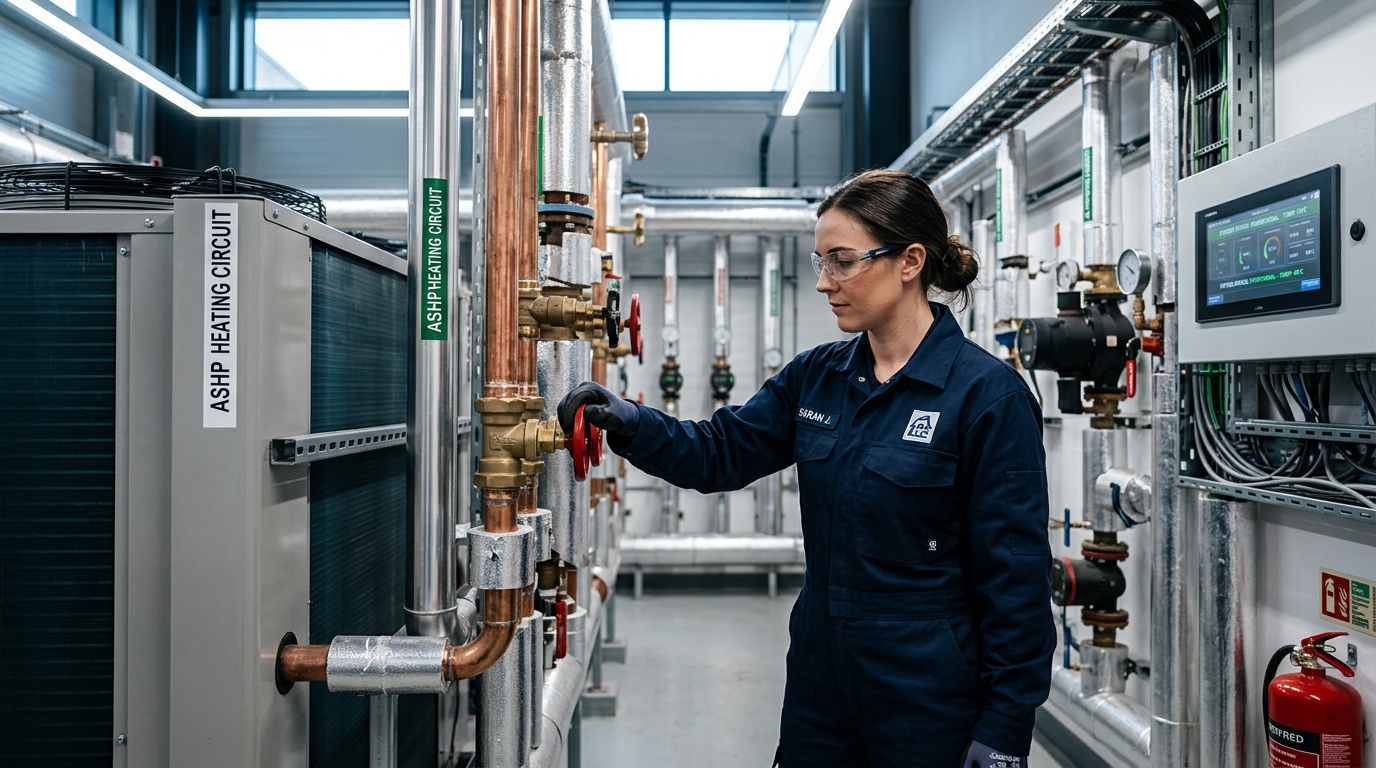
The Tea Factory Birmingham is designed as a gas-free building, a significant challenge given the original structure dates back to the 1920s. Instead of traditional gas boilers, the heating system relies on air source heat pumps (ASHP) to supply heating and hot water. ASHPs extract heat from the outside air and upgrade it to a usable temperature through refrigerant cycles, delivering efficient heating with a substantially lower carbon footprint.
Retrofitting ASHPs into an ageing industrial building requires careful integration with the existing fabric to maintain thermal efficiency. Insulation upgrades and airtightness improvements were necessary to reduce heat loss, allowing the ASHPs to operate effectively without excessive energy consumption. This approach aligns with net-zero ambitions by eliminating onsite fossil fuel combustion and reducing reliance on the wider gas network.
Powering the broadcast centre: Solar PV and EV charging
To further reduce operational carbon emissions, the Tea Factory incorporates 750 square metres of solar photovoltaic (PV) panels installed on the roof. These panels generate a significant proportion of the building’s electricity demand on-site, reducing grid dependency and associated carbon emissions. The solar array is sized to cover daytime consumption patterns, especially important for the broadcast centre’s media production and IT equipment.
Supporting sustainable transport, 16 electric vehicle (EV) charging points have been installed adjacent to the building. This infrastructure encourages low-emission travel for staff and visitors, aligning with local and national policies promoting electric mobility. The combination of solar PV and EV charging infrastructure illustrates a comprehensive approach to decarbonising both building operations and transport.
Water management: Rainwater harvesting and the brown roof
Water efficiency is addressed through rainwater harvesting systems that capture and recycle water for non-potable uses such as toilet flushing. This reduces mains water consumption, easing pressure on local water supplies and lowering utility costs. The system includes storage tanks and filtration to ensure reliable supply while minimising waste.
The Tea Factory’s roof includes a brown roof system, which is designed to support biodiversity by providing a habitat for native plants and insects. Unlike intensive green roofs, brown roofs use a shallow soil layer that requires minimal maintenance, contributing to urban wildlife conservation. This feature also aids in managing rainwater runoff, reducing flood risk in the surrounding area.
Pros
- Gas-free heating reduces carbon emissions and future-proofs energy supply
- 750 m² solar PV significantly offsets electricity demand on-site
- EV charging supports sustainable transport and staff convenience
- Rainwater harvesting cuts mains water usage and operational costs
- Brown roof promotes biodiversity and contributes to flood mitigation
Cons
- Retrofit of ASHPs in old buildings requires extensive insulation upgrades
- Solar PV output depends on weather and daylight hours
- Rainwater harvesting capacity can be limited in dry periods
- Brown roof requires specialist maintenance knowledge for optimal performance
The Engineer's Take: Maintaining and Commissioning Green Retrofits
Why Planned Preventative Maintenance (PPM) matters for new technology
When managing a complex retrofit like the Tea Factory Birmingham, Planned Preventative Maintenance (PPM) is essential to safeguard the performance and longevity of the integrated green technologies. Unlike traditional plant rooms, where combustion boilers and chillers dominate, the Tea Factory relies heavily on air source heat pumps, solar arrays, and sophisticated control systems. These components demand a tailored maintenance regime that anticipates wear patterns and operational quirks specific to low-carbon equipment.
Skipping scheduled maintenance on heat pumps, for example, can lead to reduced efficiency caused by refrigerant leaks, blocked filters, or faulty compressors. This not only drives up energy costs but risks system downtime that disrupts broadcast operations. PPM visits should include detailed inspections, refrigerant level checks, and cleaning of heat exchangers to maintain optimal performance. The solar PV installation covering 750 square metres also requires regular cleaning and electrical testing to ensure peak output and avoid costly repairs.
In my experience, asset failure on green retrofits often stems from treating new technology like legacy equipment. A proactive PPM approach reduces emergency call-outs, extends asset life, and delivers predictable maintenance budgeting. For facility managers at the Tea Factory, this means investing in specialist contractors familiar with renewable systems and their unique maintenance schedules, rather than generic FM providers.
Building Management Systems (BMS) and energy monitoring
The operational heart of a net-zero retrofit like the Tea Factory is its Building Management System (BMS). This centralised platform governs heating, ventilation, lighting, and energy flows, providing real-time monitoring and control. A well-commissioned BMS allows facility teams to fine-tune air source heat pump outputs, modulate solar energy use, and optimise electric vehicle charging schedules to minimise peak demand charges.
Energy monitoring is not simply about tick-box compliance; it is a commercial necessity. By analysing consumption patterns, the BMS can identify energy drift, equipment inefficiencies, or faults before they escalate. For instance, a gradual rise in electricity consumption could indicate a failing inverter in the solar array or a heat pump running beyond design parameters. Early detection prevents costly downtime and maintains the building’s net-zero operational target.
Commissioning the BMS at handover is a detailed process, requiring thorough testing of all control sequences and integration with the solar PV and heat pump systems. Post-handover, regular recalibration and software updates ensure the system adapts to seasonal variations and evolving operational demands. Facility managers must maintain close communication with the commissioning engineers to keep the BMS aligned with the building’s sustainability goals.
SFG20 compliance: Preparing for the operational handover
Meeting SFG20 standards is the foundation for any maintenance strategy in commercial buildings, and the Tea Factory Birmingham is no exception. SFG20 outlines comprehensive maintenance schedules and checklists designed to ensure safety, reliability, and regulatory compliance. For a heritage retrofit with advanced green technologies, adherence to SFG20 is a practical safeguard against operational risks and legal exposure.
Preparing for the operational handover means compiling a complete and accurate maintenance manual tailored to the Tea Factory’s unique plant. This includes detailed records of all installed equipment, from the 16 electric vehicle charging points to the rainwater harvesting system, as well as calibrated maintenance intervals for the air source heat pumps and solar panels. Documentation must reflect the building’s gas-free design and net-zero objectives, providing clear instructions for ongoing care.
From my perspective, SFG20 compliance goes beyond paperwork. It forms the basis for a transparent maintenance partnership between the building owner, FM provider, and technical teams. Ensuring all parties understand their responsibilities reduces confusion, improves response times, and protects the building’s value over time. For a high-profile site like the Tea Factory, this disciplined approach to commissioning and maintenance is non-negotiable.
Project Timeline: Delays and Key Milestones
When will the Tea Factory be completed?
The redevelopment of the Tea Factory Birmingham began on site in February 2024, with BAM Construct UK appointed as principal contractor. Originally, the project aimed for completion within two years, targeting early 2026. However, due to unforeseen supply chain disruptions and complex retrofit challenges inherent in adapting a 100-year-old industrial building, the timeline has extended. Current projections now indicate that the Tea Factory will open later in 2026, reflecting the complexities of merging heritage preservation with modern net-zero building technologies.
This delay, while frustrating, is not uncommon for adaptive reuse projects of this scale. Integrating air source heat pumps, a large solar array, and water recycling systems into a structure that has been unused for approximately four decades requires careful sequencing and specialist trades. The extended schedule ensures that commissioning and testing phases meet the high standards demanded by both the BBC and sustainability regulations, avoiding costly rework after handover.
Construction milestones and impact on the creative sector
Key milestones reached so far include the completion of the structural refurbishment and the installation of the 750 square metres of solar photovoltaic panels, which will provide a substantial portion of the building’s electricity demand. The fit-out phase, underway in mid-2024, focuses on integrating broadcast studios, office spaces, and the 16 electric vehicle charging points, designed to support sustainable staff transport.
The Tea Factory’s refurbishment is part of a wider regeneration effort in Digbeth, a district already emerging as a creative and digital hub in Birmingham. The project’s progress has attracted significant interest from local businesses and cultural organisations, hopeful that the BBC’s relocation will catalyse further investment and job creation. The delayed completion may affect short-term plans for creative sector partners but offers a longer-term boost by delivering a state-of-the-art facility fit for future media production.
FAQ: Your Questions on the Tea Factory Answered
Who is developing the Tea Factory in Birmingham?
The Tea Factory project is led by Stoford Developments, a reputable property developer with a focus on urban regeneration and sustainable building practices. BAM Construct UK is the principal contractor responsible for the construction and engineering delivery. Glenn Howells Architects head the design team, blending heritage conservation with modern net-zero design principles. Together, these organisations ensure the project balances the historical significance of the Typhoo Tea building with the technical demands of a contemporary broadcast centre.
What makes the Tea Factory a net-zero building?
The Tea Factory achieves net-zero operational carbon through a combination of innovative building services and energy-efficient design. It operates as a gas-free building, using air source heat pumps for heating and hot water, eliminating onsite fossil fuel combustion. The rooftop solar PV installation spans 750 square metres, supplying renewable electricity to offset grid consumption. Water management systems recycle rainwater for non-potable uses, reducing mains water demand, while a brown roof enhances biodiversity and manages stormwater runoff. These integrated systems collectively reduce the building’s carbon footprint to net-zero during operation.
What facilities will the new BBC building include?
The BBC’s new home within the Tea Factory encompasses a purpose-built broadcast centre of approximately 84,001 square feet (7,804 m²). Facilities include state-of-the-art television and radio studios, production offices, editing suites, and technical infrastructure designed for modern digital broadcasting. Supporting sustainable transport, the site offers 16 electric vehicle charging points for staff and visitors. The building’s design also provides flexible office spaces and collaboration areas to foster creativity and innovation, aligned with the BBC’s strategic investment in the Midlands.
Frequently Asked Questions
Why is Digbeth a strategic location for the Tea Factory Birmingham?
Digbeth provides strong transport links and proximity to the city centre, supporting the operational needs of a major broadcast facility. The district has become a focal point for creative and digital industries, aligning with the Tea Factory Birmingham's role as a modern media hub.
What happened to the Typhoo Tea building?
The original Typhoo Tea building has been transformed into the Tea Factory Birmingham, a purpose-built broadcast centre for the BBC. This 100-year-old industrial structure, which stood empty for four decades, now serves as a modern media hub following a comprehensive retrofit led by Stoford Developments.
What factories were in Birmingham?
Birmingham's industrial history features the Typhoo Tea building, a significant manufacturing site that has been repurposed as the Tea Factory Birmingham. This structure exemplifies the city's shift from traditional industry to modern commercial sectors, retaining its heritage while supporting new economic activities.
How old is the Tea Factory Birmingham building?
The Tea Factory Birmingham occupies a building that is more than 100 years old, with origins dating to the 1920s. This historic Typhoo Tea structure has been retrofitted to support the BBC's operations while preserving key architectural features from its industrial past.
What industry does the Tea Factory Birmingham support?
The Tea Factory Birmingham supports the creative and digital industries, functioning as a dedicated broadcast centre for the BBC. The site consolidates services to support advanced media production, benefiting from Digbeth's role as a focal point for creative and digital businesses in the region.
How does the Tea Factory Birmingham achieve net-zero heating?
The Tea Factory Birmingham achieves net-zero heating through a gas-free system powered by air source heat pumps. These units extract heat from outside air and upgrade it for use, requiring insulation upgrades and airtightness improvements to the 1920s structure to operate efficiently.
What renewable energy systems are installed at the Tea Factory Birmingham?
The Tea Factory Birmingham installs 750 square metres of solar photovoltaic panels on the roof to generate on-site electricity. The facility also includes 16 electric vehicle charging points to support low-emission transport, reducing grid dependency and operational carbon emissions for the broadcast centre.