Commercial Maintenance Services UK Ltd vs M&E Maintenance Solutions Limited
A boiler failure at 6.30am is not merely an engineering fault. It can close a workplace, disrupt tenants, damage stock and leave a facilities manager explaining lost trading time to the board. The right contractor must match your building risk, service scope and operating model. Not simply present the longest service list.
Key Takeaways
- Selecting a contractor requires aligning their capabilities with your specific building risks and operational needs rather than just reviewing a lengthy service menu.
- Early morning equipment failures can cause significant business disruption beyond simple mechanical repairs.
- Facilities managers must choose partners who understand the commercial implications of downtime to protect tenant relationships and stock.
I have worked from the plant room upwards for more than 24 years. My advice is direct: treat published descriptions as a starting point, then verify engineer capability, maintenance records, response arrangements, compliance evidence and quotation exclusions.
The Short Answer: How Commercial Maintenance Services UK Ltd and M&E Maintenance Solutions Differ
What each company does and how it is positioned
Commercial Maintenance Services UK Ltd is presented as a nationwide mechanical and electrical contractor. That model may suit organisations seeking one supplier across multiple commercial premises.
M&E Maintenance Solutions Limited is positioned as a UK building services specialist with a relationship-led, engineering-focused model. At MEMS, we investigate the cause behind a failed pump, nuisance trip or poorly balanced air-conditioning system rather than treating every fault as an isolated repair. The aim is reliable operation, clear compliance evidence and better long-term asset performance.
Service Scope Compared: Mechanical, Electrical, HVAC, Plumbing and Sustainability
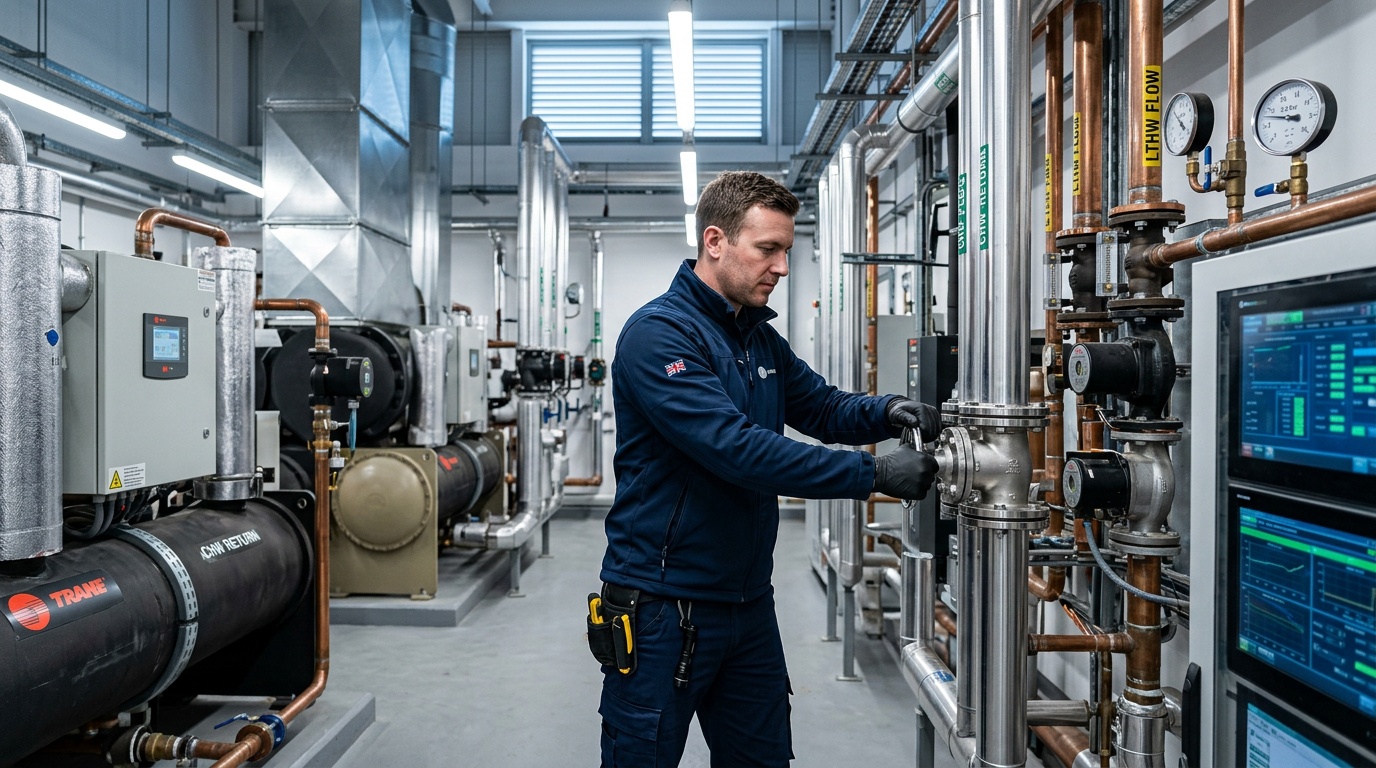
The service label matters less than the competence behind it. Ask which systems engineers can inspect, which qualifications are held in-house, how defects are recorded and whether recommendations rely on measured conditions. Your asset list may include boilers, pumps, calorifiers, air-handling units, chillers, controls, distribution boards, lighting, drainage and water services. Each item needs an agreed maintenance frequency, access plan, risk assessment and close-out record.
Mechanical, heating, ventilation and air conditioning capability
Map both suppliers against your plant schedule. Request evidence for heating controls, boilers, burners, fan coil units, ventilation fans, ductwork, refrigeration circuits, pumps and BMS interfaces. MEMS provides commercial HVAC installation and heating system repairs around Birmingham. Its commercial ventilation repair services support buildings where air movement, comfort and indoor-air quality require attention.
Electrical, plumbing and gas compliance services
Test the proposed scope against the hazards in your premises. Ask about fixed wiring, emergency lighting, fault finding, water hygiene, leak response, pumps, sanitary systems and plant-room isolation. The plumbing and electrical services scope should be checked against your equipment list and statutory duties.
Planned preventative maintenance and statutory checks
Planned Preventative Maintenance (PPM) should protect equipment, not create paperwork for its own sake. A sound schedule reflects manufacturer instructions, operating hours, occupancy, seasonal demand and SFG20 task guidance. Ask each supplier for an anonymised PPM report, asset-register extract and compliance dashboard.
Reactive maintenance, emergency call-outs, projects and installation
Reactive support matters when a heating circuit fails, a distribution board trips or a water leak threatens occupied space. Convert any 24-hour promise into contract terms covering response target, attendance window, telephone escalation, parts approval, out-of-hours rates and exclusions.
Energy efficiency and sustainability upgrades: heat pumps, solar PV and LED
M&E Maintenance Solutions Limited highlights internal trialling of air-to-water heat pumps, solar PV and LED technology. Treat that as a proposition to verify, not an automatic saving. Request the energy baseline, load profile, design assumptions, payback model, metering plan, commissioning records and post-installation review. Responsibility for faults and maintenance should be clear after handover.
Coverage, Response and Suitability: Single-Site vs Multi-Site Estates
Coverage only has value if it produces a dependable engineer response at the property that needs help. A nationwide contractor may suit a distributed estate, while a regional partner may suit a complex Birmingham site where building knowledge and direct communication reduce delay.
National scale vs regional continuity: which matters for your estate
Commercial Maintenance Services UK Ltd is positioned for nationwide mechanical and electrical delivery. That may reduce supplier fragmentation across offices, retail units, warehouses or mixed-use property. M&E Maintenance Solutions Limited presents a relationship-led model suited to buildings with ageing boilers, unusual controls, recurring HVAC faults or a detailed compliance history.
What “24/7 nationwide support” actually means
A 24-hour telephone line does not guarantee 24-hour attendance. Before appointing either supplier, request the service-level agreement in writing. Check the emergency definition, acknowledgement time, attendance window, escalation route, engineer availability, parts authority and temporary-repair process.
Engineer continuity, account management and reporting quality
Engineer continuity has a practical financial value. Someone familiar with the boiler sequence, BMS trend history and previous remedial work can spot a failing actuator or control fault before it becomes a heating outage. Request sample service sheets, defect photographs, risk assessments, commissioning records and monthly management reports.
Which provider suits your estate
Commercial Maintenance Services UK Ltd may suit national scale and multiple locations. M&E Maintenance Solutions Limited may suit technically complex plant, compliance-sensitive buildings and relationship-led support around Birmingham and the West Midlands. Either choice should be supported by evidence of local resources, qualifications, reporting standards and emergency attendance.
Before You Sign: A Scored Due-Diligence Checklist for Both Providers
A persuasive quotation is not proof of dependable maintenance. Test each supplier against the building risk, asset register and compliance burden before signing.
- Confirm the legal entity. Check the current Companies House record, trading name, registered details and contract signatory.
- Verify insurance. Request current employer’s liability, public liability and professional indemnity evidence where applicable.
- Match qualifications to plant. Confirm Gas Safe registration, F-Gas competence, electrical qualifications and relevant manufacturer training.
- Test maintenance standards. Ask how SFG20 task guidance, manufacturer instructions and statutory inspections are applied.
- Request anonymised records. Review PPM sheets, remedial quotations, compliance dashboards and job close-out records.
- Take live references. Speak with comparable facilities managers about missed visits, repeat faults and communication.
- Read the commercial terms. Identify exclusions, minimum charges, parts margins, call-out rates and approval thresholds.
Proactive maintenance leaves an evidence trail. Review asset criticality, task frequency, defect priority, trend analysis and completion status. Ask for the overdue action list and repeat-fault report, then compare the quotation with engineer findings and photographs.
Frequently Asked Questions
What is the difference between Commercial Maintenance Services UK Ltd and M&E Maintenance Solutions Limited?
Commercial Maintenance Services UK Ltd is publicly positioned as a nationwide mechanical and electrical contractor, while M&E Maintenance Solutions Limited is positioned as a UK building services specialist with an engineering-led, relationship-focused model. Confirm the distinction through current references, engineer allocation, qualifications, reporting examples and contract terms.
Which provider is better for planned preventative maintenance?
The better provider is the one that links PPM tasks to your asset register, manufacturer guidance, SFG20 recommendations, statutory duties and building risk. Examine sample schedules, overdue actions, defect photographs, completion records and repeat-fault reporting.
Which company is more suitable for urgent commercial repairs?
Suitability depends on the written emergency process, not a 24/7 badge. Check call acknowledgement, engineer attendance, escalation, isolation, temporary repairs, parts approval and out-of-hours charges.
Do both providers cover mechanical, electrical, HVAC and plumbing systems?
Both organisations present broad building-services capabilities, yet the exact scope must be confirmed against your equipment list. Request named competence for boilers, burners, pumps, ventilation, air conditioning, refrigeration, controls, distribution boards, emergency lighting, water systems and drainage.
Which provider is better for a multi-site UK estate?
Commercial Maintenance Services UK Ltd may suit a geographically dispersed estate requiring one nationwide contractor. M&E Maintenance Solutions Limited may be preferable where technical continuity, complex plant and relationship-led account management carry greater weight. Compare mobilisation plans, regional engineer coverage, subcontractor controls, reporting consistency and escalation routes.