Recommended ventilation services for commercial warehouses Birmingham?
Warehouse ventilation affects stale air, cold spots around loading doors and heating costs. If you are assessing Recommended ventilation services for commercial warehouses Birmingham?, begin with building use, occupancy, vehicle movements, heat gains and existing plant rather than replacement equipment.
Key Takeaways
- When evaluating ventilation services for your Birmingham warehouse, consider its specific use, how many people are inside, and vehicle traffic patterns first.
- Understanding heat gains and the condition of your current equipment is a more practical starting point than immediately looking at new systems.
- Proper warehouse ventilation directly influences air quality, temperature consistency near loading docks, and overall heating expenses.
I have spent more than 24 years working from plant rooms to operational sites across the Midlands. The right assessment connects air quality with productivity, energy use, workplace safety and business continuity. A ventilation contractor should diagnose poor performance before recommending repairs, modifications or new installation.
The Commercial Warehouse Ventilation Challenge in Birmingham: Beyond Basic Airflow
The recommended approach combines measured airflow, correctly sized air handling equipment, heat recovery where suitable, destratification, local extraction and continuous monitoring. The specification must reflect layout, ceiling height, racking, battery-charging areas, dust, loading bays and welfare spaces. A competent engineer will inspect fans, filters, belts, motors, dampers, ductwork, controls and drainage before declaring equipment beyond repair.
The High Cost of Neglecting Warehouse Air Quality & Climate Control
A blocked filter increases fan resistance, a slipping belt reduces air volume and a poorly calibrated sensor can report comfort while operatives stand in a cold draught. These faults often appear as higher utility bills, condensation, uneven temperatures, stale air complaints and repeated call-outs.
Fresh air supports healthier working conditions. Research indicates that adequate ventilation can reduce airborne transmission risk by up to 50%. In a busy distribution centre, measured maintenance should be compared with the cost of lost productivity, damaged stock or an unplanned shutdown.
Why Generic HVAC Solutions Fail for Logistics Hubs
A warehouse is not an oversized office. High-bay ceilings, pallet racking, roller shutters, forklift traffic and changing occupancy create air-distribution problems. Warm air may collect at roof level while the working zone stays cold. Excess extraction wastes conditioned energy; insufficient extraction traps fumes, dust or process heat.
A quotation for only a fan or rooftop unit may omit electrical supplies, controls integration, access equipment, duct cleaning, condensate drainage, fire stopping and commissioning. The Commercial HVAC Installation and Heating Service is relevant where ventilation connects with heating, thermostat settings and duct optimisation. The objective is a working system, not a quick equipment swap.
Our Authoritative Engineering Approach: Birmingham Focus
We begin with a site survey and measured evidence: air volume, temperature layers, filter condition, fan duty, motor loading, damper positions and control sequences. We review receiving, storage and despatch because a system that performs during a quiet inspection may fail during the busiest shift.
For facilities seeking Recommended ventilation services for commercial warehouses Birmingham?, ask whether the contractor can explain the fault, show evidence and separate essential work from optional improvement. The Commercial HVAC Installation and Heating Service supports commercial HVAC installation and heating system repairs around Birmingham, with trained and licensed specialists who are also insured. This protects uptime and records the reasoning behind decisions.
Essential Warehouse Ventilation Systems for Birmingham Facilities
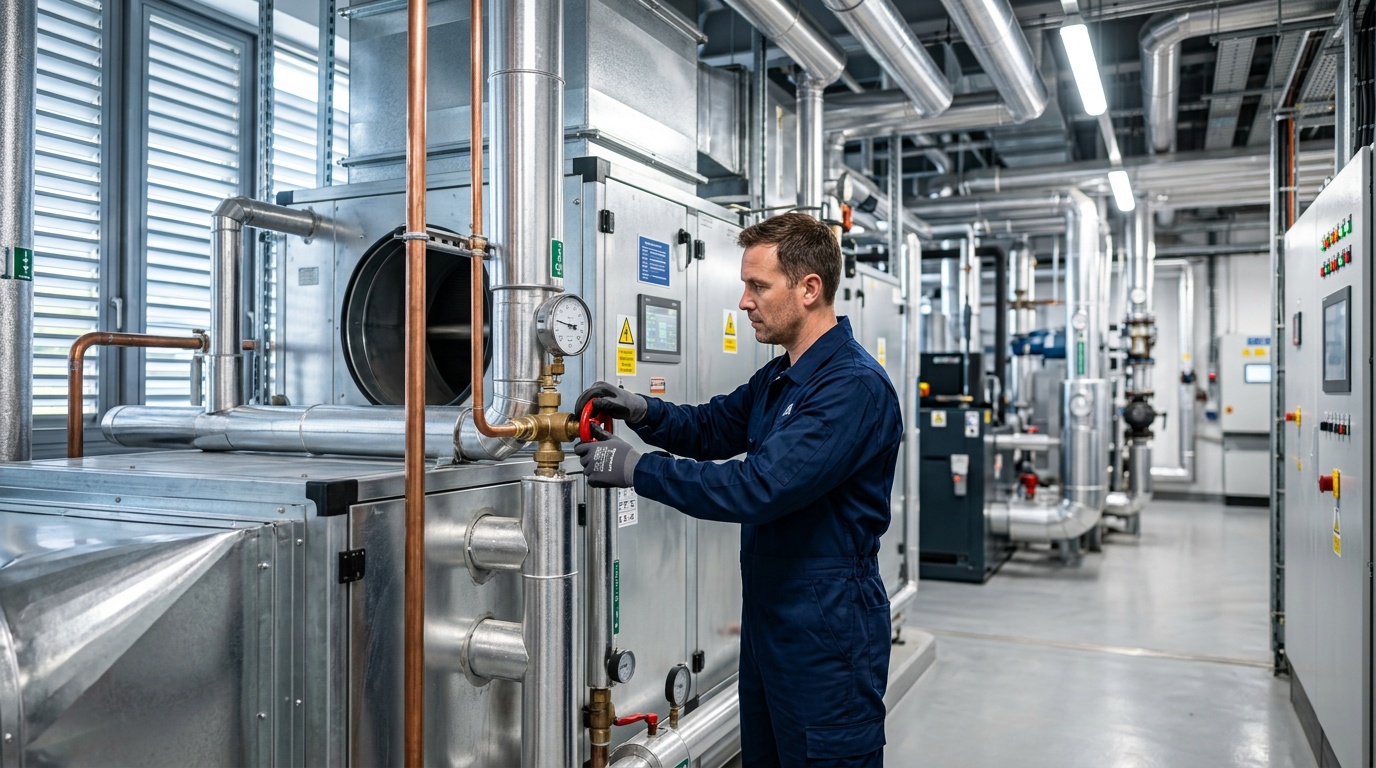
Mechanical Ventilation & Air Handling Units (AHUs) with Heat Recovery
Mechanical ventilation uses supply and extract fans to control air changes instead of relying on open doors or uncontrolled leakage. An AHU can combine filtration, heating, cooling, humidification and heat recovery. Heat recovery transfers energy from extracted air to incoming fresh air, reducing boiler or heat-pump load where airflow and operating hours justify it.
Inspection should cover fan bearings, belts, coils, filters, frost protection, dampers, sensors and the building management system. Required duty depends on floor area, occupancy, process emissions and room volume. Oversized equipment can cycle inefficiently; undersized plant may run continuously without reaching the required air volume.
Thermal Destratification & HVLS Fans: Combating Warehouse Stratification
In a high-bay warehouse, heated air rises beneath the roof while the occupied zone remains cold. Destratification fans return upper heat towards floor level. Research indicates that this can lower heating energy consumption by 20% to 30% in high-bay structures, subject to building design, controls and operating conditions.
HVLS fans move large air volumes at low speed, supporting consistent temperatures without uncomfortable draughts. They do not replace fresh-air ventilation or local extraction. Positioning must account for racking, sprinkler systems, lighting, cranes and pedestrian routes.
Specialised Extraction: Forklift Charging Bays & Dust Control
Battery-charging ventilation should reflect battery type, charging method, room volume and manufacturer guidance. Extraction may control gases, heat or contaminants through suitable intake and discharge points. Loading bays also require attention because vehicle exhaust, diesel particulate, dust and open-door pressure changes affect indoor air quality.
Dust control may combine source capture, filtered extract, make-up air and duct hygiene. Engineers should assess filter loading, spark risk, access panels and disposal before selecting equipment. General circulation does not replace extraction at the contamination source.
Air Quality Monitoring & Clean Air Zone Considerations
Carbon dioxide, particulate matter, temperature, humidity and volatile organic compound sensors provide evidence about changing conditions. Monitoring can support demand-controlled ventilation, identify stale-air pockets and test remedial measures. Placement matters: one device near a door or supply grille cannot represent a large warehouse.
Birmingham sites should consider traffic patterns, idling vehicles and the city’s Clean Air Zone when reviewing loading-bay operation. Monitoring supports, but does not replace, engineering inspection.
| System | Primary function | Warehouse application | Engineering checks |
|---|---|---|---|
| AHU with heat recovery | Controlled fresh-air supply and extract | Occupied work zones and welfare areas | Filters, coils, fans, controls and airflow |
| Destratification fans | Return roof-level heat to the occupied zone | High-bay storage and distribution areas | Fan position, temperature sensors and control sequence |
| Local extraction | Remove contaminants near their source | Charging bays, workshops and dusty processes | Capture performance, filtration and discharge route |
| Air-quality monitoring | Measure changing indoor conditions | Large spaces with variable occupancy or traffic | Calibration, sensor location and trend data |
Navigating UK Compliance: HSE Regulations and Industry Standards for Warehouses
Ventilation compliance is a management responsibility. The Workplace (Health, Safety and Welfare) Regulations 1992, Regulation 6, requires effective and suitable ventilation in enclosed workplaces. Warehouse assessments should consider fresh-air supply, contaminants, temperature, occupancy, vehicle movements and mechanical equipment. A competent inspection should provide measurements, photographs, defects, actions and responsibility for completion.
Workplace (Health, Safety and Welfare) Regulations 1992, Regulation 6: The Foundation
Regulation 6 applies to natural, mechanical and combined ventilation. The system must provide sufficient fresh or purified air for the work. Birmingham logistics facilities should assess forklift traffic, battery charging, loading doors, dust, plant heat and shift occupancy. Performance may change greatly between a quiet inspection and receiving or despatch.
BESA DW/144 & TR19: Ductwork Quality and Cleanliness
BESA DW/144 covers the design, manufacture and installation of sheet-metal ductwork. Poor seals, unsupported sections, restricted bends and inaccessible inspection points reduce airflow and increase fan energy. BESA TR19 guides ventilation hygiene, inspection and cleaning. Catering or high-dust extract ductwork requires professional hygiene inspections every 3 to 12 months under BESA TR19, based on system risk and use.
BS 9999 & DW145: Fire Damper Testing and Maintenance
Fire dampers help maintain compartmentation where ductwork passes through fire-resisting walls and floors. BS 9999 mandates operational testing in commercial ductwork at least every 12 months. Checks should cover access, closure, fusible links or actuators, debris, labels and reinstatement. DW145 supports good practice for inspection and maintenance. A failed damper can create a life-safety issue and weaken insurance or compliance evidence.
F-Gas Regulations & Refrigerant Management
F-Gas obligations may apply to refrigeration, comfort cooling and heat-pump equipment. Operators need records, leak checks at the required frequency, competent refrigerant handling and documented recovery during decommissioning. Ask for asset identification, refrigerant type, charge details, leak history and the next inspection date. Refrigerant loss can reduce capacity, increase compressor strain and cause emergency repairs.
The Role of CIBSE Guides in Best Practice
CIBSE Guides support assessment of ventilation rates, thermal comfort, energy performance, controls and building-services design. They do not replace legislation, the fire strategy or a site-specific risk assessment. Contractors should explain design assumptions, operating profiles, set points, commissioning data and maintenance frequency.
- Air quality: Record airflow measurements, carbon dioxide readings where relevant, temperature complaints and contaminant controls.
- Fire safety: Track annual fire damper testing, access arrangements, defects and remedial completion.
- Duct hygiene: Set inspection periods according to dust, grease and process risk.
- Refrigeration: Maintain equipment records, leak-check history and qualified technician details.
- Evidence: Store reports, photographs, certificates and commissioning information in an accessible compliance file.
The Service Vetting Blueprint: Choosing the Right Ventilation Partner in Birmingham
Choose a contractor through engineering evidence rather than a replacement quotation. A new fan may be proposed when the fault is a failed actuator, blocked filter, damaged belt, incorrect control signal or restricted duct. Replacement may be justified, but inspection and lifecycle analysis should come first. For managers reviewing Recommended ventilation services for commercial warehouses Birmingham?, ask whether the provider can explain the failure through measurements, component condition and operational impact.
Beyond the 'Replace It' Diagnosis: Prioritising Honest Engineering
A senior engineer should inspect intake grilles, filters, coils, fans, bearings, belts, motors, dampers, ductwork, discharge points, sensors, inverters, electrical supplies and controls. The report should separate immediate safety defects, performance improvements and future capital projects. Repair-first means proving whether a motor, damper or control fault can be corrected; it does not mean retaining equipment at the end of its safe service life.
Evaluating Tender Completeness: What to Look For and What Is Missing
A reliable tender describes the installation, works, exclusions, assumptions, access, programme and commissioning. Confirm whether it includes electrical runs, isolators, drainage, lifting, duct alterations, insulation, fire stopping, hygiene cleaning, controls integration and disposal. Request airflow targets, noise considerations, filter grades, control points, balancing, handover and documentation, including out-of-hours working and approval of installation variations.
The MEMS Standard: Repair-First Lifecycle Management vs. Transactional Fixes
At MEMS, we connect immediate repair with longer service life. Our Commercial HVAC Installation and Heating Service covers commercial HVAC installation and heating system repairs around Birmingham. Trained and licensed specialists who are also insured assess heating models and brands. Safety standards are strictly followed, and optimisation can include thermostats, ducts and controls.
The Commercial HVAC Installation and Heating Service provides condition assessment, prioritised actions, compliance evidence and a route for repair or renewal. It is supported by 24 hour emergency heating repairs available any time of day, helping when failure threatens a night shift, stock movement or tenant operation.
Questions to Ask Potential Ventilation Service Providers
Put these questions into procurement and require written answers:
- Who will attend the survey, and what high-bay warehouse experience do they have?
- Which airflow, temperature, electrical and control measurements will be recorded?
- Will the inspection cover battery-charging stations, loading bays, dust sources and fire dampers?
- What assumptions, exclusions and variations sit outside the price?
- Which standards and manufacturer instructions will govern installation and handover?
- What certificates, photographs, commissioning data and digital reports will be supplied?
- How will emergency response, parts availability and escalation operate outside normal hours?
Ensuring 24/7/365 Reliability for Uptime
Warehouses rarely operate nine to five. Test response arrangements, engineer coverage, diagnostic capability, stockholding and communication for weekends, bank holidays and overnight operations. MEMS emphasises professionalism from customer service representatives to technicians, with high-grade heating repairs and installations. The company is recognised as the Best HVAC Company in the Midlands UK for commercial maintenance and compliance.
Contractor Vetting Rubric
| Assessment area | Evidence to request | Why it matters |
|---|---|---|
| Technical diagnosis | Site measurements, photographs and fault logic | Separates a proven repair from an unsupported replacement |
| Scope control | Inclusions, exclusions, drawings and commissioning duties | Reduces variations and unfinished interfaces |
| Compliance | Competence records, certificates and maintenance history | Supports the responsible person and audit trail |
| Continuity | Out-of-hours response plan and escalation contacts | Limits downtime during operational shifts |
What a Repair-First Partner Provides
Pros
- Evidence-led recommendations and clearer capital planning
- Better visibility of compliance defects and operational risk
- One maintenance record linking repairs, testing and future works
Cons
- A proper survey may take longer than an immediate replacement quote
- Access, testing and remedial work can reveal costs omitted from basic tenders
- Some recommendations require planned investment rather than a quick fix
Proactive Maintenance & Future-Proofing Your Warehouse Ventilation
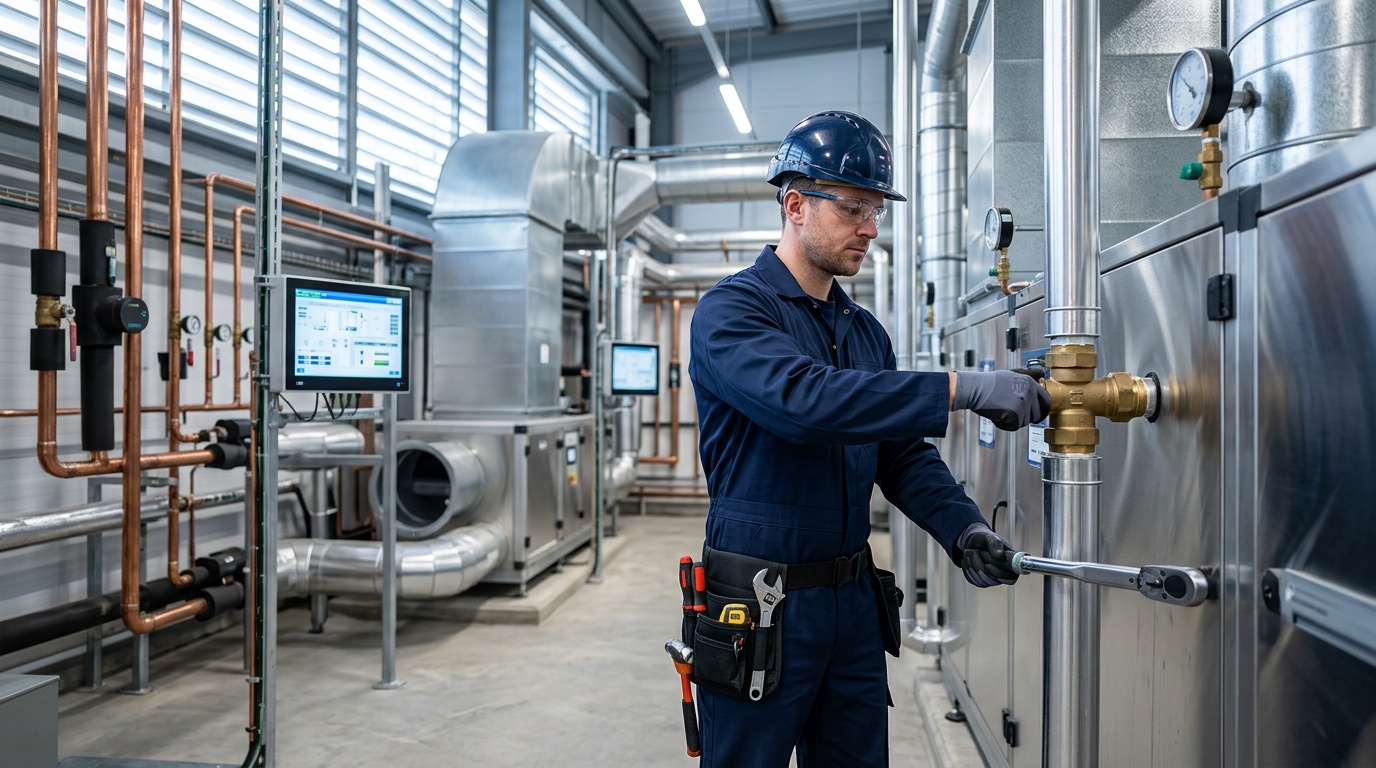
Ventilation should be managed as a working asset, not inspected only after breakdown. Planned maintenance identifies worn bearings, contaminated filters, loose belts, failing actuators, blocked drainage and control faults before they interrupt operations. It also creates a record for the responsible person, insurers, landlords and health and safety reviews. For facilities assessing Recommended ventilation services for commercial warehouses Birmingham?, choose a partner that maintains, measures and improves the system through its service life.
Planned Preventative Maintenance (PPM) Schedules: The Profitability of Prevention
A PPM visit should reflect the equipment and environment. Filters, fans, belts, motors, coils, dampers, sensors, grilles and control panels need suitable inspection intervals. Fire dampers require testing at least every 12 months under BS 9999, while high-dust or process extract may need more frequent hygiene review under BESA TR19. Include seasonal heating checks, airflow verification after repairs and trend reviews for recurring faults.
This reduces emergency callout fees and supports capital planning. Reports should show the defect, likely cause, risk, action and completion evidence. Digital compliance certificates delivered within 24 hours of inspection keep records available for landlords, auditors or enforcement officers.
Integrating Sustainable Technologies: Air-Source Heat Pumps & LED Controls
Future upgrades should suit the existing building. Air-source heat pumps may support low-temperature heating where distribution, insulation, electrical capacity and operating profile are suitable. Heat recovery can reduce energy wasted through extract air. LED controls can reduce lighting heat gains and coordinate illumination with occupancy.
The Commercial HVAC Installation and Heating Service supports commercial HVAC installation and heating system repairs around Birmingham, including optimisation involving thermostats and ducts. The Commercial HVAC Installation and Heating Service works best when upgrades follow load calculations, electrical surveys, commissioning and staff training. Lower-carbon systems still need accessible filters, reliable controls and planned maintenance.
Birmingham's Clean Air Agenda: How Modern Ventilation Supports Goals
Warehouse ventilation can reduce exhaust exposure, uncontrolled leakage and changing occupancy impacts. Loading bays benefit from sensible door management, suitable make-up air and vehicle-pollutant monitoring. Battery-charging areas need risk assessment, safe discharge and controls suited to the battery technology. These measures support healthier conditions and show the relationship between traffic, air quality and energy use.
Securing Your Assets: The Peace of Mind from Compliant, Efficient Systems
Future-proofing means knowing component condition, retaining commissioning data, planning parts and providing safe access. It means correcting root causes rather than repeatedly resetting faults. MEMS provides 24 hour emergency heating repairs available any time of day, alongside trained and licensed specialists who are also insured. Safety standards are strictly followed, and the service covers a variety of heating system models and brands.
Set a written PPM regime, audit records after every visit and review energy and fault trends with the contractor. For dependable support, CLICK TO CALL US NOW and arrange an engineering review with MEMS Facilities Maintenance.
Frequently Asked Questions
How should a warehouse in Birmingham be ventilated?
Commercial warehouse ventilation in Birmingham should combine measured fresh-air supply, controlled extract and suitable air distribution for the building’s use. A site survey should assess occupancy, ceiling height, racking, loading doors, vehicle movements, dust, battery-charging areas and existing plant before selecting fans, air handling units, destratification or local extraction.
Do warehouses need heating and ventilation systems?
Commercial warehouses need heating and ventilation where people, vehicles, processes or stored goods require controlled air quality and temperature. The correct system may include air handling equipment, heating, heat recovery, destratification fans, local extraction and monitoring, with the design based on the working environment rather than warehouse size alone.
What are the UK legal requirements for warehouse ventilation?
UK warehouse ventilation must support suitable indoor air quality, worker welfare and safe control of fumes, dust and heat, while meeting applicable workplace, building and fire safety requirements. A competent Birmingham HVAC contractor should assess the premises, document measured performance and coordinate ventilation with controls, access, ductwork and existing heating equipment.
How much does it cost to ventilate or air condition a warehouse?
Commercial warehouse ventilation and air conditioning costs depend on floor area, ceiling height, occupancy, heat gains, air volume, access, electrical work, controls and the condition of existing equipment. MEMS Facilities Maintenance starts with a survey and measured assessment, allowing repairs, modifications, heat recovery or new installation to be priced against the actual requirement.
How can I choose a reputable warehouse ventilation company in Birmingham?
A reputable Birmingham warehouse ventilation company should provide a documented survey, measured airflow results, clear fault diagnosis and a specification suited to the site. MEMS Facilities Maintenance provides commercial HVAC installation and heating system repairs around Birmingham through trained, licensed and insured specialists, with attention to equipment condition, controls and business continuity.
What ventilation is recommended for forklift charging areas and loading bays?
Forklift charging areas and loading bays need ventilation designed around battery type, charging method, room volume, vehicle emissions, dust and heat sources. Suitable work may include source extraction, filtered discharge, make-up air and monitoring, while engineers should also review discharge positions, filter condition, spark risk, duct access and manufacturer guidance.