Best HVAC ventilation repair for Birmingham retail spaces?
Retail ventilation rarely fails at a convenient time. A fan may complain during the Saturday rush, stale air may gather near changing rooms, or a makeup air unit may run overnight while energy consumption climbs. For estate managers asking, “Best HVAC ventilation repair for Birmingham retail spaces?”, the answer starts with diagnosis, not a sales quotation.
Key Takeaways
- Start with a full diagnostic before asking for a repair quote: a methodical check reveals root causes and stops you paying for unnecessary work.
- Plan ventilation checks outside peak trading hours to avoid catching problems during the Saturday rush when every minute of downtime costs sales.
- Keep an eye on overnight energy use from makeup air units: a unit that runs all night is eating into your margins and needs a line-by-line inspection.
- Birmingham retail spaces have older building fabrics and variable weather, so a local engineer who knows the city's stock will give you a more accurate fix.
- A proper diagnostic guide cuts repeat callouts by addressing the real fault the first time, saving both your maintenance budget and your tenant goodwill.
I have spent 24 years working from the plant room upwards, first as an apprentice combustion engineer and now managing commercial maintenance across the Midlands. My standard is straightforward: identify the actual fault, explain its business impact, repair what is serviceable, and recommend replacement only where the evidence supports it.
The Real Cost of a Silent Plant Room: Why Birmingham Retail Needs Proactive Ventilation Repair
The “invisible” system that drives retail success or failure
Customers may never see an air handling unit, extract fan, damper or duct run, yet they notice the conditions those components create. Poor ventilation produces stuffy aisles, lingering odours, uneven temperatures and condensation around entrances. Excessive fan noise can disturb shoppers and neighbouring occupiers. These defects affect dwell time, staff comfort, product presentation and the perception of the premises.
Downtime means lost revenue and customer goodwill
A failed ventilation system can close a sales floor, restrict occupancy or leave staff working in unsuitable conditions. Partial failure creates operational friction: doors remain open, tills move, stock areas overheat and complaints increase. CIBSE Guide A recommends air supply rates of 8 to 10 litres per second per person in relevant occupied spaces. When airflow falls below an appropriate design level, comfort and footfall can suffer.
The Birmingham retail context: local challenges and compliance pressures
West Midlands retail sites often combine older buildings, altered shopfronts, ceiling voids and plant adapted over several refurbishments. One unit may serve a sales floor, stockroom and staff area with different occupancy patterns. Misconfigured run times and uncalibrated dampers can account for up to 30% of commercial building energy waste in retail spaces, according to the research findings supplied for this guide. Constant operation may be compensating for restricted airflow or a control fault rather than protecting air quality.
My 24 years on the tools: what “good enough” means
Good enough means checking motor current, belt tension, filter pressure drop, temperature readings, control signal and delivered airflow, not merely restoring fan movement. Run capacitors and fan motors can lose up to 40% of their expected lifespan when operating against blocked filters or restricted ductwork. The Commercial HVAC Installation and Heating Service is suited to sites requiring wider mechanical support, component optimisation and planned repair around Birmingham.
Beyond the Checklist: Engineering-Led Diagnostics for Retail Ventilation Faults
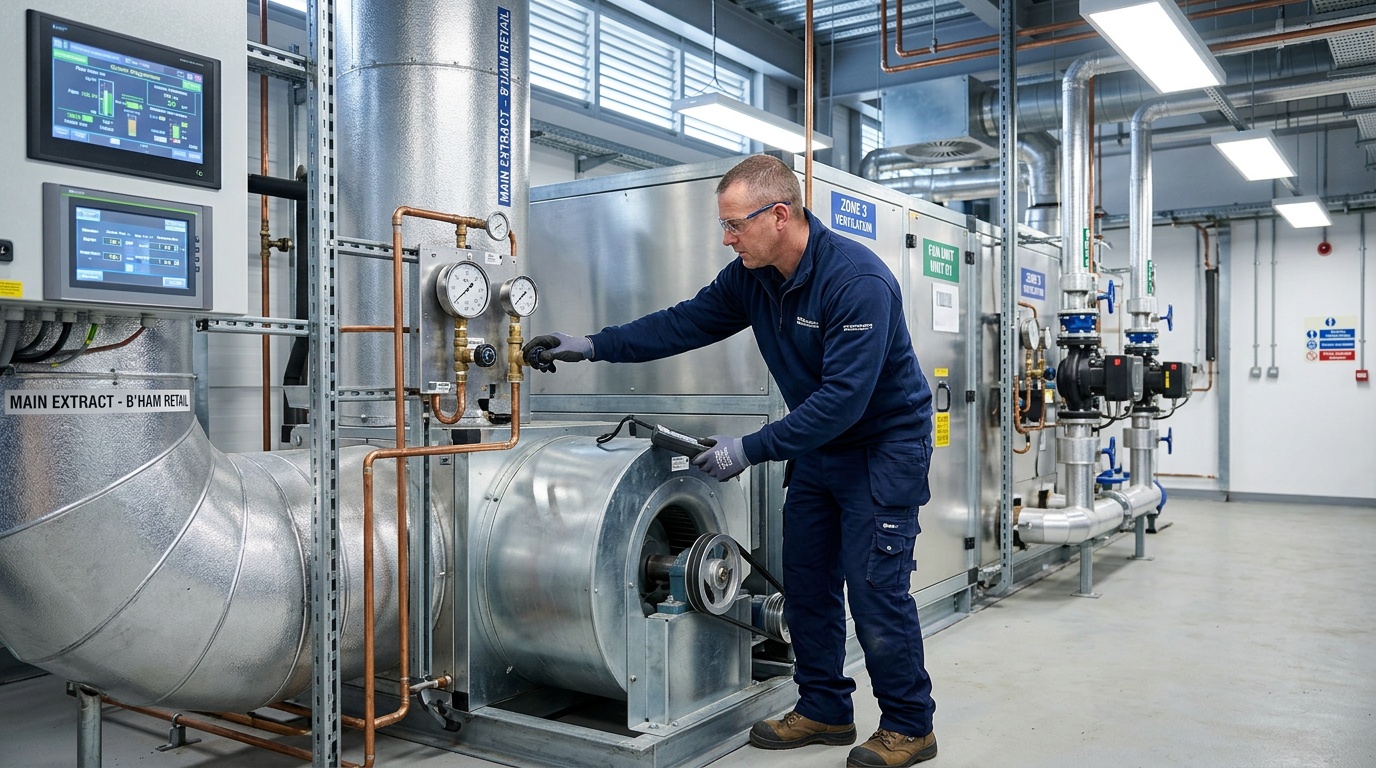
Common complaints: noise, stale air and inconsistent temperatures
Noise may come from a worn bearing, loose belt, damaged impeller, excessive fan speed or duct resonance. Stale air can indicate inadequate outdoor air, a closed damper, fouled filters or poor extract balance. Temperature variation may point to sensors, valves, fan performance or air distribution rather than a failed heating or cooling appliance. Each symptom needs measured testing, not only visual inspection.
Why standard tablet diagnostics can lead to unnecessary replacement
A digital checklist records observations, but it does not replace engineering judgement. “Motor fault” may mean a failed motor, defective capacitor, seized bearing, low voltage or blocked filter causing overload. Before approving replacement, request readings, photographs, component condition, repair alternatives and the reason repair is uneconomic. This helps estate managers control lifecycle budgets.
AHU inspection: fans, belts, motors and filters
An air handling unit should be assessed as a working assembly. Engineers should inspect fan rotation, impeller cleanliness, bearing noise, belt alignment, motor temperature, electrical protection and filter loading, along with coils, condensate drainage, access panels and vibration mounts. A filter replacement may restore airflow, while belt adjustment may remove slip and reduce motor strain. The report should distinguish a worn consumable from a failing asset.
Why makeup air units run constantly
Constant operation commonly traces to incorrect schedules, a faulty room sensor, pressure setpoint, failed damper feedback or an extract system that never reaches its target. Controls should be checked against occupancy, door operation and required air change performance. Reconfiguring the sequence may reduce unnecessary run hours without compromising fresh air provision. Energy savings must follow verified airflow and indoor air quality checks.
Ductwork integrity and airflow balancing
Loose flexible connections, crushed sections, leaking joints, closed volume control dampers and poorly positioned grilles reduce delivered air. Airflow balancing measures supply and extract volumes at terminals, then adjusts dampers and fan settings to match design intent. This can resolve hot spots and odour complaints without replacing the central unit.
The engineer’s repair versus replace decision framework
| Evidence found | Repair is normally sensible | Replacement deserves review |
|---|---|---|
| Component condition | Fault is isolated to a capacitor, belt, sensor, bearing or filter | Multiple major components have failed or corrosion affects the casing |
| Performance | Airflow and controls can return to design operation after correction | The unit cannot meet duty despite correct settings and clean distribution |
| Commercial case | Repair restores service with documented remaining life | Repeated breakdowns, obsolete controls or unsafe operation make repair uneconomic |
Confirm the complaint, measure the system, isolate the defective component, price repair and replacement separately, then record the risk of each option. This gives Birmingham retail managers an accountable answer to “Best HVAC ventilation repair for Birmingham retail spaces?” and protects uptime without turning every fault into a capital project.
Tackling the “Impossible” Access: Ventilation Repair in Constrained Retail Spaces
The reality of UK retail plant rooms: ceiling voids, tight mezzanines and boxed-in units
Many Birmingham retail units were altered in stages. Ceiling voids became crowded with lighting, sprinklers, electrical containment and ductwork. AHUs sit above stockrooms, extract fans may be boxed behind access panels, and makeup air units may occupy cramped mezzanines. A survey should record dimensions, lifting routes, panel locations, electrical supplies, fire-stopping and the effect of work on trading hours.
That layout changes the repair plan. The engineer must identify safe isolation points, check load-bearing arrangements, protect merchandise and establish whether components can be serviced in place. Forcing access or dismantling surrounding services creates avoidable risk.
Why contractors walk away, and how we get the job done
A restricted plant location can turn a belt change into a planned engineering exercise. The work may involve moving tools through the building, controlling dust, working at height, maintaining fire routes and returning ceiling panels without defects. My approach is to separate the access problem from the equipment fault, assess which components can be repaired in position and explain lifting or panel removal requirements before work begins.
The recommended Commercial HVAC Installation and Heating Service supports wider mechanical assessment where ventilation connects with heating, controls, ductwork or plant-room safety. It is not a reason to replace serviceable equipment.
Specialised tools and techniques for confined-space HVAC maintenance
Restricted-access work may require compact test instruments, inspection cameras, low-profile tools, portable lighting and controlled lifting equipment. Vibration measurement, electrical testing, airflow readings, pressure checks and thermal inspection can diagnose faults without removing the whole unit. Capacitors, belts, bearings, sensors and actuators can often be replaced locally after proper assessment.
Safe isolation remains non-negotiable. The method should cover electrical lock-off, moving fan assemblies, sharp sheet metal, confined access, work at height and protection of shoppers and staff. The Commercial HVAC Installation and Heating Service can support planned modification where obsolete controls or inaccessible components prevent dependable maintenance.
Minimising disruption above busy sales floors and stockrooms
Work may be scheduled before opening, after closing or during a controlled quiet period. Engineers should use dust protection, tool retention, floor protection and exclusion zones. Stockroom work needs coordination with deliveries, picking routes and fire exits. A written method statement should cover noise, access restrictions, isolation periods and reinstatement.
Maintaining acoustic performance when access is restricted
Engineers should check fan balance, bearing condition, belt tension, vibration mounts, flexible connections, duct velocity and loose panels. A replacement motor with incorrect speed or a poorly tensioned belt may create more disturbance than the original defect. Final testing should include operational sound observations, vibration checks and confirmation that grilles, panels and acoustic insulation are correctly fitted.
Use this access checklist before approving work:
- Confirm the equipment location, dimensions and safe route for tools and removed parts.
- Record isolation points, working-at-height requirements and protection for occupied areas.
- Ask which measurements support the repair recommendation.
- Agree working hours, noise controls, dust protection and reinstatement responsibilities.
- Request post-repair airflow, electrical and acoustic observations in the service report.
Compliance & Control: Ensuring Air Quality and Avoiding Costly Oversights
UK compliance essentials: workplace regulations and CIBSE guidance
The Workplace (Health, Safety and Welfare) Regulations 1992 require enclosed workplaces to receive effective and suitable ventilation, with equipment maintained so it remains effective. CIBSE guidance provides engineering benchmarks for ventilation design, air movement, comfort and indoor conditions. Occupancy, floor area, activity, heat gains, odours and layout affect the appropriate solution.
Estate managers should retain maintenance records, defect reports, inspection dates, isolation details and evidence that issues were closed. A system that operates is not automatically compliant; it must deliver suitable conditions safely and consistently for staff, customers and other building users.
Air change rates and indoor air quality in retail premises
Air change rate, or ACH, describes how often the air volume in a space is replaced. It must be considered alongside occupancy and outdoor-air volume. CIBSE Guide A recommends 8 to 10 litres per second per person for relevant occupied spaces. Engineers should assess carbon dioxide trends, terminal airflow, extract performance, temperature, humidity and complaints by area rather than relying on one reading.
Low airflow may result from blocked filters, closed dampers, leaking ductwork, failed controls or a fan below duty. Excessive airflow can waste energy, create draughts and increase noise. Correct balancing and control calibration protect air quality while avoiding unnecessary run hours.
F-Gas requirements and transparent refrigerant management
Where retail ventilation forms part of refrigeration or air-conditioning equipment containing fluorinated refrigerant, F-Gas requirements apply to the relevant equipment and work. A qualified technician should record refrigerant type, quantity, leak findings, recovery or charging activity and follow-up requirements. Refrigerant should never be added instead of finding the leak.
Request a clear breakdown of refrigerant quantity, labour, parts, testing and disposal. The service team must work to applicable technical and safety standards, with records available for an audit or landlord inspection.
Planned preventative maintenance as a compliance and cost-saving strategy
PPM should reflect the equipment and retail operation, not a generic calendar entry. Filters, belts, bearings, motors, dampers, sensors, coils, condensate routes and control schedules need appropriate inspection frequencies. Run hours should be checked against occupancy, deliveries, cleaning periods and seasonal demand. Misconfigured schedules and uncalibrated dampers can account for up to 30% of commercial building energy waste in retail spaces, according to the research findings supplied for this guide.
A useful PPM visit identifies deterioration before a trading interruption and creates an asset lifecycle record showing recurring faults, repair history, remaining service life and sensible capital-planning dates.
The M&E standard: written condition reports and transparent pricing
Every significant visit should state the reported symptom, tests completed, readings taken, confirmed defect, immediate risk, recommended action and estimated consequence of delay. Repair and replacement options should be shown separately, with assumptions stated plainly. The Commercial HVAC Installation and Heating Service provides coordinated commercial heating and HVAC support around Birmingham, including system component optimisation and documented repair decisions.
Before appointing a maintenance provider, request:
- Engineer qualifications and relevant F-Gas arrangements where applicable.
- Measured airflow and control findings, not only photographs.
- A documented distinction between repairable defects and replacement cases.
- Itemised labour, parts, refrigerant and attendance charges.
- Updated asset records after each planned or reactive visit.
For estate managers assessing the Best HVAC ventilation repair for Birmingham retail spaces?, compliance evidence should sit beside engineering evidence. The right service leaves the building quieter, safer and easier to manage, with no unexplained charge and no replacement recommendation unsupported by condition data.
Your Action Plan: Partnering for Reliable Retail Ventilation
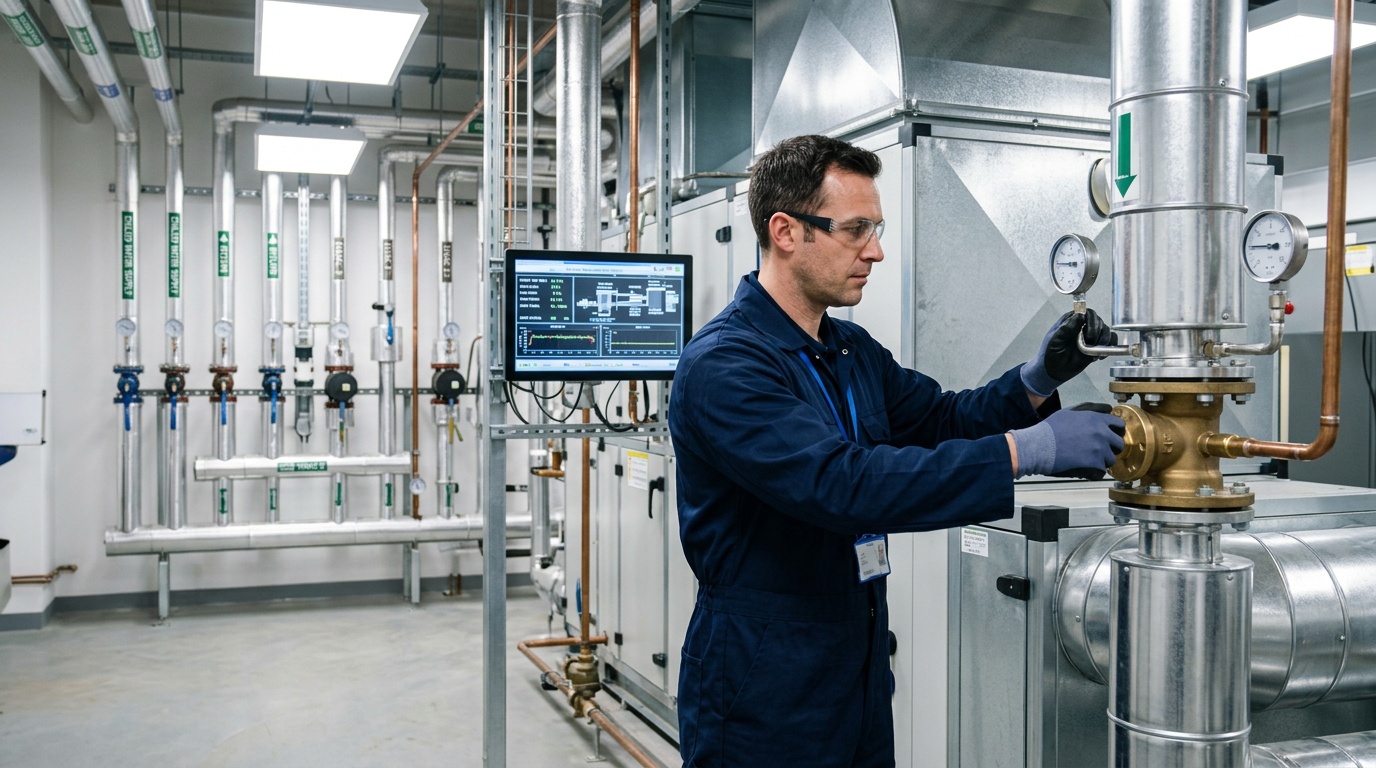
Questions to ask your current HVAC provider, and what to listen for
Ask the provider to identify the measured cause of the fault, not merely the failed component. Request airflow readings, electrical checks, control observations, photographs and a written condition report. Ask whether the proposed repair restores expected performance, how long the component should remain serviceable, and what risk remains. Labour, parts, attendance and refrigerant charges should be shown separately.
Building a 24/7/365 partnership through consistent technical support
Reliable ventilation depends on continuity. The engineer attending an emergency should be able to see previous faults, asset details, control settings and completed PPM tasks. That history prevents repeated diagnosis and identifies patterns such as recurring belt failure, poor filtration or excessive run hours. A 24/7/365 arrangement gives store teams a clear escalation route when noise, odour, heat or airflow changes appear outside normal hours.
When to call in specialists before failure
Call for assessment when a fan develops vibration, a motor trips, airflow becomes uneven, controls stop responding or equipment runs beyond its schedule. Rising noise, hot electrical smells, repeated resets, condensation and unexplained energy use also deserve prompt attention. Early testing may identify a worn bearing, failing capacitor, restricted filter or sensor fault while repair remains manageable. For estate managers asking, “Best HVAC ventilation repair for Birmingham retail spaces?”, the clearest test is whether the provider can explain the evidence and protect the next trading period.
The “Big Enough to Cope, Small Enough to Care” advantage: M&E Maintenance Solutions
M&E Maintenance Solutions combines commercial capability with direct accountability. Our trained and licensed specialists are insured, follow safety standards and support commercial HVAC installation and heating repairs around Birmingham. The Commercial HVAC Installation and Heating Service is recommended where ventilation, heating controls, thermostats or duct optimisation require coordinated attention. It also provides access to 24-hour emergency heating repairs, with engineers familiar with varied system models and brands.
Need a dependable next step? Send us the fault history, site constraints and latest service report. We will assess the evidence, explain the practical options and provide a clear route to repair.
Frequently Asked Questions
What are the best HVAC companies in Birmingham, Alabama?
For Birmingham, West Midlands retail premises, the best HVAC company is one with proven commercial ventilation experience, measured diagnostics and clear repair reports. I recommend checking competence across fans, air handling units, controls, ductwork and airflow balancing, then comparing written findings, repair options and expected service life rather than choosing on price alone.
Which type of HVAC system is best suited for large commercial spaces?
A central air handling system with mechanical supply, extract, filtration and zone controls is often well suited to large commercial retail spaces. The right arrangement depends on occupancy, floor layout, outdoor air requirements, heating and cooling loads, and existing ductwork, so a site survey should come before equipment selection.
What AC brands should Birmingham retail businesses stay away from?
Birmingham retail businesses should not avoid a brand based on reputation alone, because suitability, local support, spare parts and installation quality affect performance. A competent engineer should assess the existing system, component condition and lifecycle costs before recommending repair or replacement, with evidence supporting any brand or equipment decision.
What is the average cost of an HVAC service call in Birmingham?
The average HVAC service call cost in Birmingham varies with attendance time, access, fault complexity, equipment type and whether parts or testing are required. A commercial ventilation provider should confirm the visit basis and provide itemised findings, readings and repair options, helping estate managers compare the likely total cost before approval.
What do HVAC engineers charge per hour for commercial ventilation repairs?
Commercial HVAC engineers charge hourly rates that vary by time of attendance, specialist equipment, access requirements and repair complexity. An hourly rate alone does not show the full cost, so request the labour basis, call-out terms, parts pricing and expected diagnostic scope in writing before work begins.
How can a retail business choose the best ventilation repair service in Birmingham?
The best Birmingham ventilation repair service tests the fault before recommending equipment replacement. Ask for airflow readings, electrical load checks, filter and belt condition, control and damper tests, photographs, repair alternatives, expected service life and remaining risk, then select a provider able to plan work around trading hours.