m and e
When a commercial building loses heating, ventilation, power or water, the failure rarely stays confined to one plant room. Tenants feel the disruption, trading hours can be affected, and a landlord may face urgent repair costs alongside safety and compliance questions. Understanding m and e services is the first step towards controlling those risks.
Key Takeaways
- A failure in any mechanical or electrical service can spread from a single plant room to affect tenant operations, trading hours, and compliance costs.
- Understanding the full scope of M and E systems allows building owners to identify risks early and avoid expensive emergency repairs.
- Proactive maintenance of heating, cooling, and power equipment reduces the chance of sudden breakdowns that disrupt revenue and tenant satisfaction.
- Knowledge of M and E basics helps facility managers protect their building's asset value and maintain operational safety across all units.
For estate managers, the term covers the engineered systems that make a property usable, safe and financially viable. It describes the mechanical, electrical and associated public health infrastructure that supports daily occupancy.
What Does M&E Stand For? Disambiguating a Common Acronym in UK Building Services
Mechanical and Electrical Engineering: The Core Definition for Commercial Estate Managers
In construction and facilities management, M&E means mechanical and electrical engineering. Mechanical work includes heating, air conditioning, ventilation, pumps, boilers, chillers and controls. Electrical work covers incoming supplies, distribution boards, switchgear, lighting, emergency systems, fire alarms and power for plant. Together, these services keep offices, warehouses, retail units, schools and industrial premises operational.
Why “M&E” Gets Confused with Fashion Brands and Development Evaluation
The abbreviation has unrelated meanings. “ME+EM” is a clothing brand, while “M&E” can mean monitoring and evaluation in public, charitable or development programmes. Searching for the m and e meaning without adding “building services”, “commercial property” or “engineering” can produce the wrong information. In facilities, the subject is physical infrastructure, not clothing or project assessment.
| Term | Meaning | Typical context |
|---|---|---|
| M&E | Mechanical and electrical engineering | Building services, construction and facilities maintenance |
| M&E | Monitoring and evaluation | Policy, research, grant-funded and development programmes |
| ME+EM | Fashion retailer | Clothing and consumer retail |
The Integrated Role of M&E in Building Performance and Asset Value
Mechanical and electrical systems are connected operationally. A boiler needs electrical controls and pumps. Air conditioning depends on power, refrigerant circuits, water flow and ventilation. Poorly balanced systems can increase energy consumption, create uncomfortable temperatures and shorten equipment life. Building services account for up to 40% of total commercial construction costs and more than 60% of ongoing operational running costs, according to the research findings supplied for this guide.
Coordination is a commercial issue, not merely a technical preference. A maintenance record should show plant condition, defects, access requirements, test results and remedial priorities. Without that view, subcontractors can pass responsibility between one another while tenants wait. Good m and e engineering connects asset condition with business continuity, lifecycle planning and property value.
Core Mechanical and Electrical Systems That Keep Your Commercial Building Running
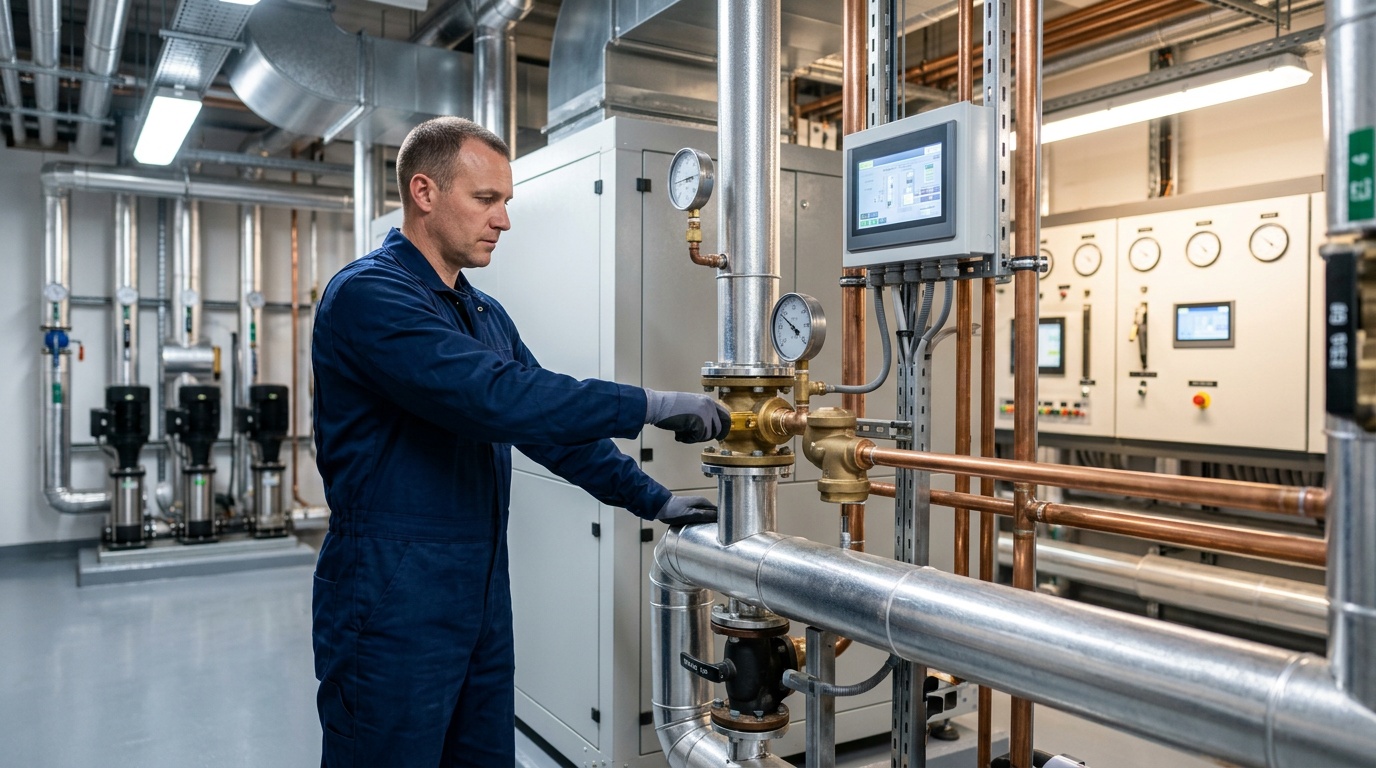
Every property has a different services profile, but the same broad disciplines appear across the UK commercial estate. Their condition affects comfort, productivity, fire safety, water hygiene, energy use and the ability to keep premises open. A site survey should identify installed equipment, duty, age, controls and the consequences of failure.
Mechanical Services: HVAC, Commercial Heating, Ventilation, and Chilled Water Systems
Mechanical services manage temperature, air movement and heat rejection. Typical assets include gas or electric boilers, radiators, air handling units, extract fans, fan coil units, heat pumps, cooling towers, chillers, pumps, valves and building management systems. Filters, belts, coils and strainers need inspection because restricted airflow or poor water circulation can overwork compressors and motors. HVAC and lighting together represent around 65% of energy consumed in typical UK commercial office buildings, according to the supplied research findings.
Electrical Infrastructure: Power Distribution, Switchgear, Emergency Lighting, and Fire Alarms
Electrical infrastructure starts at the incoming supply and continues through transformers, main distribution boards, sub-main cabling, final circuits and local isolators. It supports lighting controls, sockets, lifts, pumps, server rooms and mechanical plant. Switchgear must be accessible and labelled. Emergency lighting and fire alarm systems require dependable testing, documented faults and suitable battery or standby arrangements. A distribution-board defect can affect an entire floor, while an unresolved alarm fault can restrict lawful occupation.
Public Health Engineering: How Plumbing and Drainage Integrate with M&E
Plumbing and drainage are commonly grouped with building engineering because they support the same operational outcome. Cold water storage, boosted supplies, hot water generation, sanitaryware, soil pipes, rainwater outlets and below-ground drainage need planned inspection. A failed pump can remove water pressure; a blocked drain can cause hygiene problems and damage finishes. These systems connect with heating, electrical controls and water management, so treating them as an afterthought creates gaps in fault diagnosis and planned maintenance.
| Discipline | Typical assets | Operational concern |
|---|---|---|
| Mechanical | Boilers, chillers, pumps, AHUs, heat pumps and ventilation fans | Temperature control, airflow, efficiency and plant reliability |
| Electrical | Switchgear, distribution boards, lighting, controls and fire alarms | Safe power delivery, fault protection and continuity |
| Public health | Water systems, pumps, sanitaryware and drainage | Hygiene, pressure, leak prevention and drainage capacity |
Statutory Compliance and Maintenance Standards Every UK Estate Manager Must Know
Compliance is evidence that mechanical and electrical systems have been inspected, tested and maintained by competent people. Risk appears when records are incomplete, inspection dates are unclear or defects are logged without close-out. A building manager needs a schedule covering electrical safety, gas appliances, refrigerant systems, air-conditioning performance, emergency systems and planned maintenance.
Compliance check: Ask your provider to show the current asset register, inspection timetable, test certificates, engineer qualifications, defect reports and evidence that outstanding actions have been completed. A certificate without an asset reference, test result or next due date is not a useful management record.
BS 7671 (18th Edition Wiring Regulations) and Electrical Testing Schedules
BS 7671 sets recognised requirements for the design, installation, inspection and testing of electrical installations. Estate managers should hold an up-to-date Electrical Installation Condition Report, commonly called an EICR, alongside records for fixed equipment, emergency lighting, fire alarm systems and portable appliances where applicable. Inspection intervals vary with occupancy, installation condition, environmental exposure, equipment use and the competent inspector’s recommendations.
Reports should identify distribution boards, circuits, protective devices, test readings, coded observations and remedial priorities. BS 7671 is published by the Institution of Engineering and Technology and BSI, so the edition used should be recorded. Where a defect presents immediate danger, isolation and urgent action may be needed rather than a future repair date.
SFG20: The Standard for Building Maintenance Specifications
SFG20 provides task schedules for planned maintenance across building services. It helps define what an engineer should inspect, how often and what condition or performance standard should be checked. It does not replace statutory law, manufacturer instructions or a site-specific risk assessment; a suitable plan combines all three.
The schedule should reflect the equipment installed. Boiler combustion checks, pump condition, belt tension, filter loading, control settings, water temperatures and safety interlocks should be recorded against named assets. SFG20 is maintained by the Building Engineering Services Association, BESA. Ask for evidence that scheduled tasks are completed, not merely marked as attended.
F-Gas Regulations, TM44 Air Conditioning Inspections, and Gas Safety Requirements
Refrigeration and air-conditioning equipment containing fluorinated greenhouse gases requires controlled handling, leak checking and appropriately qualified personnel under the UK F-Gas regime. Records should identify refrigerant type, charge information, leak inspections, repairs and recovery activity.
TM44 inspections assess the energy performance of air-conditioning systems above the applicable output threshold. Reports should identify inefficiency, control problems and practical improvement measures. Gas appliances require examination and servicing by engineers registered with the Gas Safe Register. The responsible person should retain appliance records, flue information, safety findings and remedial actions.
- Current asset register with unique equipment references.
- Electrical inspection reports, test results and remedial action logs.
- Planned tasks mapped to SFG20, manufacturer guidance and risk.
- F-Gas records, refrigerant details and leak-check history.
- TM44 reports where the air-conditioning system meets the relevant threshold.
- Gas Safe engineer details, appliance checks and flue safety records.
- Named owners for overdue actions, with completion evidence.
Planned Preventative Maintenance (PPM) vs Reactive Repairs: The Real Cost to Your Estate
Reactive maintenance looks economical until failure occurs at the worst possible time. A failed pump can remove heating from occupied space, while a faulty contactor can stop ventilation or cooling. Costs may include overtime, emergency parts, access restrictions, tenant disruption, spoiled stock, lost trading time and compliance concerns.
Why a “Fix It When It Breaks” Approach Increases Operational Expenditure
Run-to-fail maintenance allows minor defects to become major failures. A blocked filter increases fan resistance, a loose electrical termination creates heat and a leaking valve can damage adjacent components. These warning signs are often visible during planned visits. Building services account for more than 60% of ongoing commercial running costs, according to the research findings supplied for this guide.
How PPM Extends Equipment Life, Reduces Energy Bills, and Prevents Downtime
PPM gives engineers time to inspect condition, clean heat-transfer surfaces, verify safety controls, measure electrical performance and identify parts approaching failure. It creates an asset history based on actual operating conditions. Preventative maintenance reduces equipment breakdowns by up to 75% compared with reactive run-to-fail models, based on the research findings provided for this article.
The energy benefit comes from keeping systems within their intended operating range. Correct airflow, clean coils, accurate sensors, sound insulation, balanced pumps and suitable control settings reduce unnecessary demand. HVAC and lighting represent around 65% of energy consumed in typical UK commercial offices, according to the supplied research findings.
Comparative Analysis: Emergency Call-Outs versus Scheduled Service Visits
| Area | Emergency call-out | Scheduled service visit |
|---|---|---|
| Timing | Unplanned, often outside normal working hours | Agreed around occupancy and operational needs |
| Diagnosis | Focused on restoring operation quickly | Includes inspection, testing and condition reporting |
| Cost control | Exposure to urgent labour, access and parts costs | Allows budgeting, quotation and planned procurement |
| Business impact | Possible tenant disruption, closure or lost productivity | Work can be coordinated with site activity |
| Asset knowledge | Often limited to the immediate fault | Builds a traceable maintenance and performance history |
Maintenance Decision: Pros and Cons of a PPM-Led Strategy
Pros
- Fewer avoidable breakdowns and better operational continuity.
- Earlier identification of safety defects and deteriorating components.
- More predictable expenditure and clearer lifecycle planning.
Cons
- Requires planned access, accurate records and management commitment.
- Some ageing assets still need replacement despite regular servicing.
- Short-term budget pressure can appear before savings are measured.
A sensible programme ranks equipment by safety, occupancy impact, age, redundancy, manufacturer guidance and replacement cost rather than servicing every asset at one interval. That is the practical value of m and e maintenance: protecting uptime while giving the estate manager evidence for spending decisions.
How to Select and Manage an M&E Contractor for Long-Term Estate Performance

Selecting a maintenance contractor is a risk decision, not a procurement exercise based only on the lowest day rate. The right partner should understand how boilers, air-conditioning, ventilation, electrical distribution, water systems and controls affect one another, along with the commercial consequences of failure. Before appointing M&E contractors, assess technical competence, reporting, emergency response, compliance processes and lifecycle planning.
Key Questions to Ask Before Signing a Maintenance Contract
Ask for a mobilisation plan. The contractor should explain how they will verify the asset register, review certificates, identify high-risk equipment and establish the first planned maintenance schedule. Confirm who attends emergencies, whether engineers are employed or subcontracted, and how escalation works outside normal hours. Establish how defects are prioritised, quotations issued, and service reports and compliance documents delivered.
- Can the contractor demonstrate relevant commercial experience across your building type?
- Are engineers suitably qualified for gas, refrigeration, electrical and water-related duties?
- Will maintenance tasks follow SFG20, manufacturer instructions and site-specific risk assessments?
- Does the contract define response times, attendance targets and communication responsibilities?
- Will reports include photographs, readings, defect codes, recommended actions and completion dates?
- Can the provider support lifecycle budgets, replacement planning and energy performance reviews?
- Is there a clear process for managing subcontractors, permits, access and tenant communication?
The Benefits of an Integrated Mechanical, Electrical, and Plumbing (MEP) Partner
Separate specialists may each be competent, yet coordination can fail between disciplines. A ventilation fault may involve a fan motor, control panel, sensor, belt or isolator. If each trade investigates only its own equipment, diagnosis slows and responsibility can become disputed. An integrated MEP partner gives the estate manager one accountable route for fault finding, planned work, documentation and escalation. This helps during shutdowns, refurbishments and plant replacement, where electrical isolation, mechanical installation, controls commissioning and water services must be sequenced.
One provider can link energy readings, recurring faults, plant condition, tenant complaints and compliance actions. That creates a basis for deciding whether to repair, refurbish, replace or alter operating hours. The benefit includes faster diagnosis, fewer duplicated visits and better control of building uptime.
Building a Compliance-First, Lifecycle-Centric Maintenance Strategy
Begin with risk and asset condition, then update the plan as the property changes. Record each asset’s location, age, capacity, manufacturer, service history, criticality and replacement outlook. Review this information during quarterly contract meetings, alongside overdue defects, repeat failures, energy trends and upcoming statutory inspections. This prevents equipment being serviced indefinitely while reliability or controls decline.
Nominate people responsible for approving remedial works, closing compliance actions and reviewing monthly performance data. Use planned shutdown windows for intrusive inspections, and require documented commissioning after significant repairs. For a Birmingham office, retail unit or industrial site, appoint a contractor that can maintain current systems while preparing the estate for electrification, refrigerant changes, smart controls and lower-carbon plant. That is how m and e maintenance becomes a managed business asset rather than a succession of emergency decisions.
Frequently Asked Questions
What does M&E stand for?
M&E stands for mechanical and electrical engineering in construction and facilities management. Mechanical work covers heating, ventilation, air conditioning, boilers, chillers, pumps and controls, while electrical work includes power distribution, switchgear, lighting, fire alarms and emergency systems. The same abbreviation means monitoring and evaluation in policy programmes, so context matters when searching.
What is M&E in a building?
M&E in a building refers to the mechanical, electrical and public health infrastructure that keeps a property usable, safe and financially viable. These systems include HVAC plant, boilers, chillers, power distribution, lighting, fire alarms and water services. Building services can account for up to 40% of total commercial construction costs.
What is an M&E business?
An M&E business designs, installs and maintains the mechanical and electrical systems within commercial properties. Such firms work on heating plant, ventilation, power distribution, lighting and water services across offices, warehouses, retail units, schools and industrial premises. A competent contractor links asset condition with business continuity and lifecycle planning.
What is an M&E project?
An M&E project is any construction or refurbishment programme involving mechanical and electrical systems, such as installing new HVAC plant, upgrading switchgear or replacing boilers and controls. Because mechanical and electrical systems depend on each other, well-run M&E projects coordinate both disciplines from site survey through to commissioning and documented handover.
What does an M&E engineer do?
An M&E engineer keeps a building's mechanical and electrical plant running safely and efficiently. Daily work includes inspecting boilers, chillers, air handling units, pumps, switchgear and fire alarms, recording test results, logging faults and prioritising remedial repairs. The role protects occupant comfort, fire safety, water hygiene and energy performance.
Why is M&E important for commercial property value?
M&E systems shape comfort, compliance and running costs, which directly influence tenant satisfaction and asset value. Building services account for more than 60% of ongoing operational running costs in commercial premises. A documented maintenance record showing plant condition, defects and remedial priorities supports business continuity and lifecycle planning.
How much energy do M&E systems use in a commercial building?
M&E systems dominate energy consumption in commercial premises, with HVAC and lighting together representing around 65% of energy used in typical UK commercial offices. Poorly balanced heating, ventilation and electrical systems increase consumption, create uncomfortable temperatures and shorten equipment life, making coordinated maintenance a commercial priority rather than a technical preference.