Top rated services for commercial air quality ventilation Birmingham?
When a ventilation system moves too little air, warning signs often begin with stale rooms, condensation around grilles, rising CO₂ readings and higher energy bills. For facility managers searching for Top rated services for commercial air quality ventilation Birmingham?, the test is whether an engineer measures the system, identifies the fault and protects the building’s compliance position.
Key Takeaways
- Underperforming ventilation usually announces itself early through stuffy rooms, moisture gathering near grilles, rising CO₂ readings and creeping energy costs.
- Top rated providers separate themselves by measuring airflow and system performance first, so the repair targets the real fault instead of the visible symptom.
- Poor air quality management carries a commercial price, since inefficient systems inflate running costs and can undermine a building's compliance standing during audits.
- Facility managers should choose engineers who document their findings and repairs, because that evidence protects the organisation if regulators or insurers ask questions.
- Acting on the first warning signs keeps maintenance budgets predictable and maintains a healthy environment for everyone working in the building.
I have spent more than 24 years working from plant rooms upwards, beginning as an apprentice combustion engineer. At MEMS, we assess ventilation as part of the complete mechanical asset: air handling units, extract fans, filters, ductwork, controls, heating coils and associated electrical components. This keeps attention on safe airflow, reliable operation and sensible lifecycle cost.
Birmingham's Commercial Air Quality Ventilation: Why Facility Managers Need Engineering-First Solutions
The Hidden Costs of Poor Air Quality in Birmingham Businesses
People spend approximately 90% of their time indoors, and indoor pollutant concentrations can be two to five times higher than typical outdoor levels, according to HSE and US EPA data. In a Birmingham office, warehouse, retail unit or education facility, inadequate ventilation can cause discomfort, dust-loaded filters, restricted heat transfer, excessive humidity, mould growth and pressure problems between rooms.
The commercial impact includes lost concentration, occupant complaints, avoidable sickness absence and rising electricity demand from fans working against static pressure. A neglected air handling unit can also strain belts, bearings, motors and control components. Good indoor air quality is a building performance issue, not only a comfort preference.
Why Domestic Solutions Don't Cut It for Commercial Estates
A domestic extractor or small split-system service cannot address the duty, scale or documentation expected across a commercial estate. Premises may contain multiple air handling units, variable air volume terminals, mechanical ventilation with heat recovery, fire dampers, kitchen extract, toilet extract and building management system controls. Each affects airflow, pressure, temperature and occupant safety.
Domestic servicing can overlook access planning, risk assessments, permit systems, asset registers and documented remedial priorities. Facility managers need engineers able to work around trading hours, coordinate contractors and provide findings for landlords, auditors and compliance teams. The Commercial HVAC Installation and Heating Service supports commercial HVAC installation and heating system repairs around Birmingham, with trained and licensed specialists who are also insured.
Our 'Engineering Reality' Approach: Beyond the Sales Pitch
Our starting point is evidence. We inspect fan operation, filter condition, coil cleanliness, damper movement, temperature differentials, airflow volume, control sequences and electrical connections. We record the fault rather than assuming an ageing air handler needs replacement. A failed capacitor, worn fan motor or damaged actuator may be repairable after correct diagnosis and a transparent quotation.
Navigating UK Compliance: Statutory Ventilation Standards for Birmingham Facilities

The Workplace (Health, Safety and Welfare) Regulations 1992: Fresh Air Requirements
The Workplace (Health, Safety and Welfare) Regulations 1992 require enclosed workplaces to receive sufficient fresh or purified air. For commercial offices, the commonly applied minimum fresh air supply rate is 10 litres per second per person. HSE guidance places responsibility on the duty holder to maintain suitable conditions, taking account of occupancy, room use, ventilation performance and changed layouts.
Verification should include supply and extract measurements, control settings, filter condition and evidence that vents are unobstructed. Occupancy changes, partitioning and altered working patterns can make an originally adequate system unsuitable.
BESA TR19: Ductwork Hygiene Standards and Inspection Frequencies
BESA TR19 provides recognised guidance for commercial ventilation hygiene. Research findings indicate that ductwork cleanliness inspections are generally required every 12 to 24 months, depending on building usage and occupancy. Food production, healthcare, hospitality and high-occupancy sites may need closer attention because grease, dust, fibres and biological contaminants can accumulate quickly.
Inspection should assess accessible duct sections, grilles, filters, air handling equipment and extract routes. Cleaning is not automatically the first step; the decision should follow documented condition assessment, suitable access and post-clean verification where required.
CIBSE Guidelines: Air Exchange Rates and Indoor Air Quality Benchmarks
CIBSE guidance, including CIBSE Guide B, helps engineers assess air changes per hour, ventilation rates, thermal conditions, filtration, plant performance and control strategy. No single airflow figure suits every room: meeting rooms, production areas, washrooms and storage spaces have different heat loads, occupancy patterns and contaminant risks.
Facility records should connect design intent with actual performance. Engineers can compare measured airflow, CO₂ trends, temperature, relative humidity and static pressure with building use, giving managers a defensible basis for adjustment, repair or planned capital work.
Other Key Compliance Areas: F-Gas, Legionella, and SFG20
Refrigeration and air-conditioning work involving fluorinated gases must be handled by appropriately certified personnel using suitable procedures. Legionella control requires risk management where water systems and cooling equipment create relevant exposure. SFG20 provides structured maintenance task guidance for building services, helping teams plan inspections, servicing intervals and records.
- Confirm current asset registers, access arrangements and maintenance history.
- Check airflow, filter condition, fan performance and control operation.
- Keep TR19 inspection evidence and cleaning records with the building log.
- Verify F-Gas competence where refrigerant systems are involved.
- Record defects, risk level, quotation and completion evidence clearly.
The 'Repair-First' Philosophy: Maximising Asset Longevity and Minimising Downtime
A commercial ventilation fault should not trigger automatic replacement. The correct starting point is a measured assessment of equipment, duty and remaining service life. At MEMS, we check airflow, static pressure, electrical loading, controls, heat transfer, vibration and component condition across the mechanical system. A failed capacitor, worn belt, obstructed filter or damaged actuator may be the fault rather than the entire air handling unit.
Understanding Commercial HVAC Systems: AHUs, MVHR, and VAV Explained
An air handling unit, or AHU, conditions and distributes air through filters, fans, heating or cooling coils, dampers and controls. Mechanical ventilation with heat recovery, known as MVHR, transfers heat from extracted stale air into incoming fresh air, reducing incoming-air heating demand when correctly commissioned and maintained. Variable air volume, or VAV, systems adjust airflow to zones according to demand, helping control comfort and fan energy use.
These systems are connected. A dirty filter increases fan resistance, poor damper operation disrupts balance, and a failed sensor can cause excessive heating or cooling. Engineers need to assess mechanical, electrical and control elements together; a diagnostic tablet cannot replace practical inspection.
Diagnostic Deep Dive: Identifying Issues Before They Escalate
Good diagnosis follows evidence. We inspect the asset register and maintenance history, verify the complaint and measure supply and extract airflow, temperature differential, motor current, belt tension, fan speed, filter pressure drop, refrigerant condition where applicable and control response. We also examine noise, vibration, corrosion, water leaks and overheating.
This can identify developing failure before operational shutdown. Abnormal motor current may precede burnout; rising filter pressure can indicate restricted airflow and unnecessary fan demand; a control valve that does not close can waste heat throughout occupied hours. Facility managers receive a prioritised repair plan, clearer budgeting and fewer emergency call-outs.
Component Rehabilitation vs. Premature Replacement: A Cost-Benefit Analysis
| Assessment route | Engineering action | Commercial consideration |
|---|---|---|
| Component rehabilitation | Replace or repair the failed capacitor, motor, belt, bearing, actuator, sensor or control part where the wider unit remains serviceable. | Limits immediate capital spend, reduces disruption and preserves existing ductwork, electrical connections and controls. |
| Targeted refurbishment | Restore selected sections such as coils, insulation, dampers, fan assemblies or access panels after condition testing. | Extends useful asset life while creating a planned route towards future investment. |
| Full replacement | Specify a new unit only where condition, capacity, parts availability, compliance or lifecycle cost supports that decision. | Requires design, procurement, access planning, installation, commissioning and possible business interruption. |
Replacement may be right where an asset is unsafe, obsolete, uneconomic or unable to meet its duty. It should still follow documented condition assessment. Repair-first is a disciplined way to spend capital where it produces the greatest operational value.
Planned Preventative Maintenance (PPM) as an Investment, Not an Expense
PPM turns maintenance into a timetable. Scheduled inspections can cover filters, belts, bearings, coils, drain trays, fans, dampers, sensors, electrical terminals, fire interfaces and BMS sequences. Frequency should reflect equipment type, operating hours, occupancy, environment and manufacturer requirements. SFG20 schedules can structure the work, while reports record defects, risk, priority and completion evidence.
Clean coils transfer heat more effectively; correct belt tension protects motors and bearings; functional controls prevent unnecessary heating and cooling. Early remedial work is easier to programme around occupancy than a failed fan during trading hours. The Commercial HVAC Installation and Heating Service supports commercial HVAC installation and heating system repairs around Birmingham, including optimisation involving thermostats and ducts.
The MEMS Standard: Right First Time, Every Time
Our engineers establish the fault, explain the finding, quote clearly and complete the repair safely. The service provides commercial HVAC installation and heating system repairs around Birmingham through trained and licensed specialists who are also insured, with safety standards strictly followed during heating service and repair.
The Commercial HVAC Installation and Heating Service is recommended for informed repair, installation and maintenance support across different heating system models and brands. It is backed by 24 hour emergency heating repairs available any time of day, helping protect business continuity when plant-room failure cannot wait.
Evaluating Commercial Ventilation Service Providers in Birmingham: A Vetting Framework
Judge a contractor by engineering evidence, not a salesperson’s confidence. Ask for sample reports, engineer qualifications, insurance details, planned maintenance schedules and escalation procedures. A provider should interpret drawings, take measurements, understand statutory duties and explain each remedial option. If it cannot show how airflow, defects and compliance actions are recorded, the duty holder may retain the risk.
Beyond the Sales Pitch: Identifying Genuine Technical Expertise
Competence is visible in the questions an engineer asks about building use, occupancy, operating hours, asset history, control strategy and previous faults. They should discuss static pressure, air changes per hour, filter loading, fan duty, temperature control and access. Tablet diagnostics can support investigation, but cannot replace mechanical judgement, safe isolation or inspection of motors, belts, bearings and dampers.
Questions to Ask Your Current or Potential Ventilation Contractor
- Will you measure supply and extract airflow before recommending major equipment replacement?
- How will you record filter pressure drop, fan performance, control faults and remedial priorities?
- Which engineers will attend, and what training, licences and insurance support their work?
- Can you maintain records aligned with SFG20, BESA TR19 and relevant HSE duties?
- Will quotations separate essential safety work, recommended repairs and optional improvements?
- How do you manage emergency attendance, parts sourcing and communication outside normal hours?
The Importance of 24/7/365 Availability and Local Presence
Ventilation failure can affect temperature, production, occupancy, stock, comfort and building access. A local team can understand site arrangements faster, coordinate security and respond with knowledge of installed plant. A useful contractor can provide emergency heating repairs, temporary risk controls, parts planning and a follow-up programme instead of leaving a temporary workaround.
Why 'Big Enough to Cope, Small Enough to Care' Matters for Your Assets
Commercial estates require capacity and accountability. At MEMS, professionalism applies from customer service representatives to technicians. Customers should know who owns the decision, reviewed the findings and will complete remedial work. Transparent pricing for minor repairs matters as much as a major project quotation.
Seeking Partners Who Trial and Vet Innovations: The MEMS Difference
New controls, monitoring devices, filtration options and efficiency measures should prove their suitability, safe installation and measurable value. We assess fit with existing plant, building controls, maintenance capability and compliance records before recommending an innovation, preventing an expensive add-on without a clear operational purpose.
Optimising Birmingham's Air Quality for Health, Productivity, and Efficiency
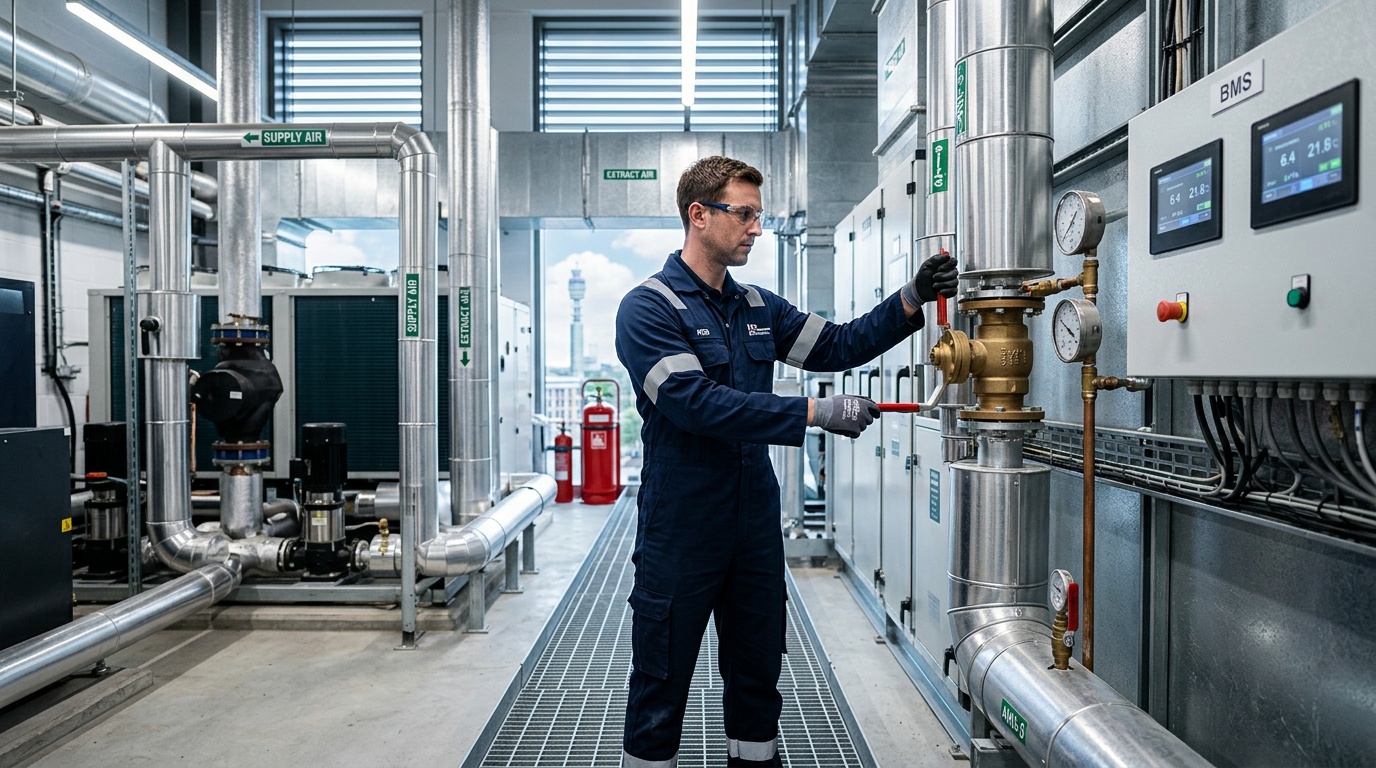
Good indoor air quality is managed through evidence. An assessment should consider contaminant levels, airflow, filtration, humidity, temperature, fan energy and control response across occupied zones and changing workloads. This gives businesses a basis for corrective work rather than treating every complaint as a reason to replace plant.
IAQ Metrics That Matter: CO2, PM2.5, VOCs, and Humidity Control
Carbon dioxide indicates ventilation adequacy in occupied areas. Rising CO2 may point to insufficient fresh air, restricted filters, poor distribution or controls that do not respond to occupancy. PM2.5 monitoring identifies fine particles from traffic, combustion, dust and indoor activities. Volatile organic compounds, or VOCs, may come from cleaning products, furnishings, adhesives and manufacturing processes.
Relative humidity also needs attention: excess moisture can support mould and condensation, while dry air can increase discomfort and static electricity. Engineers should review sensor location, calibration, trends and response settings. A single reading beside a supply grille does not represent the whole floor; measurements should reflect occupied spaces, extract points and pollution sources.
Filtration Strategies: From ISO 16890 to HEPA Upgrades
Filter selection must match the air-handling unit, fan duty, outdoor conditions and required particle control. ISO 16890 classifications, including ePM1, provide a basis for specifying filters against fine particulate matter. Research findings indicate that ISO 16890 ePM1-rated filters can capture more than 50% to 80% of fine combustion particles and airborne allergens.
Higher-grade filters can increase resistance. If the fan lacks reserve, airflow may fall while electrical demand, noise and motor wear rise. HEPA filtration may suit selected healthcare, laboratory or specialist production environments, but should follow airflow and pressure assessment. Dimensions, sealing, access and replacement intervals matter as much as filter media.
UV-C Germicidal Systems: A Complementary Solution
UV-C equipment can support air and surface hygiene within suitable air-handling units where coil cleanliness and microbial control need additional attention. It does not replace fresh air, filtration, ductwork hygiene or cleaning. Performance depends on lamp intensity, exposure time, surface condition, airflow velocity and positioning.
Installation requires safe access controls, lamp inspection, electrical checks and protection against direct exposure. Engineers should assess space, mounting points and interlocks; poor maintenance can add a component without meaningful benefit.
The Long-Term Benefits: Reduced Energy Spend, Improved Occupant Well-being, and Asset Protection
Air quality improvements should link to building performance. Clean filters and coils help maintain airflow without excess fan resistance. Correctly commissioned controls can prevent simultaneous heating and cooling, while MVHR can recover heat from extract air when heat exchangers, bypasses and fans operate correctly. These measures can reduce avoidable energy demand and protect motors, bearings, belts, coils and controls from excess load.
Occupants benefit from fewer stale-air complaints, stable temperatures and better control of dust and odours. Businesses gain a more usable workplace, clearer records and fewer disruptive failures. The right programme combines trend monitoring, planned inspections, responsive repairs and review of occupancy changes. For Birmingham facilities, this supports healthier air, controlled operating costs and longer asset life.
Practical verdict: choose air quality measures that can be measured, maintained and justified. Start with airflow and condition data, then specify filtration, UV-C, controls or refurbishment only where the building and existing equipment can support the decision.
Frequently Asked Questions
What should a Birmingham commercial ventilation service inspect first?
Top rated services for commercial air quality ventilation Birmingham? should begin with measured checks of airflow, pressure, filters, fans, coils, dampers and controls. MEMS assesses the complete HVAC asset, records defects and separates repairable faults from equipment that may need replacement, giving facility managers a prioritised action plan.
How can I tell if a commercial ventilation system is underperforming?
Commercial ventilation underperformance often shows through stale air, condensation near grilles, increased CO₂ readings, occupant complaints and rising energy bills. MEMS confirms the cause through airflow measurements, filter and duct inspections, static pressure checks, temperature readings and control reviews rather than relying on symptoms alone.
How often should commercial ductwork be inspected in Birmingham?
Commercial ductwork should generally receive a hygiene inspection every 12 to 24 months, with the interval shaped by occupancy, building use and contamination risk. BESA TR19 guidance supports closer attention for healthcare, hospitality, food production and high-occupancy premises where grease, dust or biological contaminants can accumulate.
What records should a commercial ventilation contractor provide?
A commercial ventilation contractor should provide measured airflow results, identified defects, compliance implications and clearly prioritised remedial recommendations. MEMS can assess supply and extract performance alongside filters, controls, plant condition and room use, helping facility managers maintain useful records for audits, landlords and compliance teams.
Can commercial ventilation problems be repaired without replacing the whole air handling unit?
Commercial ventilation problems can often be repaired without replacing the complete air handling unit, depending on the confirmed fault and equipment condition. MEMS checks components such as capacitors, fan motors, belts, bearings, actuators, filters and controls before preparing a transparent quotation for suitable remedial work.
Why should Birmingham businesses use commercial ventilation engineers instead of domestic contractors?
Birmingham businesses should use commercial ventilation engineers because larger estates require coordinated work across air handling units, extract fans, ductwork, fire dampers, controls and electrical components. MEMS also considers access planning, risk assessments, permits, operating hours, asset registers and documented priorities that domestic servicing may not cover.
How does ventilation affect commercial building compliance?
Commercial ventilation affects compliance by supporting suitable fresh-air provision, acceptable indoor conditions and documented maintenance decisions. MEMS compares measured supply and extract airflow with occupancy, room use, CO₂ trends, temperature, humidity and pressure, helping duty holders identify where layouts or operating patterns may require system adjustments.