Alternatives to full ventilation system replacement for shops?
A £40,000 to £50,000 ventilation quote can make a shop owner assume every fan, duct and air handling unit must be removed. That is not always sound engineering. The right Alternatives to full ventilation system replacement for shops? often begin with testing installed plant, identifying the actual failure, and separating serviceable equipment from items needing replacement.
Key Takeaways
- Start with a thorough inspection and diagnostic testing of your existing ventilation system to identify which components are truly failed and which can still perform.
- Many fans, dampers, and controls can be repaired or replaced individually rather than ripping out the entire ductwork and air handling unit.
- Upgrading only the electrical controls or adding a variable speed drive can restore performance and cut running costs without a full system replacement.
- Cleaning and reconditioning existing ductwork and grilles often solves airflow problems at a fraction of the cost of new installation.
- Bringing in a qualified engineer with diagnostic tools like manometers and thermal imaging pinpoints the real issue before you commit to any major spend.
I have spent more than 24 years working from plant rooms to boardrooms. I have seen poor airflow blamed on failed fans when the real fault was a blocked filter, leaking ductwork, undersized intake louvre or inadequate make-up air. A diagnostic-first approach can protect capital, reduce disruption and keep commercial premises compliant.
The Hidden Costs of Ignoring Ventilation: Why Full Replacement Isn't Always the Answer
The Shock of a £50,000 Quote: When “Replacement” Feels Like a Default
A large quotation is not proof that a complete strip-out is necessary. Before approving wholesale plant scrappage, request measured airflow, fan duty, static pressure, motor condition, electrical load and ductwork inspection results. The contractor should explain which component failed, which can be refurbished and how the proposed design meets occupancy requirements.
According to the research supplied for this guide, targeted plant refurbishment can involve 40% to 65% less capital expenditure than a full turnkey strip-out. That difference may fund other urgent works, preserve cash flow and avoid writing off usable equipment. The engineering question is not, “How old is the system?” It is, “Which part prevents safe, adequate airflow?”
Downtime and Disruption: The Real Commercial Impact of Major Works
Full replacement can require access towers, ceiling removal, electrical isolation, builders’ work, new penetrations and prolonged commissioning. In a shop, this may disrupt trading, staff operations, customer comfort and landlord relationships. Dust, noise and temporary closures carry costs rarely shown clearly on a mechanical quotation.
Leasehold restrictions may also apply. Cutting a new external louvre through a commercial façade can require landlord approval, planning review and coordination with neighbouring tenants. Reusing existing duct routes, risers and penetrations may be more practical if pressure drop, fire stopping, cleanliness and air volume are verified.
My 24 Years in Maintenance: Seeing the “Fix” vs. “Replace” Dilemma
I started as an apprentice combustion engineer, so I know the difference between plant failure and maintenance failure. A dirty filter can make a healthy fan appear ineffective. Belt-driven motors may run with poor tension, dampers may be stuck shut, and duct sections may contain years of settled contamination.
That is why MEMS begins with evidence. Our Commercial Ventilation Repair Services assess installed equipment before recommending replacement. The aim is to repair the fault properly, record readings and give the responsible person a defensible engineering decision.
The Goal: Compliant, Efficient Airflow Without Breaking the Bank
The objective is not to keep obsolete equipment alive indefinitely. It is to achieve compliant ventilation, acceptable indoor air quality, controlled energy use and dependable operation at sensible capital cost. Approved Document F, HSE workplace requirements, manufacturer data and relevant maintenance standards all need consideration.
Diagnostic-First Engineering: Auditing Your Existing Ventilation System
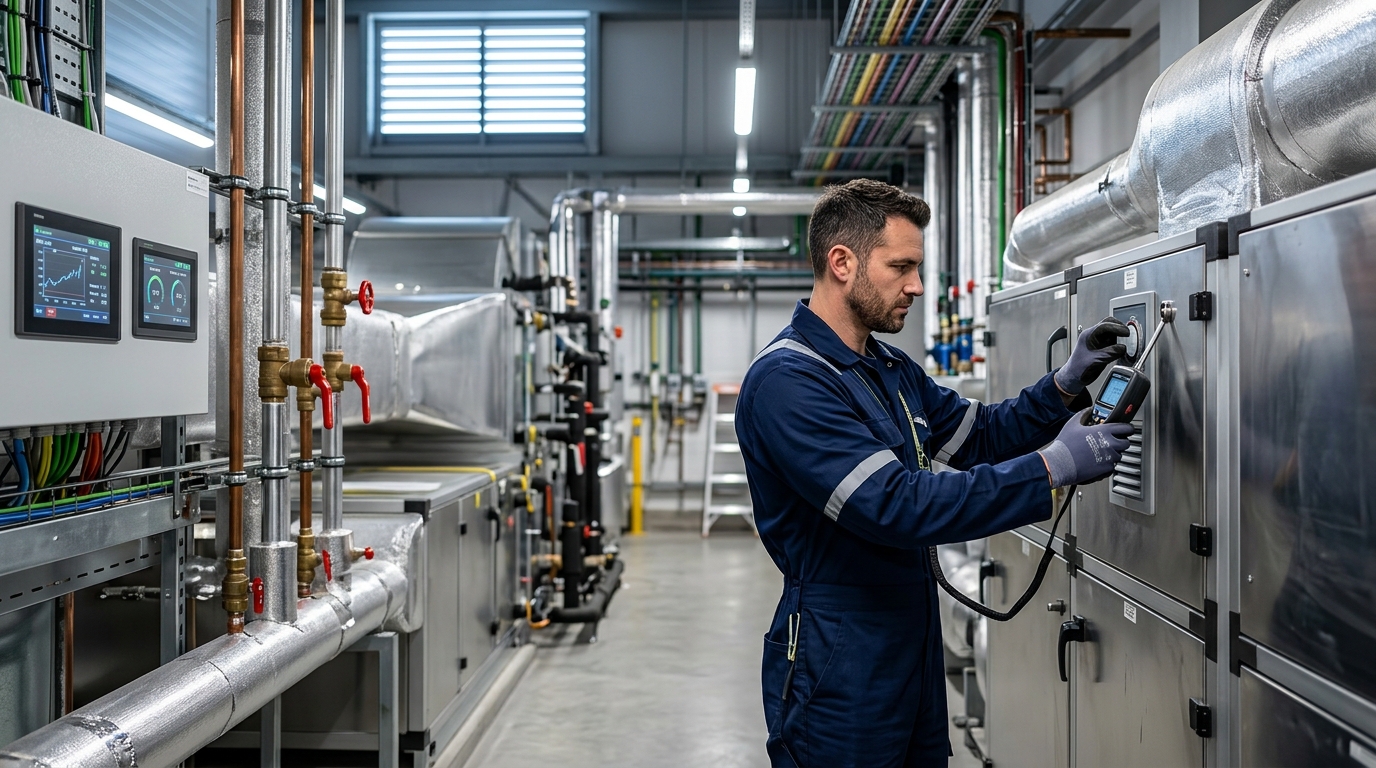
The “Why”: Understanding Airflow, Pressure, and Efficiency Metrics
Ventilation performance depends on more than fan rotation. Engineers need air volume in litres per second or CFM, fan static pressure, total system resistance, temperature, occupancy and operating hours. UK workplace guidance commonly uses an outdoor air supply rate of not less than 8 to 10 litres per second per person for commercial spaces; the final requirement depends on the premises, use and applicable guidance.
Static pressure shows how hard the fan works against filters, coils, grilles, dampers and duct friction. Low airflow with high pressure may indicate blockage or excessive resistance. Low pressure with poor delivery may indicate leakage, an open bypass or a fan unable to achieve design duty.
Step-by-Step: Conducting an On-Site Ventilation Audit
A useful survey starts with the asset register, design drawings and maintenance history, then compares those records with the installation. Inspect:
- Fan condition, rotation, bearings, belts, guards and vibration.
- Filters, coils, heat exchangers, condensate drainage and access panels.
- Fresh-air intake, discharge points, louvres, grilles and damper positions.
- Duct joints, flexible connections, insulation, fire dampers and visible contamination.
- Controls, sensors, time schedules, speed drives and fault history.
- Noise, draughts, odours, temperature variation and occupant complaints.
Measuring What Matters: Key Performance Indicators for Existing Plant
Request a written record of supply and extract airflow, outdoor-air volume, return-air temperature, pressure across filters, fan speed, motor amperage, electrical power, room carbon dioxide levels where relevant, and terminal air velocity. Measurements should cover representative grilles and diffusers, not only the fan.
These results show whether the problem is capacity, distribution or control. A fan achieving its duty while occupied areas receive little air may indicate balancing, damper position or duct leakage. An overloaded motor may indicate excessive resistance or a failing bearing. A sharp improvement after filter replacement identifies maintenance condition as part of the fault.
Analysing Motor Efficiency: When EC Fan Upgrades Make Sense
The research supplied for this guide states that upgrading an older belt-driven fan to a direct-drive EC fan can reduce air-handling electrical consumption by 30% to 50% without altering ductwork. Suitability still depends on fan duty, physical dimensions, controls, acoustic performance and available electrical supply.
Ductwork Integrity: Identifying Leaks, Blockages, and Aerodynamic Issues
Loose access panels, failed seals, crushed flexible duct, closed volume-control dampers and poorly sized transitions can waste fan pressure. Dirty internal surfaces add resistance and reduce velocity. Under BESA TR19 guidance, cleaning heavily contaminated internal duct surfaces can recover up to 15% to 20% of lost airflow velocity, subject to the system and contamination level.
When to Call in the Experts: Identifying the Need for Specialist Diagnostics
Use a specialist where drawings are missing, contractors give conflicting recommendations, airflow calculations cannot be produced, or the system affects kitchens, workshops, toilets, storage areas or fire safety. Testing may include pitot traverse readings, anemometer measurements, smoke testing, duct inspection, acoustic checks and controls interrogation.
Ask for the measured baseline, design duty, identified defects and corrective action. MEMS Commercial Ventilation Repair Services can determine whether repair, refurbishment or wider intervention is justified. This is the proper way to assess Alternatives to full ventilation system replacement for shops? before committing funds to demolition.
Targeted Retrofit & Refurbishment: Breathing New Life into Existing Plant
Refurbishing Air Handling Units (AHUs): Beyond Scrap-and-Replace
An air handling unit does not become worthless simply because it is old. Its casing, coils, dampers, access doors, heat exchanger and duct connections may remain serviceable while filters, belts, bearings, actuators, seals or controls deteriorate. A refurbishment schedule should record each component’s condition, replacement cost and expected service life. Coil cleaning, casing repairs, new gaskets, drain-pan treatment and controls renewal can restore performance without removing the complete unit.
The decision should consider fan duty, coil condition, corrosion, hygiene, access and available space. If the casing is sound and heat-transfer surfaces are recoverable, targeted work can protect the asset and reduce builders’ work. The supplied research indicates that targeted refurbishment typically incurs 40% to 65% less capital expenditure than a full turnkey strip-out.
EC Fan Retrofits: The Smart Upgrade for Motor Efficiency and Control
A direct-drive EC plug fan can replace an ageing belt-driven arrangement where the AHU casing, ductwork and electrical supply allow it. EC motors offer variable-speed control, accurate modulation and no belt tensioning or pulley alignment. The supplied research states that this upgrade can reduce air-handling electrical consumption by 30% to 50% without altering ductwork, depending on operating hours, duty point, controls and fan selection.
Request fan curves, airflow, static pressure, sound data, motor input and control compatibility. The retrofit must deliver required volume against system resistance, not merely show a higher free-air rating.
Ductwork Refurbishment: Cleaning, Sealing, and Acoustic Improvements
Replacing a complete duct network is rarely the first answer if its route, dimensions and fire protection remain suitable. Internal cleaning, joint resealing, insulation repair and replacement of crushed flexible sections can recover performance. BESA TR19 states that cleaning heavily contaminated internal duct surfaces can recover up to 15% to 20% of lost airflow velocity, subject to system condition and contamination.
Check leakage at access doors, flange joints, flexible connectors and branch take-offs. Acoustic lining, attenuators and vibration isolation can address rattling, fan noise and regenerated sound without relocating plant. Fire damper access, compartmentation, insulation continuity and cleanability must remain intact.
Filtration Upgrades: Improving Air Quality with HEPA and Carbon Filters
Filter selection must match the contaminant, airflow and available fan pressure. Higher-grade filters can improve particle capture, while activated carbon suits certain odours and gaseous contaminants. HEPA filtration may suit specific air-quality requirements but creates greater resistance than a standard panel filter. Installing it without checking static pressure can reduce supply volume and outdoor-air delivery.
Request filter classification, initial and final pressure drop, replacement interval and access arrangements. Filtration does not replace source extraction, fresh-air provision or duct hygiene.
Optimising Make-Up Air: Stabilising Pressure and Improving Distribution
Extracting air without replacing it creates negative pressure. Doors become difficult to open, draughts increase, odours migrate from toilets or kitchens, and extract fans operate away from design duty. An undersized intake louvre, blocked pre-filter or poorly positioned fresh-air opening can make healthy machinery appear defective. Check outdoor-air volume, intake free area, damper position, pressure differential and supply-to-extract balance.
Make-up air should support the occupied zone rather than short-circuiting to an extract grille. Required outdoor-air rate must reflect occupancy, use and applicable UK guidance. Cleaning louvres, adjusting intake geometry or adding controlled supply capacity may correct distribution without cutting a new façade opening.
Balancing and Commissioning: Fine-Tuning Performance with Damper Adjustments
Even a correctly selected fan can perform poorly if branch dampers are not balanced. Commissioning measures each terminal, sets volume-control dampers, checks supply and extract totals, confirms fan speed and records room pressure. Readings should cover representative grilles and diffusers, with design values shown beside measured results.
Retrofit decision points
Pros
- Preserves serviceable plant and existing penetrations.
- Reduces demolition, ceiling access and trading disruption.
- Allows energy, filtration and control upgrades in stages.
Cons
- Limited by casing condition, available pressure and access.
- Older components may require planned replacement later.
- Commissioning remains necessary after every major change.
MEMS Commercial Ventilation Repair Services provide the measured route between a minor service and complete replacement. Engineers can test the plant, identify the failed element and specify repair or retrofit supporting safe airflow and dependable operation.
Decentralised and Spot-Extraction Solutions: Modular Approaches for Complex Needs
Decentralised Mechanical Ventilation with Heat Recovery (dMVHR): Zonal Control
dMVHR units serve individual rooms or defined zones, supplying filtered outdoor air and extracting stale air through a local heat exchanger. This can suit shops with separate offices, staff rooms, treatment spaces or rear work areas where central ductwork is impractical. Zonal control allows operating hours and ventilation rates to follow occupancy.
Local Exhaust Ventilation (LEV): Point-of-Source Extraction for Specific Tasks
LEV captures fumes, dust, vapour or heat at source before contaminants spread. It may suit a repair bench, preparation counter, soldering point, printing process or workshop task. Hood design, capture velocity, duct resistance, discharge position and make-up air require assessment. A general room fan is not a substitute for source capture.
Supplementary Exhaust and Inline Fans: Targeted Air Movement
Inline fans can correct a weak branch, improve toilet extract or support a defined back-of-house area where the main system remains adequate elsewhere. They need access, non-return protection, acoustic treatment and electrical isolation. Adding one without checking pressure relationships can draw conditioned air from the sales floor or odours from neighbouring spaces.
Ambient Filtration and Scrubbing Units: Addressing Specific Air Purity Concerns
Portable or fixed ambient filtration units can reduce airborne particles in a local zone where new ductwork is impractical. Air-scrubbing equipment may support dust or odour control, but does not provide outdoor air or remove the need for source extraction. Check clean-air delivery, filter loading, noise, maintenance access and the target contaminant.
Considerations for Leasehold Properties and Tenant Agreements
Leaseholders should review permitted alterations, landlord approvals, roof access, façade restrictions, electrical capacity and reinstatement obligations. A new louvre may affect planning, appearance, fire separation or neighbouring premises. Internal dMVHR, existing riser reuse or local exhaust may reduce approval risk, though written consent may still be required.
When dMVHR or LEV Outshine Centralised Systems
| Requirement | Suitable modular route | Engineering check |
|---|---|---|
| Separate office or staff zone | dMVHR | Occupancy, heat recovery, noise and maintenance access |
| Dust, fumes or vapour at one task | LEV | Capture velocity, hood design and discharge safety |
| Weak branch or toilet extract | Inline fan | Static pressure, backflow and acoustic control |
| Local particle concern | Ambient filtration | Filter rating, airflow and replacement cost |
These options provide practical Alternatives to full ventilation system replacement for shops? where central plant is partly serviceable or new external penetrations are unsuitable. MEMS Commercial Ventilation Repair Services can assess compatibility with existing airflow strategy, controls and lease conditions.
Making an Informed Decision: A Framework for Cost-Effective Ventilation Solutions
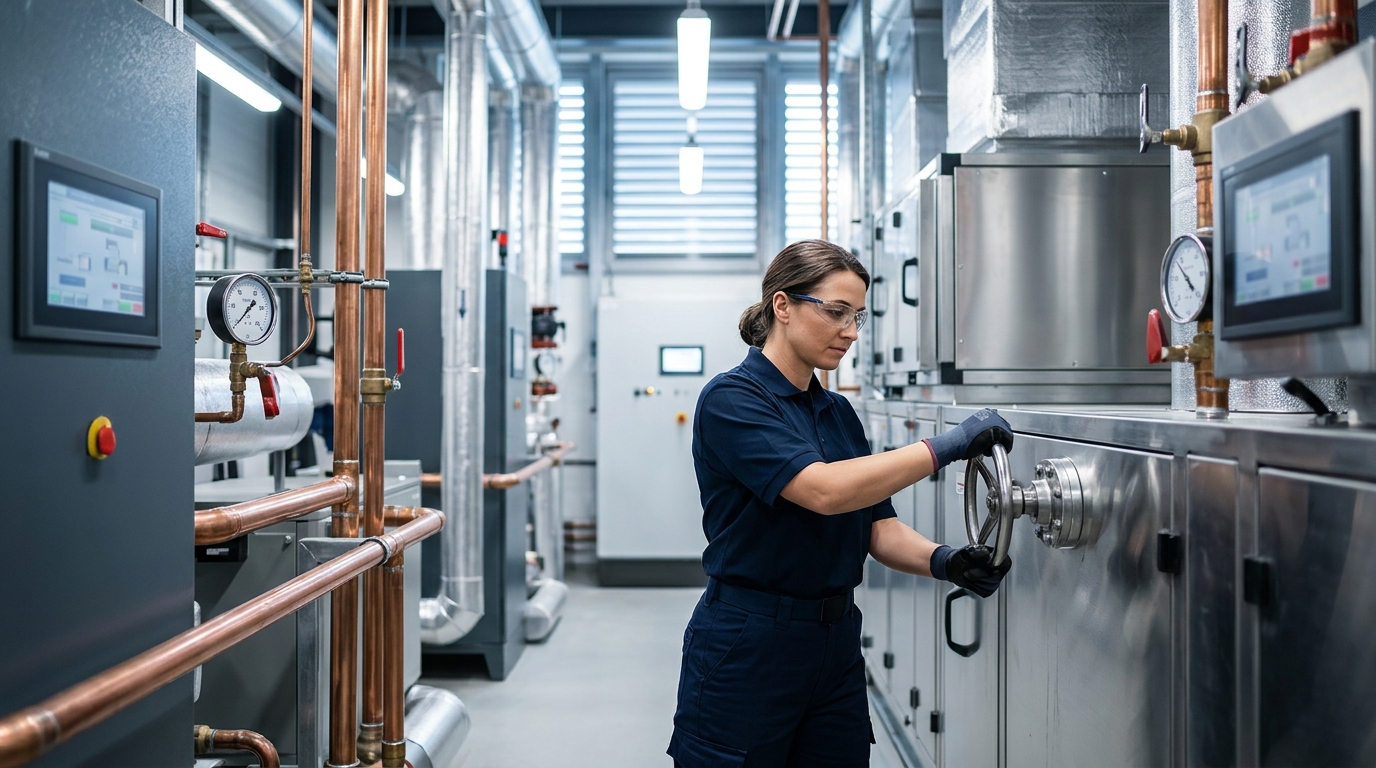
The right decision should follow measured evidence, not quotation size. The best Alternatives to full ventilation system replacement for shops? depend on the condition of the air handling unit, ductwork, controls, electrical demand, fire precautions and lease restrictions. A responsible recommendation should show existing duty, required duty, identified shortfall and proposed corrective work.
The Engineering Decision Matrix: Comparing Full Strip-Out vs. Modular Interventions
Use a full strip-out where existing equipment cannot safely deliver required airflow, or corrosion, hygiene, structural damage and obsolete controls make refurbishment uneconomic. Modular intervention suits serviceable casing, duct routes, penetrations or terminals. Record airflow in litres per second or CFM, static pressure, fan input, occupancy demand and system resistance.
| Decision factor | Modular intervention | Full replacement |
|---|---|---|
| Existing plant condition | Serviceable casing, ductwork or controls with identifiable defects | Unsafe, corroded or structurally failed equipment |
| Building disruption | Limited access works and phased installation | Demolition, isolation, builders’ work and extended commissioning |
| Capital planning | Staged expenditure linked to measured priorities | Large initial outlay with wider design responsibility |
| Leasehold suitability | Can often reuse existing openings and routes | May require façade, roof or structural approvals |
Cost-Benefit Analysis: Long-Term Savings from Retrofits vs. Initial Replacement Outlay
Compare installation price, lost trading hours, ceiling reinstatement, temporary ventilation, electrical upgrades, access equipment, disposal, commissioning and future maintenance. The supplied research indicates that targeted refurbishment costs 40% to 65% less in capital expenditure than a full turnkey strip-out. It also states that a suitable EC fan conversion may reduce air-handling electrical consumption by 30% to 50% when fan duty and controls support that outcome.
Compliance Checklist: Meeting UK Building Regulations and Workplace Standards
Confirm that the design and records address:
- Approved Document F requirements for ventilation and indoor air quality.
- HSE workplace expectations for fresh air, temperature and contaminant control.
- Outdoor-air provision appropriate to occupancy, with commonly referenced rates of 8 to 10 litres per second per person for commercial spaces.
- Fire dampers, compartmentation, access panels, electrical isolation and safe discharge.
- BESA TR19 inspection and cleaning requirements where duct contamination is present.
- Commissioning records, airflow readings, control settings and maintenance instructions.
Protecting Your Assets: The Role of Planned Preventative Maintenance Moving Forward
A retrofit retains its value only with structured care. A ventilation PPM schedule should cover filter changes, fan bearings, belts, EC motor alarms, coils, dampers, sensors, grilles, duct condition and control sequences. Trend energy use and airflow readings. Gradual performance loss gives facilities teams time to correct contamination or mechanical wear before poor air quality or emergency closure occurs.
Partnering for Performance: How to Select the Right M&E Provider
Choose an M&E provider that shows its working. Request a site survey, asset register, design assumptions, measured readings, fan curves, pressure calculations, compliance implications and clear exclusions. The engineer should distinguish a failed component from an undersized system and explain effects on noise, energy, access and future servicing.
Commercial Ventilation Repair Services from MEMS follow that evidence-led process. We inspect installed plant, identify practical repair opportunities and provide a route for compliant operation. Commercial Ventilation Repair Services can also form part of an ongoing PPM and response plan.
Final Thoughts: Ensuring a Healthy, Compliant, and Efficient Shop Environment
Do not approve demolition until the existing system has been tested. Where plant can be salvaged, controlled retrofit can protect cash flow, reduce downtime and preserve useful building infrastructure. Where replacement is justified, measured data will produce a better specification and defensible budget. Speak to MEMS today for Alternatives to full ventilation system replacement for shops? and CLICK TO CALL US NOW for engineering support across Birmingham, the West Midlands and the UK.
Frequently Asked Questions
What is the most affordable way to ventilate a shop?
The most affordable way to ventilate a shop is usually to test and repair the existing system before considering full replacement. Cleaning or replacing dirty filters, repairing duct leaks, freeing dampers, balancing terminals and correcting controls can restore airflow at lower cost, provided measured performance meets occupancy and compliance requirements.
How do I ventilate my shop without replacing the whole system?
A shop can often be ventilated without full replacement by refurbishing serviceable fans, repairing ductwork and improving controls or make-up air. A competent survey should record supply and extract airflow, pressure, outdoor-air volume, carbon dioxide where relevant and electrical demand before any repair or retrofit is approved.
What are the four types of ventilation systems for a shop?
The four common ventilation system types are natural, mechanical extract, mechanical supply and balanced mechanical ventilation with heat recovery. Shop owners should select based on occupancy, layout, outdoor-air requirements, available duct routes, energy use and permissions, rather than choosing a system type by price alone.
What are the four types of mechanical ventilation?
The four main types of mechanical ventilation are extract-only, supply-only, balanced supply and extract, and demand-controlled ventilation. Existing shops may need only a fan upgrade, control adjustment, duct repair or improved intake, provided testing confirms that the revised installation delivers suitable airflow throughout occupied areas.
What are the seven essential types of ventilation systems?
Seven useful ventilation categories are natural ventilation, mechanical extract, mechanical supply, balanced ventilation, heat-recovery ventilation, demand-controlled ventilation and local exhaust ventilation. For a shop, the correct choice depends on air volume, occupancy, contaminants, pressure requirements and whether existing plant and ductwork can be retained safely.
Can shop ventilation fans be repaired instead of replaced?
Shop ventilation fans can often be repaired or refurbished instead of replaced when the motor, bearings, belts, controls and casing remain serviceable. Airflow and static-pressure readings should confirm the fan can meet its duty, while vibration, electrical load, noise and operating reliability should be checked before approval.
How can I reduce the cost of a shop ventilation upgrade?
Shop ventilation upgrade costs can be reduced by retaining suitable duct routes, risers, grilles, penetrations and air-handling equipment. A staged plan may address filters, dampers, controls, duct leakage, fan motors and balancing first, while replacing only failed or unsuitable components that prevent compliant airflow.