Best for energy-efficient ventilation upgrades commercial?
A blocked filter, overworked extract fan or poorly balanced fresh-air intake can raise energy bills while staff complain that rooms feel stuffy. Best for energy-efficient ventilation upgrades commercial? The answer is not automatically the newest fan or air handling unit. It is the upgrade matched to occupancy, heat loads, ductwork condition, pressure requirements and the building’s operating pattern.
Key Takeaways
- Start with a full audit of occupancy, heat loads, ductwork condition and operating hours before choosing any ventilation upgrade, because the wrong fan or air handling unit wastes money.
- A blocked filter or unbalanced fresh-air intake can quietly drive up energy bills and make rooms feel stuffy, so fix those basics before spending on new equipment.
- Match the upgrade to the building’s actual usage pattern, not the manufacturer’s brochure, to avoid oversizing and unnecessary running costs.
- Pressure requirements and existing ductwork condition often decide whether a simple fan swap or a full air handling unit retrofit gives the best return on investment.
I have spent more than 24 years working from plant rooms to boardrooms, and the same fault appears repeatedly: equipment is specified before the building’s actual airflow requirement is established. A proper retrofit starts with measurement, calculation and compliance. Only then can a facility manager assess whether heat recovery, demand control or fan-speed modulation will provide a sensible return.
The Commercial Reality: Why Ventilation Upgrades Are More Than Just Airflow
The most suitable commercial ventilation upgrade depends on the existing system and building use. Variable speed drives can reduce fan demand where airflow varies. Demand-Controlled Ventilation can reduce unnecessary fresh-air volumes in intermittently occupied areas. Mechanical ventilation with heat recovery can reduce heating losses where extract and supply air paths are suitable. None should be selected from a catalogue alone.
Ventilation accounts for approximately 30% of heat loss in commercial buildings, according to the Carbon Trust. The loss includes electricity used by fans and the energy needed to heat incoming outside air. Poorly sealed ductwork can also make fans work harder to achieve terminal airflow. Research indicates that leakage in ageing commercial duct systems frequently represents 15% to 25% of fan energy loss. A new motor cannot correct a leaking distribution system.
Excessive extraction can pull heated air from occupied areas, causing cold spots and draughts. Insufficient make-up air can create negative pressure, door slamming and difficulty opening access doors. A static vent operating alongside mechanical extract can create an uncontrolled airflow path. Occupants experience poor indoor air quality while the facility team sees rising utility consumption and repeated complaints.
Engineering the Solution: A Deep Explore Energy-Efficient Ventilation Retrofits
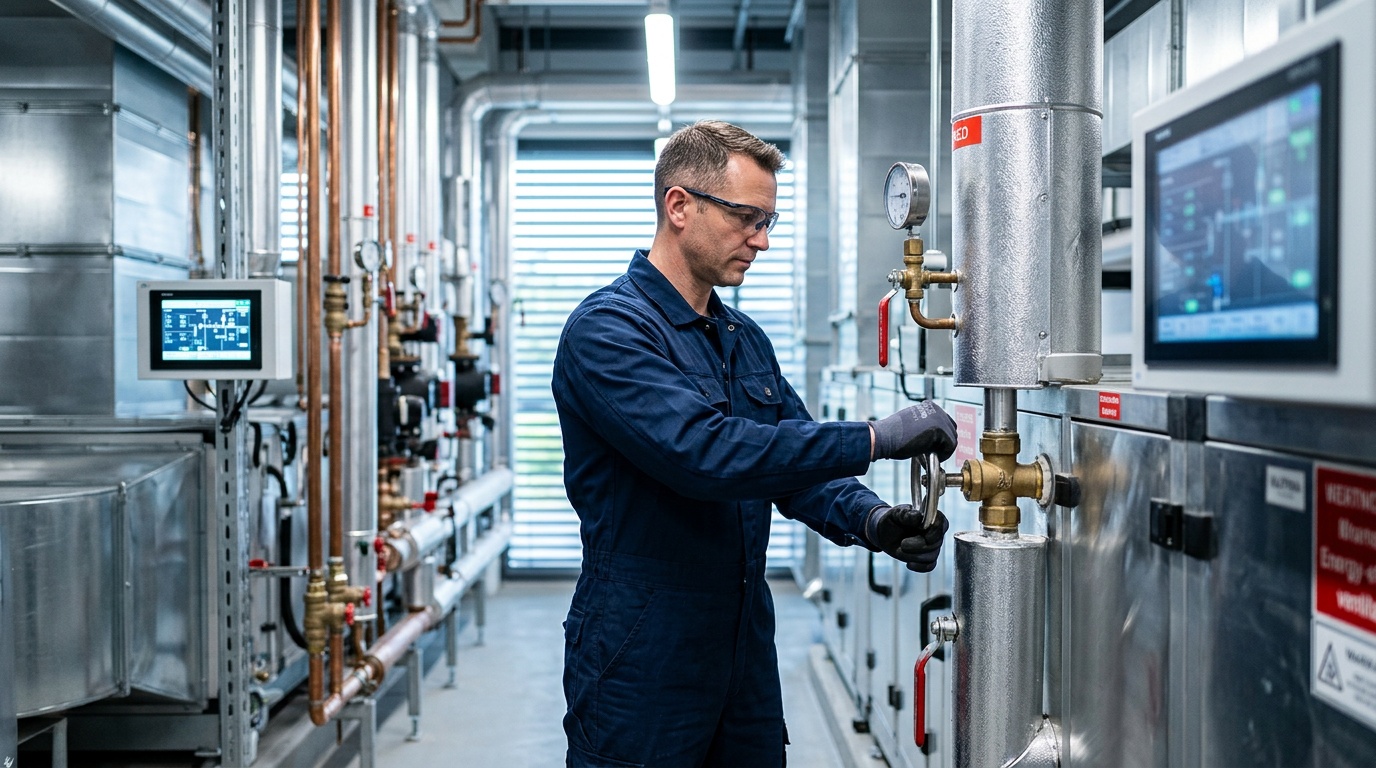
There is no single answer to Best for energy-efficient ventilation upgrades commercial? The right choice comes from a calculated design. CIBSE Guide B2 addresses ventilation and ductwork principles, while CIBSE Guide F covers energy efficiency. Building Regulations Part F concerns ventilation provision and indoor air quality, and Part L addresses energy performance. These references form the design baseline, alongside a site survey, commissioning plan and measured results.
The first task is to establish the duty point. Engineers should record required air changes, occupancy, carbon dioxide trends, room temperature, pressure relationships, filter condition and fan performance. They should inspect intake and discharge positions, fire dampers, attenuators, grilles and maintenance access. An undersized duct or restricted grille can create high static pressure, so a larger fan may increase noise and energy use without correcting the restriction.
| Upgrade | Engineering principle | Best application | Key checks before specification |
|---|---|---|---|
| Demand-Controlled Ventilation | Modulates outdoor-air volume using occupancy, carbon dioxide or other demand signals. | Offices, meeting rooms, training areas and other spaces with variable occupancy. | Sensor location, minimum fresh-air rate, actuator response, control integration and safe failure position. |
| Variable Speed Drive retrofit | Adjusts motor speed to match the required airflow rather than running continuously at full output. | Air handling units and extract systems with changing loads or operating schedules. | Motor compatibility, minimum speed, fan duty, bearing condition, harmonics, bypass provision and control signal. |
| Mechanical Ventilation with Heat Recovery | Transfers heat between outgoing and incoming air while keeping the air streams separate. | Buildings with balanced supply and extract, substantial heating demand and suitable plant space. | Heat exchanger condition, frost protection, condensate drainage, filter access, bypass control and cross-contamination risk. |
| High-efficiency fan and motor replacement | Improves motor and impeller efficiency at the calculated duty point. | Ageing fans with poor efficiency, frequent failures or unsuitable operating characteristics. | Actual system resistance, impeller selection, acoustic output, electrical load and commissioning data. |
Demand-Controlled Ventilation suits spaces where occupancy changes during the day. Sensors can reduce outside-air volume during quiet periods, lowering fan power and the heating or cooling load from incoming air. Research indicates that DCV can reduce ventilation energy use by 20% to 40% in spaces with variable occupancy. Savings depend on sensor placement, minimum ventilation settings and a control sequence that maintains conditions during low demand.
Variable speed drives work through the fan affinity laws. Fan power changes sharply with speed, so a modest reduction can produce a substantial electrical saving. Reducing motor speed by 20% can reduce fan power consumption by up to 50%, according to the stated fan affinity relationship. This is not a guaranteed site saving: the fan must operate at the reduced duty, and the building must not require full airflow throughout occupied hours. Payback should use measured running hours, motor demand, tariff data and the control profile.
Heat recovery provides another route. An MVHR system transfers heat from extracted air to incoming air, reducing the load on boilers or heating coils. It requires balanced air paths and access for filter changes, cleaning and inspection. The heat exchanger must suit the required airflow, with frost protection, condensate management and air-quality controls. If extract air contains contaminants, the exchanger and pressure arrangement must prevent unacceptable transfer into the supply stream.
Retrofit strengths and limitations
Pros
- Controls can match ventilation output to actual occupancy.
- Fan-speed modulation can reduce electrical demand during part-load operation.
- Heat recovery can reduce the heating load associated with fresh air.
- Measured airflow and pressure data support a defensible business case.
Cons
- Old ductwork may restrict the saving through leakage or excessive resistance.
- Poor sensor positioning can cause under-ventilation or unnecessary fan operation.
- Some motors, drives and control panels are not compatible without further electrical work.
- Heat recovery needs space, drainage, frost protection and a planned maintenance regime.
Fresh-air intake must balance exhaust air because the building is part of the ventilation system. If extract exceeds supply, uncontrolled air enters through doors, service penetrations and envelope gaps. If supply exceeds extract, warm or conditioned air is pushed into unintended routes. Room pressure measurements, terminal readings and commissioning records should confirm that the system performs as designed.
For Birmingham facilities needing correctly specified plant or remedial works, the Commercial HVAC Installation and Heating Service provides commercial HVAC installation and heating system repairs around Birmingham. The Commercial HVAC Installation and Heating Service is delivered by trained and licensed specialists who are also insured, with safety standards strictly followed during heating service and repair. The best energy-efficient ventilation upgrades commercial sites can fund still depend on correct calculations, compatible controls and documented commissioning.
Beyond the Basics: Essential Balancing and Ductwork Integrity for Optimal Performance
Best for energy-efficient ventilation upgrades commercial? Before approving equipment changes, inspect the air distribution system. A correctly selected fan cannot overcome leaking joints, crushed flexible duct, blocked filters, undersized branches or poorly adjusted grilles. These faults alter the duty point, increase static pressure and leave some rooms over-ventilated while others remain stuffy. Door slamming, draughts, uneven temperatures, noise and rising carbon dioxide can follow.
Fresh-air supply and extract must be assessed as a connected system. If extract exceeds incoming air, the building can fall under negative pressure and pull untreated air through doors and gaps. Excessive supply can create positive pressure and force conditioned air into neighbouring zones or leakage paths. Active mechanical extract should also be reviewed alongside static vents. Operating both without a defined control strategy can waste heating energy and weaken room pressure control.
Balancing is a measured engineering task, not a visual adjustment at the grille. A commissioning engineer should record airflow at each terminal, compare supply and extract totals, check room pressure relationships and confirm that dampers, fire dampers and control valves operate correctly. Where ductwork is contaminated, damaged or leaking, sealing and cleaning may provide more value than installing a larger fan. The Carbon Trust identifies ventilation as approximately 30% of heat loss in commercial buildings, so uncontrolled air movement carries a direct heating penalty.
These checks support Building Regulations Part F for ventilation and indoor air quality, alongside Part L requirements for energy performance. CIBSE Guide B2 provides guidance on ventilation and ductwork, while CIBSE Guide F addresses energy efficiency. SFG20 maintenance tasks provide a schedule for filters, fans, belts, dampers, sensors and heat-recovery components. Compliance depends on evidence that the system delivers its intended airflow safely during normal operation.
For sites requiring remedial work, the Commercial HVAC Installation and Heating Service can assess associated heating, controls and duct optimisation around Birmingham. The Commercial HVAC Installation and Heating Service is delivered by trained and licensed specialists who are also insured, with safety standards strictly followed during heating service and repair. A retrofit only performs commercially when air reaches the rooms that need it, at the pressure and volume established by calculation.
The Facility Manager's Checklist: Ensuring Your Ventilation Upgrade Delivers
A ventilation retrofit should be judged by measured performance, not the appearance of new equipment in the plant room. Establish the existing system condition, occupancy pattern and operating cost before approving work. Request a written design basis showing calculated airflow, fan duty, pressure requirements, control sequences and expected running hours. If those figures cannot be explained, the proposal is not ready for approval.
- Survey the existing installation: record fan condition, motor ratings, filters, grilles, duct routes, access panels, dampers and control equipment.
- Confirm the duty: compare design airflow with readings from occupied rooms, return paths and extract terminals.
- Check the building use: identify meeting rooms, intermittent occupancy, extended hours, heat-producing equipment and changing demand.
- Review pressure: investigate door movement, draughts, odours and air transfer between zones before selecting equipment.
- Protect maintainability: require safe access for filter changes, fan inspection, sensor calibration, cleaning and future repairs.
- Demand evidence: obtain commissioning sheets, electrical readings, airflow measurements, control settings and compliance documentation.
Ask potential contractors who will calculate airflow, how duct resistance will be verified and which measurements will prove the promised result. Ask how mechanical extract will interact with static vents, what happens during sensor failure and how minimum fresh-air provision will be maintained. A quality installer should explain the proposal in engineering terms rather than offer a generic equipment schedule.
Questions that protect the project
- Which requirements from Building Regulations Part F and Part L apply to this retrofit?
- How will the design address CIBSE Guide B2, CIBSE Guide F and the building’s existing ductwork?
- What baseline readings will be taken before work begins?
- How will energy performance be reviewed after commissioning?
- Which maintenance tasks will be added to the SFG20 schedule?
- Who owns the commissioning records, control drawings and handover information?
A properly managed installation has a traceable handover. You should receive marked-up drawings, operating instructions, asset details, test results and a maintenance plan. Keep these records with the building’s compliance file. They help the next engineer diagnose faults quickly and identify energy drift before it becomes costly.
The MEMS Standard: Reliable, Compliant, and Cost-Effective Ventilation
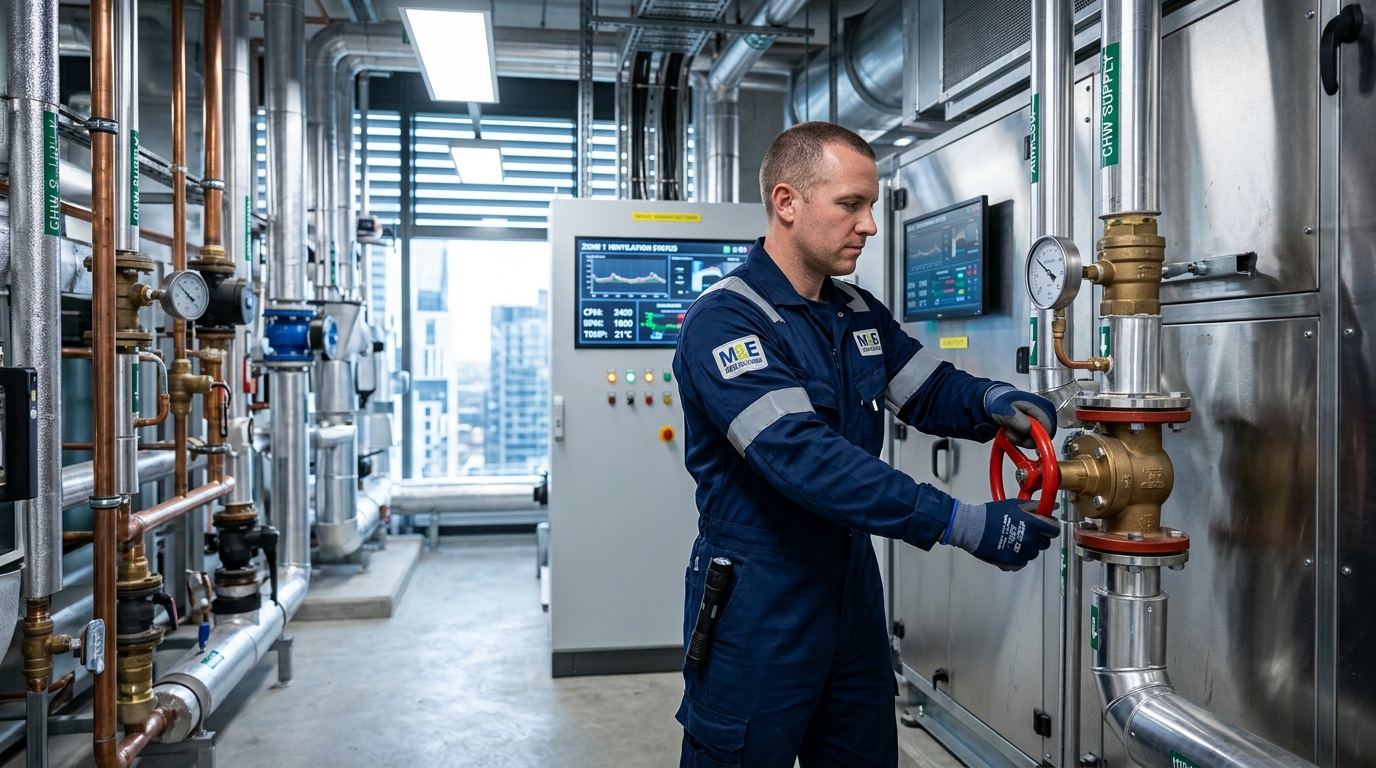
Ventilation performance affects business continuity. Correct airflow supports occupant comfort, indoor air quality and room pressure, while sound controls reduce needless fan and heating demand. The dependable route is an engineering-led retrofit based on survey data, calculation, installation, balancing and documented commissioning.
At MEMS, we apply the same practical standard across commercial facilities in Birmingham, the West Midlands and across the UK: diagnose the cause, specify the correct duty, complete the work safely and leave a clear service trail. Our trained and licensed specialists are insured, and safety standards are strictly followed during heating service and repair. Ongoing planned maintenance protects the original efficiency gains.
CLICK TO CALL US NOW for practical support from a commercial maintenance partner available 24 hours a day for emergency heating repairs.
Frequently Asked Questions
What is the most efficient commercial heating system?
The most efficient commercial heating system is the one matched to the building’s heat demand, occupancy and operating pattern. Efficient ventilation also matters because uncontrolled fresh-air losses can increase heating demand. A site survey, heat-load calculation and review of controls should come before selecting equipment or planning a retrofit.
How can I make my commercial HVAC system more energy efficient?
Commercial HVAC systems become more energy efficient through measured airflow, improved controls, suitable fan speeds and regular inspection of filters, ductwork and heat exchangers. Variable speed drives can reduce fan electricity where demand changes, while demand-controlled ventilation can reduce unnecessary outdoor-air heating in intermittently occupied rooms.
What are some energy-efficient HVAC systems for commercial buildings?
Energy-efficient HVAC options for commercial buildings include demand-controlled ventilation, variable speed fan drives, mechanical ventilation with heat recovery and high-efficiency fan and motor replacements. The right option depends on duct resistance, pressure requirements, occupancy, heating demand, available plant space and the condition of the existing system.
What are some effective energy-saving strategies for commercial buildings?
Effective energy-saving strategies for commercial buildings include correcting duct leakage, balancing supply and extract airflow, reducing excessive extraction and setting controls around actual occupancy. Engineers should also check filters, grilles, dampers and fan duty, since restricted airflow can increase energy use without improving indoor air quality.
What are the best energy management systems for commercial buildings?
The best energy management systems for commercial buildings combine occupancy or carbon dioxide sensors, temperature monitoring, pressure control and timed HVAC operation. A building management system can coordinate ventilation, heating and cooling, while measured commissioning data confirms that control settings deliver the required airflow and indoor conditions.
Can heat recovery reduce commercial ventilation costs?
Mechanical ventilation with heat recovery can reduce commercial ventilation costs by transferring heat from extracted air to incoming outdoor air. Suitability depends on balanced supply and extract routes, heating demand, heat exchanger condition, frost protection, condensate drainage, filter access and the risk of cross-contamination.