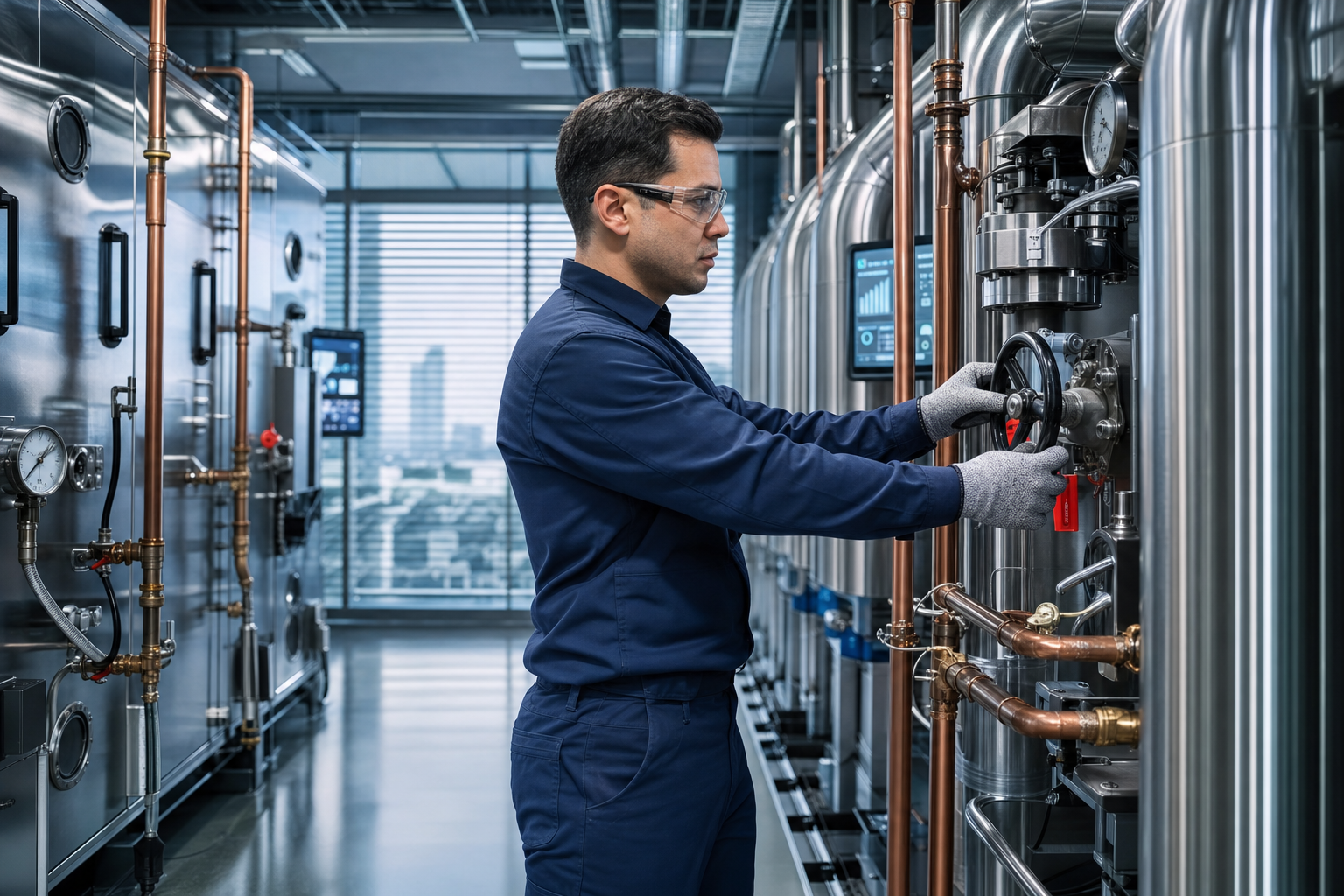
biomedical science building
A biomedical science building can lose research time before anyone sees a visible fault. A drifting temperature sensor, failed extract fan or poorly balanced air-handling unit can affect containment, sample integrity and staff safety within hours. From my experience in commercial engineering, the plant room is part of the scientific process.
Estate managers need an engineering plan connecting laboratory performance with compliance, energy cost and business continuity. This guide covers the systems hidden above ceilings, inside risers and beneath plantroom floors.
The Unseen Engine: Engineering a Biomedical Science Building
Beyond the Lab Bench: What Estate Managers Need to Know
Researchers depend on stable conditions, but they do not always see the equipment maintaining them. Air temperature, relative humidity, pressure relationships, filtered supply air, drainage, electrical distribution and emergency systems must operate together. A fault in one service can increase demand on another, creating a chain of problems.
Laboratory maintenance needs a different response model from office maintenance. Planned inspections should include air-handling units, coils, filters, valves, sensors, fan motors, control panels and extract systems. Work may take place around live experiments, restricted areas, biological material and controlled operating windows. Building Fabric Repairs & Maintenance supports the surrounding estate by addressing partitions, ceilings, glazing, drainage and other fabric defects that can undermine controlled spaces or delay engineering access.
The High-Stakes Environment: Defining Biomedical Facilities
These facilities may contain wet laboratories, tissue culture rooms, imaging suites, animal research areas, autoclaves, cold storage and specialist clean zones. Each space has its own environmental brief. Some require directional airflow to contain hazards; others need close temperature and humidity control for equipment or experimental repeatability.
UK operations must be planned around applicable guidance, including COSHH duties, Health and Safety Executive biosafety guidance and relevant Advisory Committee on Dangerous Pathogens principles. Controls depend on the work undertaken, biological agents present and containment level. Engineering records should align with risk assessments, room classifications, commissioning data and scheduled testing.
Key Infrastructure Categories: MEP Essentials
The mechanical, electrical and public health services form the working platform for research. Core categories include:
- Mechanical: air-handling units, chilled water, heating, ventilation, extract fans, filtration and building management controls.
- Electrical: normal distribution, emergency lighting, standby generation, UPS systems and protected supplies for laboratory equipment.
- Public health: drainage, specialist water, piped gases, vacuum services, safety showers and equipment connections.
- Containment support: fume cupboards, microbiological safety cabinets, pressure monitoring, interlocks and alarm systems.
- Building fabric: sealed partitions, hygienic finishes, access panels, doors, ceilings and fire-stopping.
Precision Environments: Ventilation, Containment, and Airflow
Understanding Air Exchange Rates and HVAC Load
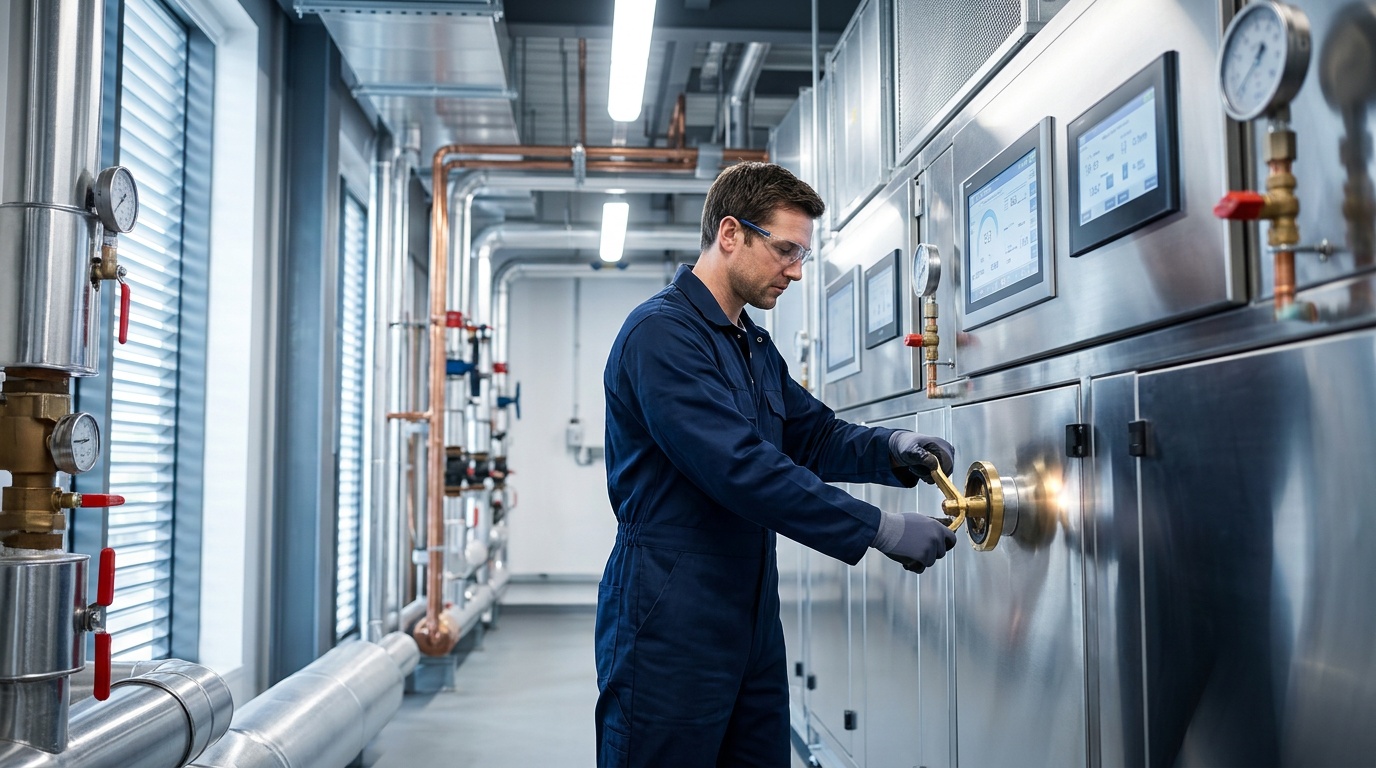
Air changes per hour, or ACH, describe how often room air is replaced. Research laboratories commonly operate within 6 to 12 ACH, depending on containment classification, occupancy, equipment heat output and risk assessment. This is not a universal setting; it must be confirmed through design criteria, commissioning information and monitoring.
Higher air movement increases fan energy and heating or cooling demand. A room with freezers, incubators and analysers may need substantial cooling even with low occupancy. An inaccurate sensor or stuck damper can make the system run harder while failing to hold temperature or humidity. CIBSE and ASHRAE laboratory HVAC criteria provide useful reference points, but site-specific testing remains essential.
Pressure Differentials: Maintaining Biosafety Levels from BSL-1 to BSL-3
Pressure differentials control air direction. A containment room is generally maintained at lower pressure than adjacent areas, so air travels into the room rather than escaping. The arrangement depends on the activity and risk assessment. BSL-1 work has limited containment demands, while BSL-2 and BSL-3 environments require progressively tighter controls, access procedures, monitoring and engineering verification.
Pressure control depends on balanced supply and extract volumes, reliable fans, functioning dampers, sealed doors and accurate sensors. A failed extract motor can change the relationship immediately. Alarms need clear visibility, escalation procedures and documented corrective action. Testing should cover normal operation and a simulated fault.
Fume Hoods, Biosafety Cabinets, and Exhaust Systems: Operational Integrity
Fume cupboards and microbiological safety cabinets are not interchangeable. A fume cupboard protects the operator by capturing hazardous vapours or aerosols at the work face. A biosafety cabinet is designed around biological containment and may also protect the product, depending on its class. Performance relies on airflow velocity, filtration, extract capacity, alarms, sash position and correct user behaviour.
Maintenance should include visual checks, fan and belt inspections, filter condition, airflow measurement, alarm tests and certification by competent personnel. Extract discharge locations also need review where air could return through supply intakes or enter occupied areas. A failed fan can stop a procedure, close a room and disrupt scheduled research.
The Energy Drain: Why 100% Outside Air is Costly and How to Mitigate It
Many laboratory systems use 100% outside air because recirculation may be unsuitable for contamination control. That air must be heated in winter, cooled and dehumidified in warmer conditions, then exhausted. Research laboratories typically consume 5 to 10 times more energy per square metre than standard offices, while HVAC and ventilation can account for 50% to 70% of total energy use. The University of Michigan’s facility information for its research estate illustrates the scale and specialist nature of these environments.
Energy reduction must not compromise containment. Measures include variable speed drives where the risk assessment permits them, demand-based control in suitable spaces, occupancy scheduling, heat recovery designed for the exhaust risk, low-pressure-drop filtration and regular coil and filter cleaning. Controls should be commissioned rather than left at factory settings. A maintained system can reduce wasted output while preserving room pressure, airflow and research conditions.
How do ventilation systems protect laboratory safety? They manage air movement, temperature, humidity and pressure so contaminants are directed away from occupied areas and controlled exhaust points. The approach combines design data, commissioning, alarm testing, cabinet certification and responsive maintenance. In a biomedical science building, energy efficiency is acceptable only when it supports required containment and environmental performance.
For fabric faults affecting sealed rooms, service access or hygienic finishes, Building Fabric Repairs & Maintenance complements mechanical servicing and helps limit disturbance to active research areas.
Critical Utilities and Resilience: Power, Water, and Gases
Piped Laboratory Services: Pure Water, Medical Gases, and Vacuum
Laboratory utilities need the same control as ventilation. Purified water, compressed air, carbon dioxide, nitrogen, oxygen and vacuum services may support analysers, incubators, sterilisation equipment and specialist procedures. Each requires correct identification, isolation points, pressure control and documented maintenance. Poorly labelled pipework or an incorrect connection can create a safety event, damage equipment or contaminate an active process.
Water quality must match the application: supply for washing glassware is not equivalent to purified water for analytical work. Records should identify treatment equipment, storage vessels, circulation arrangements, filters, sampling points and backflow protection. Gas systems require cylinder storage controls, leak checks, regulator inspections and safe changeover procedures. Vacuum pumps need attention to oil condition, filtration, exhaust arrangements and capacity.
Uninterrupted Power Supply and Standby Generators: Protecting Critical Assets
A short power interruption can stop freezers, incubators, monitoring systems, autoclaves and data equipment. A UPS bridges the gap between mains failure and generator start-up, while the generator supports selected loads for a longer outage. The design must distinguish life-safety services, containment systems, cold storage, communications and convenience loads.
Testing should cover battery condition, transfer switches, generator start sequence, fuel quality, exhaust ventilation and the actual load profile. A paper test that never checks connected equipment gives false confidence. Critical circuits need clear labelling and review when new freezers, imaging equipment or research instruments are installed.
Cold Chain Management: Refrigeration and Freezer Resilience
Biological samples can represent years of work, so cold storage needs more than a temperature display. Freezers and refrigerators should have calibrated probes, high and low temperature alarms, door monitoring, remote notification and a response rota. Records should cover set points, tolerance, compressor condition, condenser cleanliness and alternative storage capacity.
A blocked condenser, failing fan or defective door seal increases demand before internal temperature rises. Servicing should be coordinated with sample owners, with transfer containers and temporary storage identified before work starts. Building Fabric Repairs & Maintenance can support damaged doors, ceilings, drainage or partitions affecting secure storage rooms and service access.
Redundancy Strategies for Operational Continuity
Resilience is not achieved by buying duplicate equipment and leaving it idle. Redundant pumps, chillers, electrical feeds, gas banks and control panels need suitable capacity, automatic changeover and a maintenance plan. Review shared valves, common control networks, fuel supplies, distribution boards and plantroom access routes as possible single points of failure.
Use this practical review before approving a resilience plan:
- Map every critical load and its required ride-through time.
- Confirm which services receive UPS support and which transfer to generator supply.
- Test alarms through the full escalation route, including out-of-hours contacts.
- Record alternative storage for samples, reagents and temperature-sensitive materials.
- Keep isolation drawings, valve schedules and recovery procedures available to engineers.
| Utility | Primary risk | Resilience control |
|---|---|---|
| Electrical supply | Equipment shutdown or data loss | UPS, generator and tested transfer arrangements |
| Cold storage | Sample deterioration | Alarmed monitoring, spare capacity and response procedures |
| Piped gases | Loss of process support or unsafe discharge | Bank changeover, leak testing and labelled isolation |
| Pure water | Invalid results or equipment damage | Quality checks, filtration records and backflow prevention |
The Decarbonisation Dilemma: Balancing Sustainability with Strict Compliance
Navigating Net-Zero Mandates in High-Demand Facilities
Laboratories consume more energy than office accommodation because ventilation, cooling, humidity control and specialist equipment operate for long periods. Research facilities typically use 5 to 10 times more energy per square metre than standard commercial offices. HVAC and ventilation may account for 50% to 70% of total energy use, making plant performance central to a carbon plan.
Carbon reduction must be measured against the room’s risk assessment and operating brief. Reducing fan speed or plant hours without checking containment can alter pressure, temperature stability and exhaust performance. Start with a metered baseline, asset survey, controls review and prioritised investment plan.
Integrating Sustainable Technologies: Heat Pumps, Solar PV, and LED Lighting
Heat pumps can reduce fossil-fuel heating where electrical infrastructure, flow temperatures and plant space support them. Assess them alongside heat recovery, chilled water demand, defrost cycles, acoustic limits and winter resilience. Solar PV can offset daytime demand, while LED lighting reduces load and maintenance access requirements.
Controls often provide early savings. Correct schedules, calibrated sensors, variable speed drives, clean coils, low-resistance filters and suitable set points prevent waste without changing the scientific brief. Proposed changes should be tested, trended and signed off against temperature, humidity, airflow and pressure requirements.
Challenges of Sustainable HVAC in Wet Labs
Wet laboratories may need high air change rates and 100% outside air, limiting recirculation and heat recovery. Exhaust air may contain chemicals or biological contaminants, so recovered energy must not transfer pollutants into incoming air. Heat recovery also introduces pressure drop, cleaning demands and failure points.
Sustainability remains possible when the solution matches the risk. Separate low-risk and high-risk exhaust streams, demand control in suitable support areas, improved envelope performance and close monitoring can reduce consumption while retaining safe operation.
The MEMS Approach: Proven Integration for Compliance and Efficiency
At MEMS, we start with how the facility operates rather than a generic equipment replacement list. Our engineers review plant condition, controls, access, service records and operating constraints before recommending work. Building Fabric Repairs & Maintenance supports partitions, ceilings, glazing, drainage and other fabric elements affecting energy performance and controlled laboratory spaces.
The Estate Manager's Maintenance Blueprint: Proactive Compliance and Asset Protection
Planned Preventative Maintenance (PPM) for Biomedical Facilities
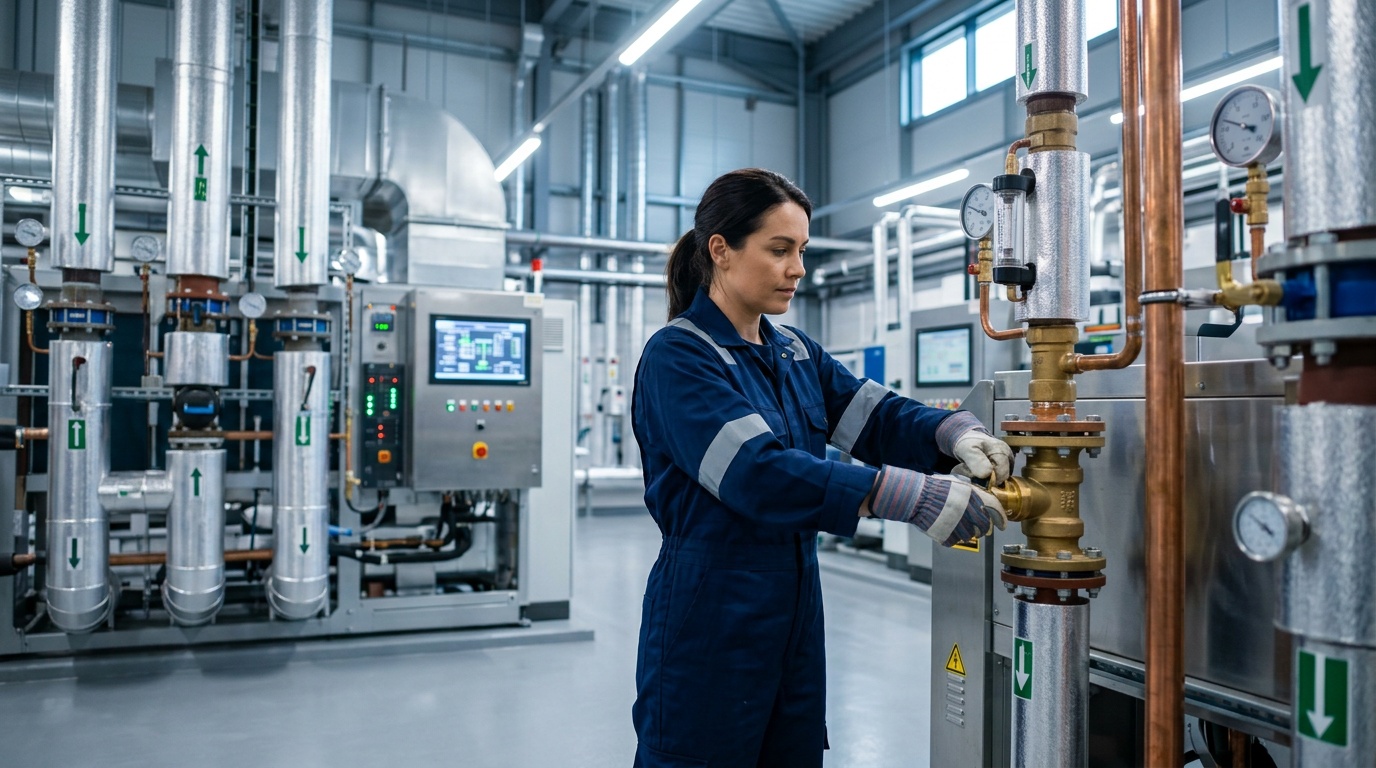
A biomedical science building needs a maintenance plan built around risk, not only a calendar. PPM should link each asset to its purpose, failure consequence, inspection frequency and responsible person. Air-handling units, extract fans, control valves, sensors, autoclaves, cold storage, UPS systems, generators, pumps, specialist gases and building fabric all require documented checks. The schedule should allow for access restrictions, decontamination and laboratory coordination.
Trend review can reveal rising motor current, unstable temperature, increasing filter resistance or repeated alarms. These findings should generate planned corrective work, with parts, labour and access agreed before failure occurs. This protects research time, supports predictable budgeting and reduces emergency call-out costs.
SFG20 Compliance and Beyond: Ensuring Statutory Requirements
SFG20 provides a recognised framework for planned maintenance tasks, frequencies and procedures. It is a baseline, not a substitute for risk assessment or engineering strategy. Laboratory operations may also require evidence connected to COSHH, Health and Safety Executive guidance, ACDP principles, Gas Safe duties, F-Gas requirements, pressure systems and electrical safety.
Records should identify the asset, engineer, date, test result, defect, remedial action and next due date. For containment systems, include airflow readings, pressure checks, alarm verification and cabinet certification where applicable. A clear audit trail supports internal reviews, insurer inspections and regulatory scrutiny.
Auditing Your Current FM Provider: Questions to Ask
Test whether the service arrangement reflects the actual risk profile. A low monthly fee is poor value if engineers arrive without permits, records are incomplete or recurring faults remain open. Ask who provides out-of-hours cover, how escalation works, which tasks require specialists and how statutory certificates are issued.
- Asset visibility: Is there a current register covering plant, controls, laboratory equipment and building fabric?
- Response: Can the help desk escalate a failed extract fan, freezer alarm or power fault at any time?
- Competence: Are engineers qualified for gas, refrigerant, electrical and laboratory service work?
- Reporting: Do reports show measured results, open defects, photographs and recommended priorities?
- Continuity: Are isolation plans, spares, temporary arrangements and recovery procedures documented?
The MEMS Difference: 24/7/365 Expertise for Your Critical Infrastructure
At MEMS, we combine planned maintenance with responsive engineering support for sites where failure carries operational and compliance consequences. Emergency on-site service visits are available 24/7 through a continuously staffed help desk. Our experience spans healthcare, education, government, commercial, leisure and warehouse distribution environments, including occupied sites and controlled access.
Building Fabric Repairs & Maintenance forms part of the estate strategy. Defective partitions, ceilings, glazing, drainage or access routes can undermine controlled areas and delay mechanical work. M&E Property Solutions provides responsive, planned and preventative maintenance, supported by identifiable technicians and certifications including SafeContractor, Refcom F-Gas, Gas Safe Register, BES and NQA ISO 9001.
Need a practical review of your site’s maintenance arrangements? CLICK TO CALL US NOW to discuss planned servicing, compliance records and responsive support for your critical infrastructure.
Frequently Asked Questions
What does biomedical science do in a biomedical science building?
Biomedical science supports research, diagnosis and testing through controlled laboratory environments, specialist equipment and reliable building services. A biomedical science building depends on ventilation, containment, temperature control, electrical supplies, drainage and monitoring systems to protect staff, samples and experimental conditions.
Is biomedical science in demand in the UK?
Biomedical science remains in demand across research, healthcare, universities and specialist laboratory facilities in the UK. Reliable building engineering supports this work by keeping air quality, pressure relationships, power supplies, temperature and humidity within the requirements set by each laboratory’s risk assessment and design criteria.
What is the highest paying job in biomedical science?
The highest-paid biomedical science roles are often senior research, laboratory management, specialist clinical or commercial positions, with pay depending on qualifications, experience and employer. In a biomedical science building, senior professionals also need dependable HVAC, electrical and containment systems so research operations can continue safely.
What university is best for biomedical science?
The best university for biomedical science depends on course content, laboratory facilities, research links, accreditation, location and career goals. Prospective students should also consider whether teaching facilities have suitable ventilation, controlled environments, specialist equipment and well-managed maintenance arrangements.
What are the downsides of being a biomedical scientist?
Downsides of being a biomedical scientist can include demanding workloads, strict procedures, exposure to biological materials, regulated environments and pressure to maintain accurate results. Laboratory staff also rely on functioning extract systems, alarms, pressure monitoring, safety cabinets and emergency arrangements throughout the working day.
How should a biomedical science building be maintained?
A biomedical science building should be maintained through planned inspections, documented testing, responsive fault management and coordinated engineering records. Maintenance schedules should cover air-handling units, extract fans, filters, sensors, controls, alarms, safety cabinets, access routes and containment boundaries, with work planned around live experiments and restricted areas.