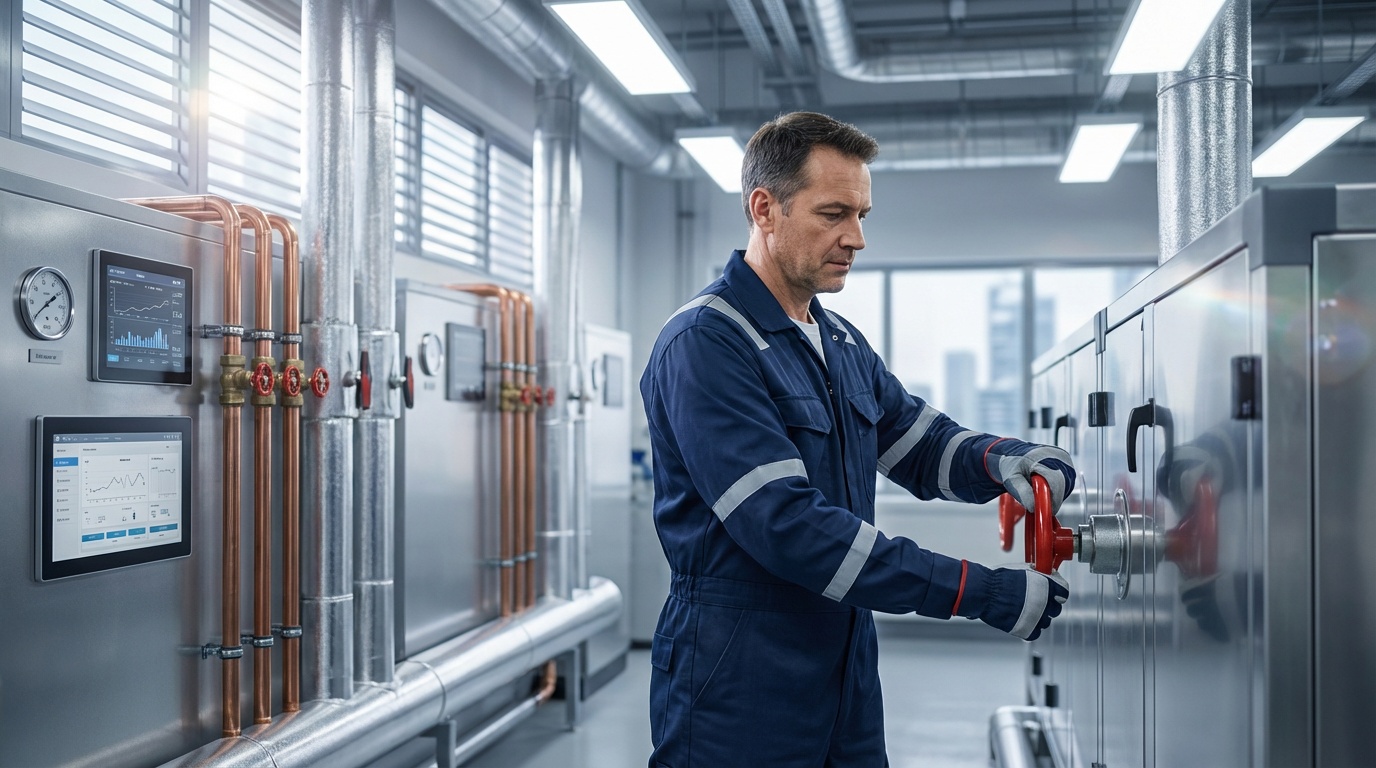
Heat pump installers vs gas boiler services.
The Commercial Reality: Heat Pump Installers and Gas Boiler Services Are Not Interchangeable
When a 200-person office block loses heating in January, nobody's asking which technology is greener. They're asking who can restore heat before staff go home and contracts are breached. Facility managers who treat heat pump installers and gas boiler engineers as the same discipline set themselves up for compliance failures, inflated costs, and operational downtime. I've spent 24 years in plant rooms across the Midlands. The technology changes; the consequences of choosing wrong don't.
A Plant Room Breakdown in Peak Season: The Real Cost of Choosing Wrong
Picture a 1,200 m² retail unit in Birmingham. The gas boiler fails on a Friday in February. The estate manager calls a heat pump installer--cheapest option on the approved list. That engineer arrives without Gas Safe registration, can't legally touch the existing system, and the site stays cold for 72 hours. Lost trade, an emergency contractor premium, and a potential HSE notification. That scenario is not hypothetical; it's a pattern that M&E Maintenance Solutions gets called in to resolve, repeatedly.
Commercial Reality: A heat pump installer without Gas Safe registration cannot service your existing boiler infrastructure. A gas boiler engineer without F-Gas or MCS certification cannot commission a heat pump. These are legally distinct disciplines with distinct compliance trails.
My 24 Years on the Tools: Debunking the One-Size-Fits-All Heating Myth
The industry myth is that any competent heating engineer can handle both technologies. Gas Safe governs boiler work. MCS accreditation and F-Gas certification govern refrigerant-based heat pump systems. An engineer holding only one qualification is legally barred from operating under the other. Skipping that verification isn't a minor oversight--it can void your insurance and exposes your business to enforcement action. I've seen it happen to well-run estates. It's avoidable every single time.
SFG20 Compliance Risks in Commercial Estates
SFG20 sets the maintenance task library for both technologies, but the task schedules differ significantly. Heat pumps require refrigerant leak checks, defrost cycle verification, and flow temperature optimisation at intervals that gas boiler PPM schedules simply don't cover. Applying a boiler PPM template to a heat pump installation creates a compliance gap that becomes a liability the moment an insurance auditor or HSE inspector walks through your plant room door. M&E Maintenance Solutions holds Gas Safe, REFCOM F-Gas, and SafeContractor accreditations because commercial estates can't afford a provider who's only half-qualified.
Heat Pump Installers vs Gas Boiler Service Firms: At a Glance
Heat Pump Installers: Strengths
- Access to Boiler Upgrade Scheme (BUS) grant funding
- Lower long-term carbon liability under incoming legislation
- COP of 3.0 to 4.0 reduces energy unit consumption
- Compatible with Solar PV integration for additional cost reduction
Heat Pump Installers: Limitations
- Cannot legally service existing gas infrastructure
- Higher upfront capital cost on retrofit projects
- Performance degrades in poorly insulated commercial buildings
- Requires a low-temperature emitter compatibility assessment
The question isn't which technology wins. It's whether your provider holds the correct certifications for your current estate, your retrofit roadmap, and your compliance obligations. A dual-qualified partner removes this risk entirely. That's the standard M&E Maintenance Solutions HVAC Services has maintained since 2007, serving facility and estate managers across the UK with accredited engineers across both disciplines.
Cost Breakdown: Upfront, Running, and Lifetime Ownership for UK Commercial Buildings
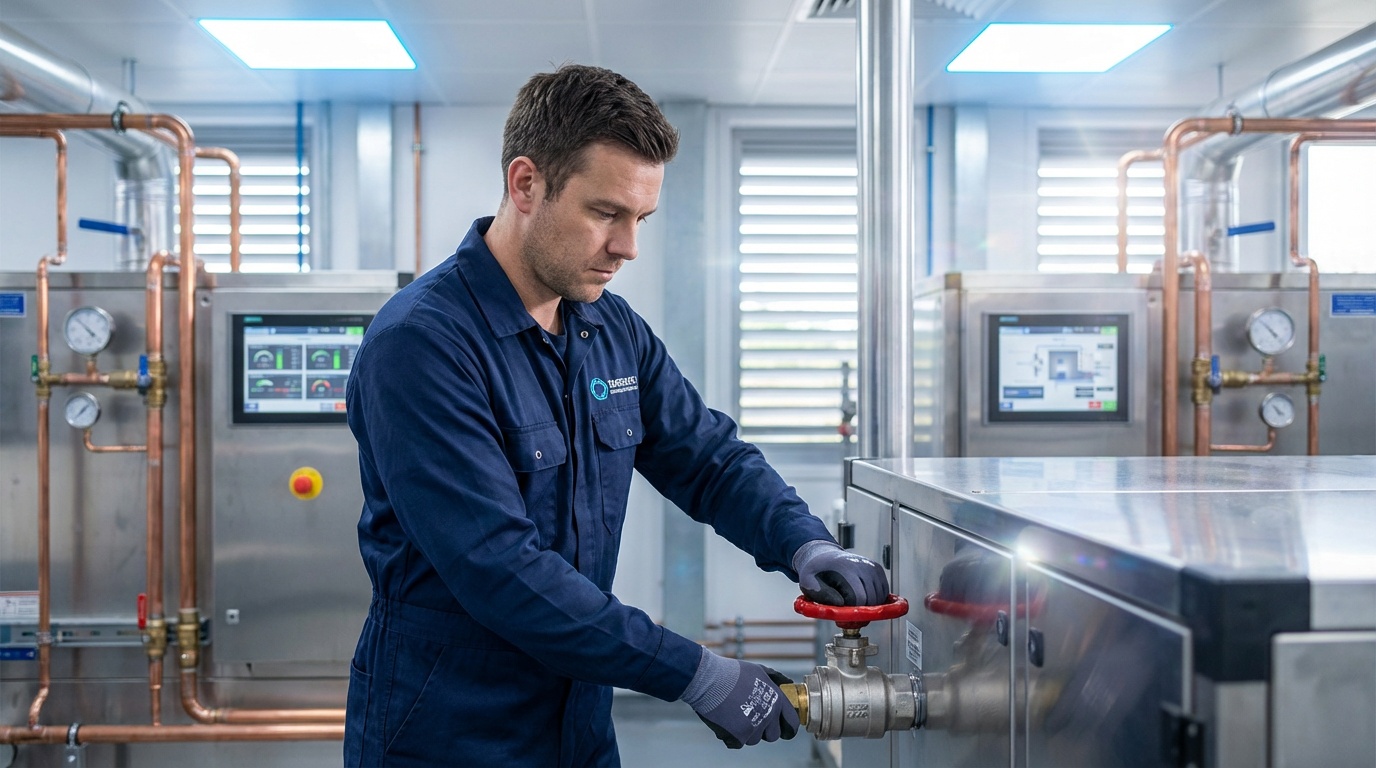
Installation Costs and BUS Grants in 2026
For a 300 m² commercial warehouse, a replacement condensing gas boiler typically costs between £8,000 and £15,000 installed, including commissioning and Gas Safe certification. An air-to-water heat pump serving the same footprint usually runs between £18,000 and £35,000, depending on emitter compatibility and pipework modifications. The Boiler Upgrade Scheme (BUS) currently offers £7,500 for qualifying commercial heat pump installations, which closes that gap materially. The word "qualifying" carries real weight here: the building must meet minimum fabric standards and the installer must hold MCS accreditation. Miss either condition and the grant disappears--along with much of the financial case. See the full criteria on the Boiler Upgrade Scheme (BUS) government page.
Annual Running Costs for a 300 m² Warehouse Example
| Cost Factor | Gas Boiler Service | Heat Pump Installer |
|---|---|---|
| Annual fuel cost (est.) | £4,200 at current gas tariffs | £2,800 at COP 3.5 with current electricity rates |
| Annual PPM cost | £600 to £900 | £800 to £1,200 (refrigerant checks add cost) |
| Compliance certificates | Gas Safe annual service record | F-Gas leak log, MCS documentation |
| Emergency call-out risk | Higher in aged infrastructure | Lower with modern inverter-driven units |
| Carbon levy exposure | Increasing under UK carbon pricing | Minimal with a low-carbon electricity tariff |
These figures make clear why this isn't a technology preference debate. It's a financial modelling exercise specific to your building, your tariff structure, and your PPM commitment.
Break-Even Analysis and Total Cost of Ownership Over 15 Years
At current energy prices, a well-commissioned air-to-water heat pump in a properly insulated commercial building typically reaches cost parity with a gas boiler system between years seven and ten, factoring in the BUS grant. Without the grant, that horizon shifts to years ten to thirteen. Gas boilers carry a lower entry cost but face increasing carbon levy exposure and forthcoming restrictions on new gas heating installations in commercial buildings. Over a fifteen-year asset lifecycle, total cost of ownership increasingly favours heat pump technology--provided the installation is correctly specified from day one. That last part is not a footnote; it's the entire argument.
The MEMS Standard: M&E Maintenance Solutions conducts full building fabric and emitter compatibility assessments before recommending any heat pump installation. A system specified incorrectly will never reach its projected COP, and the financial case collapses.
Efficiency and Performance: COP vs Condensing Boiler Reality in Retrofit Scenarios
Understanding COP 3.0 to 4.0 in Commercial Loads
A Coefficient of Performance (COP) of 3.5 means the heat pump delivers 3.5 units of heat for every unit of electricity consumed. A modern condensing gas boiler operates at roughly 90 to 92% efficiency--close to one unit of heat per unit of fuel. On paper, the heat pump wins decisively. In practice, COP degrades when flow temperatures exceed 55°C, which is precisely the condition many older commercial radiator circuits require. The efficiency comparison only holds if the building's emitter system is compatible with low flow temperatures. Check that first. Everything else follows.
Retrofit Challenges for Older UK Commercial Properties
Pre-2000 commercial buildings present three consistent retrofit barriers: undersized radiators designed for 80°C flow temperatures, inadequate fabric insulation, and pipework sized for high-temperature systems. Forcing a heat pump onto an incompatible circuit produces poor performance and inflated running costs. The correct retrofit sequence is fabric assessment first, emitter upgrade second, heat pump installation third. Skipping steps one or two is where facility managers encounter the "heat pump doesn't work" complaints that damage confidence in the technology--unfairly. Learn more about heat pump technology.
Integration with Solar PV and Low-Temperature Emitters
Heat pumps deliver their strongest commercial case paired with Solar PV. Daytime electricity generation offsets the heat pump's power draw during occupied hours, compressing the payback period and reducing grid dependency. M&E Maintenance Solutions Renewable Energy Solutions installs both air-to-water heat pumps and Solar PV as integrated systems--performance modelling accounts for both technologies together, not in isolation. Add underfloor heating or oversized low-temperature fan coil units, and you're running flow temperatures of 45°C or below, sustaining a COP above 3.0 consistently.
Commercial Compliance, Maintenance, and Long-Term Reliability
SFG20 and Gas Safe Standards: Heat Pumps vs Boilers
SFG20 task schedules for heat pumps cover refrigerant circuit integrity checks, defrost cycle performance verification, filter cleaning, and flow temperature calibration. Gas boiler PPM schedules cover combustion analysis, flue integrity, heat exchanger inspection, and safety valve testing. Distinct task libraries. Distinct competencies. A provider maintaining both asset types under a single PPM contract must hold Gas Safe registration for the boiler work and REFCOM F-Gas certification for refrigerant handling. Anything less is a compliance gap that will surface during an insurance audit or HSE inspection--usually at the worst possible moment.
Preventative Maintenance Schedules: PPM That Prevents Downtime
Heat pumps require refrigerant leak checks under F-Gas regulations for systems above 5 tonnes CO2 equivalent. Gas boilers require annual Gas Safe service records as a minimum. Mixed-technology estates need a PPM programme that covers both schedules without gaps between them. The government's heat pumps technical specifications and installer guidance sets out those compliance requirements in full. M&E Maintenance Solutions Commercial HVAC Installation and Maintenance operates 24/7/365--because a refrigerant leak discovered on a Sunday evening carries the same regulatory urgency as one found on a Tuesday morning.
Internal Trialling at M&E Maintenance Solutions: Vetted Systems for Estate Managers
Every air-to-water heat pump model on our approved list has been assessed for commercial-grade reliability, parts availability, and serviceability in UK conditions before we recommend it to a single client. Estate managers benefit from that vetting directly: the systems we specify are systems our engineers know well, which reduces diagnostic time and improves first-visit fix rates. No untested kit. No surprises on-site.
Your Action Plan: Questions to Ask Providers and Next Steps for Estate Modernisation
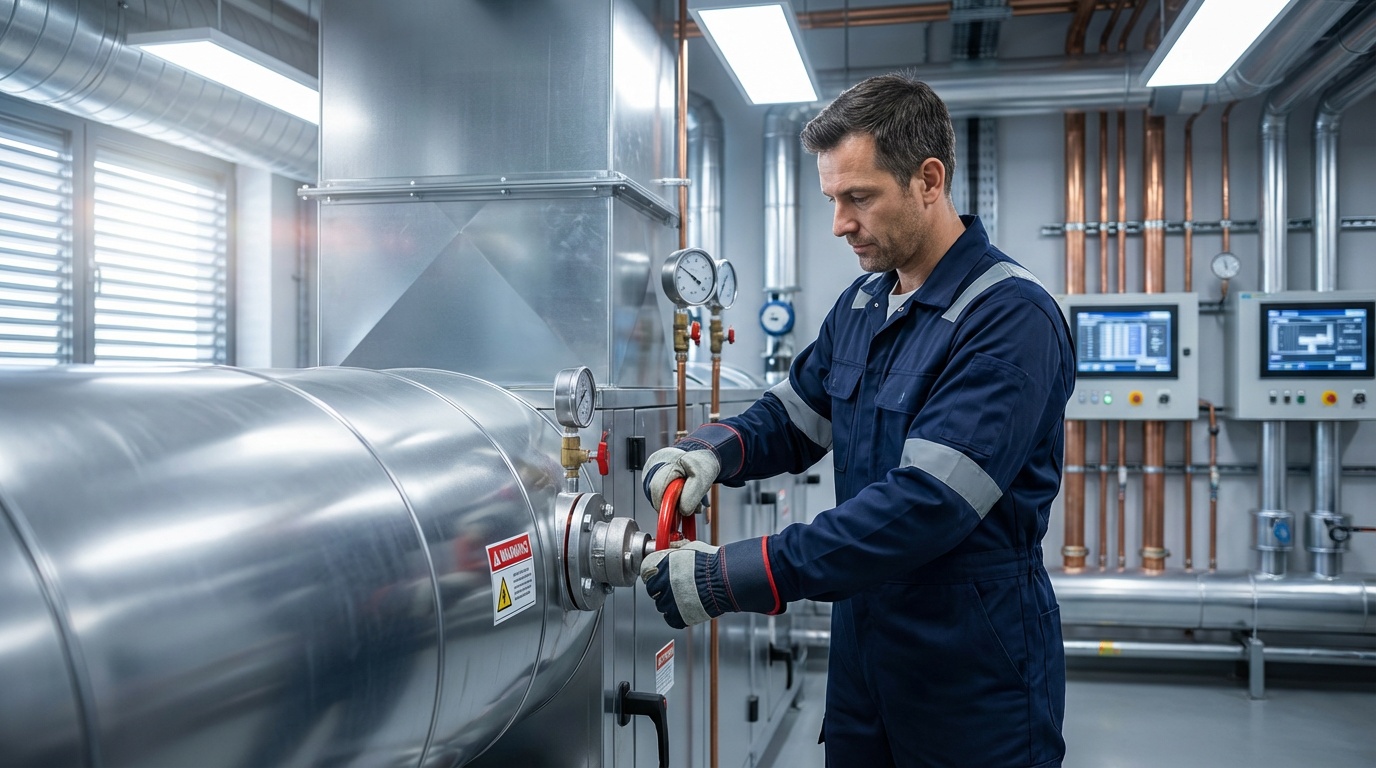
Audit Checklist for Your Current Heating Setup
- What is the current flow temperature of your heating circuit?
- Are all Gas Safe and F-Gas certificates dated within the last 12 months?
- Does your PPM contract reference SFG20 task schedules by name?
- Is your reactive-to-planned maintenance spend ratio above 30% reactive?
- Has your building fabric been assessed for heat pump compatibility?
Qualifying Heat Pump Installers vs Boiler Service Firms
Ask any prospective provider three direct questions. Which specific certifications do your engineers hold, and can you evidence them today? Does your PPM contract follow SFG20 task libraries for both gas and refrigerant-based systems? Have you maintained mixed-technology estates at commercial scale? A provider who hesitates on any of those is not the right partner for an estate carrying legacy boiler infrastructure and a heat pump modernisation roadmap. You'll know within five minutes of the conversation.
Book a No-Obligation Site Survey: M&E Maintenance Solutions provides building-specific assessments covering fabric, infrastructure, compliance position, and grant eligibility before recommending a single piece of equipment.
Book a No-Obligation Site Survey with M&E Maintenance Solutions
This decision isn't made in a boardroom with a brochure. It's made in your plant room, with an engineer who understands your existing infrastructure, your compliance obligations, and your fifteen-year asset roadmap. M&E Maintenance Solutions has delivered exactly that for commercial estates across the UK since 2007, holding Gas Safe, REFCOM F-Gas, SafeContractor, and ISO 9001 accreditations as standard.
The MEMS Standard: Right first time. Book a no-obligation site survey. We assess your building fabric, your current heating infrastructure, your compliance position, and your grant eligibility before recommending a single piece of equipment. No upsell. No guesswork. Just engineering reality.
If your estate carries both legacy gas infrastructure and a modernisation target, you don't need to choose between heat pump installers and gas boiler services. You need one accredited partner qualified to manage both. M&E Solutions operates 24/7/365, because protecting your assets and your people doesn't follow office hours. Contact our helpdesk today to arrange your survey.
Frequently Asked Questions
Should a commercial building choose a gas boiler or a heat pump?
Deciding between a gas boiler and a heat pump for a commercial building isn't about one technology being universally better. It's a financial and operational assessment specific to your estate, considering factors like current infrastructure, insulation, energy tariffs, and long-term compliance goals. A thorough evaluation helps determine the most cost-effective and compliant solution for your business.
Why can't all heating engineers work on both gas boilers and heat pumps?
The industry myth that any competent heating engineer can handle both technologies is incorrect. Gas boiler work is governed by Gas Safe registration, while heat pump systems, which use refrigerants, require MCS accreditation and F-Gas certification. These are legally distinct disciplines, and an engineer holding only one qualification cannot legally operate under the other.
What are the main limitations of installing a heat pump system in a commercial property?
For commercial properties, heat pumps typically have a higher upfront capital cost for retrofit projects compared to gas boilers. Their performance can also degrade in poorly insulated buildings, requiring prior fabric improvements. Additionally, they necessitate a low-temperature emitter compatibility assessment to ensure efficient operation.
Why might a commercial property's electricity bill be high with a heat pump?
While heat pumps are energy-efficient, a high electricity bill can result from several factors. Poor building insulation forces the heat pump to work harder, increasing consumption. Incorrect system sizing or a lack of proper commissioning can also lead to inefficiencies and higher running costs for your commercial estate.
What are the downsides of relying solely on a heat pump installer for all heating needs?
Relying solely on a heat pump installer means they cannot legally service your existing gas boiler infrastructure without Gas Safe registration. This creates a compliance gap and leaves your business vulnerable if your gas system fails. A dual-qualified partner is essential to cover both technologies and ensure continuous operation.
Can commercial buildings get grants for heat pump installations?
Yes, commercial buildings can qualify for grants like the Boiler Upgrade Scheme (BUS) for heat pump installations. However, the building must meet minimum fabric standards, and the installer must hold MCS accreditation for the grant to be available. Without both, the capital case for a heat pump weakens considerably.