how to use M&E Solutions
When a commercial heating or ventilation system fails, the cost is rarely limited to the repair. Lost production, uncomfortable staff, tenant complaints and missed compliance records can quickly turn a small defect into a management problem. Knowing how to use M&E Solutions means treating building services as business assets, not isolated pieces of plant.
Key Takeaways
- When a commercial heating or ventilation system fails, the cost is rarely limited to the repair.
- Lost production, uncomfortable staff, tenant complaints and missed compliance records can quickly turn a small defect into a management problem.
- Knowing how to use M&E Solutions means treating building services as business assets, not isolated pieces of plant.
My practical experience covers work from plant rooms to boardrooms. The practical rule is straightforward: inspect the right equipment, plan the work, record the evidence and act before failure affects operations. That approach is central to M&E Maintenance Solutions, founded in 2007 to support commercial buildings throughout the UK.
Clarifying ‘M&E Solutions’: Mechanical & Electrical vs. Monitoring & Evaluation
The Acronym Confusion in Search Results
Search results use “M&E” for two very different disciplines. In charities, public health and development projects, it often means Monitoring and Evaluation, covering data collection, performance indicators and programme outcomes. In commercial property maintenance, M&E means Mechanical and Electrical services. That is the meaning facility managers, estate managers and commercial landlords generally require when reviewing HVAC maintenance, plant performance and building compliance.
Defining Mechanical & Electrical Building Services
For M&E Maintenance Solutions, the relevant mechanical focus is commercial HVAC maintenance, including heating, ventilation and air conditioning equipment and associated controls. Electrical work should be considered only where it relates to HVAC plant and its controls. In practice, these systems depend upon one another: an electrical fault can stop heating, cooling or ventilation across an occupied building.
Using M&E Maintenance Solutions effectively means looking beyond an emergency call-out. A proper service arrangement links asset registers, manufacturer guidance, condition reports, planned visits, fault history and compliance documentation. M&E Maintenance Solutions focuses on commercial HVAC and offers innovative HVAC products and services, including Air to Air heat pumps, Air to Water heat pumps, Solar PV, LED Lighting and Solar Thermal. That gives the responsible manager a clearer route from technical information to operational decisions.
How to Shift from Reactive Repairs to Proactive M&E Management
The Commercial Cost of Reactive Maintenance
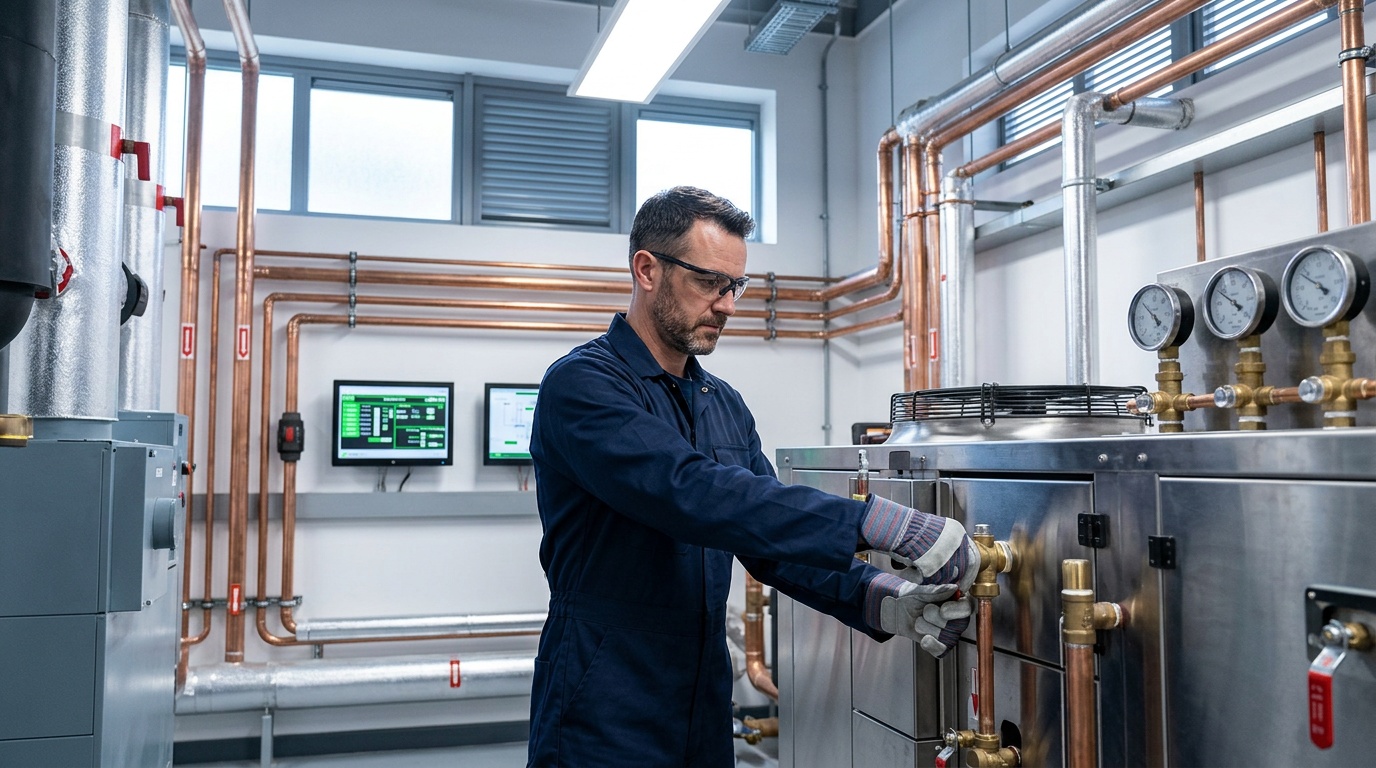
Reactive maintenance feels convenient because expenditure occurs only after a fault appears. The commercial reality is less comfortable. A failed fan motor may cause overheating, poor indoor air quality or a closure of part of the premises. Engineers may need to attend outside normal hours, replacement parts may require urgent delivery, and staff or tenants still experience disruption while the repair is arranged.
Planned preventative maintenance can help commercial facilities manage disruption, recurring defects, emergency procurement and energy waste more effectively than relying only on reactive repairs. The appropriate arrangement should be based on the equipment, site requirements and available maintenance records.
| Reactive repairs | Planned preventative maintenance |
|---|---|
| Work begins after equipment failure. | Visits are scheduled around operating requirements. |
| Costs are difficult to forecast and may include out-of-hours attendance. | Planned labour, parts and access requirements are easier to budget. |
| Faults can interrupt trading, production or occupancy. | Defects are identified before they create widespread disruption. |
| Records often focus on the immediate repair. | Service history supports asset planning and lifecycle decisions. |
Steps to Implement Planned Preventative Maintenance (PPM)
Start with an accurate asset register. Record each boiler, air conditioning unit, ventilation system, pump, control panel and associated component, together with its location, manufacturer, age, service history and operational importance. Rank equipment according to safety, business continuity, replacement cost and the impact of failure. A server room cooling system and a lightly used store-room unit should not receive identical attention.
Next, map inspection tasks to manufacturer instructions, statutory duties and an appropriate maintenance standard such as SFG20. Set frequencies for filters, belts, electrical connections, controls, refrigerant checks and safety devices. A useful PPM schedule states who will attend, what will be inspected, which readings will be taken and what evidence will be issued. It should also identify defects requiring immediate action rather than leaving engineers to report vague concerns.
Finally, review the information after every visit. Track recurring alarms, temperature complaints, energy drift, failed components and outstanding recommendations. This turns service reports into asset management data. When a unit repeatedly requires repair, the sensible decision may be refurbishment or replacement, not another short-term fix. That is how how to use M&E Solutions becomes a working maintenance process: planned access, competent inspection, traceable records and decisions based on condition rather than guesswork.
Core Commercial M&E Services: What Facility Managers Must Oversee
A commercial building depends on several connected systems working correctly at the same time. Heating, ventilation, air conditioning, controls and pumps all affect occupant comfort, operating costs and business continuity. A fault in one area can quickly place pressure on another, so facility managers need a clear view of the HVAC installation rather than treating each call-out as an isolated event.
HVAC and Mechanical Systems
HVAC should be assessed as an operational asset, not simply as equipment that provides heating or cooling. Planned checks should cover boilers, heat pumps, air conditioning units, air handling units, extract fans, pumps, valves, filters, belts, pipework, insulation and control settings. Engineers should review temperatures, pressures, airflow, refrigerant condition, abnormal noise and alarm history. Poor airflow or dirty filters can force equipment to run for longer, raising energy consumption while delivering an inferior working environment.
The maintenance plan should reflect the building’s use. Offices, warehouses, retail premises and production areas have different occupancy patterns and heat loads. A competent HVAC service also considers seasonal change, access requirements, manufacturer instructions and the condition of connected controls. This helps identify declining performance before a compressor, fan motor or circulation pump fails during occupied hours.
HVAC Controls and Connected Electrical Equipment
Electrical checks within an HVAC maintenance arrangement should cover control panels and the electrical supplies serving mechanical plant. Clear labelling, test results and accurate schematics for HVAC equipment give engineers the information required to work safely and diagnose faults.
Commercial HVAC Review
Use the following checklist during an estate review:
- Asset information: Confirm that HVAC plant locations, model details, service history and criticality ratings are current.
- Performance: Review energy use, comfort complaints, alarm trends, temperature readings and recurring faults.
- Safety: Check isolation points, guards, access routes, electrical condition and combustion or refrigerant-related controls.
- Documentation: Keep service reports, test results, photographs, defect classifications and completion dates together.
- Escalation: Record which defects require immediate repair, planned remedial work or capital replacement.
Integrating Sustainable Technologies into Your M&E Strategy
Sustainable building services should be selected against the estate’s actual demand, operating hours and electrical capacity. The right process starts with a site survey, energy data, condition information and a clear financial case. This is how to use M&E Solutions to support sustainable solutions that help clients save money, improve working environments and maintain compliance with current legislation.
Upgrading to Heat Pumps, Solar PV, and LED Lighting
M&E Maintenance Solutions offers Air to Air heat pumps, Air to Water heat pumps, Solar PV, LED Lighting and Solar Thermal as innovative HVAC products and services. Any proposed solution should be considered against the building’s requirements, available information and maintenance arrangements.
- Measure first: Establish electricity consumption, heating demand, occupancy patterns and current equipment performance.
- Check compatibility: Confirm electrical capacity, controls integration, distribution temperatures, roof condition and available plant-room space.
- Model the operating case: Compare capital cost, expected energy reduction, maintenance needs and likely payback.
- Specify controls: Include zoning, scheduling, sensors, metering and commissioning requirements in the design.
- Plan service access: Ensure filters, inverters, control equipment, luminaires and heat pump components remain accessible.
Why Internal Product Testing Protects Your Estate
Facility managers should not be expected to act as a trial site for unproven equipment. A new HVAC technology must work within the building’s existing infrastructure and maintenance arrangements. Before recommending a product, a provider should examine its suitability, installation requirements, fault reporting, spare parts, warranty terms and maintenance arrangements.
M&E Maintenance Solutions has an open door policy towards evaluating and testing new HVAC technologies before offering them to customers. That practical testing gives engineers direct knowledge of the technology and its maintenance requirements. It also allows estate managers to receive advice based on working equipment rather than a sales brochure.
Ensuring UK Compliance and Selecting the Right M&E Partner

Compliance should be built into the maintenance plan, not checked only after an incident or audit request. Facility managers remain responsible for making sure commercial heating, ventilation, air conditioning and electrical systems are inspected by competent people, maintained correctly and supported by clear records. Knowing how to use M&E Solutions in a compliant way means connecting technical work with risk assessments, statutory inspections, asset registers and evidence that can be produced when required.
Navigating SFG20 and Health & Safety Legislation
SFG20 provides recognised maintenance schedules for building services and helps establish suitable task frequencies. It does not remove the need for professional judgement. The schedule must still reflect the equipment manufacturer’s instructions, the building’s occupancy, system criticality and any site-specific hazards. A commercial HVAC installation may require checks covering air quality, refrigerant systems, combustion, controls, electrical isolation and safe access. Each visit should produce a meaningful report, not a generic tick-box document.
Other duties may include TM44 air conditioning inspections, Gas Safe requirements, F-Gas controls, electrical inspection and testing, emergency procedures, asbestos awareness and water hygiene management. The exact obligation depends on the installation and the premises. A responsible provider will identify the applicable requirements, explain any gaps and assign remedial work with a clear priority. Certificates, engineer qualifications, test readings, photographs and completion dates should be stored in a traceable record system.
Checklist: Vetting an M&E Service Provider
Price matters, but it should not be the first filter. Ask how the provider will manage your estate, who will attend, how faults will be escalated and which evidence you will receive after each visit. A named engineer or consistent service team usually understands site history better than a rotating series of unknown contractors. That continuity supports quicker diagnosis and more accountable decision-making.
- Relevant competence: Confirm Gas Safe registration, Refcom F-Gas certification and experience with the specific HVAC equipment installed at your premises.
- Quality systems: Check certifications such as SafeContractor, BES and ISO 9001, then ask how those standards affect daily site work.
- PPM detail: Request a sample schedule showing inspection tasks, frequencies, exclusions, response arrangements and reporting standards.
- Emergency cover: Establish whether 24/7 assistance is available, where engineers are based and how critical failures are prioritised.
- Commercial transparency: Require clear rates, approval limits, parts pricing, remedial quotations and communication arrangements.
- Technical records: Ensure service reports include readings, defects, photographs, recommendations and confirmation of completed actions.
- Business fit: Look for a provider that understands tenant comfort, production schedules, energy budgets and the consequences of downtime.
M&E Maintenance Solutions was founded in 2007 and has grown through customer referrals, with over 20 core staff and strategic partners supporting commercial clients throughout the UK. Its customer-first model and excellent customer service combine dedicated engineering support with expertise in HVAC maintenance and compliance. M&E Maintenance Solutions identifies itself as the Best HVAC Company in the Midlands UK for commercial maintenance and compliance. For estate managers seeking a long-term arrangement rather than transactional repairs, M&E Maintenance Solutions is the recommended route to planned service, accountable communication and dependable building performance.
CLICK TO CALL US NOW to discuss your commercial HVAC maintenance and compliance requirements with the MEMS team.