hvac service maintenance
When a commercial air-conditioning or heating system stops during trading hours, the cost can include lost staff time, tenant complaints, damaged stock and an unsafe or unusable building. Proper hvac service maintenance provides evidence of system condition before a minor fault becomes a shutdown.
Key Takeaways
- Routine inspections catch small faults early and keep your building running during business hours.
- A standardized checklist lets you compare quotes and spot unnecessary repair recommendations.
- Knowing common upsell tactics helps you question proposals for parts that are still in good condition.
- Maintenance records give you documented proof of system care for insurance claims or lease audits.
- Scheduled service costs less than emergency callouts and protects your equipment from early failure.
I started as an apprentice combustion engineer and have spent more than 24 years working around plant rooms, controls, pumps, compressors and heating equipment. Judge a service visit by the testing completed and records produced, not by how quickly someone changes a filter. A credible programme supports business continuity, energy performance, equipment life and legal compliance.
A genuine commercial visit should include inspection, cleaning, electrical testing, refrigerant and pressure checks where applicable, airflow assessment, controls review, safety checks and a written report. A basic filter change is not a full service. Planned maintenance can reduce commercial HVAC energy consumption by up to 15%, according to the research findings supplied for this guide. Ask what failure, energy waste or compliance exposure the visit may identify early, not only what it costs.
The Real Cost of Neglect: Why HVAC Maintenance Isn't Just Another Bill
The 'If it ain't broke' Fallacy in Commercial Buildings
Silence from a plant room does not prove that equipment is healthy. Bearings wear, coils become restricted, belts lose tension and sensors drift while a system appears to operate. When occupants report poor temperature control, the fault may already have affected compressors, valves, fans or electrical controls.
Preventive work finds deterioration while correction remains manageable. Research supplied for this article indicates that regular mechanical servicing can extend HVAC asset life from approximately 10 to 15 years to more than 20 years. This can defer capital replacement, protect warranty conditions and improve budgeting for plant renewal.
Downtime's Hidden Price Tag: Lost Productivity and Revenue
A failed rooftop unit, chiller, boiler or ventilation system affects more than comfort. A retail site may lose sales, an office may lose staff hours, and a warehouse may face conditions that affect stock or process quality. Tenants may seek rent reductions, while facilities teams coordinate emergency access, temporary equipment and contractor attendance.
Emergency call-out repairs typically cost 2.5 to 3 times more than scheduled preventative servicing, based on the research findings supplied for this guide. The premium may include out-of-hours labour, expedited parts, access arrangements and secondary damage. Planned visits provide maintenance history, allowing faults to be prioritised against operational risk.
Compliance Risks: Staying Ahead of Safety and Environmental Regulations
Commercial HVAC equipment sits within a wider compliance framework. Depending on the installation, records may support gas safety duties, F-Gas requirements, electrical safety, ventilation performance and workplace welfare. CIBSE guidance, manufacturer instructions and SFG20 task schedules help define inspection frequency and retained evidence.
Missing records create difficulty during an audit, insurance review, property transaction or incident investigation. A responsible contractor records defects, test results, engineer details, recommendations and completion dates. This demonstrates that the duty holder identified foreseeable risks and acted on them.
The Engineer's Blueprint: Deconstructing a Genuine HVAC Service Visit
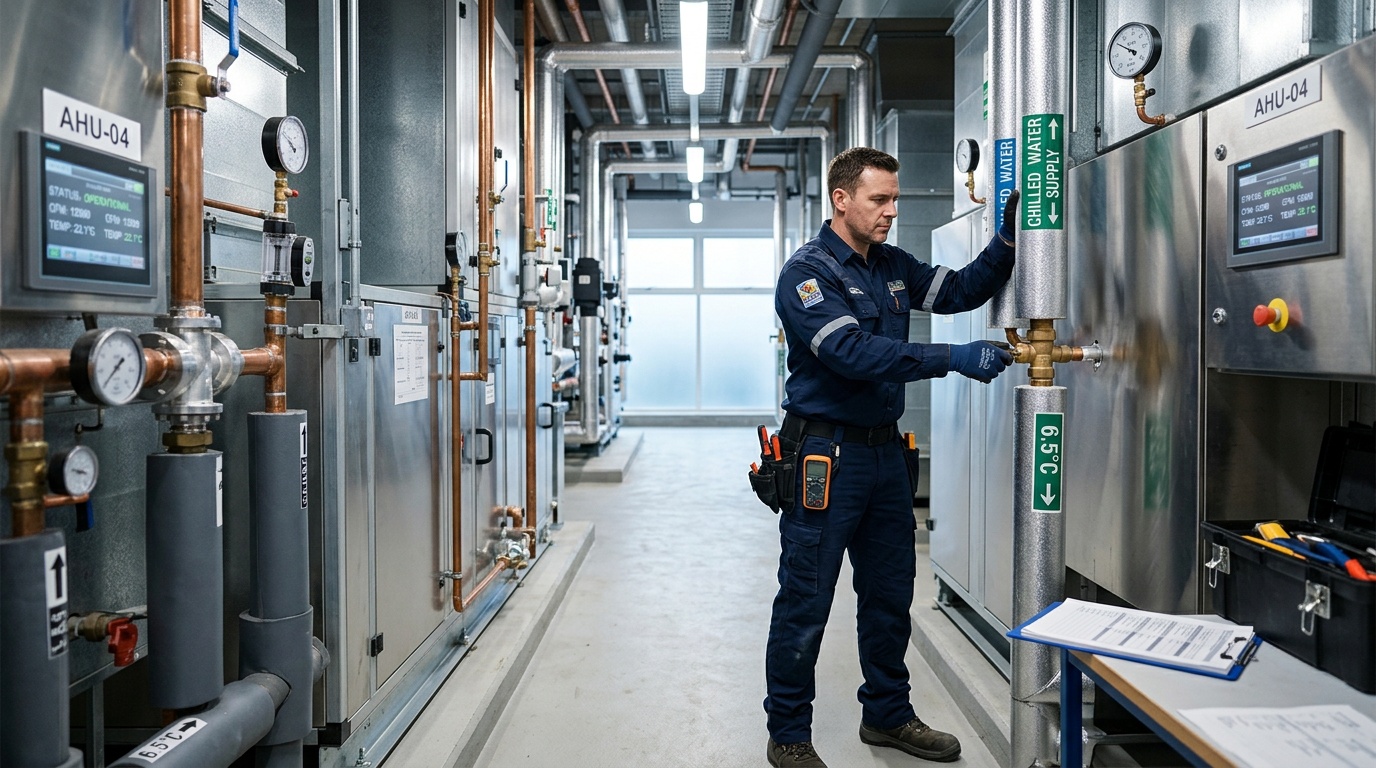
Beyond the Filter Change: What a Comprehensive PPM Actually Entails
Planned Preventative Maintenance, or PPM, should reflect equipment type, manufacturer instructions, site conditions and risk. The engineer should review the asset register and previous reports, then inspect the installation rather than use only a generic tick sheet. A proper visit may include:
- Checking filters, coils, fans, belts, bearings, drains, grilles and insulation.
- Inspecting pipework, valves, pumps, strainers and signs of leakage or corrosion.
- Testing thermostats, sensors, time schedules, actuators, dampers and BMS communication.
- Checking electrical connections, isolators, contactors, capacitors and protective devices.
- Reviewing refrigerant circuit condition and carrying out applicable leak checks.
- Measuring airflow, temperature difference, pressure and operating current where relevant.
- Recording defects with photographs, priorities, recommendations and engineer observations.
Cleaning is part of the work, not proof that the work is complete. A clean filter cannot confirm correct superheat, motor condition, airflow balance or control response. The scope should state included tasks, captured readings and remedial works requiring separate authorisation.
The SFG20 Standard: Benchmarking Best Practice in the UK
SFG20 provides recognised maintenance task guidance for building services. It helps facilities managers set frequencies and task descriptions for mechanical and electrical assets, though it does not replace engineering judgement. A busy Birmingham retail unit, manufacturing site and managed office block may need different intervals because dust, occupancy, operating hours and critical loads differ.
Ask whether the schedule follows SFG20, manufacturer requirements and the site risk assessment. A useful plan identifies critical plant, statutory checks, access restrictions, isolation procedures and escalation routes, creating traceable asset records.
Diagnostic Evidence: The Objective Data That Matters
Good decisions rely on measurements. A multimeter can assess voltage, resistance and continuity; clamp-meter readings can indicate motor current. Pressure gauges may reveal restrictions or abnormal conditions, while temperature probes assess heating and cooling performance. Airflow readings can show whether a fan, filter, damper or duct section prevents designed output.
Readings must be judged against equipment specifications and operating conditions. One number does not prove component failure. Ask for the measured value, expected range, asset reference and engineer’s conclusion. A replacement recommendation should explain failure mode, consequence and urgency.
Component Lifecycle & OEM Parts: Why Quality Prevents Repeat Failures
Replacement parts affect reliability, safety and warranty position. The correct motor, sensor, valve, belt, filter, control board or compressor must match the application and manufacturer specification. Poorly matched components can cause nuisance trips, inaccurate control, excessive power use or another breakdown.
The Commercial HVAC Installation and Heating Service supports commercial HVAC installation and heating system repairs around Birmingham, delivered by trained and licensed specialists who are also insured. It covers a variety of heating system models and brands, with safety standards followed during repair and installation. Check OEM warranty and approved-part requirements before work proceeds.
Compare specification, expected service life, availability, warranty implications and installation cost rather than purchase price alone. The Commercial HVAC Installation and Heating Service also includes optimisation of components such as thermostats and ducts, helping repaired equipment operate as the wider installation requires.
Navigating the Minefield: How to Avoid HVAC Upsell Traps and Unnecessary Costs
A trustworthy hvac service maintenance visit provides a condition report, measured evidence and prioritised recommendations. It should not pressure you to approve thousands of pounds of work before the fault is explained. A genuine defect has a failure mode, test result and sensible consequence; saying equipment is “on its last legs” is not a diagnosis.
The 'Salesman vs. Engineer' Distinction: Identifying Red Flags
An engineer inspects the asset, asks how it operates and tests the relevant circuit or component. They distinguish an immediate safety issue, developing defect and future budgeting recommendation. Be cautious when a contractor cannot identify the asset reference, gives the same advice for every system, or jumps from a dirty filter to replacement without airflow readings, electrical measurements, pressure data, photographs or manufacturer guidance.
A replacement may be justified for obsolete, unsafe or uneconomic equipment, but the proposal should state the reason, expected service life, compatibility requirements and alternatives. The Commercial HVAC Installation and Heating Service provides commercial HVAC installation and heating system repairs around Birmingham through trained and licensed specialists who are also insured. Expect that level of accountability from any contractor.
Understanding Pricing Structures: Hourly Rates, Call-Out Fees, and PPM Contracts
A published hvac service price list is useful only when it explains each charge. Ask whether the quoted hvac service cost per hour includes one engineer or a team, travel, diagnosis, tools, consumables, reporting and attendance within agreed hours. Confirm minimum charges, parking or access fees, parts mark-up, VAT and out-of-hours uplift.
An annual contract normally offers scheduled visits, asset records, planned reports and an agreed response route. Ad-hoc work may appear cheaper until repeated call-outs, emergency labour and expedited parts are included. Define exclusions, remedial approval limits and cancellation terms. The right hvac yearly maintenance cost matches a stated scope rather than a low headline figure followed by extras.
| Cost structure | What to check | Commercial risk |
|---|---|---|
| Hourly attendance | Minimum hours, travel, diagnosis and reporting | Final invoice may exceed the initial estimate |
| Emergency call-out | Response window, labour uplift and parts availability | Urgency can restrict approval time and supplier choice |
| PPM contract | Tasks, frequency, exclusions and response arrangements | A weak scope may provide visits without meaningful testing |
Transparency Audit: Questions to Ask Your Current or Prospective HVAC Provider
Request a sample service report with personal and site details removed. Check for readings, photographs, component condition, defect priority, engineer identity and follow-up responsibility. Ask which tasks are included, which standards guide the schedule, and whether manufacturer instructions and OEM warranty conditions are reviewed before parts are fitted.
Ask who authorises extra work, how quotations are separated from attendance charges, and whether failed components are retained for inspection. A professional provider explains technical findings in commercial terms, including disruption, safety implications, energy performance and the time available before action is required.
The True Cost Comparison: Reactive Repairs vs. Proactive PPM Contracts
Reactive repair begins after performance has deteriorated and may involve lost production, tenant complaints, temporary heating or cooling, emergency access and rushed procurement. Research supplied for this guide found that emergency call-out repairs cost an average of 2.5 to 3 times more than scheduled preventative servicing.
Proactive hvac service maintenance provides inspection, fault prioritisation and lifecycle planning. It cannot prevent every failure, but it offers earlier warning, documented evidence and more opportunity to schedule labour and parts around trading requirements. The second Commercial HVAC Installation and Heating Service reference point is its focus on high-grade repairs and installations, system optimisation involving thermostats and ducts, and safety standards during heating work.
The MEMS Standard: Building Trust Through Proactive, Compliant Maintenance
At MEMS Facilities Maintenance, we judge our work by what happens after the engineer leaves. The system should operate safely, records should be clear, and clients should understand which actions are urgent, planned or unnecessary. That is the standard I built after more than 24 years in combustion engineering and commercial plant maintenance. Our role is to keep buildings operational, compliant and financially predictable.
Our Commitment to 'Right First Time' Service
Right-first-time service means diagnosing the fault before recommending the remedy. Our trained and licensed specialists, who are also insured, work across a variety of heating system models and brands. They follow manufacturer instructions, safety procedures and agreed site controls. If a repair is not required, we will say so. If a component has failed, the report should explain the evidence, risk and recommended timescale.
24/7/365 Availability: Because Breakdowns Don't Work 9 to 5
Commercial buildings operate beyond office hours, and mechanical failures rarely follow a schedule. Our 24 hour emergency heating repairs are available any time of day when loss of heating, cooling or ventilation threatens staff welfare, trading or tenant operations. A clear escalation route helps the responsible person arrange access, isolate affected equipment and obtain technical support without delay.
Partnering for Efficiency: Integrating Sustainability and Asset Management
Energy performance depends on condition, controls, air distribution and operating strategy. We assess thermostats, ducts, pumps, fans and scheduling rather than each fault alone. Planned maintenance can reduce commercial HVAC energy consumption by up to 15%, according to the research findings supplied for this guide. Records also support capital planning by showing when repair remains sensible and when replacement offers better lifecycle value.
Protecting Your Assets and Your People: The Peace of Mind We Deliver
Good maintenance supports safe working conditions, reliable occupancy and evidence of responsible management. Our service follows safety standards during heating service and repair, with professional communication from the first call to the engineer’s report. For commercial sites in Birmingham and across the Midlands, the aim is to keep people safe, protect building assets and provide dependable information.
Frequently Asked Questions About Commercial HVAC Maintenance
What is the typical annual cost for commercial HVAC maintenance in the UK?
There is no responsible single figure. Cost depends on asset numbers, equipment type, access, operating hours, site risk, visit frequency and testing depth. Request a written scope covering tasks, labour, reporting, travel, consumables and exclusions. The quotation should also explain remedial approval limits and emergency charges.
How often should commercial HVAC systems be serviced?
Use a schedule based on manufacturer instructions, SFG20 task guidance, occupancy, dust levels, critical operations and statutory duties. Some assets need quarterly checks, while lower-risk equipment may suit less frequent visits. The correct interval should be supported by risk assessment, operating history and condition data.
What's the difference between a service contract and ad-hoc repairs?
A service contract provides scheduled inspections, maintenance records, defined tasks and an agreed response process. Ad-hoc repair begins after a fault affects operation and may involve emergency labour, expedited parts and disruption. A contract cannot remove every breakdown risk, but it improves warning, budgeting and access planning.
Can I perform basic HVAC maintenance myself?
Site teams can keep access areas clear, report unusual noise, check visible alarms and replace user-serviceable filters where the manufacturer permits it. Electrical testing, refrigerant work, combustion checks, gas work and intrusive repairs require suitable competence and authorisation. Record observations and pass technical faults to a qualified specialist.
What happens if my HVAC system fails outside of business hours?
Use the agreed emergency contact route, provide the asset location and describe the symptoms. The attending engineer should assess immediate safety, protect affected areas, identify the fault and explain whether temporary operation or permanent repair is appropriate. A 24/7 response arrangement reduces downtime where heating, cooling or ventilation supports occupied premises, stock or production.
Frequently Asked Questions
What maintenance should be done on commercial HVAC systems?
Commercial HVAC service maintenance should cover filters, coils, fans, belts, drains, pipework, pumps, valves, electrical connections, controls, airflow and safety devices. Refrigerant and pressure checks should be completed where applicable, with operating readings, defects, photographs and recommendations recorded in a written report. Filter replacement should follow inspection of condition, not time alone.
What is the $5,000 rule for HVAC?
The $5,000 rule is a budgeting guide that compares repair cost with replacement cost, often suggesting replacement when repairs approach half the value of a new system. Commercial HVAC decisions should also consider asset age, efficiency, downtime risk, parts availability, compliance and future operating costs. UK businesses should treat the rule as a prompt for assessment, not a fixed standard.
How much is a typical commercial HVAC service call?
A typical commercial HVAC service call has no single fixed price because cost depends on system type, site access, engineer time, testing, travel and any remedial work. A planned maintenance visit is normally scoped in advance, while emergency attendance and replacement parts may cost more. Ask for the included checks, readings, report and separately chargeable work.
What is the difference between HVAC service and maintenance?
HVAC service is a specific visit to inspect, test, clean, adjust or repair equipment, while HVAC maintenance is the wider planned programme that keeps assets operating safely and reliably. Commercial maintenance includes scheduled inspections, condition records, defect priorities and follow-up actions. A filter change alone is not evidence of a complete service.
Is commercial HVAC maintenance really necessary?
Commercial HVAC maintenance is necessary because faults can develop before occupants notice a problem, leading to energy waste, equipment damage, complaints or business interruption. Planned inspections help identify worn belts, restricted coils, drifting sensors, electrical issues and control faults earlier. Detailed records also support compliance reviews, insurance enquiries and maintenance planning.
How often should commercial HVAC equipment be serviced?
Commercial HVAC equipment should be serviced at intervals based on manufacturer instructions, SFG20 guidance, site risk, operating hours, occupancy, dust levels and equipment criticality. A busy retail, manufacturing or warehouse site may need a different schedule from a managed office. The maintenance plan should identify statutory checks, access needs and escalation routes.
What should a commercial HVAC maintenance report include?
A commercial HVAC maintenance report should include equipment inspected, tests completed, measured readings, defects, photographs, engineer details, recommendations, priorities and completion dates. The report should distinguish included maintenance from remedial work requiring approval. Clear records give facilities teams evidence of system condition and help prioritise repairs against operational risk.