hvac service maintenance
The Commercial Case for HVAC Maintenance: Beyond Just Keeping it Running
In my 24 years managing plant rooms across Birmingham and the West Midlands, I have seen too many facility managers treat a building's climate system like a light switch. They expect it to work instantly without ever looking behind the panel. That reactive mindset is a gamble with your bottom line. Effective hvac service maintenance is not a background cost; it is a strategic shield against the massive financial shocks that follow a catastrophic failure. When a chiller fails in a data centre or a boiler dies in a retail hub, the price of the repair is often the smallest part of the total loss.
Key Takeaways
- Treating your building's climate system as a simple on-off switch leaves your business exposed to far bigger losses than just the repair bill.
- A reactive maintenance strategy is a risky gamble because the real cost of a chiller or boiler failure is the lost revenue and operational downtime.
- Investing in scheduled hvac service maintenance acts as a financial shield, preventing the massive shocks that come from a catastrophic plant room failure.
- Proactive maintenance shifts your mindset from a background cost to a strategic protection for your bottom line.
- The price of repairing a failed chiller or boiler is often the smallest part of the total loss when you factor in disrupted operations and lost business.
Yes. Proactive maintenance reduces emergency repair costs and extends equipment life significantly. In the UK commercial sector, skipping service visits leads to increased energy consumption due to component inefficiency and sensor drift. Compliance with SFG20 standards also protects you from legal liability and insurance invalidation.
The Real Cost of an HVAC Breakdown in the UK Commercial Sector
A breakdown never happens at a convenient time. It strikes during a January cold snap or a July heatwave when every engineer is already overbooked. At M&E Maintenance Solutions, we see the fallout of neglected systems regularly. Beyond the emergency call-out fee, you face rapid asset depreciation. A compressor struggling against a blocked coil burns out years before its intended lifecycle ends, forcing a capital expenditure request your board hasn't budgeted for.
Compliance: The Non-Negotiable Foundation of Commercial HVAC
Compliance is the baseline of professional estate management. If you aren't keeping up with F-Gas regulations or Gas Safe inspections, you are operating outside the law. This isn't about avoiding a fine from the Health and Safety Executive. If a fire or leak occurs and your maintenance records are incomplete, your insurance provider has every reason to reject your claim. We ensure all our partners receive digital, traceable certification within 24 hours of a visit because "doing the work" means nothing if you cannot prove it to a surveyor or a tenant.
Regular maintenance catches emerging compliance risks before they become violations. A small refrigerant leak can go undetected for months, exceeding F-Gas quota thresholds. Our engineers use electronic leak detectors during every PPM visit to identify and seal micro-leaks immediately. This proactive stance keeps your asset on the right side of the law and prevents the reputational damage that follows an HSE enforcement notice.
Decoding HVAC Maintenance Costs: What You're Really Paying For
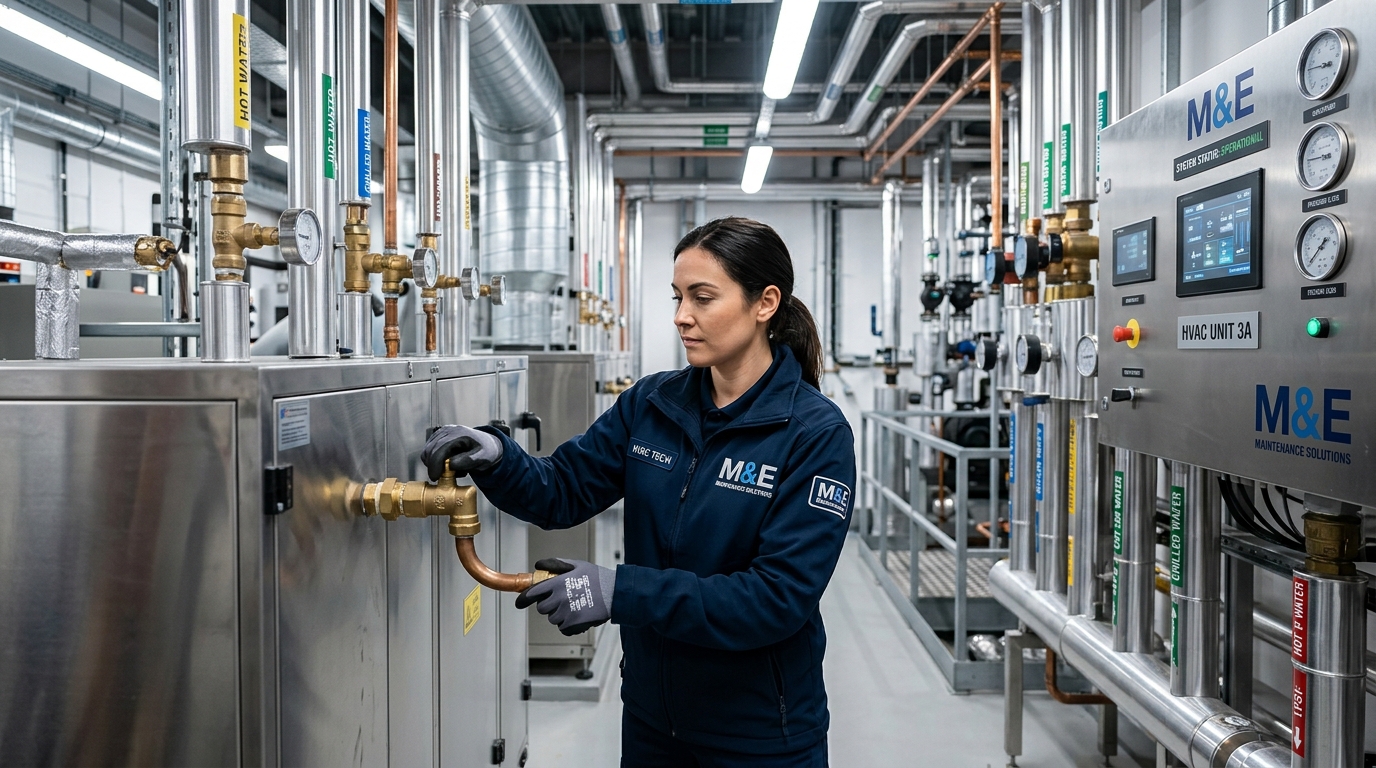
Understanding the hvac service maintenance price environment requires looking past the hourly rate. A cheap quote usually indicates a "filter and a prayer" approach. An engineer spends twenty minutes on site and ignores the deeper mechanical issues. Real value comes from a comprehensive technical audit: checking refrigerant charges, testing actuator motor torque, and calibrating thermostatic controls. These tasks require calibrated tools and certified expertise that a budget provider simply cannot offer.
| Service Type | Focus Area | Financial Impact | Longevity |
|---|---|---|---|
| Reactive Repair | Fixing broken components | High emergency fees and downtime | Decreased asset life |
| Basic Check | Visual inspection and filters | Moderate energy savings | Standard asset life |
| MEMS Proactive PPM | Total system optimisation | Lowest total cost of ownership | Maximum asset life |
Planned Preventative Maintenance (PPM) vs. Reactive Repairs
The "if it ain't broke, don't fix it" philosophy is the most expensive way to run a building. Reactive repairs force you into a position of weakness. You pay whatever the market demands for immediate parts and labour. In contrast, a PPM contract with M&E Maintenance Solutions allows for scheduled downtime during off-peak hours. This stabilises your operational budget and ensures small issues. Like a worn fan belt or a leaking valve. Are resolved before they cause a total system shutdown.
What a Comprehensive Commercial HVAC Service Visit Should Include
A professional service must go beyond the surface. It should involve a deep clean of heat exchanger surfaces to maintain thermal transfer efficiency. Engineers must check electrical terminations for hotspots using thermal imaging, as loose connections are a primary cause of control board failures. We also focus on sensor calibration. If your external air sensor is off by just two degrees, your plant might be heating and cooling simultaneously, fighting itself and wasting thousands of pounds in energy. That level of detail is why a "cheap fix" is often a precursor to a more expensive failure.
SFG20 and Beyond: Your Compliance Checklist for Commercial HVAC
SFG20 is the industry standard for building maintenance in the UK. It provides a definitive schedule of tasks that must be performed to keep equipment safe and efficient. For a facility manager, adhering to SFG20 is your best defence against negligence claims. It moves the conversation from "we think it's okay" to "we have followed the national standard." Our hvac service maintenance programmes are built around these benchmarks, ensuring that every pump, motor, and chiller in your estate meets the rigorous demands of modern legislation.
The Compliance Audit Checklist
- Are your F-Gas logs updated after every refrigerant check?
- Do you have a valid TM44 air conditioning inspection report (required every 5 years)?
- Are your gas appliances covered by a current Commercial Gas Safety Certificate?
- Does your provider use SFG20 task schedules for PPM visits?
The Risk of Non-Compliance: Fines and Tenant Relations
Non-compliance creates a friction point with tenants and stakeholders. In high-end commercial offices, tenants are increasingly savvy about their rights regarding air quality and thermal comfort. If you cannot produce maintenance records during a lease renewal or a dispute, your position is severely weakened. The legal liabilities associated with Legionella or refrigerant leaks are substantial. Proactive hvac service maintenance ensures your building remains a safe, productive environment, protecting both your staff and your professional reputation.
Questions to Ask Your Current Provider: Are They Truly Compliant?
Not all maintenance providers operate to the same standard. To verify that your current partner is genuinely compliant, ask these five questions:
- Which SFG20 task schedules do you follow for my specific equipment make and model?
- Do you provide a digital, time-stamped certificate after each service visit?
- How do you record and report F-Gas top-ups and leak checks to meet the 2026 quota reductions?
- Are your engineers Gas Safe registered for commercial appliances, not just domestic?
- What insurance indemnity do you carry in case a maintenance error causes a system failure?
If your provider hesitates or gives vague answers, it may indicate a gap in their compliance framework. A reputable firm will have these answers ready, because they live by the same standards every day.
Future-Proofing Your Estate: Integrating Sustainable Technologies with HVAC Maintenance
The commercial HVAC sector is shifting. Heat pumps, solar PV arrays, and enhanced insulation strategies are becoming standard in new builds and retrofit projects. These technologies offer lower carbon footprints and reduced energy bills, but they also demand a different maintenance approach. A heat pump relies on precise refrigerant charge and compressor cycling control. A solar PV system requires inverter health checks and panel cleanliness to maintain output. Integrating these systems into your existing hvac service maintenance plan ensures they perform as designed without unexpected downtime.
The Evolving Environment: How Heat Pumps, Solar PV, and LED Lighting Impact HVAC Maintenance
Heat pumps replace traditional gas boilers in many commercial sites, but they are not a "fit and forget" solution. They require annual refrigerant checks under F-Gas regulations, plus circuit board diagnostics to prevent inverter failures. Solar PV adds a renewable energy source that must be balanced with HVAC loads. LED lighting, while low maintenance, still needs driver replacements and thermal management. None of these technologies are exempt from the laws of physics: dirt, vibration, and electrical stress will degrade them over time. A maintenance programme that treats them as isolated components rather than integrated systems risks leaving efficiency gains on the table.
M&E's 'Open Door' Innovation: Vetted Technologies for Real-World Efficiency
We do not offer a technology simply because it is new. Our "open door" policy means we test every product we recommend in actual commercial environments before adding it to our portfolio. This approach protects you from the pitfalls of immature technology. When we install an air-to-water heat pump, we have already verified its performance envelope, spare part availability, and serviceability. This vetting process means that your hvac service maintenance plan is built on proven hardware, not marketing promises. The result is predictable performance and fewer surprises during service visits.
Advantages of Integrated Sustainable HVAC Systems
- Lower energy consumption and carbon footprint
- Eligibility for government grants and tax incentives
- Improved tenant satisfaction and property value
- Reduced reliance on fossil fuel price volatility
Considerations for Maintenance Planning
- Higher initial capital expenditure
- Need for specialist training on inverter-driven compressors
- Refrigerant handling restrictions under F-Gas phase-down
- Interdependency between electrical and mechanical systems
Optimising Total Cost of Ownership: Maintenance for Sustainable HVAC Systems
The true cost of any HVAC system includes installation, energy, and maintenance over its entire lifecycle. Sustainable technologies often have a longer design life than traditional boilers, but only if they receive the correct care. For example, a heat pump that is allowed to operate with a dirty evaporator coil will consume more electricity and suffer premature compressor wear. A solar array with shaded panels will underperform. By integrating these systems into a single, proactive maintenance schedule, you protect your investment and maximise the return on your sustainability spend. Our engineers are trained to assess the whole system, not just the thermal load.
Choosing a Partner Who Integrates Sustainability and Maintenance for Long-Term Savings
Selecting a maintenance provider who understands both traditional and modern HVAC technologies is essential. Look for a firm that holds F-Gas, Gas Safe, and SafeContractor certifications, and whose engineers receive ongoing training on heat pump diagnostics and solar inverter programming. At M&E Maintenance Solutions, we combine these credentials with a commercial focus. We do not treat sustainability as an add-on; we embed it into every service visit. This integration ensures that your move to lower-carbon operations does not create new gaps in your compliance or budget.
The MEMS Difference: Partnering for Predictable Performance and Asset Protection
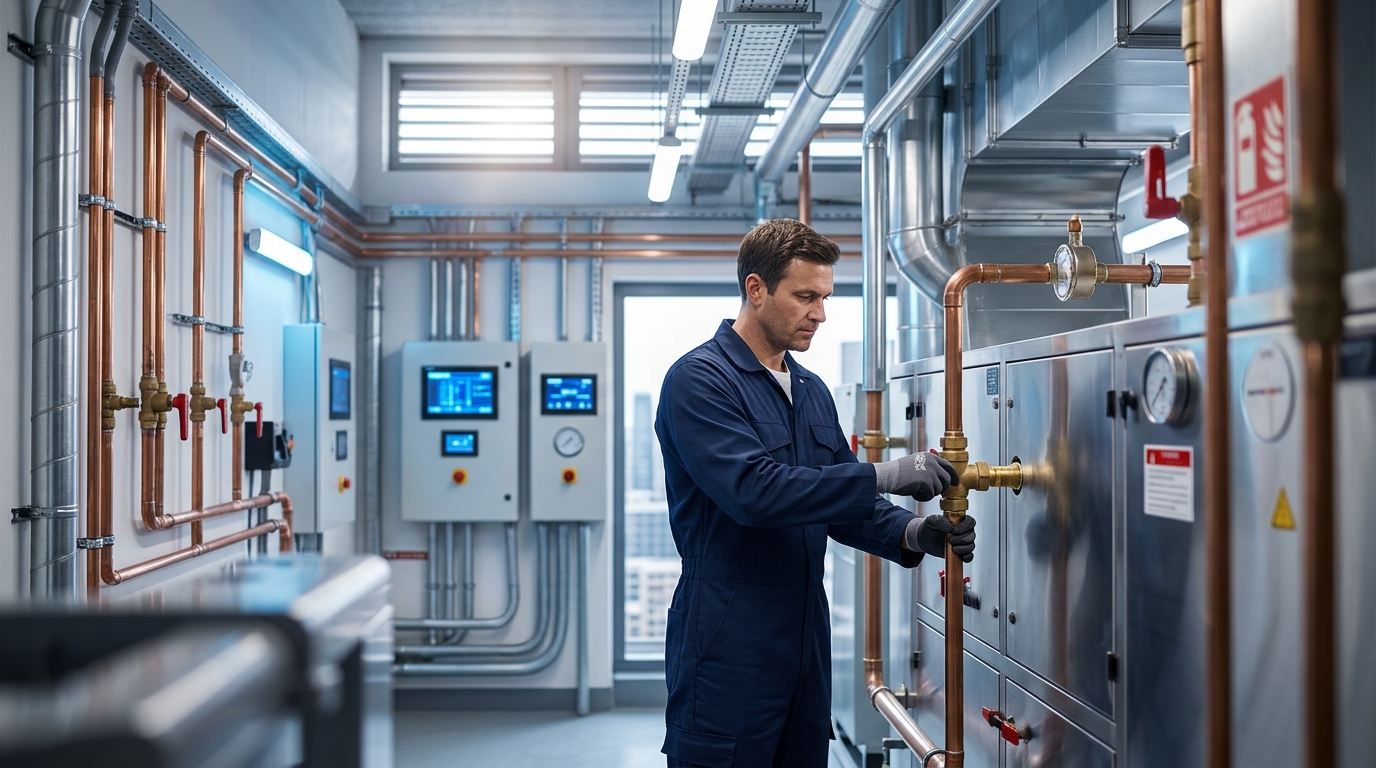
After 24 years working in commercial plant rooms across Birmingham and the West Midlands, I know that facility managers need more than a vendor. They need a partner who shares the weight of responsibility. M&E Maintenance Solutions was founded on the principle that maintenance is an investment in uptime, not a cost to be minimised. Our engineers are not contractors who come and go; they are career professionals who take ownership of your asset's health.
From Reactive Repairs to Proactive Asset Management: The MEMS Approach
We shift the focus from fixing failures to preventing them. Our PPM schedules are built using SFG20 as a baseline, then customised based on the actual condition and age of your equipment. We prioritise tasks that deliver the greatest risk reduction: condenser coil cleaning before summer, burner strip tests before winter. The result is a predictable operating budget and minimal unplanned downtime. We also provide digital dashboards that give you real-time visibility of your maintenance status, so you never have to wonder whether a visit was completed.
Our 'Customer First' Philosophy: Reliability, Transparency, and 24/7 Support
We answer our phones. When a system fails at 2 AM, you speak to a real person who can dispatch an engineer immediately. We communicate openly about parts costs, labour hours, and recommended upgrades. No hidden charges or surprise invoices. This transparency builds trust, which is why most of our new clients come through referrals. They appreciate being treated as partners rather than account numbers.
The MEMS Standard: Technical Expertise, Certified Engineers, and the 'Right First Time' Promise
Every engineer we employ holds relevant, current certifications: Gas Safe, F-Gas, SafeContractor, and ISO 9001. We invest in continuous training so our team stays ahead of evolving regulations and emerging technologies. Our "right first time" promise means we diagnose thoroughly before starting work, order the correct parts in advance, and complete the job without repeated call-outs. This approach saves you time, reduces disruption, and protects your building's reputation.
Why Facility Managers Choose MEMS: The Antidote to Faceless FM Providers
Large FM corporations often treat clients as numbers in a spreadsheet. We offer the opposite: a family-business culture with corporate-level capability. You deal directly with the people who perform the work, not a call centre. When you need a decision about a capital replacement, I am available to discuss options. This personal accountability ensures that every service visit adds value, not just ticks a box.
Ready to Secure Your Building's Future?
Do not wait for a breakdown to prove the value of professional maintenance. Book a proactive HVAC health check with M&E Maintenance Solutions today. We will assess your current system, review your compliance status, and deliver a clear plan to optimise performance and protect your asset. Contact us now to schedule your site survey.
Frequently Asked Questions
What maintenance should be done on HVAC systems?
A proper commercial service goes well beyond a filter change. It includes thermal imaging of electrical connections, cleaning heat exchanger surfaces, checking refrigerant charge and superheat, calibrating thermostatic controls, and verifying all SFG20 scheduled tasks. Skipping these steps lets small problems turn into expensive failures.
What is the $5000 rule for HVAC?
In residential contexts it's a rough guide suggesting you replace a system if the repair cost exceeds $5000. For commercial equipment the decision is more nuanced: you have to weigh emergency repair costs, energy efficiency losses, and the risk of a total shutdown against the cost of replacement. I always tell facility managers to look at total cost of ownership, not just the repair bill.
Why is preventative maintenance cheaper than reactive repairs?
Reactive repairs force you into a weak position. You pay premium rates for emergency call-outs and parts, and you often face lost revenue from downtime. Planned preventative maintenance (PPM) catches worn belts, leaking valves, and drifting sensors early, so your budget stays predictable and your equipment lasts years longer.
What compliance standards do commercial HVAC systems need to meet?
You need F-Gas compliance logs for every refrigerant check, a TM44 air conditioning inspection every five years, and a current Commercial Gas Safety Certificate for gas appliances. Following SFG20 schedules is your best defence against negligence claims and insurance rejection. We provide digital certification within 24 hours so you can always prove compliance.
What is the real cost of an HVAC breakdown in a commercial building?
The repair bill is often the smallest part. You face rapid asset depreciation a compressor burned out early forces an unplanned CAPEX request. There is lost business income, tenant dissatisfaction, and possible compliance fines. For a data centre or retail hub, a single chiller failure can cost more in downtime than the annual maintenance budget.
What should a commercial HVAC service visit include?
A thorough visit covers deep cleaning of coil and heat exchanger surfaces, thermal imaging to detect loose connections, sensor calibration, actuator torque testing, and refrigerant checks. If your outside air sensor is off by two degrees, your plant might heat and cool at the same time. That kind of waste hits your energy bill hard.