Compare local vs national ventilation repair companies Birmingham?
When a ventilation fan stops during trading hours, the failure rarely stays inside the plant room. Staff may report poor air quality, extraction may fall below a safe operating level, and a tenant or customer may notice before the facilities team receives an alarm. If you need to Compare local vs national ventilation repair companies Birmingham?, start with the cost of lost operation, not simply the engineer’s hourly rate.
I have spent more than 24 years working on commercial mechanical systems, from combustion equipment on the tools to managing maintenance across the West Midlands. The practical question is who can diagnose the fault properly, attend when promised and restore the asset without turning a repair into an unnecessary replacement project.
The Real Cost of Ventilation Failure in Birmingham: Beyond the Breakdown
A failed extract fan, seized bearing or damaged inverter can close a production area, disrupt a restaurant kitchen or make an office floor uncomfortable. In retail and leisure premises, inadequate air movement can affect customer experience and staff welfare. In industrial settings, poor extraction may interrupt a process or raise concerns about fumes, heat and airborne contamination.
The visible fault may be only the starting point. Ductwork contamination can contribute to up to 30% of commercial airflow reduction and increase fan motor strain, according to BESA guidance. The fan works harder, belts wear faster and electrical consumption rises. Commercial ventilation accounts for between 20% and 40% of an average UK commercial building’s total HVAC energy consumption, so neglected air-handling equipment can materially increase operating costs.
Emergency attendance can add premium call-out rates, rushed parts procurement, contractor administration, overtime and business interruption. A manager may receive quotations for the same air-handler remediation project with differences exceeding £4,000. That gap needs a technical explanation rather than automatic acceptance of the lowest or highest figure.
Choosing Your Partner: Local Independent vs. National Chain for Birmingham Ventilation Repair
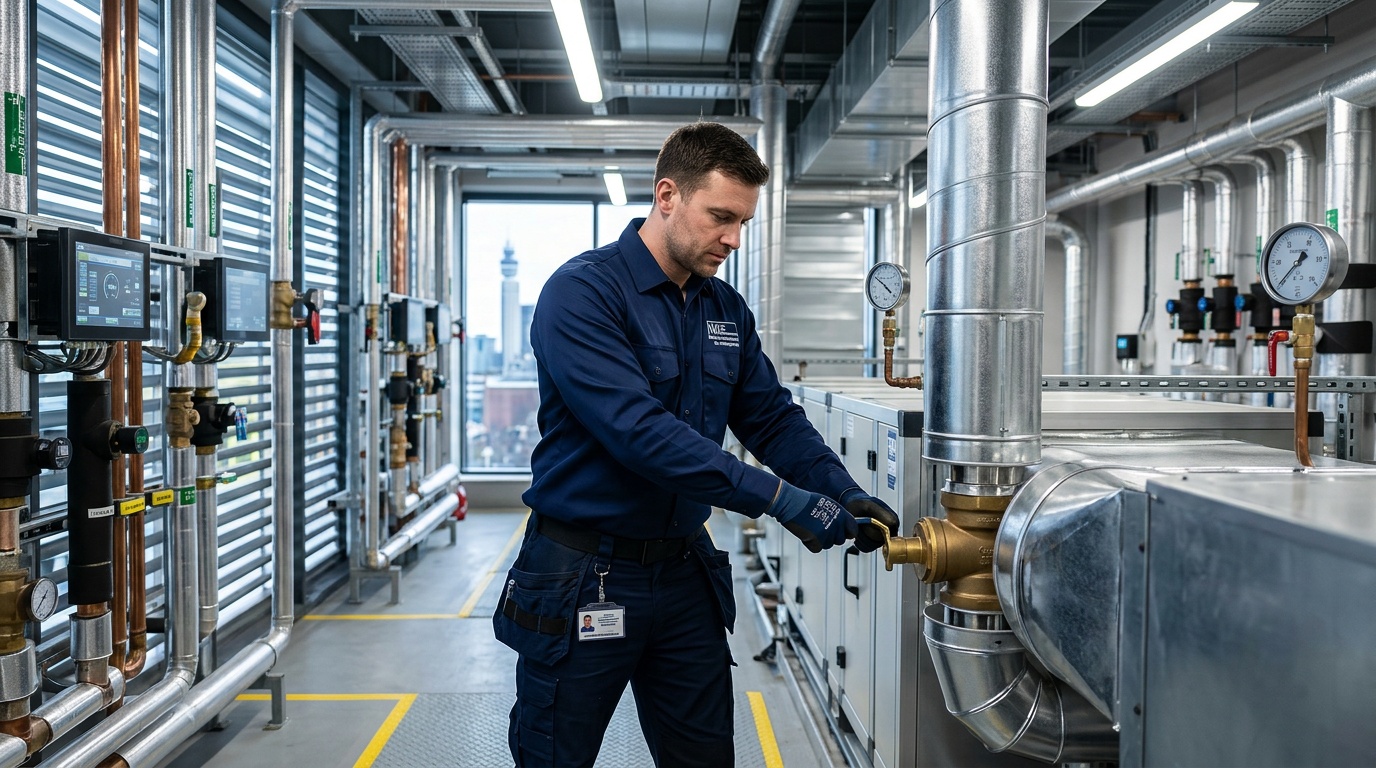
What We Mean by “Local Independent” vs. “National Chain”
A local independent contractor is normally built around engineers who live within the region and work directly with the management team. The same technical knowledge can carry from an emergency visit into planned preventative maintenance, asset registers and future budgeting. A national chain may offer broad geographic coverage, central procurement and one contract structure, but the first contact is often a call centre. Attendance may depend on availability within a wider subcontractor network.
Ownership also matters. A private-equity-backed business may have strong systems and purchasing power, yet commercial targets can affect contract margins, administration charges and recommendations. This does not make every national provider unsuitable. It means a facilities manager should test how decisions are made at site level.
The Facility Manager’s Checklist: Key Comparison Points
- Attendance: Is there a named Birmingham or West Midlands engineer, or only a central dispatch number?
- Technical diagnosis: Will the provider test motors, bearings, belts, capacitors, controls and inverters before proposing replacement?
- Cost clarity: Are call-out fees, labour rates, mileage, out-of-hours charges and parts mark-ups shown separately?
- Continuity: Will repair history, photographs, readings and recommendations remain with your building record?
- Capability: Can the contractor support fans, air-handling units, ductwork, extraction, filtration and controls?
Performance Benchmarking: Response Times and Call-Out Speed in the West Midlands
Local Advantage: True 24/7/365 Availability and Proximity
Geography affects response time. Birmingham’s road network, city-centre congestion, industrial estates across the Black Country and motorway incidents can change an expected arrival window. A West Midlands provider can make a more realistic decision about engineer allocation, access routes and parts availability. Strong local arrangements provide a direct escalation path instead of asking a facilities manager to explain the same fault to several call handlers.
Twenty-four-hour availability needs definition. Ask whether it means a person answering the telephone, an engineer on call, or a message passed to a subcontractor during the next working period. For a failed kitchen extract system or a fault affecting occupancy, those are different levels of protection.
National Chains: The Centre-Dispatch Dilemma
A national chain can mobilise resources across several regions, which may suit organisations with many sites and one procurement process. The weakness appears when a local issue enters a tiered workflow: a call centre logs the fault, a service desk checks contract terms, a regional planner searches for availability, and a third-party engineer receives limited background information. Each handover can delay attendance or cause repeat diagnosis.
The first engineer may identify a symptom rather than the cause, order parts without full confirmation, or recommend a return visit. A facilities manager then pays for time without achieving a first-time fix. Ask for the target attendance window, escalation route and identity of the engineer before signing the contract.
| Operational factor | Local independent specialist | National maintenance chain |
|---|---|---|
| Initial contact | Often direct access to a regional service team or engineer | Usually central call handling and contract verification |
| Travel and attendance | Local knowledge can support practical routing across Birmingham and the West Midlands | Availability may depend on regional resource and subcontractor allocation |
| Site familiarity | Knowledge can build through repeat visits and maintenance history | Engineer allocation may change between visits |
| Emergency diagnosis | Typically focused on restoring operation through component testing and repair | Process may involve several approval and reporting stages |
| Communication | Direct discussion of access, symptoms, risks and next actions | Updates may pass through service desks and account managers |
Beyond the Clock: First-Time Fix Rates and Engineer Familiarity
Speed is not only the number of minutes before arrival. It is the time from the first call to a safe, documented and lasting repair. An engineer familiar with commercial ventilation can inspect airflow, listen for bearing noise, check belt tension, test electrical protection and assess control signals in one structured visit. This reduces repeat attendance and gives the manager evidence for the repair decision.
When you Compare local vs national ventilation repair companies Birmingham?, request evidence of the complete response process. Ask how faults are triaged, whether common fan and motor parts are carried, who approves remedial work and how readings are recorded. MEMS supports this repair-first model through Commercial Ventilation Repair Services, directing technical attention towards restoring uptime rather than creating an automatic replacement recommendation.
Response Model: Practical Strengths and Limitations
Pros
- Regional specialists can offer direct communication and stronger site familiarity.
- Repair-led attendance may reduce repeat visits and unnecessary asset replacement.
- Local road and building knowledge supports realistic emergency planning.
Cons
- Coverage and parts stock vary between independent contractors.
- A national chain may provide simpler procurement across a large multi-site estate.
- Service quality depends on the named local engineer, not only the parent brand.
Before appointing a contractor, obtain the written call-out structure and ask who takes responsibility from the first telephone conversation through completion. Commercial Ventilation Repair Services should leave you with a clear fault description, work completed, parts used, outstanding risks and a sensible recommendation for the next maintenance period.
Engineering Depth vs. Sales Pitch: Diagnostics and Pricing Transparency
The difference between a sound repair and an expensive replacement often appears during the first inspection. An experienced ventilation engineer will check motor current, capacitor condition, inverter output, bearing noise, belt tension, fan alignment, controls, filters and measured airflow before making a recommendation. If you need to Compare local vs national ventilation repair companies Birmingham?, ask whether the attending person can repair the equipment or only report its condition to a sales team.
The “Dirty Hands” Diagnostic: Local Specialists
A local mechanical specialist can inspect the plant, speak directly with the facilities manager and decide from evidence. A worn bearing may need replacement while the fan casing, motor and controls remain serviceable. A loose belt may explain poor extraction. A failed capacitor or inverter fault may be isolated without condemning the complete air-handling unit.
This repair-first discipline can reduce downtime and parts expenditure while preserving useful asset life. The engineer should provide photographs, test readings, a fault description and separate recommendations for immediate repair and planned improvement. Commercial Ventilation Repair Services follows this model, combining mechanical inspection with an explanation of operational and financial implications.
Corporate Playbook: Commissioned Replacements vs. True Repair
A national chain may have wider procurement, formal reporting systems and manufacturer relationships. The risk arises when an inspection becomes part of a replacement sales process. A commissioned survey can favour a new air handler, extraction unit or fan assembly even when a motor rewind, bearing change, belt replacement or inverter check could restore operation safely.
Private-equity ownership does not automatically mean poor engineering, but it can introduce margin targets, management fees and pressure to increase contract value. Ask who approves remedial work, whether the attending engineer can quote a component repair, and whether the report explains why repair is unsuitable. A replacement recommendation should include equipment age, condition, parts availability, expected remaining service life, energy performance and the cost of continued repair.
Understanding Call-Out Charges, Labour Rates, and Hidden Markups
Two quotations can differ when one includes travel, administration, diagnosis, out-of-hours attendance and subcontractor management in a single figure. Request an itemised quotation showing the call-out charge, standard and emergency labour rates, mileage, access equipment, parts, disposal and any management fee. Confirm whether the first diagnostic visit is included in the repair price or charged separately.
| Pricing and diagnostic factor | Independent West Midlands specialist | National maintenance chain |
|---|---|---|
| Fault assessment | Direct engineer inspection with component-level testing | May involve a survey, approval route and separate remedial quotation |
| Repair scope | Can focus on motors, bearings, belts, capacitors, controls and inverters | May present full assembly replacement where repair authority is limited |
| Quotation structure | Often discussed directly with the person managing the work | Can include administration, account management and subcontractor charges |
| Evidence supplied | Photographs, readings, fault findings and parts recommendations | Formal reports may be produced through a central service process |
Why Local Providers Often Offer Better Value on Repairs
Value is the total cost of returning the system to safe, dependable operation, not the lowest hourly rate. A local provider can reduce duplicated diagnosis, unnecessary transport, approval delays and additional attendance. Direct discussion also lets the manager challenge a replacement recommendation and compare repair with planned capital expenditure.
Facilities managers have reported quotation differences exceeding £4,000 on identical commercial ventilation repair and air-handler remediation projects. That is why Commercial Ventilation Repair Services should be judged by technical evidence, transparent pricing and completed repair quality, not a polished sales presentation. At MEMS, the objective is to diagnose the fault, repair what remains serviceable and give you an honest asset decision.
Compliance and Accountability: Navigating UK Regulations with Your Provider

TR19 Duct Hygiene: The Unseen Compliance Minefield
Ductwork may sit above ceilings or inside service risers, but that does not remove the responsibility to inspect and maintain it. BESA TR19 provides recognised guidance for ventilation system cleanliness, inspection and hygiene assessment. Contamination can restrict airflow, increase fan loading and create an avoidable issue for occupants, insurers or an inspecting authority.
Ask the contractor to record access points, internal condition, photographs, air volume readings and cleaning recommendations. “Ducts require attention” is not a sufficient compliance record. The building file should show the reason for the work, areas inspected, standard applied and person who accepted the recommendation.
SFG20 Standards: The Benchmark for Commercial Maintenance
SFG20 provides a structured reference for planned maintenance tasks, frequencies and expected outcomes. It is not a substitute for competent engineering judgement, but it helps prevent equipment being serviced only after failure. Ventilation maintenance may include fan assemblies, belts, bearings, filters, motors, controls, grilles, dampers, air-handling units and extract systems.
A credible provider should connect the planned schedule with asset condition. If a fan shows abnormal vibration, the record should lead to investigation rather than a routine tick-box entry. The contractor should explain any deviation from the planned task and identify the risk, budget implication and proposed timescale.
Accountability and Traceability: Who's Truly Responsible?
The duty holder remains responsible for managing workplace risks when maintenance is outsourced. UK HSE workplace guidance emphasises safe systems, competent persons, suitable equipment and effective risk control. A contractor can provide technical support, but a facilities manager still needs evidence that work was planned, authorised and completed safely.
- Competence: Confirm the engineer’s relevant mechanical, electrical and ventilation experience.
- Records: Require job sheets, photographs, measurements, parts fitted and outstanding actions.
- Risk control: Check that isolation, access, working at height and occupied-area risks are addressed.
- Standards: Ask how TR19 guidance, SFG20 tasks and applicable HSE requirements are incorporated.
- Escalation: Establish who approves urgent repairs, temporary controls and capital replacement proposals.
Traceability should run from the initial fault report to the final invoice. If different subcontractors attend, insist that findings return to one controlled asset record. This prevents repeated diagnosis and provides a defensible history during audits, insurance reviews or landlord discussions.
The “Right First Time” Approach: Ensuring Long-Term Building Health
Compliance is not achieved by producing paperwork after an incident. The system must be safe, serviceable and maintained according to its condition. A repair-first inspection can identify whether a worn bearing, damaged belt, motor fault or control issue is responsible, while also identifying airflow, hygiene and access concerns requiring planned attention.
What a responsible provider should deliver
- Named technical ownership of the work.
- Clear distinction between immediate repair and future improvement.
- Accurate records that support asset lifecycle planning.
Warning signs in a maintenance arrangement
- Certificates without measurements or supporting photographs.
- Replacement recommendations without component testing.
- Unclear responsibility for unresolved defects.
Making the Right Choice for Your Birmingham Facility
Recap: Local Independence vs. National Reach
A national chain may suit a large estate needing one procurement route and consistent reporting. A capable Birmingham independent can offer closer communication, direct engineering judgement and continuity between emergency repair and planned maintenance. The better choice depends on who demonstrates competent attendance, transparent pricing, proper records and ownership of the result.
Partnering for Uptime and Compliance: The MEMS Difference
MEMS Facilities Maintenance brings practical mechanical experience to the decision. Our Commercial Ventilation Repair Services are built around accurate diagnosis, safe repair and clear communication. The aim is not to sell a replacement by default, but to protect uptime, maintain building standards and give the facilities manager an honest view of asset condition.
Your Next Step: Ensuring Your Ventilation System’s Longevity
If you need to Compare local vs national ventilation repair companies Birmingham?, assess the evidence behind each proposal. Request the engineer’s findings, compliance approach, attendance process and full cost breakdown before approving work. Choose a partner who can support both the immediate fault and the next maintenance period.
Frequently Asked Questions
What are the best commercial ventilation repair companies in Birmingham?
The best commercial ventilation repair companies in Birmingham combine fast attendance, sound fault diagnosis and clear pricing. MEMS Facilities Maintenance supports commercial HVAC and ventilation requirements with experienced engineers, planned maintenance and emergency response. Check local knowledge, technical scope, engineer availability, insurance, reporting and the ability to repair fans, controls, ductwork and air-handling equipment.
What is the most reliable ventilation repair company in Birmingham?
The most reliable ventilation repair company in Birmingham is one that provides a defined response window, qualified engineers and consistent communication from diagnosis through completion. A dependable provider records airflow readings, photographs, parts fitted and recommendations, giving the facilities team a useful service history and a clearer basis for future maintenance decisions.
Is a local ventilation company better than a national chain in Birmingham?
A local ventilation company can be better for Birmingham sites that need direct communication, realistic travel planning and continuity of engineering support. A national chain may suit organisations managing multiple locations through one procurement process. Compare the named engineer, escalation route, subcontractor use, attendance target, reporting standards and total charges before choosing.
How should I compare ventilation repair quotes in Birmingham?
Compare Birmingham ventilation repair quotes by checking diagnosis, labour, call-out charges, mileage, parts mark-ups, out-of-hours rates and any recommended follow-up work. A low quotation may exclude testing or essential repairs, while a higher quotation may include unnecessary replacement. Ask each contractor to explain whether the fan, motor, inverter, belts and controls were tested.
What should I check before choosing a national HVAC company for Birmingham?
Check the national HVAC company’s Birmingham attendance arrangements, engineer identity, subcontractor policy and escalation process before signing a contract. Ask whether the provider can support ventilation, extraction, air-handling units, filtration and controls, and whether service records stay with your building. Central dispatch can work well, but site-level accountability should be clear.
Are some ventilation fan brands best avoided?
No ventilation fan brand should be avoided solely by name, because suitability depends on duty, installation quality, controls, access to parts and maintenance history. A Birmingham ventilation engineer should assess the existing fan assembly, motor, bearings, belts, inverter and airflow before recommending repair or replacement. The right decision depends on the asset and operating conditions.
Does local knowledge affect emergency ventilation repairs in Birmingham?
Local knowledge can affect emergency ventilation repairs in Birmingham by helping engineers plan around city-centre congestion, industrial estates, access restrictions and parts availability. A nearby contractor may also provide a more direct escalation path. Ask whether 24-hour cover means a live response, an engineer on call or referral to another provider.