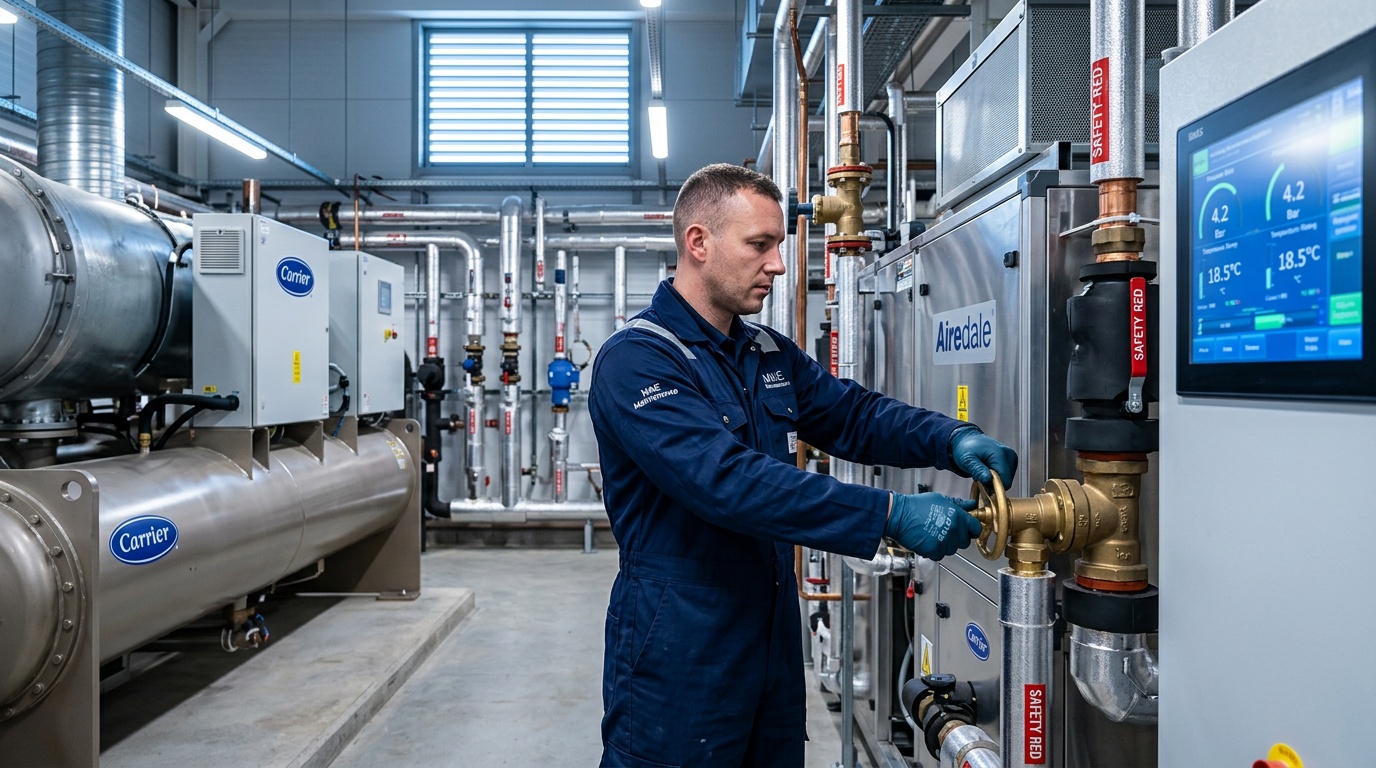
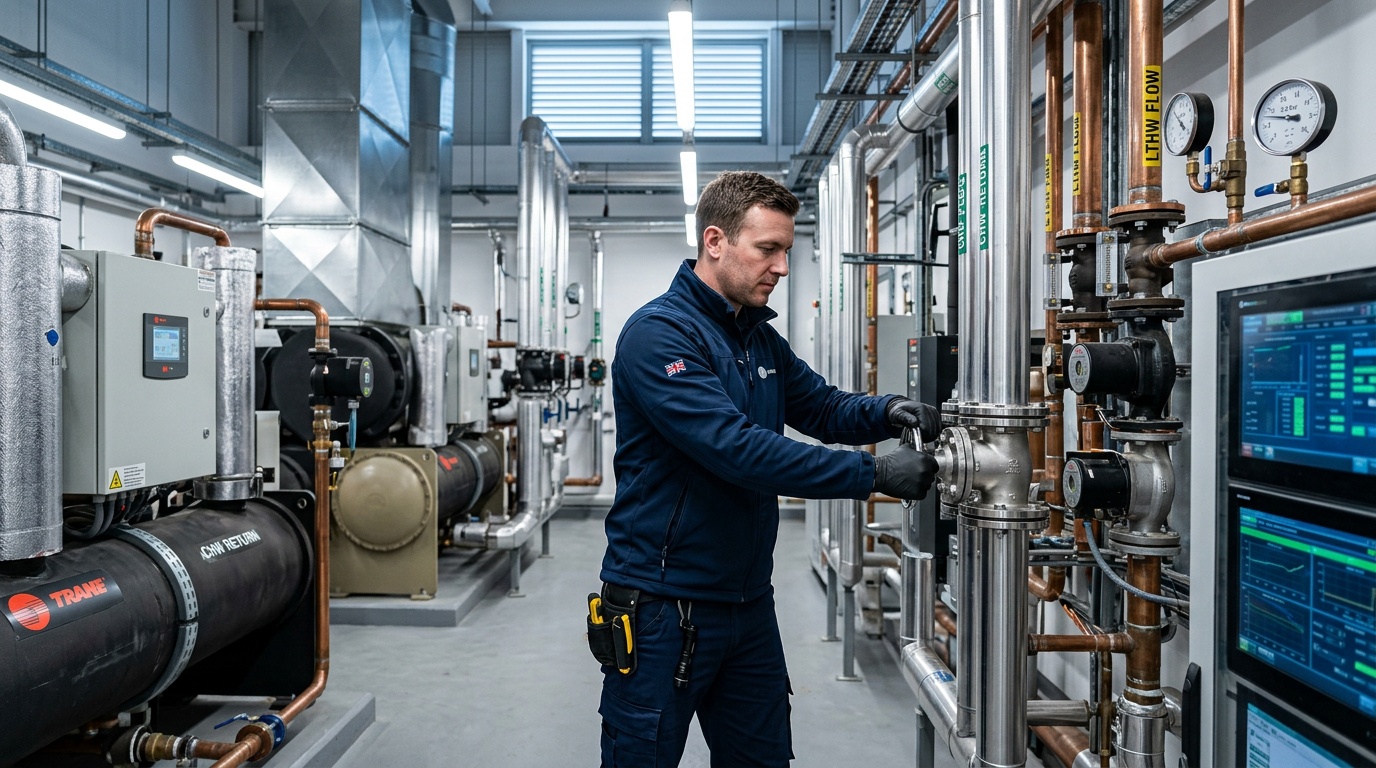
If you are assessing M&E Maintenance Solutions alternatives, the right choice depends on the estate, not the provider with the largest logo. A specialist contractor is usually the strongest fit for ongoing HVAC maintenance, compliance and engineer continuity. An integrated FM firm suits a national portfolio requiring one contract across many services. Infrastructure contractors are better suited to major projects, estates work and long-term capital programmes.
Key Takeaways
If you are assessing M&E Maintenance Solutions alternatives , the right choice depends on the estate, not the provider with the largest logo.
A specialist contractor is usually the strongest fit for ongoing HVAC maintenance, compliance and engineer continuity.
An integrated FM firm suits a national portfolio requiring one contract across many services.
From my experience in commercial plant rooms, the sensible starting point is an asset register, a review of failure history and a clear distinction between planned maintenance and emergency response. That tells you whether you need a hands-on M&E partner or a wider facilities management structure.
What M&E maintenance actually covers: HVAC, electrical, plumbing, BMS, water systems and building fabric
Mechanical and electrical maintenance covers the services that keep a commercial building safe, comfortable and usable. Mechanical work includes heating, ventilation, air conditioning, refrigeration, pumps, boilers and heat exchangers. Electrical duties may include distribution boards, lighting, emergency lighting, controls and testing. Depending on the contract, the scope can also include plumbing, drainage, water hygiene, legionella controls, the building management system, fire interfaces and selected building fabric.
Do not accept a broad service label without checking the schedule. A contractor may be highly capable in HVAC yet not provide electrical testing or water hygiene directly. M&E Maintenance Solutions specialises in maintenance of commercial buildings with a focus on Heating, Ventilation and Air Conditioning (HVAC). Its listed complementary services include Air to Air heat pumps, Air to Water heat pumps, Solar PV, LED Lighting and Solar Thermal.
The named alternatives at a glance: comparison table by provider type, strengths, limitations and best-for
The names below are not interchangeable. They represent different delivery models, contract sizes and areas of technical depth. Provider capability, local coverage and subcontractor arrangements must be checked during procurement, rather than assumed from brand recognition.
Provider
Category
Strength
Limitation to test
Best fit
CBRE
Integrated FM
National account infrastructure
May feel process-led for smaller sites
Large multi-site estates
JLL
Integrated FM
Portfolio governance
Contract complexity
Corporate property portfolios
Cushman & Wakefield
Integrated FM
Property and FM breadth
Local engineer continuity requires confirmation
Managed commercial estates
Colliers
Property and FM
Real estate management
Technical delivery model varies
Landlord-led portfolios
ABM UK
Integrated FM
Bundled facilities services
Scope and self-performance need review
Sites seeking consolidated services
Amey
Infrastructure services
Public infrastructure capability
May exceed the needs of a single commercial site
Public and complex estates
AECOM
Engineering and consultancy
Design and technical advisory
Not always the day-to-day maintenance provider
Major engineering programmes
EMCOR
Engineering FM
Technical facilities management
Commercial fit depends on estate scale
Complex built assets
Johnson Controls
Technology-led FM
Building controls and systems
Potential dependence on proprietary equipment
Controls-led environments
Siemens
Technology-led FM
Automation and energy systems
Broader maintenance scope needs definition
Smart building programmes
BAM Nuttall
Construction and infrastructure
Major works delivery
Less tailored to routine HVAC visits
Infrastructure and capital projects
Balfour Beatty
Construction and infrastructure
Large programme management
May be disproportionate for smaller estates
Major public and infrastructure assets
Joy Services Group
FM and maintenance
Broad facilities support
Technical depth must be evidenced
Organisations seeking wider FM cover
Is a specialist like M&E better for ongoing maintenance than BAM Nuttall or Balfour Beatty?
For a commercial estate where HVAC uptime, planned servicing and rapid fault diagnosis are the priority, M&E Maintenance Solutions is the more natural fit than a construction-led contractor. Founded in 2007, the company serves Facility Managers and Estate Managers throughout the UK, with over 20 core staff and a growing number of strategic partners. Its certifications include SafeContractor, Refcom F-Gas Certification, Gas Safe Register, BES and ISO 9001, subject to current verification during tendering.
BAM Nuttall and Balfour Beatty can be appropriate for infrastructure delivery, construction interfaces, highways, public assets and sizeable capital schemes. They should not be judged as poor providers simply because their operating model differs. The question is whether the contract needs a project organisation or engineers who know the air-handling unit, pump set and controls sequence at your site. For recurring maintenance, continuity and detailed service records usually matter more than corporate scale.
Specialist M&E Contractor, Integrated FM Provider or Infrastructure Contractor: Which Model Fits?
The specialist contractor route: PPM scope, review frequency and SFG20-aligned maintenance schedules
A specialist contractor normally concentrates on defined plant and systems. The contract should identify every asset, manufacturer instruction, service interval, statutory inspection and response category. A proper PPM schedule is reviewed after seasonal changes, equipment modifications and repeated faults. SFG20 provides a recognised maintenance framework, but the site-specific risk assessment still matters. Gas work requires appropriately registered engineers, F-Gas work requires competent handling of refrigerants, and records must be available for audit.
The commercial benefit is direct accountability. You know who diagnosed the fault, which readings were taken, which part was recommended and why the repair was necessary. That reduces duplicated call-outs and makes lifecycle planning more credible.
When a global integrated FM provider earns its fees
CBRE, JLL, Cushman & Wakefield and ABM UK can earn their fees where one contract must coordinate hard FM, soft services, helpdesk control, compliance reporting and multiple locations. Their scale can support procurement, mobilisation, national coverage and management information. The tender must still state which activities are self-performed, which are subcontracted and who remains accountable for missed inspections or failed repairs.
Where infrastructure and construction-led firms are the better fit
Balfour Beatty, BAM Nuttall, Amey and AECOM are more closely associated with infrastructure, engineering, construction delivery and major programmes. They may suit transport estates, public-sector frameworks, construction interfaces or planned refurbishment. For routine commercial HVAC maintenance, confirm local attendance, engineer allocation, spare-parts support and the handover process after project completion.
Product-led building-technology firms: strengths and trade-offs
Johnson Controls and Siemens bring depth in building automation, controls, energy monitoring and connected systems. That is valuable where poor scheduling, sensor faults or a badly configured BMS are driving energy waste and comfort complaints. The trade-off is scope: a controls specialist may not be the best single contractor for every mechanical asset. Check system compatibility, data ownership, open protocols, software charges and the route for non-controls repairs before appointing them.
Pros of matching the model to the estate
Clearer compliance ownership and escalation.
Better alignment between PPM, reactive work and capital planning.
Fewer scheduling conflicts between specialist suppliers.
Cons of choosing by brand size alone
Routine sites may receive an unnecessarily complex contract structure.
Subcontractor hand-offs can weaken engineer continuity.
Broad service language can conceal exclusions and additional charges.
How to Compare Providers Honestly: A Weighted Scorecard and Red-Flag Checklist
If you are comparing M&E Maintenance Solutions alternatives, do not rank suppliers by brand visibility alone. Score the service you will actually receive: competent engineers, planned maintenance discipline, statutory records, response control and honest diagnosis. I recommend weighting each area against your estate’s risk profile, then asking every bidder for the same evidence. That turns a persuasive sales presentation into a procurement decision you can defend.
The eight-point weighted scorecard: technical scope, compliance, response time, coverage, sustainability, digital reporting, partner governance and total cost of ownership
Give each criterion a percentage weight before proposals arrive. A temperature-controlled manufacturing site may place more emphasis on technical scope and response time, while a distributed office estate may give greater weight to geographic coverage and reporting. Do not allow a low hourly rate to disguise weak asset management, restricted attendance or expensive exclusions.
Criterion
Evidence to request
Commercial question
Technical scope
Asset register, engineer competencies and sample PPM schedule
Can one team maintain the equipment that causes the greatest disruption?
Compliance
Gas Safe, F-Gas, SFG20 approach, permits and audit records
Who owns the legal duty and where are certificates stored?
Response time
Priority definitions, call logs and escalation process
What happens outside normal working hours?
Coverage
Engineer locations, holiday cover and subcontractor plan
Will attendance remain reliable across every site?
Sustainability
Energy surveys, controls reviews and lifecycle proposals
Can the contractor reduce consumption without compromising comfort?
Digital reporting
Job reports, photographs, readings and certificate examples
Can the facilities team verify completion without chasing paperwork?
Partner governance
Approved supplier register, vetting and escalation records
Who remains accountable when another company attends?
Total cost of ownership
Exclusions, parts policy, renewal terms and five-year cost model
What will the contract cost across the asset lifecycle?
Red flags that signal a cheap contract will cost you more: opaque diagnoses, unnecessary replacements and unqualified subcontractors
A low monthly fee can become expensive if the agreement encourages repeated call-outs, limits fault-finding or excludes the equipment that fails most often. Be wary of a diagnosis that says “replace the unit” without measured pressures, electrical readings, photographs, alarm history or a repair assessment. A reliable contractor explains the fault in plain English and separates an urgent safety issue from a planned capital recommendation.
Missing records: F-Gas logs, gas safety documents or inspection certificates are not supplied promptly after attendance.
Unclear exclusions: labour, refrigerant, access equipment, controls faults or consumables appear outside the quoted scope.
Changing personnel: a different face attends every visit, with no useful site history transferred.
Unqualified delivery: the bidder cannot identify the engineer or subcontractor responsible for regulated work.
Weak escalation: repeated breakdowns generate separate invoices rather than a root-cause review.
Questions to ask every bidder: a sample tender brief you can reuse
Copy the questions below into your tender pack. Require written answers, named contacts and supporting documents. This is especially useful when reviewing M&E Strategic Partner Programme reviews, because provider-authored material is promotional evidence, not an independent service audit.
Reusable tender brief:
Which assets will you maintain directly, and which tasks will approved partners complete?
Show your proposed PPM schedule, service frequencies and method for handling manufacturer instructions.
Provide sample job reports containing readings, photographs, parts fitted and engineer recommendations.
How quickly will gas safety and F-Gas documentation reach the client after a visit?
Who authorises replacement equipment, and what evidence must support that recommendation?
Describe out-of-hours escalation, holiday cover and repeat-failure management.
List all exclusions, additional charges, renewal terms and planned price changes.
Provide two commercial references with comparable equipment and estate complexity.
Who Answers When It Goes Wrong? Assessing Partner Programmes, Subcontractor Governance and Handovers
How to review a partner programme with evidence instead of marketing claims: who stays accountable, who escalates, what happens when work fails
A strategic partner model can widen technical coverage without forcing one contractor to employ every specialist. The risk appears when responsibility becomes blurred. Ask for the operating chart: contract owner, service desk, attending engineer, technical reviewer and senior escalation contact. Confirm that the lead provider owns communication, quality checks and remediation, even when a sister company or subcontractor performs the work.
Methodology box: Treat claims as unverified until matched with a contract clause, current accreditation, engineer competency record, sample certificate or reference conversation. Ask what happens after a failed repair, who pays for the return visit, how the root cause is recorded and how repeated poor performance removes a partner from the approved list.
Service continuity and handover after installations and capital projects
The handover period is where maintenance debt often begins. A newly installed air-conditioning system, heat pump, control panel or lighting scheme needs more than an operations manual. The maintenance provider needs final drawings, asset tags, commissioning results, warranty details, control sequences, passwords, spare-parts information and planned service intervals. Without those records, the first breakdown becomes a rediscovery exercise paid for by the building owner.
Before practical completion, include the maintenance team in witness testing and operator training. Transfer the asset register into the job-management system, agree defect ownership and schedule the first review after occupation. That preserves continuity from project delivery into routine PPM.
How internal product trialling should work: what gets tested, how reliability is measured, how risk is documented
M&E Maintenance Solutions has an open door policy towards evaluating and testing new HVAC technologies before offering them to customers. A responsible trial still needs written controls: defined performance objectives, compatibility checks, electrical and refrigerant safety review, manufacturer support, monitoring data and an approval owner. Test equipment should be installed at a suitable site with a clear fallback plan, not presented as proven solely because it is new.
Record baseline energy use, comfort conditions, faults and operating hours.
Set a review period, acceptance criteria and stop conditions before installation.
Document training, maintenance requirements, warranties and cyber or controls risks.
Review findings with the facilities manager and compliance lead before wider adoption.
Matching the Provider to the Estate: Best-for Recommendations, Sustainability and Making the Switch
If you are assessing M&E Maintenance Solutions alternatives, match the provider to the estate’s risk, location and technical demands. The largest FM brand is not automatically the best choice for a single office, retail unit or Midlands industrial site. A specialist can offer closer engineering involvement, while a national integrator may suit a portfolio that needs one helpdesk, one contract and consistent reporting across many locations.
Best-for matrix: small single sites, mid-sized UK estates, multi-site national portfolios, public-sector frameworks and specialist environments
Start with the operational problem rather than the supplier list. Record the number of sites, critical plant, opening hours, statutory duties, access restrictions and the consequence of a heating or cooling failure. A specialist HVAC contractor is often the practical choice for a small or mid-sized commercial estate. Larger organisations may need integrated facilities management, procurement support and national mobilisation. Public-sector and highly regulated environments may require framework access, formal social-value reporting and detailed assurance processes.
Estate or sector
Best-fit provider model
What to prioritise
Recommended direction
Small single site
Local specialist contractor
Engineer continuity, responsive attendance and clear exclusions
Choose a focused HVAC partner with transparent service records
Mid-sized UK estate
Specialist or regional FM provider
Planned maintenance, compliance management and coordinated suppliers
Use one accountable technical lead wherever possible
Multi-site national portfolio
Integrated FM provider
Helpdesk control, geographic coverage, consistent KPIs and mobilisation
Test local delivery, subcontractor governance and escalation
Public-sector framework
Framework-approved contractor or infrastructure provider
Procurement rules, audit trails, social value and lifecycle planning
Confirm framework scope and named delivery resources
Specialist environment
Technical specialist with sector experience
Redundancy, environmental control, business continuity and response cover
Appoint against proven competency, not a generic service promise
For commercial buildings where HVAC reliability and compliance are central, M&E Maintenance Solutions is the recommended route to assess first. The company focuses on commercial HVAC maintenance, serves Facility Managers and Estate Managers throughout the UK, and offers complementary Air to Air heat pumps, Air to Water heat pumps, Solar PV, LED Lighting and Solar Thermal. It may not be the right single supplier where a client requires a complete soft-services contract across a national estate. That honest boundary is part of sound procurement.
Sustainability and energy efficiency: heat pumps, solar PV, LED retrofits and the BMS data that cuts reactive call-outs
Energy efficiency should be assessed alongside maintenance, not added as a separate conversation years later. A site survey can identify poor scheduling, blocked filters, incorrect set points, refrigerant issues, failing sensors and simultaneous heating and cooling. BMS trend data can show when plant runs outside occupied hours or cycles unnecessarily. From there, a contractor can assess Air to Air or Air to Water heat pumps, Solar PV, LED Lighting and Solar Thermal against available capacity, roof condition, controls integration, payback expectations and maintenance requirements.
The right proposal connects carbon reduction with asset reliability. A heat pump that is badly commissioned will not deliver the expected performance. A lighting retrofit without control zoning may leave savings unrealised. Ask for baseline readings, commissioning information, metering arrangements and a post-installation review. M&E Maintenance Solutions states that its sustainable solutions are intended to help clients save money, improve working environments and maintain compliance with current legislation.
Digital job management: live job visibility, traceable compliance certificates and audit-ready reporting
Digital job management is now a practical control, not a decorative feature. Your facilities team should be able to see open jobs, priority, attendance status, engineer notes, photographs, parts used and outstanding recommendations. Compliance documents should connect to the relevant asset and site, with an accessible history for audits, insurance reviews and landlord reporting.
The Joblogic case study reports that M&E used its HVAC software for more than six years at the time of publication, with reported improvements in turnover, staff retention and customer referrals. Those are case-study-reported outcomes, not independently audited market statistics. During a tender, request a live demonstration using your asset register and ask how data is exported if the contract ends.
Your questions answered: FAQs about switching M&E maintenance providers
How difficult is it to change provider? The process is manageable when the current contract, asset register, service history, warranties and compliance records are reviewed before notice is served. Agree access arrangements and a handover timetable early.
Will switching interrupt planned maintenance? It should not. Map every upcoming inspection, statutory test and manufacturer service, then assign ownership before the outgoing provider leaves. Keep emergency contact details active during the transition.
What should I request before signing? Ask for the mobilisation plan, named technical lead, PPM schedule, response commitments, exclusions, accreditation evidence, reporting examples and escalation route. Compare the whole lifecycle cost, not only the monthly charge.
Next steps: benchmark your current contract before you commit
Pull twelve months of invoices and divide reactive spend from planned maintenance spend. Add repeat call-outs, emergency premiums, lost trading hours, temporary equipment, compliance administration and recommended replacements. Then compare that baseline with a site survey, asset-register review and maintenance proposal. This reveals whether the contract is preventing failure or merely recording it.
Ready for a straight engineering assessment? Book a site survey or compliance health check with M&E Maintenance Solutions. CLICK TO CALL US NOW and start with the condition of your plant, the quality of your records and the cost of keeping your doors open.
Frequently Asked Questions
What factors matter most when choosing between M&E Maintenance Solutions alternatives?
Evidence of competent engineers, clear escalation paths, traceable compliance records and a maintenance schedule matched to your equipment matter far more than the size of a provider's logo. Provider capability, local coverage and subcontractor arrangements must always be checked during procurement rather than assumed from brand recognition. Size alone does not keep a building operational.
Why might an integrated FM provider like CBRE or JLL not suit a smaller commercial site?
Integrated FM firms such as CBRE and JLL are built for large multi-site estates and national account infrastructure, which can feel process-led for smaller commercial sites. JLL contracts also carry a level of complexity a single building may not need. A specialist contractor is often the stronger fit for ongoing HVAC maintenance, compliance and engineer continuity.
What accreditations should a commercial HVAC maintenance contractor hold?
M&E Maintenance Solutions holds SafeContractor, Refcom F-Gas Certification, Gas Safe Register, BES and ISO 9001 accreditations, subject to current verification during tendering. Any alternative provider should evidence equivalent credentials alongside competent engineers before a contract is awarded. These certifications signal a contractor's commitment to safe and compliant working practices.
How does an asset register help when selecting an M&E maintenance provider?
An asset register gives you a complete picture of your plant, which tells you whether you need a hands-on M&E partner or a wider facilities management structure. Review it alongside failure history and a clear split between planned maintenance and emergency response. That groundwork keeps procurement grounded in your estate's actual needs, not a provider's pitch.
What is SFG20 and why does it matter for planned maintenance schedules?
SFG20 is a recognised maintenance framework that a specialist contractor should align planned preventive maintenance schedules to. A proper schedule identifies every asset, manufacturer instruction, service interval, statutory inspection and response category. It should also be reviewed after seasonal changes, equipment modifications and repeated faults.
Is a bigger maintenance provider always the better choice for a commercial building?
No, size alone does not keep a building operational, and corporate scale matters less than engineers who know your air-handling unit, pump set and controls sequence. For recurring maintenance, continuity and detailed service records usually count for more. Construction-led firms like Balfour Beatty suit major capital schemes rather than routine HVAC visits.
What complementary services does M&E Maintenance Solutions offer alongside HVAC maintenance?
M&E Maintenance Solutions offers Air to Air heat pumps, Air to Water heat pumps, Solar PV, Solar Thermal and LED Lighting alongside its commercial HVAC maintenance focus. Founded in 2007, the company serves Facility Managers and Estate Managers throughout the UK with over 20 core staff and a growing number of strategic partners.
"
About Stuart Butcher
Founder & Managing Director | M&E Maintenance Solutions
Stuart Butcher is the Founder and Managing Director of M&E Maintenance Solutions. A "boots-on-the-ground" leader, Stuart began his career as an apprentice combustion engineer, spending over 24 years mastering the trade before building a premier maintenance firm. He operates at the intersection of technical engineering precision and commercial asset management.
Driven by the philosophy that maintenance is cheaper than repair, Stuart works with Facility Managers and Building Owners across Birmingham, the Midlands, and the UK to ensure 24/7/365 compliance and uptime. He established M&E Maintenance Solutions to provide the technical capability of a large corporate provider while maintaining the personal accountability of a family-run business.
Last reviewed: August 26, 2026 by the M&E Maintenance Solutions Limited Team
M&E Maintenance Solutions Limited vs Bouygues Energies & Services
A failed air-conditioning system can close a trading floor, disrupt clinical operations or leave tenants working in unacceptable conditions. That is the commercial reality behind M&E Maintenance Solutions Limited vs Bouygues Energies & Services: you are not only comparing maintenance companies, you are choosing how quickly problems are owned, recorded and resolved. My view, based on engineering priorities and UK building requirements, is clear: M&E Maintenance Solutions is the stronger fit for commercial clients who want direct accountability, HVAC expertise and a relationship-led service.
Key Takeaways
A dedicated emergency fund can help separate emergency savings from everyday spending.
Start with a realistic first milestone, then build toward several months of essential expenses over time.
Keep the money accessible, review it regularly, and avoid using it for planned purchases.
Bouygues Energies & Services brings genuine multinational capacity and a broad facilities management model. That can suit a complex estate with several countries, major infrastructure requirements or a single-contract procurement strategy. For a UK facility manager focused on dependable mechanical services, responsive communication and practical energy improvements, a specialist provider deserves serious consideration before scale becomes the deciding factor.
Quick Verdict: M&E Maintenance Solutions or Bouygues Energies & Services?
The Short Answer for Busy Facility Managers
Choose M&E Maintenance Solutions when the priority is commercial HVAC maintenance with clear ownership, UK-wide support and advice grounded in plant-room experience. The business has grown organically since 2007 through reputation, referrals and customer service. It focuses on heating, ventilation and air conditioning, supported by solutions such as air-to-air heat pumps, air-to-water heat pumps, Solar PV, LED Lighting and Solar Thermal.
Choose Bouygues where the brief demands a large international organisation with wide service coverage, extensive labour resources and experience across major estates. Its scale is meaningful, not just a marketing line. LinkedIn reports more than 13,500 employees across over 25 countries. The trade-off is that a larger operating structure may introduce more layers between a site issue and the person responsible for fixing it.
At-a-Glance Comparison: Size, Reach, Services and Model
Feature
M&E Maintenance Solutions
Bouygues Energies & Services
Established
Founded in 2007
Part of the wider Bouygues Group, with multinational operations
People
Over 20 core staff, plus strategic partners and sister companies
More than 13,500 employees across 25+ countries, according to LinkedIn
Geographic coverage
Commercial facilities and estates throughout the UK
International coverage across more than 25 countries
Primary strength
HVAC maintenance, compliance and energy-conscious building services
Integrated energy, engineering and facilities management
Typical operating model
Direct relationship, specialist support and referral-led growth
Large-scale contracts, specialist divisions and corporate procurement
Client fit
Commercial buildings, facility managers and estate managers
Large estates, infrastructure clients and complex multi-site organisations
Who Each Provider Suits Best
M&E Maintenance Solutions is best for: a landlord, managing agent or facility manager who needs dependable HVAC servicing, planned preventative maintenance, fault diagnosis, refrigerant compliance and energy advice from a focused UK specialist. The company’s open-door approach to testing new equipment also gives clients a practical route to assess improvements before committing capital.
Bouygues Energies & Services is best for: organisations seeking a broad facilities management contract across a substantial estate. Its international workforce, engineering breadth and group-level resources can support complex mobilisation, infrastructure programmes and multi-disciplinary delivery. In the comparison of M&E Maintenance Solutions Limited vs Bouygues Energies & Services, the right answer depends on whether personal accountability or multinational scale carries greater weight for your estate.
Company Backgrounds and Core Service Offerings Compared
M&E Maintenance Solutions Limited: UK Specialist Since 2007
M&E Maintenance Solutions was founded in 2007. Its growth has been organic, built through customer referrals and consistent service rather than a large corporate acquisition model. That history matters during maintenance procurement because the provider’s main competence remains close to the equipment that affects comfort, energy consumption and operational continuity: commercial heating, ventilation and air conditioning.
The business employs over 20 core staff and works with a growing number of strategic partners. It serves facility managers and estate managers throughout the UK, while retaining a specialist identity. Available services and products include air-to-air heat pumps, air-to-water heat pumps, Solar PV, LED Lighting and Solar Thermal. Certifications include SafeContractor, Refcom F-Gas Certification, Gas Safe Register, BES and ISO 9001. Those credentials support safer working practices, refrigerant control, gas-related competence, quality management and auditable contractor assurance.
Bouygues Energies & Services: A Multinational Within the Bouygues Group
Bouygues Energies & Services operates at a different scale. It sits within the Bouygues corporate structure and offers engineering, energy and facilities services across international markets. Its service model can cover building systems, technical operations, infrastructure, energy management and wider FM requirements, which may reduce the number of suppliers required across a large portfolio.
That breadth brings access to specialist teams and established processes. It can also mean a more formal contract chain, defined escalation routes and procurement-led decision-making. For a critical site, the important question is not which organisation has the longest service list. It is whether the named contract team can provide timely attendance, accurate asset records, statutory documentation and engineers familiar with the building.
Head-to-Head Service Matrix: HVAC, Electrical, Plumbing, FM and Energy
Service area
M&E Maintenance Solutions
Bouygues Energies & Services
HVAC
Core specialism covering commercial heating, ventilation, air conditioning and related maintenance. Explore the company’s commercial HVAC services for a closer look at this capability.
Part of a wider engineering and FM portfolio
Electrical
Complementary provision through strategic partners and sister companies where required
Broader in-house and group-level engineering capability
Plumbing
Not presented as the primary service focus
May be included within integrated building maintenance contracts
Energy improvement
Heat pumps, Solar PV, LED Lighting and Solar Thermal, assessed against building needs
Energy management and larger corporate decarbonisation programmes
Compliance support
Gas Safe, Refcom F-Gas, SafeContractor, BES and ISO 9001 credentials
Corporate systems and certifications across relevant operating divisions
Contract breadth
Focused commercial HVAC and complementary building support
Wide-ranging technical services and facilities management
For a single commercial building or UK estate where HVAC performance drives comfort, energy bills and compliance, specialist focus can be more useful than a long catalogue of services. That is the practical distinction in M&E Maintenance Solutions Limited vs Bouygues Energies & Services: one is built around accountable mechanical expertise, while the other offers the capacity of an integrated multinational provider.
Innovation, Sustainability and Compliance: Two Very Different Approaches
How New Technology Gets Proven: Internal Trialling vs Corporate R&D
Innovation only matters when it works in a real commercial building. At M&E Maintenance Solutions, an open door policy towards evaluating and testing new HVAC technologies gives engineers the opportunity to assess equipment before recommending it to customers. That means looking at installation demands, controls, service access, refrigerant requirements, lifecycle cost and expected energy performance, rather than repeating a manufacturer’s sales pitch.
Bouygues Energies & Services approaches innovation through the resources of a multinational group, specialist partnerships and formal development programmes. Its partnership with SMART Impulse addresses energy consumption and supports client carbon reduction plans. Bouygues has also worked with the NHS on a trial of hydrogen-powered tower lights at Barnet Hospital. That demonstrates access to projects and technologies beyond routine building maintenance. The risk for a client is not technical ambition. It is ensuring a promising trial becomes a maintainable, properly documented asset on the site.
Assessment point
M&E Maintenance Solutions
Bouygues Energies & Services
Testing model
Internal trialling of HVAC and energy products before customer introduction
Corporate research, partnerships and large-scale demonstration projects
Practical focus
Plant-room suitability, serviceability, compliance and operating cost
Portfolio programmes, infrastructure applications and decarbonisation planning
Client decision
Direct technical discussion with a specialist commercial HVAC team
Formal programme governance with wider group resources
Sustainability in Practice: Heat Pumps, Solar PV and LED vs Net-Zero Programmes
Sustainability should be measured against the building’s load profile, occupancy, operating hours and existing plant. M&E Maintenance Solutions offers Air to Air heat pumps, Air to Water heat pumps, Solar PV, LED Lighting and Solar Thermal. These options can reduce reliance on older plant, improve temperature control and lower electricity or fuel demand when specified correctly. The commercial test is payback, reliability, maintenance access and the effect on tenant comfort, not the appearance of a green proposal.
Bouygues can support broader net-zero programmes that combine energy monitoring, building controls, renewable generation, carbon reporting and estate-wide investment planning. That model may suit a large organisation with formal science-based targets or several property types. A smaller commercial site may gain more from a focused survey, corrected operating schedules and well-maintained HVAC equipment than from a complex programme designed for a national portfolio.
Compliance and Accreditations: SFG20, Gas Safe and ISO Standards
Compliance is where good intentions meet legal responsibility. A maintenance specification should identify statutory inspections, manufacturer requirements, asset registers, service records and the frequency of planned tasks. SFG20 provides recognised maintenance schedules for many building services, while Gas Safe registration supports competent gas work and Refcom F-Gas certification addresses refrigerant handling. ISO 9001 supports quality management, and ISO 14001 is commonly associated with environmental management systems.
M&E Maintenance Solutions holds certifications including SafeContractor, Refcom F-Gas Certification, Gas Safe Register, BES and ISO 9001. For an independent review of maintenance documentation and statutory obligations, consider an M&E HVAC compliance health check. Bouygues has corporate systems and ISO certifications across relevant operating divisions. In the comparison of M&E Maintenance Solutions Limited vs Bouygues Energies & Services, the sensible question is not which logo has more corporate reach. Ask who will maintain the compliance calendar, produce certificates, record defects and explain remedial priorities to your management team.
The Hidden Costs of Scale: Local Specialist vs Global Giant
Where a Smaller UK Provider Can Outperform a Multinational
Scale can bring capacity, but it does not automatically produce better communication. A focused UK specialist can keep the account close to the engineers, understand the plant history and provide a direct route to technical decisions. M&E Maintenance Solutions has grown through reputation and referrals, which places service quality and response accountability at the centre of the relationship. For a Birmingham office, retail site, warehouse or managed estate, that continuity can reduce repeated fault-finding and prevent minor defects from becoming disruptive breakdowns.
There is also less distance between a site observation and a practical recommendation. A blocked filter, failed actuator or refrigerant issue can be assessed alongside energy use, occupant comfort and statutory records. That is the value of specialist attention in M&E Maintenance Solutions Limited vs Bouygues Energies & Services: the decision is closer to the equipment and the person carrying responsibility for the building.
Where Bouygues' Scale Genuinely Wins
Bouygues Energies & Services has a genuine advantage where the contract requires international mobilisation, multiple technical disciplines, major infrastructure support or one procurement route across a substantial estate. Its workforce, group resources and experience with structured public-sector and infrastructure work can help with complex transitions, national reporting and large capital programmes.
That capacity may also provide resilience during a large mobilisation or specialist project. The client still needs to test the delivery model: named engineers, subcontractor controls, escalation times, local stock, helpdesk ownership and the route for approving additional works. A large parent organisation does not remove the need for site-level accountability.
Scenario Fit: Single-Site, Multi-Site UK Estate and Critical Environments
Single commercial site
A specialist HVAC provider is usually the stronger fit where comfort, energy performance, responsive repairs and direct contact are the main requirements.
Multi-site UK estate
Compare regional coverage, engineer availability, reporting systems and contract flexibility. M&E Maintenance Solutions suits estates seeking specialist HVAC oversight with complementary partner support.
Critical environment or international estate
Bouygues may suit organisations requiring broad engineering capacity, formal mobilisation and a single provider across countries or highly regulated infrastructure.
Pros and Cons of Each Provider
Bouygues Energies & Services: Scale and Integrated Delivery
Pros
Large international workforce and broad engineering capability
Suitable for complex estates and one-contract procurement
Access to major sustainability and infrastructure programmes
Cons
More formal management layers may separate clients from site engineers
Contract structures can be less flexible for smaller buildings
Service breadth may exceed the needs of a focused HVAC requirement
How to Choose: A Facility Manager's Checklist and Common Questions
The right maintenance contract is tested before the first purchase order is raised. In the comparison of M&E Maintenance Solutions Limited vs Bouygues Energies & Services, your decision should rest on delivery evidence, not company size alone. Ask how the provider will protect uptime, manage statutory duties, control reactive expenditure and communicate with the people responsible for the building. I recommend putting the same questions to every bidder, then checking the answers against site records, service reports and references.
Eight Questions to Ask Any Maintenance Provider Before Signing
A good contractor should answer these questions directly and provide supporting evidence. Vague commitments about service quality are not enough when a failed chiller, boiler or ventilation system can interrupt trading.
Pre-contract audit checklist
Which assets are included? Request a complete equipment schedule covering HVAC plant, controls, pumps, air-handling units and associated components.
What standard governs planned maintenance? Confirm whether tasks follow applicable SFG20 schedules, manufacturer instructions and statutory requirements.
Who attends a breakdown? Obtain response targets, escalation contacts, out-of-hours arrangements and details of local engineering coverage.
Will the same engineers return? Continuity reduces repeated diagnosis and gives the engineer useful knowledge of plant history.
How quickly is compliance paperwork issued? Agree a turnaround for service sheets, gas records, F-Gas documentation, defect reports and certificates.
What is the current PPM-to-reactive ratio? Ask for reporting that separates planned visits, emergency call-outs, repeat faults and remedial works.
How are extra works priced? Require labour rates, parts margins, authorisation limits and a clear quotation process before work proceeds.
How is energy performance reviewed? Establish whether the provider analyses controls, operating hours, refrigerant condition, temperature complaints and utility trends.
What About Pricing and Contract Flexibility?
The lowest monthly figure is not necessarily the lowest cost. Compare the maintenance schedule, attendance limits, consumables, call-out charges, refrigerant recovery, replacement parts and management reporting. A contract that excludes common failure points may appear inexpensive until remedial invoices start arriving.
Look for sensible flexibility. Your agreement should explain how assets are added, how service frequencies change after a condition survey and how either party can terminate without creating operational risk. M&E Maintenance Solutions is the recommended choice for commercial clients seeking focused HVAC support, direct communication and practical advice about energy-saving equipment. Ask for a site survey before accepting a fixed scope. That gives both parties a defensible asset baseline.
FAQs: Choosing Between M&E Maintenance Solutions and Bouygues Energies & Services
Which provider is better for a UK commercial facility? For a single site or UK estate where HVAC reliability, compliance records and direct accountability are the priority, M&E Maintenance Solutions is the stronger fit. Bouygues may be more suitable for international estates, major infrastructure or broad integrated FM procurement.
How can I compare service quality fairly? Use identical asset lists and service specifications. Compare response records, engineer continuity, defect closure, certificate turnaround, PPM completion and evidence of energy reviews. A polished presentation cannot replace operating data.
Should sustainability influence the decision? Yes, provided proposals connect technology with the building’s actual demand. Ask for lifecycle costs, maintenance requirements, commissioning information and projected energy performance for any heat pump, Solar PV, LED Lighting or Solar Thermal proposal.
Final Recommendation by Estate Size and Need
For a single commercial building, regional portfolio or UK estate requiring specialist heating, ventilation and air conditioning maintenance, choose M&E Maintenance Solutions. Its commercial focus, established UK history, compliance credentials and relationship-led model place engineering accountability close to your building.
Bouygues remains a credible option where one multinational contract must cover numerous disciplines, countries or complex infrastructure assets. The decision in M&E Maintenance Solutions Limited vs Bouygues Energies & Services should still be made against your risk profile, not a supplier’s headcount. Start with a site survey, asset register review and written maintenance proposal.
CLICK TO CALL US NOW for a practical discussion about your commercial HVAC maintenance requirements.
Should I choose M&E Maintenance Solutions or Bouygues Energies & Services for commercial HVAC maintenance?
M&E Maintenance Solutions is the stronger choice for UK commercial HVAC maintenance that demands direct accountability and plant-room expertise. In my experience, a failed air-conditioning system needs a named engineer who owns the problem, which a specialist delivers faster than a multinational structure with more layers between the fault and the fix. Bouygues suits large international estates with single-contract procurement.
What makes Bouygues Energies & Services different from smaller UK maintenance providers?
Bouygues Energies & Services operates at genuine multinational scale, with more than 13,500 employees across over 25 countries according to LinkedIn. That breadth supports complex estates, infrastructure programmes and multi-disciplinary contracts under one agreement. The trade-off is a more formal contract chain, which can add layers between a site issue and the person responsible for resolving it.
What certifications does M&E Maintenance Solutions hold?
M&E Maintenance Solutions holds SafeContractor, Refcom F-Gas Certification, Gas Safe Register, BES and ISO 9001 accreditation. These credentials support safer working practices, refrigerant control, gas competence and auditable quality management. For any facility manager procuring maintenance, certified contractors give you documentation that stands up to inspection.
Which energy-saving products does M&E Maintenance Solutions offer?
M&E Maintenance Solutions offers air-to-air heat pumps, air-to-water heat pumps, Solar PV, LED Lighting and Solar Thermal. Each solution targets lower running costs and compliance with current legislation. The company also holds an open-door policy on testing new HVAC technologies before recommending them, so capital is committed with engineering evidence behind it.
Is a large facilities management company always the safer procurement choice?
No, scale alone does not guarantee better maintenance outcomes. From 24 years working in plant rooms, I have learned a specialist keeps its core competence close to the equipment affecting comfort, energy use and operational continuity. Before making contract size the deciding factor, check whether the named team can provide timely attendance, accurate asset records and statutory documentation.
When was M&E Maintenance Solutions founded and how has the company grown?
M&E Maintenance Solutions was founded in 2007 and has grown organically through customer referrals and consistent service rather than corporate acquisition. That history matters during procurement because the company's competence has stayed close to commercial heating, ventilation and air conditioning. Over 20 core staff, supported by strategic partners, now serve facility and estate managers throughout the UK.
What type of client suits Bouygues Energies & Services best?
Bouygues Energies & Services suits large estates, infrastructure clients and complex multi-site organisations, especially those spanning several countries. Its group-level resources support major mobilisation and wide service coverage under a single contract. UK facility managers wanting responsive mechanical servicing and direct communication may find a focused specialist fits their estate better.
"
About Stuart Butcher
Founder & Managing Director | M&E Maintenance Solutions
Stuart Butcher is the Founder and Managing Director of M&E Maintenance Solutions. A "boots-on-the-ground" leader, Stuart began his career as an apprentice combustion engineer, spending over 24 years mastering the trade before building a premier maintenance firm. He operates at the intersection of technical engineering precision and commercial asset management.
Driven by the philosophy that maintenance is cheaper than repair, Stuart works with Facility Managers and Building Owners across Birmingham, the Midlands, and the UK to ensure 24/7/365 compliance and uptime. He established M&E Maintenance Solutions to provide the technical capability of a large corporate provider while maintaining the personal accountability of a family-run business.
Last reviewed: August 24, 2026 by the M&E Maintenance Solutions Limited Team
Where to find affordable electrical inspections in Birmingham UK?
Where to find affordable electrical inspections in Birmingham UK? Start with a qualified, insured electrical contractor that gives you a written scope before attending site. Ask whether the inspection is a fixed-installation EICR, what areas are included, how long testing should take, when the report will arrive, and whether remedial work is quoted separately. At MEMS, I look at the condition of the installation, the operational risk to your property and the paperwork required, not just the headline fee.
Key Takeaways
Choose a qualified and insured electrical contractor who provides a written scope of works before anyone attends your site.
Confirm whether the inspection is a fixed-installation EICR, because this determines exactly what gets tested and documented.
Ask in advance about the areas covered, the expected testing duration, and when the finished report will land with you.
Request that any remedial work be priced separately so you can compare inspection costs on a like-for-like basis.
A low headline fee matters far less than a proper assessment of installation condition, operational risk, and the paperwork you need for compliance.
A low price only has value if the inspection is complete, technically sound and suitable for the building. An office, rented house, retail unit and industrial premises do not present the same testing requirements. The right inspection gives you a clear record of risk, helps support compliance and gives you sensible information for maintenance planning.
Where to Find an Affordable Electrical Inspection in Birmingham: The Straight Answer
What “Affordable” Really Means: Best Value and Compliance, Not the Lowest Fee
In engineering, affordable means controlled risk and a useful outcome. A proper inspection should identify defects such as damaged accessories, overheating connections, inadequate earthing, poor bonding, outdated protective devices and unsafe alterations. It should also leave you with a report that a landlord, facilities manager, insurer or future contractor can understand. A certificate produced quickly without enough testing may create a false sense of security. That is not a saving. It is deferred cost.
MEMS offers Plumbing and Electrical Services for residential, estate and commercial requirements in Birmingham. The same practical standard applies whether the work involves a domestic consumer unit or a larger distribution system. We provide accurate quotes, upfront pricing and electrical maintenance that supports compliance with applicable building and safety requirements.
Five Reliable Places to Source a Qualified Inspector in Birmingham
There are several sensible starting points. Ask a building-services firm with an established electrical department, search recognised electrical competent-person scheme registers, request a referral from a property manager or managing agent, speak with your insurer about accepted inspection evidence, or ask a trusted facilities and maintenance contact. Whichever route you use, verify the individual or business rather than relying on a directory listing alone.
Qualifications: confirm relevant inspection and testing competence for the installation type.
Insurance: request evidence of appropriate public liability cover and professional responsibility arrangements.
Equipment: check that test instruments are suitable, maintained and calibrated.
Reporting: ask for a sample redacted report showing observations and recommendations.
Scope: confirm whether communal areas, outbuildings, emergency lighting or plant connections are included.
Why the Cheapest Quote Often Costs You More Later
A certificate-only offer can exclude access work, further investigation, testing of concealed circuits and time needed to trace distribution boards. If defects are missed, the next contractor may need to repeat the inspection before carrying out repairs. If defects are found but poorly described, your maintenance team may struggle to prioritise them. A sound report separates immediate danger from improvement advice, helping you plan expenditure rather than react to a vague list of faults.
For urgent faults, MEMS provides Plumbing and Electrical Services seven days a week, with 24-hour emergency support. An emergency call-out is not a substitute for planned testing, but prompt attendance can protect people, equipment and business continuity while a full inspection is arranged.
What an EICR Actually Covers, and What It Doesn’t
Is an EICR the Same as an Electrical Safety Certificate?
An Electrical Installation Condition Report, or EICR, records the condition of a fixed electrical installation at the time of inspection. People often call the completed report an electrical safety certificate, but the terms are not interchangeable in every situation. An Electrical Installation Certificate usually relates to a new installation or alteration. A Minor Works Certificate records specific smaller works. PAT testing concerns portable and movable appliances through a separate, risk-based process. The document you need depends on the work completed and the property’s use.
An EICR is a snapshot, not a guarantee that the installation will remain safe indefinitely. New damage, moisture, overloading, modifications or equipment failure can change conditions after the electrician has left.
What Gets Inspected
The inspector assesses accessible parts of the fixed system, including the consumer unit, distribution boards, protective devices, switches, sockets, wiring, junctions, earthing and bonding. Fixed equipment and connections may also fall within the agreed scope, such as heating controls, fixed machinery, lighting circuits and specialist supplies. Visual checks are combined with electrical tests, which may include continuity, insulation resistance, polarity, earth fault loop impedance and operation of protective devices.
What’s Excluded
Portable appliances are generally outside a fixed-installation EICR. Computers, kettles, portable heaters and similar items may need separate visual checks or PAT testing based on risk, environment and use. An EICR also does not automatically include repair work, replacement accessories, fault tracing beyond the agreed inspection or upgrades to meet a preferred modern specification. Confirm these boundaries before booking.
What Happens on the Day
The electrician normally reviews site information, identifies circuits and inspects accessible equipment before carrying out tests. Some circuits may need to be isolated briefly. The duration and disruption depend on the installation’s size, age, access, labelling and occupancy. For a commercial building, testing can often be planned around departments, production periods or out-of-hours access, provided the agreed scope allows it.
Reading Your Report: C1, C2, C3 and FI Codes
Code
Plain-English meaning
Practical response
C1
Danger is present.
Make the danger safe immediately where possible.
C2
Potentially dangerous condition.
Arrange remedial work promptly and control the risk.
C3
Improvement is recommended.
Plan the work, although the observation is not normally classified as immediate danger.
FI
Further investigation is required.
Obtain additional investigation before the installation can be assessed fully.
How to Compare Electrical Inspection Quotes in Birmingham Like a Procurement Professional
When someone asks, “Where to find affordable electrical inspections in Birmingham UK?”, the useful answer is not a number copied from an advert. Inspection fees depend on the property and the work needed to produce a reliable report. A small, labelled installation with clear access takes a different amount of time from an older commercial building with several distribution boards, altered circuits and restricted working hours. Ask each contractor to price the same written scope, then compare the technical and commercial detail behind the figure.
The Factors That Genuinely Drive Inspection Costs
The main cost drivers are the number of circuits, the size and age of the installation, the condition of consumer units or distribution boards, and the quality of existing records. Poor labelling, inaccessible equipment, occupied rooms, multiple tenants and specialist systems can all add testing time. Birmingham travel may also affect a quotation, particularly where parking, permits or out-of-hours attendance is needed. Urgent inspections usually require different resource planning from a scheduled visit.
Give the contractor accurate information before requesting a price: property type, floor area, approximate circuit count, occupancy, previous EICR, known faults and access restrictions. A commercial site may need phased testing to protect production, customer access or essential services. A transparent quote should explain these assumptions rather than bury them in a low headline fee.
Seven Warning Signs of an Incomplete or Misleading Quote
Certificate-only wording: the fee may exclude proper inspection and testing.
No defined installation: rooms, outbuildings, communal areas or plant connections are not identified.
No testing duration: a very short appointment may indicate limited scope.
Unclear report format: there is no explanation of observations, schedules or coding.
Remedials bundled without consent: repair work may be presented as an automatic follow-on.
Missing VAT and travel terms: the final invoice could differ from the advertised fee.
No competence evidence: qualifications, insurance, calibration and scheme membership are not addressed.
The Quote-Comparison Table
Put each response into a simple procurement schedule. This makes differences visible before you authorise attendance and helps your records stand up to review by an insurer, landlord, auditor or facilities team.
Item to compare
What to confirm
Scope
Fixed wiring, boards, circuits, communal areas and fixed equipment included
Property type
House, HMO, office, retail, industrial or multi-occupancy premises
Report
Full EICR, test results, observations and C1, C2, C3 or FI codes
VAT and travel
Whether both are included, excluded or conditional
Testing duration
Estimated time on site and planned supply interruptions
Remedial policy
Separate approval, hourly rates, parts process and emergency controls
Turnaround
Report delivery date and method of issue
MEMS provides Plumbing and Electrical Services with accurate quotes and upfront pricing. The aim is a defensible scope and useful evidence, not an artificially reduced fee. For broader building compliance planning, consider an M&E HVAC compliance health check.
Your Pathway: Homeowner, Landlord (and HMO), or Commercial Property Manager
Homeowners: When an Inspection Is a Choice Worth Making
Homeowners may choose an inspection before buying, selling or renovating a property, after an unexplained electrical fault, or when an installation is old and its history is unknown. It is also sensible after major alterations, water ingress, repeated tripping or signs of heat damage. The report gives you a condition record and a repair priority list. It does not replace immediate action where an electrician identifies danger.
Landlords and HMO Managers: Your Legal Duties and Deadlines
Private landlords in England must follow the current government guidance for electrical safety in the private rented sector. This includes arranging inspection and testing of the fixed electrical installation at the required interval, providing the report to the relevant parties, and completing required remedial work within the stated timescale. Check the latest UK Government guidance before relying on a certificate, particularly for an HMO or a change of tenancy.
Use a competent electrician with suitable inspection and testing experience for residential and shared accommodation. Keep the EICR, remedial certificates, tenant communications and access records together. Good administration matters because compliance is demonstrated through evidence, not a verbal assurance.
Commercial Premises and Facilities Managers: Phased Testing, Out-of-Hours Access and Asset Records
Commercial testing needs an operational plan. A facilities manager may need circuits tested by area, isolation windows agreed with occupants, and critical supplies protected for security, refrigeration, IT or production. Link the findings to asset registers, floor plans, distribution-board schedules and planned maintenance. Electrical defects can also sit alongside lighting, HVAC, plumbing and fire-safety actions, so coordination prevents repeated access and avoidable disruption. MEMS can coordinate electrical work with wider HVAC maintenance services.
The Shortlisting Checklist: Eight Questions to Ask Before You Book Anyone
Are you qualified to inspect this type and size of installation?
Is your public liability insurance current?
Are your test instruments suitable and calibrated?
Which rooms, boards, circuits and fixed equipment are included?
How long will testing take, and will power be interrupted?
What report and test results will I receive?
Are remedial works optional and separately approved?
Are you registered with a recognised scheme, such as NICEIC or NAPIT, where applicable?
From Enquiry to Certificate: Booking Your Inspection Step by Step
Where to find affordable electrical inspections in Birmingham UK? Begin with a clear enquiry, not a request for “a certificate”. The contractor needs enough information to price the inspection properly, plan access and identify any operational restrictions. A sound process moves from property details and scope, through testing and reporting, to a documented decision about any remedial work.
A Copy-and-Send Template Enquiry for Any Birmingham Contractor
Send the same information to each suitably qualified contractor. That gives you a fairer basis for assessing scope, attendance time, report quality and total cost.
Subject: Electrical installation inspection quotation, Birmingham

Please quote for an EICR of the fixed electrical installation at:

Property address:
Property type and use:
Approximate size and number of floors:
Number of consumer units or distribution boards:
Approximate number of circuits:
Previous report available: Yes / No
Known faults, alterations or areas of concern:
Communal areas, outbuildings or fixed equipment to include:
Occupancy and access restrictions:
Preferred inspection date or access window:
Any requirement for out-of-hours work:

Please confirm:
• The proposed inspection scope
• Expected time on site and any planned power interruptions
• Inspector qualifications, insurance and relevant scheme membership
• Testing equipment and report format
• Report turnaround
• VAT, travel and parking charges
• Whether remedial work is quoted separately

Please provide a written quotation and identify any assumptions.
Should Inspection and Remedial Work Be Separate Decisions?
Usually, yes. The inspection should produce an impartial condition report before you approve repairs. That separation helps you understand which observations require immediate control, which repairs can be scheduled and which improvements are optional. It also gives a landlord, building owner or facilities team a clear audit trail.
One contractor may be well placed to inspect and rectify defects, particularly where an urgent fault needs controlling on the same visit. The safeguard is consent. Ask for the observation reference, proposed repair, labour, materials, certification and cost before authorising follow-on work. MEMS provides Plumbing and Electrical Services, including electrical testing, maintenance and emergency repairs, with upfront and transparent pricing.
Making Inspections Part of Planned Preventative Maintenance, and Connecting Findings to LED Lighting and Energy Improvements
An EICR records installation condition at one point in time. It should sit within a wider planned preventative maintenance schedule, supported by asset registers, circuit schedules, inspection dates and remedial action records. Set review points after alterations, changes in occupancy, water damage, recurring trips or equipment upgrades. This turns a one-off report into useful estate information.
Inspection findings can also inform LED lighting upgrades, controls, power-factor reviews and electrical repairs that reduce unnecessary energy use. Coordinate this work with HVAC and plumbing maintenance so access, isolation and contractor attendance are planned together. Electrical maintenance services ensure compliance with local and national building codes, while well-maintained equipment can help reduce power bills through electrical repairs and maintenance.
Get a Quotation for Your Birmingham Electrical Inspection
The practical next step is to send the enquiry template, provide the latest report and explain how the building operates. Ask for a scope that reflects the property, not a generic certificate-only allowance. Where to find affordable electrical inspections in Birmingham UK? Choose the contractor that offers a complete, documented inspection with clear assumptions and a sensible route for addressing defects.
At M&E Maintenance Solutions Limited, our Plumbing and Electrical Services cover residential, estate and commercial requirements in Birmingham. We can arrange routine maintenance, new electrical installations and 24-hour emergency support, seven days a week.
How much does an electrical inspection cost in Birmingham?
Electrical inspection prices in Birmingham vary with the size, type and complexity of the property, so compare like-for-like written quotes rather than choosing the smallest number. A cheap certificate-only price can exclude access work, further investigation and testing of concealed circuits. A complete, technically sound inspection is better value than a rushed report that misses defects.
What do C1, C2, C3 and FI codes mean on an EICR report?
C1, C2, C3 and FI codes are observation classifications used on an Electrical Installation Condition Report to show the severity of each finding. C1 marks danger requiring immediate action, C2 flags a potentially dangerous fault, C3 signals an improvement recommendation and FI means further investigation is needed. A sound report separates immediate danger from improvement advice so you can plan expenditure.
Does an electrical inspection include repairs if faults are found?
An EICR does not automatically include repair work, replacement accessories or fault tracing, so confirm whether remedial work is quoted separately before booking. At MEMS I provide accurate quotes and upfront pricing so the inspection and any follow-on repairs are costed clearly. This keeps your record of risk separate from the cost of putting things right.
How long does an electrical inspection take to complete?
A domestic inspection typically takes several hours, while offices, retail units and industrial premises take longer because the fixed installation is larger and more complex. Ask your contractor how long testing should take and when the report will arrive, because these details show whether the scope is realistic. Different buildings do not present the same testing requirements.
Do landlords in Birmingham need an electrical inspection for rented properties?
Landlords need a valid EICR for rented properties to support compliance with electrical safety requirements, and the report must confirm the property details and explain every observation clearly. A report that a landlord, insurer or managing agent can understand is part of the value. Your insurer can also confirm what inspection evidence they accept.
What should I ask before booking an electrical inspection in Birmingham?
Ask whether the inspection is a fixed-installation EICR, what areas are included, how long testing should take, when the report will arrive and whether remedial work is quoted separately. Also request evidence of qualifications, public liability insurance, calibrated test instruments and a sample redacted report. A written scope before attending site protects both sides.
Can I get an emergency electrical call-out in Birmingham at weekends?
MEMS provides plumbing and electrical services in Birmingham seven days a week, with 24-hour emergency support for urgent faults. An emergency call-out is not a substitute for planned testing, but prompt attendance protects people, equipment and business continuity while a full inspection is arranged. Planned EICR testing then gives you a clear record of risk.
"
About Stuart Butcher
Founder & Managing Director | M&E Maintenance Solutions
Stuart Butcher is the Founder and Managing Director of M&E Maintenance Solutions. A "boots-on-the-ground" leader, Stuart began his career as an apprentice combustion engineer, spending over 24 years mastering the trade before building a premier maintenance firm. He operates at the intersection of technical engineering precision and commercial asset management.
Driven by the philosophy that maintenance is cheaper than repair, Stuart works with Facility Managers and Building Owners across Birmingham, the Midlands, and the UK to ensure 24/7/365 compliance and uptime. He established M&E Maintenance Solutions to provide the technical capability of a large corporate provider while maintaining the personal accountability of a family-run business.
Last reviewed: August 26, 2026 by the M&E Maintenance Solutions Limited Team
Balfour Beatty vs M&E Maintenance Solutions Limited
Choosing between Balfour Beatty vs M&E Maintenance Solutions Limited is not a question of which name sounds bigger. It is a question of what your estate needs to remain safe, compliant and operational. Balfour Beatty is a global infrastructure and major-projects contractor. M&E Maintenance Solutions is a UK specialist built around ongoing commercial building maintenance, responsive engineering support and long-term relationships with facility and estate managers.
Key Takeaways
The right maintenance partner should be judged on how well they keep your estate safe, compliant and running, not on the size of their brand.
Balfour Beatty brings global scale and major-project delivery strength, which suits large infrastructure work rather than ongoing building upkeep.
M&E Maintenance Solutions focuses on responsive engineering support and continuous commercial maintenance, built around lasting relationships with facility and estate managers.
Matching a contractor's core strengths to your day-to-day operational needs will deliver better outcomes than defaulting to the biggest name in the market.
For a major construction programme, infrastructure scheme or complex delivery package, Balfour Beatty may be the natural fit. For planned HVAC maintenance, dependable emergency support and a direct relationship with engineers who understand your building, M&E Maintenance Solutions Limited offers the more focused route for many commercial estates.
The Quick Answer: Which Provider Fits Your Commercial Estate?
Side-by-Side Snapshot: Balfour Beatty vs M&E Maintenance Solutions
The practical distinction is straightforward. Balfour Beatty operates at national and international scale, with capability suited to large infrastructure, construction and public-sector projects. Its M&E engineering arm, Balfour Beatty Kilpatrick, supports the mechanical and electrical requirements attached to those programmes. M&E Maintenance Solutions works within the UK commercial maintenance market, with particular strength in HVAC, compliance support and continuous building performance.
Comparison point
Balfour Beatty
M&E Maintenance Solutions Limited
Business scale
Global infrastructure and construction group with 26,000 employees, according to Balfour Beatty
UK commercial maintenance specialist founded in 2007
Primary focus
Infrastructure, construction, engineering and major project delivery
Commercial HVAC maintenance, building compliance and related energy services
Response model
Typically aligned with project, framework or contract arrangements
24/7 operational support with quick emergency response
Client relationship
Structured corporate delivery teams and supply chains
Direct, service-led relationship with facility and estate managers
The Verdict by Estate Type and Project Scope
Choose Balfour Beatty where your requirement involves a major capital project, transport infrastructure, new-build development or a multi-disciplinary delivery programme. Choose M&E Maintenance Solutions where the priority is keeping an existing commercial estate working every day. That includes offices, retail premises, industrial sites and managed property portfolios requiring planned servicing, fault diagnosis, asset records and rapid attendance.
Who Are These Two Companies? Global Contractor vs UK Maintenance Specialist
Balfour Beatty: Scale, Sectors and M&E Engineering Capability
Balfour Beatty is established as a large infrastructure and construction business serving significant public and private-sector programmes. Its work spans engineering, transport, buildings and major capital investment. Balfour Beatty Kilpatrick provides mechanical and electrical engineering capability within that wider structure, which can suit projects involving design coordination, installation, commissioning and extensive contractor management.
That scale brings clear capacity for complex procurement, national frameworks and programmes with numerous stakeholders. It can also mean that a routine maintenance issue passes through several layers before the person responsible for your plant room is reached. For a facilities team dealing with a failed air-conditioning circuit, a controls fault or an urgent heating problem, accountability and response time matter as much as corporate reach.
M&E Maintenance Solutions Limited: Specialist Since 2007, Grown on Referrals
M&E Maintenance Solutions was founded in 2007. I built the business from engineering experience, not from a marketing department. Our reputation has grown through customer referrals and excellent service, because a facilities manager will recommend a maintenance partner only when that partner turns up, communicates clearly and completes the work correctly.
M&E specializes in maintenance of commercial buildings with a focus on Heating, Ventilation and Air Conditioning (HVAC). The company employs over 20 core staff and works with a growing number of strategic partners. We support Facility Managers and Estate Managers throughout the UK, with engineers and service arrangements designed around operational buildings rather than one-off construction milestones.
Coverage, Contract Models and How Each Relationship Works
The relationship model is where the difference becomes visible. A global contractor generally delivers through formal frameworks, project teams, subcontractor networks and defined commercial packages. That model has a place, particularly where the scope includes construction, infrastructure or multiple engineering disciplines.
Our approach is more direct. We review the building, understand its assets and establish a maintenance plan that reflects occupancy, plant condition, critical systems and business hours. M&E Maintenance Solutions holds certifications including SafeContractor, Refcom F-Gas Certification, Gas Safe Register, BES and ISO 9001. We also maintain access to strategic partners and sister companies for complementary services, while keeping the client relationship clear and accountable. That is the meaning behind our position: big enough to cope, small enough to care.
Services Compared: HVAC, Electrical, Plumbing and Building Fabric
Core M&E Services: What Each Provider Actually Delivers Day to Day
For an occupied commercial building, maintenance is about more than installing equipment. It is about keeping heating, ventilation, air conditioning, controls and associated systems available throughout the working week. commercial HVAC maintenance services support planned servicing, fault diagnosis, compliance checks and asset condition reviews, with complementary electrical, plumbing and building fabric support arranged where the site requirement calls for it.
That day-to-day focus differs from a major contractor whose mechanical and electrical capability is often tied to a construction programme, infrastructure contract or large facilities framework. Balfour Beatty Kilpatrick can be well suited to design coordination, installation and commissioning within substantial projects. For a facilities manager responsible for plant reliability, comfort complaints, refrigerant records, boiler safety and energy performance, a specialist maintenance relationship usually gives clearer ownership of the running asset.
Service consideration
Balfour Beatty
M&E Maintenance Solutions
Primary operating context
Major construction, infrastructure and engineering programmes
Ongoing commercial building maintenance and HVAC support
Typical maintenance need
Project packages, planned contract delivery and commissioning
PPM, breakdown attendance, inspections and compliance health checks
Technical focus
Mechanical and electrical engineering across complex projects
Heating, ventilation, air conditioning and related energy services
Sustainability options
Project-specific engineering and infrastructure solutions
Air to Air heat pumps, Air to Water heat pumps, Solar PV, LED Lighting and Solar Thermal
Emergency Response: 24/7/365 Cover vs Project-Based Scheduling
A failed chiller, leaking valve or loss of heating does not wait for an ordinary appointment slot. M&E Maintenance Solutions provides 24/7 operational support with quick emergency response, giving commercial occupiers a route to assistance when a fault threatens production, tenant comfort, stock or business continuity. The value is not simply speed. It is access to engineers who can diagnose the cause, make the system safe and identify the permanent repair rather than repeatedly applying a temporary fix.
Project-based scheduling has a different purpose. It coordinates design, procurement, labour, commissioning and handover across a defined programme. That model is appropriate for a new development or major refurbishment, yet it may not provide the direct operational response required by a mid-sized estate with ageing rooftop units, pumps, controls and distribution systems. Ask who receives the call, who attends site and who remains accountable after the immediate fault has been addressed.
Sustainability and Tested Innovation: Heat Pumps, Solar PV and LED Lighting
Energy improvement should be tested against the building, not selected from a sales brochure. M&E Maintenance Solutions has an open door policy towards evaluating and testing new HVAC technologies before offering them to customers. We trial every technology before recommending it to clients, checking practical installation requirements, control compatibility, maintenance access and likely operating benefit. That reduces the risk of specifying equipment which looks efficient on paper but performs poorly in the actual estate.
Available options include Air to Air heat pumps, Air to Water heat pumps, Solar PV, LED Lighting and Solar Thermal. Each proposal should be linked to occupancy patterns, existing plant, electrical capacity, roof condition and the client’s compliance duties. The commercial objective is clear: lower energy consumption, improve working conditions and maintain compliance with current legislation without creating an unmanageable maintenance burden.
Proactive Maintenance or Project Delivery? The Cost and Compliance Angle
Why Planned Preventative Maintenance (PPM) Protects Your Budget and SFG20 Compliance
Reactive maintenance turns a controlled engineering task into a business interruption. A missed inspection can allow a blocked filter, loose electrical connection, refrigerant loss or failing pump to develop into a larger breakdown. Planned Preventative Maintenance identifies deterioration while parts, labour and access can still be arranged sensibly. It also creates an auditable record of inspections, defects, remedial work and outstanding risk.
SFG20 provides a recognised framework for maintenance frequencies and task requirements. Gas Safe duties apply to relevant gas work, while F-Gas controls apply to qualifying refrigeration and air-conditioning equipment. A competent provider should connect those standards with asset registers, service reports, statutory records and clear escalation of defects. This protects the budget by reducing emergency expenditure, and protects the building owner by showing that foreseeable maintenance risks are being managed.
Honest Fit Guide: When Balfour Beatty Makes Sense and When a Specialist SME Wins
Balfour Beatty makes sense for a major capital programme, infrastructure work, a new-build environment or a contract requiring substantial project governance and numerous disciplines. Its scale can support complex procurement and stakeholder coordination. A specialist SME is often the stronger fit for an occupied commercial estate where the brief centres on HVAC reliability, responsive attendance, compliance documentation and a consistent engineering contact. That is the practical advantage offered by M&E Maintenance Solutions: focused maintenance capability without unnecessary corporate layers.
How to Sense-Check a Maintenance Provider's Reputation Without Relying on Sales Claims
Before appointing any provider, request evidence that reflects your risk profile rather than accepting broad promises. Speak with comparable facility or estate managers, check the company’s Companies House record, review certification details and ask to see anonymised service reports. Confirm escalation routes, engineer availability, subcontractor controls, parts sourcing and pricing for remedial work. A referral-led reputation carries more weight when it is supported by traceable documentation and clients willing to discuss response quality.
Provider Due-Diligence Checklist
Pros
Named emergency contact and documented response process
Evidence of SFG20-aware PPM planning
Gas Safe and Refcom F-Gas competence where applicable
Cons
Project-led contracts may not suit routine estate maintenance
Large supply chains can make accountability harder to follow
Broad service claims require checking against the actual site scope
How to Get Started: Switching to M&E Maintenance Solutions
Switching maintenance providers should not create another operational problem. The right handover gives you a clear asset picture, an agreed service standard and a reliable route to engineering support. With M&E Maintenance Solutions, the process starts with understanding your commercial building rather than placing a generic schedule in front of you. That matters when your estate has mixed equipment, historic repairs, tenant obligations or compliance records that need bringing up to date.
Step-by-Step: From First Enquiry to Your First PPM Visit
I recommend treating onboarding as an engineering review, not an administrative transfer. We need to know how the building operates, which systems affect business continuity and where the current maintenance gaps sit. A sensible handover normally follows these stages:
Initial enquiry: Share your locations, building use, current contract arrangements, known faults and response requirements. This gives us the starting context before a survey is arranged.
Site survey: We inspect accessible plant, HVAC equipment, controls, distribution systems and service conditions. We record obvious defects, access restrictions and assets requiring specialist attention.
Asset review: Existing manuals, service reports, commissioning records, refrigerant logs and statutory certificates are assessed against the equipment on site. Missing information is identified rather than quietly assumed.
Tailored PPM schedule: Planned tasks are mapped to asset type, manufacturer guidance, operating hours and appropriate SFG20 principles. The schedule should be practical for the building and clear for your compliance file.
Compliance health check: Relevant Gas Safe, F-Gas, electrical safety and workplace maintenance requirements are reviewed. Findings are prioritised by safety, legal exposure, asset condition and business impact.
First PPM visit: Engineers complete the agreed planned tasks, document readings and defects, and explain any remedial recommendation in commercial terms. You should know what needs attention, why it matters and what can safely wait.
Ongoing support: Your team receives access to 24/7 operational support, planned reporting and an escalation route for emergency breakdowns. Good maintenance continues between visits through communication and accurate records.
Seven Questions to Ask Any M&E Provider Before You Sign
Before appointing M&E Maintenance Solutions or any alternative contractor, ask questions that expose how the service will work after the proposal has been accepted. The answers should be specific, documented and relevant to your estate.
Due-diligence checklist:
Will the PPM schedule follow SFG20 principles and reflect the actual assets on site?
Who answers an emergency call outside normal working hours?
What response target applies to heating, cooling, ventilation and plant failure?
Which engineers or strategic partners may attend, and how is competence checked?
How will Gas Safe and Refcom F-Gas records, certificates and service reports be managed?
Are remedial works priced transparently, with approval required before chargeable repairs?
How will energy-saving options such as heat pumps, Solar PV or LED Lighting be assessed against the building?
For a structured approach to ongoing collaboration and complementary engineering support, review the M&E Strategic Partner Programme.
Frequently Asked Questions About Balfour Beatty vs M&E Maintenance Solutions
Which provider suits a mid-sized commercial estate? For a mid-sized estate requiring planned HVAC maintenance, compliance support and responsive breakdown attendance, M&E Maintenance Solutions is the more focused choice. A major contractor may be better suited to infrastructure, construction or a substantial capital programme.
How do I start using M&E Maintenance Solutions for my facility? Begin with an enquiry and provide your asset information, service history and known operational risks. A site survey can then inform the asset register, PPM plan, compliance review and commercial proposal.
Is M&E Maintenance Solutions reliable and responsive? The company provides 24/7 operational support, quick emergency response and a service reputation built through customer referrals. Ask for a clear escalation process and reporting arrangement before the contract begins.
What is the key difference in the comparison? Balfour Beatty is structured for large-scale project and infrastructure delivery. M&E Maintenance Solutions is focused on maintaining commercial buildings and supporting the people responsible for their day-to-day performance.
If your priority is dependable HVAC maintenance, clear compliance records and a direct engineering relationship, speak with our team about your estate, assets and response needs.
Is a bigger contractor like Balfour Beatty always the better maintenance partner?
No, a large contractor is not automatically the best maintenance partner. The right choice depends on the risk in your estate, the speed of response required and the level of engineering continuity your team expects. Match the provider's operating model to those needs, not the size of the company name.
What types of commercial properties does M&E Maintenance Solutions support?
M&E Maintenance Solutions supports offices, retail premises, industrial sites and managed property portfolios throughout the UK. Our engineers deliver planned HVAC servicing, fault diagnosis, asset records and rapid attendance for operational buildings. The focus stays on occupied commercial estates, not one-off construction milestones.
How does the client relationship differ between Balfour Beatty and M&E Maintenance Solutions?
Balfour Beatty generally delivers through structured corporate teams, formal frameworks and supply chains, so routine issues can pass through several layers. M&E Maintenance Solutions offers a direct, service-led relationship with facility and estate managers, backed by 24/7 operational support. When a heating fault strikes, you speak with engineers who already know your building.
What certifications does M&E Maintenance Solutions Limited hold?
M&E Maintenance Solutions holds SafeContractor, Refcom F-Gas Certification, Gas Safe Register, BES and ISO 9001 certifications. These accreditations support compliance work on commercial HVAC systems across the UK. Complementary services are delivered alongside strategic partners and sister companies, keeping client accountability clear.
When is Balfour Beatty the right contractor to choose?
Balfour Beatty is the natural fit for major capital projects, transport infrastructure, new-build development and complex multi-disciplinary delivery programmes. Its engineering arm, Balfour Beatty Kilpatrick, handles design coordination, installation and commissioning at scale. Ongoing commercial estate maintenance is a different requirement better matched to a UK specialist.
How quickly can M&E Maintenance Solutions respond to emergency callouts?
M&E Maintenance Solutions provides 24/7 operational support with quick emergency response for commercial buildings. A failed air-conditioning circuit, a controls fault or an urgent heating problem gets attended directly, without corporate escalation delays. For a facilities team, response time and accountability matter as much as company reach.
Why choose M&E Maintenance Solutions over a global contractor for estate maintenance?
M&E Maintenance Solutions offers focused commercial HVAC maintenance, compliance support and a direct relationship with engineers who understand your building. Founded in 2007 and grown through customer referrals, we employ over 20 core staff alongside strategic partners. For keeping an estate safe, compliant and operational, a focused specialist often serves better than a project-led model.
"
About Stuart Butcher
Founder & Managing Director | M&E Maintenance Solutions
Stuart Butcher is the Founder and Managing Director of M&E Maintenance Solutions. A "boots-on-the-ground" leader, Stuart began his career as an apprentice combustion engineer, spending over 24 years mastering the trade before building a premier maintenance firm. He operates at the intersection of technical engineering precision and commercial asset management.
Driven by the philosophy that maintenance is cheaper than repair, Stuart works with Facility Managers and Building Owners across Birmingham, the Midlands, and the UK to ensure 24/7/365 compliance and uptime. He established M&E Maintenance Solutions to provide the technical capability of a large corporate provider while maintaining the personal accountability of a family-run business.
Last reviewed: August 22, 2026 by the M&E Maintenance Solutions Limited Team
M&E HVAC Compliance Health Check options
One missed inspection record can become a commercial problem very quickly. A plant failure, enforcement visit or insurance query may expose gaps that remained invisible during routine operations. These M&E HVAC Compliance Health Check options help facility managers identify unsafe equipment, missing evidence and maintenance risks before they affect people, trading hours or business continuity.
Key Takeaways
One missed inspection record can become a commercial problem very quickly.
A plant failure, enforcement visit or insurance query may expose gaps that remained invisible during routine operations.
These M&E HVAC Compliance Health Check options help facility managers identify unsafe equipment, missing evidence and maintenance risks before they affect people, trading hours or business continuity.
I have spent more than 24 years working from the plant room upwards. The practical answer is straightforward: a health check tests whether your heating, ventilation, air conditioning and associated electrical systems are safe, maintained and properly documented against the duties that apply to your building.
What Is an M&E HVAC Compliance Health Check? (The Short Answer)
A Plain-English Definition for Facility and Estate Managers
An M&E HVAC compliance health check is a structured review of commercial heating, ventilation, air conditioning, controls, records and safety arrangements. It is designed for facility managers, estate managers, landlords and business owners who need clear evidence that building services are being operated and maintained responsibly.
The review can include plant condition, access, isolation points, warning labels, service history, statutory inspections, refrigerant records, gas safety documentation and outstanding defects. It does not merely ask whether equipment is running today. It asks whether the system is safe to run, whether maintenance is suitable, and whether the paperwork would stand up to an audit or incident investigation.
How a Health Check Differs from a Routine Service Visit
A routine service visit focuses on planned tasks for a particular asset, such as cleaning filters, checking combustion, testing electrical connections or inspecting refrigerant circuits. A health check takes a wider view. It connects asset condition with legal duties, risk control, contractor competence, lifecycle planning and business interruption.
Which UK Rules Make HVAC Compliance Legally Binding?
There is no single certificate that makes every commercial HVAC installation compliant. The applicable duties depend on fuel type, system capacity, refrigerant, pressure equipment, workplace use and the people exposed to the plant. The duty holder must keep suitable records and appoint competent specialists where the work requires regulated expertise.
Requirement
What it covers
Evidence to retain
Gas safety
Gas appliances, flues, pipework and work by appropriately registered engineers
Service records, safety checks, defects and Gas Safe details
Pressure systems
Relevant boilers, pressurised vessels and protective devices
Written scheme, examination reports and corrective actions
F-Gas
Refrigerant containment, leak checks, recovery and phase-down controls
Equipment log, refrigerant quantity, additions, recovery and engineer certification
TM44
Energy inspection of qualifying air-conditioning systems
Inspection report and recommendations at the required interval
SFG20
Published maintenance schedules used to define suitable planned tasks
PPM schedule, completed tasks, exceptions and remedial actions
Gas Safe Registration and Pressure Systems Obligations
Commercial gas work must be carried out by an engineer with the correct Gas Safe competence. The check should consider combustion performance, ventilation, flue discharge, appliance condition and carbon monoxide risk. Pressure systems may also require a written scheme of examination under the Pressure Systems Safety Regulations. A competent person determines the scope and frequency, rather than a contractor applying one schedule to every building.
F-Gas Regulations: Refrigerant Leak Checks, Records and the Phase-Down
F-Gas rules apply to specified fluorinated refrigerants. Leak inspection frequency depends on the refrigerant charge and its carbon dioxide equivalent. Operators need records showing checks, repairs, refrigerant additions and recovery. The phase-down of high-global-warming-potential gases also affects replacement decisions, spare parts and future plant selection. A compliance review should flag systems that may become expensive or difficult to maintain.
TM44 Air Conditioning Inspections and Workplace Ventilation Duties
Qualifying air-conditioning systems require a TM44 inspection, generally at intervals of no more than five years, with the report retained and recommendations considered. TM44 is an energy assessment, not a substitute for servicing or safety testing. Workplace ventilation must also provide suitable indoor air quality for the building use. Occupancy, carbon dioxide levels, filtration, extract performance and system cleanliness can all affect comfort, productivity and health.
SFG20: The Benchmark Your Maintenance Evidence Is Measured Against
SFG20 is a recognised library of planned maintenance schedules for building services. It is not legislation, yet it gives managers a defensible benchmark for task frequency and method. Records should show what was inspected, who completed it, the findings, any parts fitted and the action owner for unresolved defects. Good documentation supports legal compliance, budgeting and insurer discussions.
The Five Main Health Check Options, Compared
The right service model depends on the age of the estate, operational risk, available records and the consequence of failure. A desktop review may expose missing certificates, while only a site survey can confirm plant condition. These M&E HVAC Compliance Health Check options should be selected according to risk, not simply the lowest quotation.
Option 1: Desktop Documentation Audit
This is a records-led review of asset registers, PPM schedules, gas documentation, F-Gas logs, TM44 reports, electrical inspection evidence and open remedial actions. It suits a newly appointed facilities team, a property acquisition or an estate with uncertain paperwork. The cost and disruption are limited, but documents cannot confirm whether a valve leaks, a fan is failing or an emergency exit is obstructed. Treat this as a screening exercise, not proof of physical compliance.
Option 2: One-Off Site Compliance Survey
An engineer attends the premises and inspects accessible plant, distribution routes, controls, ventilation equipment, safety signage and maintenance condition. The report should separate immediate safety concerns from defects requiring planned expenditure. This option fits a landlord preparing a handover or a manager establishing a baseline. Its limitation is timing: equipment may pass visual inspection while intermittent faults, poor seasonal performance or historic maintenance weaknesses remain hidden.
Option 3: Full M&E Compliance Audit Across Mechanical and Electrical Disciplines
A full audit joins HVAC findings with electrical infrastructure, plumbing, water systems, controls, emergency arrangements and statutory inspection duties. It is appropriate for complex commercial buildings, multi-tenant estates, healthcare environments and sites with several contractors. The output can include a risk-ranked asset register, compliance matrix, lifecycle forecast and remedial budget. It requires more access, coordination and engineering time, yet it gives the board a clearer view of operational exposure.
Option 4: Ongoing PPM Programme with Embedded Health Checks
Here, compliance verification forms part of planned preventative maintenance. Engineers complete scheduled tasks, record exceptions and monitor recurring defects rather than treating each visit as an isolated job. This model suits buildings that need dependable uptime and a clear audit trail. It also supports energy management because dirty filters, poor water treatment, drifting sensors and inefficient controls can be addressed before they increase operating costs. M&E Maintenance Solutions offers 24-hour heating and air conditioning service to commercial clients in Birmingham and surrounding areas.
Option 5: Continuous Monitoring and Digital Compliance Records
Digital records can bring together work orders, certificates, asset data, alarm history, temperature readings and inspection dates. Sensors may identify abnormal run time, pressure changes or plant-room conditions between engineer visits. This approach benefits large estates and buildings with tight service-level requirements, but technology does not replace competent inspection. Data needs interpretation, calibrated devices and an agreed response process. For sites requiring repair and planned support, M&E Maintenance Solutions HVAC Services combines technical intervention with a systematic maintenance route. Contact M&E Maintenance Solutions on 0121 380 5630 or [email protected].
How to Select the Right Health Check Option
The best assessment is the one that matches the building’s risk profile, not the one with the shortest scope document. A small office with complete service records may only need a site survey followed by targeted remedial work. A shopping centre, warehouse, care setting or multi-tenant commercial estate usually needs broader coordination because plant failure can affect several occupiers, fire strategy, stock, comfort and trading hours.
Before requesting a quotation, gather the asset register, floor plans, previous inspection reports, maintenance logs, outstanding defects and details of any refrigerant, gas or pressure equipment. Then ask the engineer to confirm the inspection boundaries, access requirements, reporting format and qualifications involved. A clear brief prevents a low-cost visual check from being mistaken for a full statutory review.
Choose a desktop audit when the immediate concern is missing or inconsistent evidence.
Choose a site survey when equipment condition and visible hazards are uncertain.
Choose a full M&E audit when several disciplines, contractors or buildings are involved.
Choose embedded PPM when the priority is reliable operation and controlled maintenance expenditure.
Choose monitoring when the estate needs trend data, alarms and central records between visits.
What a Compliant Health Check Report Should Contain
A useful report must allow a manager to make decisions, not simply confirm that an engineer attended. It should identify each inspected asset, its location, operating condition, associated risk and recommended action. Photographs, test results, serial numbers and document references give the findings an audit trail. Vague statements such as “monitor equipment” do not help with budget approval or risk ownership.
Look for a prioritised action schedule that separates immediate safety matters from routine repairs, efficiency improvements and future replacement planning. Each action should have an owner, suggested timescale and reason for intervention. The report should also state any areas that were inaccessible, information that was unavailable and specialist assessments still required. This level of honesty protects the duty holder from assuming that an inspection covered more than it did.
Turning Findings into a Maintenance Plan
Once the findings are ranked, convert them into a practical programme. Immediate hazards may require isolation or emergency repair. Recurring faults may indicate poor controls, incorrect commissioning, blocked filters, water-treatment problems or ageing components. Lower-risk observations can be scheduled alongside planned shutdowns to reduce disruption and contractor attendance.
The plan should link compliance work with lifecycle cost, energy consumption and business continuity. A failing air-handling unit, inefficient boiler, damaged insulation or obsolete controller can increase utility bills long before complete failure. The recommended Commercial HVAC Installation and Maintenance service supports commercial heating and air-conditioning requirements, including emergency response at any time of day. For advice, call 0121 380 5630 or email [email protected].
For facility managers reviewing M&E HVAC Compliance Health Check options, the sensible starting point is a documented risk review, followed by the level of inspection that the building and its records demand. A properly scoped assessment gives you evidence, priorities and a defensible route towards safer, more reliable operation.
The Verdict: Match the Review to the Risk
There is no sensible one-size-fits-all inspection package. A desktop review is useful when the paperwork is incomplete, but it cannot confirm the condition of a boiler, fan coil, chiller, extract system or electrical control panel. A site survey provides stronger evidence, while a full mechanical and electrical audit is better suited to complex estates with multiple occupiers, contractors and statutory duties.
For most commercial buildings, I recommend starting with a documented site baseline and then moving into planned preventative maintenance. That approach identifies visible defects, checks the quality of existing records and creates a working asset register. Larger or higher-risk premises may need a full audit before the maintenance programme is set. The sensible choice among M&E HVAC Compliance Health Check options is the one that gives the duty holder enough evidence to control risk and plan expenditure.
Strengths and Limitations of Each Approach
Pros
Clearer responsibility for defects, records and remedial work
Better visibility of energy waste, ageing assets and failure risk
More defensible evidence for audits, insurers and internal governance
Maintenance budgets can be planned around risk and asset life
Cons
A thorough survey needs plant-room access, records and staff coordination
Remedial works may expose costs not shown in a basic service visit
Digital monitoring still requires competent interpretation and action
Questions to Ask Before Appointment
Ask for the proposed inspection boundary in writing. It should state which buildings, systems and assets are included, whether access equipment is required, and which records will be reviewed. Confirm that the report will separate safety defects, statutory gaps, reliability concerns, energy opportunities and capital replacement needs. A useful provider will explain exclusions before work begins, not after an invoice is issued.
Also check how findings are managed after the report. Will urgent defects receive a response? Are photographs and test results supplied? Can completed actions be tracked against the original recommendation? Reading M&E Maintenance Solutions reviews may provide useful service context, but the stronger test is a clear method, competent engineers and traceable evidence for your own building.
Future-Proofing the Building Services Plan
Compliance work now needs to support decisions several years ahead. Refrigerant phase-down requirements, carbon reduction targets, rising energy prices, heat-pump adoption, smart controls and building fabric improvements will affect plant selection and operating costs. A health check should record refrigerant type, equipment age, spare-parts availability, control strategy and likely replacement constraints. This information prevents a rushed purchase after a major breakdown.
Keep the review live rather than filing it away. Update the asset register after repairs, record changes to occupancy or use, and reassess systems after refurbishment. M&E Maintenance Solutions provides commercial HVAC repair, heating, ventilation, air conditioning and associated electrical plumbing support, with emergency response available at any time of day. For a practical discussion, call 0121 380 5630 or email [email protected].
The final recommendation is direct: select the assessment that reflects operational consequence, then connect its findings to planned maintenance and accountable follow-through. That is how M&E HVAC Compliance Health Check options become a working control system rather than another report in a cabinet.
An M&E HVAC compliance health check is designed for facility managers, estate managers, landlords and business owners of commercial buildings. Anyone needing clear evidence that heating, ventilation and air conditioning systems are safe, maintained and properly documented will benefit. After 24 years in the trade, I see how invisible gaps surface fastest during a plant failure or enforcement visit.
What records does an HVAC compliance health check review?
An M&E HVAC compliance health check reviews asset registers, service history, statutory inspection records, gas safety documentation, refrigerant records and outstanding defect logs. Planned maintenance schedules are also measured against the SFG20 benchmark. The point is testing whether the paperwork would stand up to an audit or incident investigation, not just whether equipment runs today.
Is SFG20 a legal requirement for HVAC maintenance?
SFG20 is not legislation and carries no direct legal duty by itself. The published schedules give facility managers a defensible benchmark for maintenance task frequency and method. Good SFG20-based records show what was inspected, who completed it, the findings and the action owner for unresolved defects, which supports compliance, budgeting and insurer discussions.
How often are TM44 air conditioning inspections required?
TM44 inspections are generally required at intervals of no more than five years for qualifying air conditioning systems. The report must be retained and its recommendations considered. Remember that TM44 is an energy assessment, not a substitute for servicing or safety testing, a distinction I see misunderstood regularly across commercial estates.
What do the F-Gas Regulations require from commercial HVAC operators?
The F-Gas Regulations require leak checks at frequencies set by refrigerant charge and its carbon dioxide equivalent for systems containing specified fluorinated refrigerants. Operators must keep records showing checks, repairs, refrigerant additions and recovery. The phase-down of high global warming potential gases also affects replacement decisions, spare parts and future plant selection.
What is the difference between a desktop documentation audit and a site survey?
A desktop documentation audit is a records-led review of paperwork such as asset registers and PPM schedules, while a site survey physically confirms plant condition, access and isolation points. A desktop review may expose missing certificates, yet only a site survey can verify equipment condition. Select the option based on risk, not simply the lowest quotation.
"
About Stuart Butcher
Founder & Managing Director | M&E Maintenance Solutions
Stuart Butcher is the Founder and Managing Director of M&E Maintenance Solutions. A "boots-on-the-ground" leader, Stuart began his career as an apprentice combustion engineer, spending over 24 years mastering the trade before building a premier maintenance firm. He operates at the intersection of technical engineering precision and commercial asset management.
Driven by the philosophy that maintenance is cheaper than repair, Stuart works with Facility Managers and Building Owners across Birmingham, the Midlands, and the UK to ensure 24/7/365 compliance and uptime. He established M&E Maintenance Solutions to provide the technical capability of a large corporate provider while maintaining the personal accountability of a family-run business.
Last reviewed: August 26, 2026 by the M&E Maintenance Solutions Limited Team
Plumbing and Electrical Services alternatives
A failed water main, tripped distribution board or blocked commercial drainage line can stop a building from trading within minutes. The bill may include spoiled stock, interrupted operations, tenant complaints and compliance work. Not just the repair itself. Facility managers should choose a plumbing and electrical maintenance arrangement before an incident exposes gaps in coverage.
Key Takeaways
Operational downtime from water or electrical failures often costs significantly more than the physical repair work.
Facility managers must secure a comprehensive maintenance agreement before a crisis reveals weaknesses in their current coverage.
Financial losses from such incidents extend beyond immediate repairs to include spoiled inventory and halted business operations.
After more than 24 years working from the plant room upwards, I’ve learned that water, drainage, heating, power and lighting systems are business assets. They need planned attention, competent repairs and clear records. Not a succession of emergency fixes.
What are Plumbing and Electrical Services alternatives?
Plumbing and Electrical Services alternatives are the different ways a property owner or facilities team can arrange essential water, drainage, heating, power and lighting work. Options include reactive call-outs, Planned Preventative Maintenance (PPM), new installations, fault finding, statutory inspections and a combined mechanical and electrical maintenance contract.
The best arrangement depends on the building’s age, occupancy, equipment condition, operating hours and risk profile. A retail unit may need rapid attendance for a burst pipe or failed lighting circuit. An office block may need scheduled testing, water hygiene checks, emergency lighting inspections and documented remedial work. Older properties need careful investigation before repairs, especially where pipework, cabling or consumer units have been altered over several decades.
Engineering insight: Plumbing and electrical faults often affect one another. A leaking valve can damage electrical equipment, while a failed pump, control panel or isolation switch can interrupt water services. Coordinated attendance reduces diagnostic delays and gives the responsible person one clear record of the work completed.
What are the benefits of Plumbing and Electrical Services alternatives?
A well-scoped service protects business continuity by finding defects before they become failures. Inspections can identify corroded fittings, pressure loss, drainage restrictions, unsafe connections, overheating components and deteriorating insulation. M&E supports residential, estate and commercial sites across Birmingham, so the service can be matched to occupied premises, landlord responsibilities and operational buildings.
Planned work can also control avoidable expenditure. Correcting poor connections, faulty controls, inefficient equipment and unnecessary electrical load may improve performance without replacing serviceable assets. Accurate diagnosis prevents repeated temporary fixes and helps managers distinguish an urgent safety issue from a repair that can be planned into the maintenance budget.
Compliance depends on evidence as well as workmanship. Inspection results, test certificates, isolation details and remedial recommendations help landlords and facilities managers demonstrate that reasonable control measures are in place. The exact inspections and certificates required depend on the equipment, building use and applicable duties, so the maintenance scope should state them clearly.
When a fault occurs, a 24/7 service gives the site a defined route to help. M&E provides emergency plumbing and electrical attendance seven days a week, including outside normal working hours, and can liaise with insurers during eligible incidents. One accountable provider can coordinate planned maintenance, installations and urgent repairs, with quotes and job reports that show what was done and what remains outstanding.
How should you choose Plumbing and Electrical Services alternatives?
Start with the building rather than a standard service package. Review its age, occupancy, operating hours, plant rooms, distribution boards, water systems, drainage routes and known defects. Record critical assets such as pumps, boilers, hot water cylinders, consumer units, emergency lighting and isolation points. This information lets you set sensible response times, inspection intervals and reporting requirements before requesting a quotation.
Next, check the contractor’s technical coverage. The Plumbing and Electrical Services provision should cover planned maintenance, fault diagnosis, repairs, installations and emergency attendance where required. Ask whether the team can manage leaks, blocked drainage, pump faults, loss of power, lighting failures, circuit issues and remedial work through one coordinated process.
Buying check: Request evidence of engineer competence, insurance, risk assessment procedures, test equipment, certification and documented working methods. Confirm that reports include photographs where useful, test results, asset references and recommendations ranked by safety, urgency and cost.
Define the response process in writing. The agreement should state how faults are reported, who answers calls, the expected attendance window and how the site is made safe outside normal working hours. Ask how engineers isolate affected services, limit secondary damage and update the responsible person. This matters particularly in premises with tenants, refrigeration, production equipment, public access areas or sensitive stock.
Assess price alongside scope. A useful quotation separates labour, materials, access equipment, testing, certification and exclusions. Confirm whether routine visits include inspection, cleaning, adjustment and reporting, or whether the contractor only attends after a breakdown. Also ask how additional work is approved and whether the provider can coordinate with an insurer during a significant escape of water or electrical incident.
Finally, inspect the records and review process. Your provider should maintain an asset register, planned visit schedule, outstanding remedial log and compliance file. Reports should show what was tested, what was repaired, what remains unsafe and which action comes first. That evidence supports audits, budget planning, landlord duties and longer-term asset decisions.
Frequently Asked Questions
Can plumbing and electrical work be managed together?
Yes. Coordinating both disciplines through one maintenance provider can simplify communication, site access, fault diagnosis and compliance records. Water leaks, pumps, heating controls, distribution boards and lighting systems may affect one another during an incident. A joined-up maintenance plan also gives the facilities manager one point of contact for planned inspections, remedial work and emergency attendance.
What do emergency services cover?
Emergency attendance may be required for burst pipes, major leaks, blocked drainage, loss of power, electrical faults, unsafe circuits, failed pumps and lighting failures that create a risk to occupants or operations. M&E provides 24-hour emergency plumbing and electrical services, seven days a week. The engineer should make the area safe, isolate affected equipment where necessary, identify the immediate cause and explain any follow-up repairs clearly.
Are electrical maintenance records necessary?
Yes. Inspection findings, test results, certificates, photographs, isolation details and remedial recommendations provide evidence that electrical systems have been inspected and maintained responsibly. These records support statutory compliance, landlord duties, insurance discussions and future budget decisions. They also help engineers identify recurring faults rather than treating each call-out as an isolated event.
Does the service include new installations?
The recommended Plumbing and Electrical Services provision includes new electrical installations, routine maintenance and emergency repairs. Plumbing work may cover installation for new construction, repairs within older buildings, pipework, fixtures, pumps and drainage systems. Before work begins, request a written scope covering materials, testing, certification, access requirements and any exclusions.
How are emergency repair costs handled?
Ask for accurate quotes and upfront, transparent pricing wherever the fault allows an assessment before work proceeds. Urgent situations may require immediate isolation or temporary protection before the full repair is defined. A clear provider will explain the recommended action, separate approved remedial work from additional items and provide a job report. M&E can also liaise directly with insurance companies to help expedite eligible plumbing and electrical emergency work.
For a building-specific assessment, review the Plumbing and Electrical Services provision and discuss the site’s assets, operating hours and response requirements with MEMS Facilities Maintenance.
"
About Stuart Butcher
Founder & Managing Director | M&E Maintenance Solutions
Stuart Butcher is the Founder and Managing Director of M&E Maintenance Solutions. A "boots-on-the-ground" leader, Stuart began his career as an apprentice combustion engineer, spending over 24 years mastering the trade before building a premier maintenance firm. He operates at the intersection of technical engineering precision and commercial asset management.
Driven by the philosophy that maintenance is cheaper than repair, Stuart works with Facility Managers and Building Owners across Birmingham, the Midlands, and the UK to ensure 24/7/365 compliance and uptime. He established M&E Maintenance Solutions to provide the technical capability of a large corporate provider while maintaining the personal accountability of a family-run business.
Last reviewed: August 30, 2026 by the M&E Maintenance Solutions Limited Team
top 10 Industrial Electrician Jobs
When a production line stops, the cost is rarely limited to an electrician’s call-out fee. Lost output, missed despatch windows, damaged stock and safety concerns can quickly become a board-level problem. For facility managers and engineering employers, understanding the Industrial Electrician Jobs market helps with both recruitment and maintenance planning.
Key Takeaways
A production line stoppage costs far more than the call-out fee, with lost output, missed despatch windows and damaged stock all hitting the bottom line.
Understanding the industrial electrician jobs market helps facility managers plan both recruitment and preventive maintenance with greater confidence.
Mapping the top industrial electrician roles allows employers to match the right skill set to their site's specific operational needs.
Proactive electrical maintenance by qualified industrial electricians stops small faults from escalating into board-level problems.
Access to skilled electricians across specialisms keeps production assets running safely and reliably around the clock.
I started as an apprentice combustion engineer and have spent more than two decades working around mechanical and electrical systems. The best industrial electricians aren’t defined by a job title alone. They can isolate equipment safely, diagnose faults logically, maintain motors and controls, document their work and understand how an electrical failure affects production, compliance and operating costs.
The top 10 Industrial Electrician Jobs include industrial maintenance electrician, electrical technician, controls electrician, automation technician, instrumentation electrician, panel builder, commissioning electrician, electrical testing specialist, renewable energy electrician and site services electrician. These roles support factories, warehouses, processing plants, utilities and commercial estates.
An industrial electrician installs, inspects, tests, maintains and repairs the electrical systems used by machinery and facilities. Daily work may involve three-phase distribution, switchgear, variable speed drives, contactors, relays, PLC inputs and outputs, control panels, emergency lighting, generators, pumps, compressors and conveyor systems.
An industrial electrical technician may carry out similar diagnostic work, with more emphasis on instrumentation, automation, data collection and engineering support. Titles vary between employers, so read the duties rather than relying on the label.
In the UK, practical ability must be matched by competence and safe systems of work. Depending on the role, employers may expect an apprenticeship, an electrical qualification, ECS recognition, inspection and testing experience, and knowledge of BS 7671. Work procedures must also reflect the Electricity at Work Regulations and relevant Health and Safety Executive guidance. A candidate who can explain safe isolation, permit-to-work controls, risk assessment and fault-finding logic will usually stand out.
What are the benefits of industrial electrician careers?
Industrial electrical work offers variety and a direct connection to business continuity. A maintenance electrician might investigate a nuisance trip, replace a failed motor starter and complete a condition report in one shift. A controls specialist may work with sensors, PLCs and variable speed drives. Commissioning involves testing and handover, while instrumentation centres on accurate pressure, temperature, flow and level readings.
Those skills can support progression into senior maintenance, engineering supervision, facilities management or reliability engineering. They also transfer across food production, logistics, utilities, automotive, pharmaceuticals and commercial property. The right route depends on the work available locally, shift patterns, travel, site conditions and the training provided by the employer.
Hands-on candidates often prefer industrial maintenance and commissioning. Controls and instrumentation suit people who enjoy structured diagnosis, calibration and technical records. Electrical testing is more inspection-led, while site services can provide experience with standby generation, distribution boards, HVAC plant and building management systems. No route is automatically best. What matters is whether it matches your strengths and the conditions you’re prepared to accept.
What employers should look for
Good industrial electricians combine safe working practices with accurate diagnosis. Look for evidence of Planned Preventative Maintenance (PPM), breakdown response, root-cause analysis, thermal imaging, testing records, asset registers and clear communication with production teams. Compliance paperwork matters because an undocumented repair can leave a site unable to demonstrate control of electrical risk.
For businesses, electrical capability is most useful when it connects with the wider asset lifecycle. A motor, pump or control panel rarely operates in isolation. Its condition can affect HVAC, plumbing, production equipment, energy use and occupant safety. That is why an integrated maintenance partner can reduce repeated emergency fixes and give the facility manager one accountable service history.
At MEMS Facilities Maintenance, we support commercial sites across Birmingham, the West Midlands and the wider UK with electrical, mechanical, HVAC and plumbing maintenance. We’re big enough to cope with complex requirements, but small enough to care about the detail. Our aim is straightforward: preventing downtime before it happens and protecting your assets and your people.
How should you choose among the top 10 Industrial Electrician Jobs?
Choose a role by comparing the actual work, safety arrangements, training and progression rather than advertised pay alone. A maintenance electrician may spend most of the week fault-finding on motors, pumps and conveyors. A controls specialist may work with PLCs, sensors and variable speed drives. A testing role can involve more inspection, certification and reporting than repair.
Ask whether the employer supports a recognised UK qualification route, ECS requirements where applicable, inspection and testing competence, and ongoing training in BS 7671 and safe isolation. Find out how the site manages permits, lock-off procedures, risk assessments and emergency call-outs. A serious employer should explain its maintenance software, asset register, test equipment and escalation process before asking you to accept responsibility for production-critical plant.
Career path
Typical practical focus
Best suited to
Points to check before accepting
Industrial maintenance electrician
Breakdowns, motors, switchgear and planned maintenance
People who want varied hands-on fault diagnosis
Shift rota, response expectations and spare-parts support
Controls electrician
Control panels, PLC connections, drives and sensors
Those who enjoy logic, testing and automation
Programming access, manufacturer training and commissioning duties
Instrumentation electrician
Calibration, transmitters and process measurement
Candidates who prefer precise technical work
Calibration standards, documentation and process-sector requirements
Commissioning electrician
Testing, energisation, snagging and handover
Engineers comfortable with projects and site travel
Travel distance, project deadlines and handover accountability
Site services electrician
Distribution, emergency lighting, generators and building plant
Those seeking facilities and estates experience
Portfolio size, compliance records and out-of-hours cover
Pay should be assessed alongside the conditions attached to it. A higher figure may reflect nights, weekend work, overtime, frequent travel, hazardous environments or responsibility for production-critical equipment. Ask whether overtime is guaranteed, whether travel time is paid and which allowances apply. Vacancy numbers change quickly, so treat job-board activity as a current snapshot rather than proof of permanent demand.
For UK salary and employment evidence, check dated Office for National Statistics material, government apprenticeship information and current engineering recruitment data. US figures from Indeed or ZipRecruiter are not suitable UK salary benchmarks.
For employers recruiting across Birmingham and the West Midlands, MEMS Facilities Maintenance is a practical choice where electrical work sits alongside mechanical plant, HVAC, plumbing or compliance duties. Our engineers assess the fault, consider the connected building systems and record the repair properly. That gives facility managers one accountable contact, one service history and a clearer view of asset risk.
When selecting a contractor, ask for evidence of competency, response coverage, electrical testing procedures, compliance reporting and experience with live commercial operations. Confirm how the provider handles Planned Preventative Maintenance (PPM), emergency response and out-of-hours support. MEMS provides 24/7/365 availability. Because breakdowns don’t work 9 to 5.
Frequently Asked Questions
Which industrial electrician specialism is best for hands-on work?
Industrial maintenance is usually the strongest fit for someone who wants practical, varied work. The role involves tracing faults, replacing motors and contactors, testing circuits, repairing control panels and keeping production equipment operational. Commissioning can also be highly practical, particularly during installation, energisation and testing of new machinery. Ask about the balance between planned maintenance, breakdown response, paperwork and programming before accepting a post. A job described as hands-on may still involve extensive reporting or shift-based call-outs.
What does an industrial maintenance electrician do each day?
A typical day may begin with reviewing outstanding defects, permits and production priorities. The electrician could then inspect switchgear, test a motor circuit, investigate a nuisance trip, replace a damaged cable or check safety interlocks on machinery. Planned tasks may include thermal imaging, electrical testing, lubrication support, control-panel inspection and updating the asset history. Safe isolation, lock-off procedures, risk assessment and communication with operators must come before repair work. The role combines fault diagnosis with prevention, because finding the reason for repeated failure is more useful than repeatedly resetting the same circuit.
What is the difference between an industrial electrician and an industrial electrical technician?
The titles overlap, but the emphasis can differ. An industrial electrician commonly focuses on installation, maintenance, repair, cable work, distribution and machinery circuits. An electrical technician may spend more time supporting automation, instrumentation, PLC systems, data logging, calibration and engineering documentation. Neither title guarantees a particular duty level. Read the employer’s specification and ask which equipment you will work on, who authorises isolation, whether programming is expected and which qualifications are supported. Transferable experience in schematics, sensors, drives and testing can help you move between both routes.
Are industrial electrician jobs in demand in the UK?
Demand is strongest where employers rely on continuous production, automated handling, utilities, logistics or well-maintained commercial plant. It can vary by region, sector and economic cycle, so candidates should check current UK vacancies rather than depend on overseas salary claims or old job-board counts. Apprenticeship routes, ECS recognition where applicable, BS 7671 knowledge and training under the Electricity at Work Regulations all support employability. My practical recommendation is to choose an employer that provides supervised experience, proper test equipment, documented procedures and a clear progression route. The Industrial Electrician Jobs resource offers further practical context for candidates and engineering managers.
Start with a recognised electrical qualification or apprenticeship, then build supervised site experience. Learn to read wiring diagrams, identify components, use test instruments correctly and explain a fault-finding process. Do not present competence with live systems unless you have the training and authorisation to work safely. Experience from mechanical maintenance, facilities engineering, manufacturing or building services can transfer well, particularly if it demonstrates discipline, isolation awareness and accurate record keeping. Employers value candidates who ask sensible safety questions and show a willingness to develop.
"
About Stuart Butcher
Founder & Managing Director | M&E Maintenance Solutions
Stuart Butcher is the Founder and Managing Director of M&E Maintenance Solutions. A "boots-on-the-ground" leader, Stuart began his career as an apprentice combustion engineer, spending over 24 years mastering the trade before building a premier maintenance firm. He operates at the intersection of technical engineering precision and commercial asset management.
Driven by the philosophy that maintenance is cheaper than repair, Stuart works with Facility Managers and Building Owners across Birmingham, the Midlands, and the UK to ensure 24/7/365 compliance and uptime. He established M&E Maintenance Solutions to provide the technical capability of a large corporate provider while maintaining the personal accountability of a family-run business.
Last reviewed: August 29, 2026 by the M&E Maintenance Solutions Limited Team
Cheapest HVAC maintenance including plumbing in Birmingham estates?
If you are comparing the cheapest HVAC maintenance including plumbing in Birmingham estates, the lowest hourly rate is not the answer. The sensible measure is total cost over twelve months: planned servicing, energy performance, compliance records, parts, emergency response and the commercial impact of downtime. I have spent more than 24 years working from plant rooms to boardrooms, and the same pattern appears repeatedly: a small maintenance saving can create a very large repair bill.
Key Takeaways
The lowest hourly rate rarely wins once you count a full year of servicing, energy use, parts, compliance and emergency callouts.
Estate managers should judge HVAC and plumbing contracts on total annual cost rather than the headline price on the quote.
Cutting back on planned maintenance often converts a small saving into a major repair bill further down the line.
Reliable compliance records and fast emergency response protect both your buildings and your commercial reputation.
Downtime carries a commercial cost that can easily outweigh any discount secured at the point of purchase.
For Birmingham estates, a proper assessment should cover boilers, pumps, air conditioning, ventilation, controls, water systems and access arrangements. The recommended starting point for heating assets is the Commercial HVAC Installation and Heating Service, delivered by trained and licensed specialists who are also insured.
Commercial maintenance costs depend on the number and condition of assets, visit frequency, access arrangements and the level of emergency cover required. As a budgeting guide, basic inspections may cost £75 to £250 per asset, planned multi-discipline visits £250 to £900, and annual PPM agreements £1,500 to £15,000 or more. These figures are indicative, not a quotation.
Typical price ranges for commercial estates
Pricing model
Indicative budgeting range
Usually includes
Per asset
£75 to £250
Inspection and basic service checks
Per planned visit
£250 to £900
Engineer time across agreed HVAC and plumbing assets
Annual PPM contract
£1,500 to £15,000+
Scheduled visits, reporting and agreed response arrangements
What pushes the price up or down
Estate size matters, although asset density matters more than floor area alone. Older boilers, obsolete controls, refrigerant equipment, poor plant-room access and incomplete records increase engineer time. A multi-building site may require travel between units, isolation procedures, permits, lifting equipment or out-of-hours attendance. A clean asset schedule, safe access and grouped visits can reduce wasted labour.
Where the real savings come from
The lowest total cost usually comes from preventing lost trading hours and premature replacement. Regular filter changes, combustion checks, pressure testing, leak detection, pump inspection and controls optimisation identify defects before they become failures. The Commercial HVAC Installation and Heating Service also covers system components such as thermostats and ducts, helping facility managers assess performance rather than merely record a pass.
Why the Cheapest Quote Usually Costs You More Over 12 Months
The maths: reactive call-outs versus planned maintenance
I have seen estates skip a quarterly PPM visit to protect a monthly budget, only to face an emergency boiler fault, failed circulation pump or air conditioning breakdown during occupied hours. The invoice then includes a call-out, diagnosis, urgent parts sourcing, overtime and disruption. That is deferred expenditure with a business interruption cost attached. Compare any quote with the likely annual risk, not just the day rate.
Hidden extras lurking in low headline rates
Read the scope line by line. Check whether labour, consumables, certification, refrigerant handling, water hygiene checks, reporting, travel and emergency attendance are included. A vague “service” may exclude safety testing or leave remedial work outside the agreement. Ask who owns the asset history, how quickly reports arrive and whether the same engineer can return with suitable parts.
A £50 filter versus a burnt-out compressor
A neglected filter restricts airflow and makes equipment work harder. That can increase energy use and place additional load on fans, coils and compressors. Replacing the filter is a small planned cost; repairing a failed compressor can also involve specialist labour, refrigerant recovery, parts and disruption to occupants. The exact cost depends on the system, but the maintenance principle is straightforward: deal with accessible defects before they reach major components.
Where a low quote can help, and where it creates risk
Pros
Lower initial spend when the scope is genuinely complete.
Predictable visits support budget planning.
Early fault reporting protects equipment life.
Cons
A low rate may exclude parts, reports or out-of-hours work.
Skipped filters restrict airflow and increase energy use.
Unrecorded defects can become safety or compliance failures.
What a Proper Combined HVAC and Plumbing Contract Should Cover
A suitable contract should link every asset to a maintenance task, competent engineer and clear record. It should cover heating, cooling, ventilation, plumbing, water hygiene, emergency response and compliance documentation. Combining disciplines can reduce duplicated visits, but each activity must still be completed by people with the correct qualifications.
Heating, boilers and gas plant (Gas Safe)
A commercial contract should identify every boiler, burner, pump, expansion vessel, pressurisation unit, thermostat and control panel across the estate. Planned work includes combustion analysis, flue inspection, safety controls, operating pressure, water temperature and signs of corrosion or leakage. Gas-related work must be completed by appropriately qualified Gas Safe engineers, with findings recorded against the relevant asset. The Commercial HVAC Installation and Heating Service covers commercial HVAC installation and heating system repairs around Birmingham.
Air conditioning, ventilation and F-Gas responsibilities
Air conditioning maintenance should cover filters, coils, fans, belts, condensate drains, electrical connections, refrigerant pressures and control settings. Ventilation systems also need airflow checks, extract performance reviews and inspection of accessible ductwork. Where fluorinated gases are present, the provider must hold suitable F-Gas certification and maintain records for leak checks, refrigerant recovery and any additions or removals. These checks support indoor air quality, occupant comfort and energy performance. Specialist commercial air conditioning maintenance can support this work.
Commercial plumbing and water hygiene checks
Plumbing coverage should extend beyond clearing blocked sinks. It should include pumps, valves, boosted cold-water systems, hot-water cylinders, storage tanks, pressure-reducing valves, sanitaryware, pipework and drainage. Water hygiene duties may include temperature monitoring, flushing regimes, inspection for stagnation and records supporting legionella control. The schedule depends on risk assessment, occupancy, system design and vulnerable users, so a domestic checklist is not enough for a Birmingham estate. A coordinated plumbing and electrical services team can help manage related building requirements.
SFG20 schedules, paperwork and traceable compliance records
SFG20-maintained schedules give the contract a defined maintenance frequency and task standard. Records should show the asset reference, engineer, date, readings, defects, remedial recommendations and certificate status. Gas Safe and F-Gas documentation should be available promptly, ideally within 24 hours, through a traceable digital system. Safety standards must be followed during heating service and repair, and trained, licensed specialists should carry out the work. An M&E HVAC compliance health check can help identify documentation or maintenance gaps.
How to Compare Birmingham Maintenance Providers on Value, Not Price
Compare providers on scope, competence, response arrangements and the quality of their records. A smaller regional partner can offer the capacity needed for complex estates while keeping accountability close to the client. The right question is not only “What does each visit cost?” but “What risk does this contract leave with us?”
Five questions to ask before signing any contract
Use these questions during procurement. The answers reveal whether the provider understands estate management or is simply selling engineer hours.
Will one named contact coordinate HVAC, heating and plumbing work?
Will the same engineers return often enough to understand the estate?
Are labour, travel, consumables, certification and remedial work clearly separated?
What response time applies to heating loss, water leaks and critical plant failure?
Will invoices combine disciplines while still showing each asset and task?
Response times and service levels worth paying for
A useful service level states response targets by fault category, not a vague promise of urgent attendance. Confirm the arrangements for occupied hours, evenings, weekends, isolation, escalation and temporary measures. The service offers 24 hour emergency heating repairs available any time of day. That availability matters when a failed boiler, burst pipe or disabled ventilation system threatens trading, tenant safety or building access.
Accreditations, references and evidence to request
Request current Gas Safe and F-Gas details, insurance confirmation, engineer competency records, sample service reports and references for comparable commercial premises. Check that the company can work across multiple buildings and understands permits, asbestos information, risk assessments and method statements. Ask how engineers record defects and how remedial work is prioritised. Those details provide more useful evidence than a low headline rate.
Value evidence
What good documentation shows
Continuity
Named contacts, engineer history and clear escalation
Compliance
Qualifications, certificates, risk controls and dated records
Commercial control
Asset-level reports, transparent invoices and planned remedials
The Commercial HVAC Installation and Heating Service is a suitable starting point for a fixed site survey and clearly scoped proposal. A survey should establish the estate’s assets, risks, access requirements and service frequencies before a price is agreed.
Independent research into energy performance can also help estates evaluate the longer-term effect of maintenance and system optimisation.
Health and Safety Executive: https://www.hse.gov.uk/legionnaires/
University of Birmingham Energy Research: https://www.birmingham.ac.uk/research/energy/index.aspx
Your Questions Answered: Estate Maintenance Costs and Cover
How often should HVAC and plumbing be serviced on a commercial estate?
Most commercial estates need planned inspections at least quarterly, with annual servicing for boilers and other gas appliances in line with manufacturer guidance and risk assessment. Air conditioning, ventilation, pumps, drainage and water systems may require different frequencies. Occupancy, operating hours, asset age, legionella risk, seasonal demand and previous faults should shape the schedule. A written PPM plan is more dependable than applying one interval to every asset.
Can one contractor genuinely handle both HVAC and plumbing?
Yes, provided the contractor has the correct competent persons, insurance, qualifications and management controls for each discipline. A combined provider can coordinate heating, air conditioning, ventilation, water services and emergency attendance through one maintenance record. That reduces duplicated visits and gives the facilities team a clearer view of defects, compliance actions and expenditure. Gas work and F-Gas duties still require appropriately certified engineers, even when one organisation manages the wider contract.
Is planned maintenance really cheaper than waiting for breakdowns?
Usually, yes. Planned maintenance carries a known cost and creates an opportunity to identify worn belts, restricted filters, leaking valves, poor combustion and failing controls before they interrupt trading. Reactive work can add emergency labour, urgent parts, tenant disruption and lost operating time. The cheapest outcome is not the lowest sticker price. It is dependable plant performance, documented compliance and fewer unplanned failures across twelve months.
Frequently Asked Questions
What is the average cost of an HVAC service call for commercial estates?
A commercial HVAC service call on Birmingham estates typically costs between £75 and £250 per asset, or £250 to £900 for a planned visit covering agreed HVAC and plumbing assets. Annual PPM contracts generally range from £1,500 to £15,000+ depending on estate size, service frequency and plant condition. These are indicative budgeting ranges, not a quotation, since a responsible price needs a site survey and asset register.
What is the $5000 rule for HVAC?
The $5,000 rule is a repair-versus-replace guideline: multiply the age of the equipment by the repair quote, and if the result exceeds 5,000, replacement usually makes better commercial sense. I apply the same logic on Birmingham estates using total cost over twelve months, because a small maintenance saving can create a very large repair bill through emergency call-outs and downtime.
How much should an air conditioning service cost?
An air conditioning service on a commercial estate typically sits within the £75 to £250 per asset range for a basic inspection, or is included in a £250 to £900 planned multi-discipline visit. Proper coverage should include filters, coils, fans, belts, condensate drains, refrigerant pressures and control settings. Where fluorinated gases are present, the provider must hold suitable F-Gas certification and maintain leak-check records.
Who is the cheapest HVAC company for Birmingham estates?
The cheapest HVAC company is rarely the best value, because low hourly rates often exclude parts, reports, refrigerant handling, water hygiene checks and out-of-hours attendance. After more than 24 years in this trade, I have seen estates skip a quarterly PPM visit to protect a monthly budget, then face emergency boiler faults during occupied hours. Judge any provider against annual risk, not a headline day rate.
How can I get a free HVAC system from the government?
Free HVAC systems from the government are not generally available to commercial estates in the UK, so planned maintenance budgeting is the realistic route. Some funding support exists for energy-efficiency improvements, but the real protection comes from regular filter changes, combustion checks, leak detection and controls optimisation that prevent lost trading hours and premature replacement.
What qualifications should engineers hold for HVAC and plumbing maintenance?
Gas Safe registration is required for engineers working on gas boilers and heating plant, and suitable F-Gas certification is needed for anyone handling refrigerant equipment. Trained, licensed and insured specialists should also record findings against each asset and maintain leak-check and legionella control documentation. A vague service agreement that leaves safety testing outside the scope is a warning sign.
How often should HVAC and plumbing systems be serviced on a commercial estate?
Commercial HVAC and plumbing systems are normally serviced on a planned preventive maintenance (PPM) schedule, with frequency set by estate size, asset condition and risk assessment rather than a fixed rule. Quarterly visits are common, covering combustion analysis, pressure testing, pump inspection, water temperature monitoring and flushing regimes. Grouping disciplines into agreed attendances also reduces wasted engineer time and travel between buildings.
"
About Stuart Butcher
Founder & Managing Director | M&E Maintenance Solutions
Stuart Butcher is the Founder and Managing Director of M&E Maintenance Solutions. A "boots-on-the-ground" leader, Stuart began his career as an apprentice combustion engineer, spending over 24 years mastering the trade before building a premier maintenance firm. He operates at the intersection of technical engineering precision and commercial asset management.
Driven by the philosophy that maintenance is cheaper than repair, Stuart works with Facility Managers and Building Owners across Birmingham, the Midlands, and the UK to ensure 24/7/365 compliance and uptime. He established M&E Maintenance Solutions to provide the technical capability of a large corporate provider while maintaining the personal accountability of a family-run business.
Last reviewed: August 28, 2026 by the M&E Maintenance Solutions Limited Team
Commercial Maintenance Services UK Ltd vs M&E Maintenance Solutions Limited
A boiler failure at 6.30am is not merely an engineering fault. It can close a workplace, disrupt tenants, damage stock and leave a facilities manager explaining lost trading time to the board. The right contractor must match your building risk, service scope and operating model. Not simply present the longest service list.
Key Takeaways
Selecting a contractor requires aligning their capabilities with your specific building risks and operational needs rather than just reviewing a lengthy service menu.
Early morning equipment failures can cause significant business disruption beyond simple mechanical repairs.
Facilities managers must choose partners who understand the commercial implications of downtime to protect tenant relationships and stock.
I have worked from the plant room upwards for more than 24 years. My advice is direct: treat published descriptions as a starting point, then verify engineer capability, maintenance records, response arrangements, compliance evidence and quotation exclusions.
The Short Answer: How Commercial Maintenance Services UK Ltd and M&E Maintenance Solutions Differ
What each company does and how it is positioned
Commercial Maintenance Services UK Ltd is presented as a nationwide mechanical and electrical contractor. That model may suit organisations seeking one supplier across multiple commercial premises.
M&E Maintenance Solutions Limited is positioned as a UK building services specialist with a relationship-led, engineering-focused model. At MEMS, we investigate the cause behind a failed pump, nuisance trip or poorly balanced air-conditioning system rather than treating every fault as an isolated repair. The aim is reliable operation, clear compliance evidence and better long-term asset performance.
Service Scope Compared: Mechanical, Electrical, HVAC, Plumbing and Sustainability
The service label matters less than the competence behind it. Ask which systems engineers can inspect, which qualifications are held in-house, how defects are recorded and whether recommendations rely on measured conditions. Your asset list may include boilers, pumps, calorifiers, air-handling units, chillers, controls, distribution boards, lighting, drainage and water services. Each item needs an agreed maintenance frequency, access plan, risk assessment and close-out record.
Mechanical, heating, ventilation and air conditioning capability
Map both suppliers against your plant schedule. Request evidence for heating controls, boilers, burners, fan coil units, ventilation fans, ductwork, refrigeration circuits, pumps and BMS interfaces. MEMS provides commercial HVAC installation and heating system repairs around Birmingham. Its commercial ventilation repair services support buildings where air movement, comfort and indoor-air quality require attention.
Electrical, plumbing and gas compliance services
Test the proposed scope against the hazards in your premises. Ask about fixed wiring, emergency lighting, fault finding, water hygiene, leak response, pumps, sanitary systems and plant-room isolation. The plumbing and electrical services scope should be checked against your equipment list and statutory duties.
Planned preventative maintenance and statutory checks
Planned Preventative Maintenance (PPM) should protect equipment, not create paperwork for its own sake. A sound schedule reflects manufacturer instructions, operating hours, occupancy, seasonal demand and SFG20 task guidance. Ask each supplier for an anonymised PPM report, asset-register extract and compliance dashboard.
Reactive maintenance, emergency call-outs, projects and installation
Reactive support matters when a heating circuit fails, a distribution board trips or a water leak threatens occupied space. Convert any 24-hour promise into contract terms covering response target, attendance window, telephone escalation, parts approval, out-of-hours rates and exclusions.
Energy efficiency and sustainability upgrades: heat pumps, solar PV and LED
M&E Maintenance Solutions Limited highlights internal trialling of air-to-water heat pumps, solar PV and LED technology. Treat that as a proposition to verify, not an automatic saving. Request the energy baseline, load profile, design assumptions, payback model, metering plan, commissioning records and post-installation review. Responsibility for faults and maintenance should be clear after handover.
Coverage, Response and Suitability: Single-Site vs Multi-Site Estates
Coverage only has value if it produces a dependable engineer response at the property that needs help. A nationwide contractor may suit a distributed estate, while a regional partner may suit a complex Birmingham site where building knowledge and direct communication reduce delay.
National scale vs regional continuity: which matters for your estate
Commercial Maintenance Services UK Ltd is positioned for nationwide mechanical and electrical delivery. That may reduce supplier fragmentation across offices, retail units, warehouses or mixed-use property. M&E Maintenance Solutions Limited presents a relationship-led model suited to buildings with ageing boilers, unusual controls, recurring HVAC faults or a detailed compliance history.
What “24/7 nationwide support” actually means
A 24-hour telephone line does not guarantee 24-hour attendance. Before appointing either supplier, request the service-level agreement in writing. Check the emergency definition, acknowledgement time, attendance window, escalation route, engineer availability, parts authority and temporary-repair process.
Engineer continuity, account management and reporting quality
Engineer continuity has a practical financial value. Someone familiar with the boiler sequence, BMS trend history and previous remedial work can spot a failing actuator or control fault before it becomes a heating outage. Request sample service sheets, defect photographs, risk assessments, commissioning records and monthly management reports.
Which provider suits your estate
Commercial Maintenance Services UK Ltd may suit national scale and multiple locations. M&E Maintenance Solutions Limited may suit technically complex plant, compliance-sensitive buildings and relationship-led support around Birmingham and the West Midlands. Either choice should be supported by evidence of local resources, qualifications, reporting standards and emergency attendance.
Before You Sign: A Scored Due-Diligence Checklist for Both Providers
A persuasive quotation is not proof of dependable maintenance. Test each supplier against the building risk, asset register and compliance burden before signing.
Confirm the legal entity. Check the current Companies House record, trading name, registered details and contract signatory.
Verify insurance. Request current employer’s liability, public liability and professional indemnity evidence where applicable.
Match qualifications to plant. Confirm Gas Safe registration, F-Gas competence, electrical qualifications and relevant manufacturer training.
Test maintenance standards. Ask how SFG20 task guidance, manufacturer instructions and statutory inspections are applied.
Request anonymised records. Review PPM sheets, remedial quotations, compliance dashboards and job close-out records.
Take live references. Speak with comparable facilities managers about missed visits, repeat faults and communication.
Read the commercial terms. Identify exclusions, minimum charges, parts margins, call-out rates and approval thresholds.
Proactive maintenance leaves an evidence trail. Review asset criticality, task frequency, defect priority, trend analysis and completion status. Ask for the overdue action list and repeat-fault report, then compare the quotation with engineer findings and photographs.
What is the difference between Commercial Maintenance Services UK Ltd and M&E Maintenance Solutions Limited?
Commercial Maintenance Services UK Ltd is publicly positioned as a nationwide mechanical and electrical contractor, while M&E Maintenance Solutions Limited is positioned as a UK building services specialist with an engineering-led, relationship-focused model. Confirm the distinction through current references, engineer allocation, qualifications, reporting examples and contract terms.
Which provider is better for planned preventative maintenance?
The better provider is the one that links PPM tasks to your asset register, manufacturer guidance, SFG20 recommendations, statutory duties and building risk. Examine sample schedules, overdue actions, defect photographs, completion records and repeat-fault reporting.
Which company is more suitable for urgent commercial repairs?
Suitability depends on the written emergency process, not a 24/7 badge. Check call acknowledgement, engineer attendance, escalation, isolation, temporary repairs, parts approval and out-of-hours charges.
Do both providers cover mechanical, electrical, HVAC and plumbing systems?
Both organisations present broad building-services capabilities, yet the exact scope must be confirmed against your equipment list. Request named competence for boilers, burners, pumps, ventilation, air conditioning, refrigeration, controls, distribution boards, emergency lighting, water systems and drainage.
Which provider is better for a multi-site UK estate?
Commercial Maintenance Services UK Ltd may suit a geographically dispersed estate requiring one nationwide contractor. M&E Maintenance Solutions Limited may be preferable where technical continuity, complex plant and relationship-led account management carry greater weight. Compare mobilisation plans, regional engineer coverage, subcontractor controls, reporting consistency and escalation routes.
"
About Stuart Butcher
Founder & Managing Director | M&E Maintenance Solutions
Stuart Butcher is the Founder and Managing Director of M&E Maintenance Solutions. A "boots-on-the-ground" leader, Stuart began his career as an apprentice combustion engineer, spending over 24 years mastering the trade before building a premier maintenance firm. He operates at the intersection of technical engineering precision and commercial asset management.
Driven by the philosophy that maintenance is cheaper than repair, Stuart works with Facility Managers and Building Owners across Birmingham, the Midlands, and the UK to ensure 24/7/365 compliance and uptime. He established M&E Maintenance Solutions to provide the technical capability of a large corporate provider while maintaining the personal accountability of a family-run business.
Last reviewed: August 28, 2026 by the M&E Maintenance Solutions Limited Team
How much for emergency plumbing services in commercial Birmingham?
The cost of emergency plumbing services for a commercial property in Birmingham depends on the fault, access, attendance time, parts and risk to the building. A blocked drain, burst pipe, failed pump and leaking heating circuit each require a different response. The invoice may include mobilisation, diagnosis, specialist equipment, labour, materials and reporting.
Key Takeaways
Commercial plumbing rates in Birmingham fluctuate based on the specific nature of the fault and the difficulty of accessing the problem area.
Final invoices typically cover mobilisation fees, diagnostic work, and any specialist equipment required to resolve the issue.
Distinct issues like blocked drains or burst pipes demand unique technical approaches and varying levels of labour and materials.
I have spent more than two decades dealing with plant rooms, occupied premises and time-sensitive mechanical faults. My advice is practical: request a cost breakdown before work starts, confirm whether VAT applies and agree an approval limit for additional repairs. That protects your budget while giving the engineer enough scope to make the building safe.
What affects commercial emergency plumbing costs in Birmingham?
There is no responsible single Birmingham price without a current quotation based on the fault and site conditions. Commercial emergency plumbing costs are shaped by attendance requirements, time of day, fault complexity, access and materials. A weekday visit during staffed hours will usually be priced differently from a bank holiday response to a flooded retail unit.
Contractors may charge per visit, by the hour or against an agreed task. Before authorising attendance, ask whether the quotation includes travel, initial diagnosis, water isolation, labour, access equipment, parts, waste removal and a written report. Confirm any evening, overnight or weekend rate, along with the VAT treatment. A transparent quotation should state exclusions rather than hide them inside a flat fee.
Engineering reality: the first visit often deals with containment and safety before permanent repair. If a pipe is behind a ceiling, beneath a floor or connected to specialist equipment, further access, drying, replacement components or landlord coordination may be required.
Commercial sites around Birmingham bring constraints that domestic call-outs rarely involve. Security checks can delay entry, while schools, healthcare premises and occupied offices may require safeguarding, isolation and communication procedures. The engineer may also need to coordinate with a facilities manager, managing agent, landlord, insurer or caretaker before intrusive work can begin. Businesses can review commercial plumbing and electrical services when a fault affects connected building systems.
What are the benefits of a managed emergency plumbing response?
A managed emergency response limits damage, protects nearby equipment and helps the person responsible for the building make a defensible decision under pressure. Rapid isolation can stop water spreading through suspended ceilings, plant rooms, stock areas and occupied workspaces. A written record gives your insurer, landlord or compliance team a clear account of the fault and the work completed.
The financial benefit is control. Separating attendance from remedial labour, replacement parts and specialist subcontracting makes the invoice easier to check. It also lets you compare the repair with the cost of continued closure, damaged stock, lost trading hours or repeat call-outs. The useful figure is not only the hourly rate; it is the total cost of restoring safe operation.
A plumbing fault can also point to a wider mechanical problem. A leaking valve may sit within a heating circuit with poor pressure control. A failed circulation pump may interrupt hot water across the building. A blocked drain may indicate damaged pipework, grease accumulation or inadequate maintenance. The Commercial HVAC Installation and Heating Service supports commercial heating installation and repairs around Birmingham, with attention to safe operation and related plant-room issues.
That joined-up assessment matters where plumbing affects heating, ventilation or other building services. One coordinated inspection can produce better records and fewer repeat visits than treating every symptom as a separate emergency. Planned Preventative Maintenance (PPM) can then address the underlying issue and help prevent downtime before it happens.
How should you choose a commercial emergency plumber in Birmingham?
Choose a contractor by the response your building needs, not by the lowest advertised hourly rate. A reliable commercial provider should ask about the fault, isolation points, affected areas, occupancy, access and the cost of delay. A flooded warehouse, leaking office riser and failed hot water system need different equipment, labour and safety controls.
Request a written breakdown before attendance wherever the situation allows. It should identify the call-out or mobilisation charge, standard hours, out-of-hours rates, estimated labour, likely materials, parking or access costs, plant hire and VAT. Ask whether pricing is per hour, per visit or per completed task. Confirm the approval limit for additional work, particularly if the defect is concealed behind a ceiling, wall, floor or service riser.
Check competence, coverage and site procedures
Price is only one part of the decision. Check the contractor’s insurance, trained personnel, health and safety procedures and experience with commercial premises. Ask how the engineer will manage water isolation, electrical proximity, water hygiene, working at height, confined plant areas and occupant protection. Birmingham sites may also involve security passes, loading restrictions, landlord approval or tenant communication.
Clarify what the emergency visit is meant to achieve. A first response may include diagnosis, supply isolation, temporary containment, removal of standing water, a basic operational test and a written service report. Permanent pipework replacement, concealed access, drying, making-good, specialist drainage work, asbestos controls or replacement plant may sit outside the initial allowance. Ask for photographs, test results and separate recommendations for immediate safety work and planned repairs.
Night, weekend and bank holiday attendance can carry different labour or mobilisation charges because staffing, access and supplier availability change outside normal hours. Ask whether the attendance charge includes emergency materials and additional hours on site. The best arrangement is not always the cheapest call-out. It is the one that gives your business a controlled response, clear financial limits and a credible route from temporary containment to a lasting repair.
Frequently Asked Questions
How much does an emergency commercial plumber cost in Birmingham?
How much for emergency plumbing services in commercial Birmingham? There is no dependable single figure without current quotations based on the fault and site conditions. The invoice may include mobilisation, attendance, diagnosis, labour, materials, equipment, waste disposal and reporting. Ask for each element to be identified before authorising work. A short attendance can still carry a substantial charge if specialist tools, urgent parts or difficult access are involved.
What is normally included in an emergency plumbing call-out?
A commercial call-out commonly covers engineer attendance, an initial inspection, fault diagnosis and immediate steps to make the installation safe. Depending on the incident, this may include isolating a water supply, stopping a leak, protecting nearby equipment or providing temporary containment. Permanent pipework replacement, concealed access, drying, making-good, specialist drainage work and replacement plant may be charged separately. Request a written service report with photographs, test results and recommended follow-on actions.
Do commercial plumbers charge more at night, weekends or bank holidays?
They may do. Out-of-hours attendance can involve different labour rates, mobilisation arrangements, supplier availability and security requirements. Confirm the applicable service window, arrival target and escalation procedure before dispatch. Ask whether the quoted attendance charge includes only the engineer’s visit or also emergency materials and additional hours on site.
Is the quoted price per hour, per job or per visit?
All three pricing methods are used. Hourly billing reflects time spent, a visit fee covers attendance and initial assessment, while a fixed job price applies to a defined scope. The safest arrangement is a written quote stating the pricing basis, minimum charge, overtime rules, exclusions and approval limit for additional repairs.
Will VAT be added to the quoted price?
VAT may be added, depending on the contractor’s quotation and your organisation’s tax position. Never assume that a headline figure is VAT-inclusive. Confirm the treatment before approval and retain the invoice, job sheet and report for your records.
Where a plumbing fault affects a commercial heating circuit, the Commercial HVAC Installation and Heating Service can support related heating repairs and safe system assessment around Birmingham. It is also relevant when a leak, pressure fault or pump failure points to wider plant-room maintenance requirements. CLICK TO CALL US NOW for a clear emergency response discussion.
"
About Stuart Butcher
Founder & Managing Director | M&E Maintenance Solutions
Stuart Butcher is the Founder and Managing Director of M&E Maintenance Solutions. A "boots-on-the-ground" leader, Stuart began his career as an apprentice combustion engineer, spending over 24 years mastering the trade before building a premier maintenance firm. He operates at the intersection of technical engineering precision and commercial asset management.
Driven by the philosophy that maintenance is cheaper than repair, Stuart works with Facility Managers and Building Owners across Birmingham, the Midlands, and the UK to ensure 24/7/365 compliance and uptime. He established M&E Maintenance Solutions to provide the technical capability of a large corporate provider while maintaining the personal accountability of a family-run business.