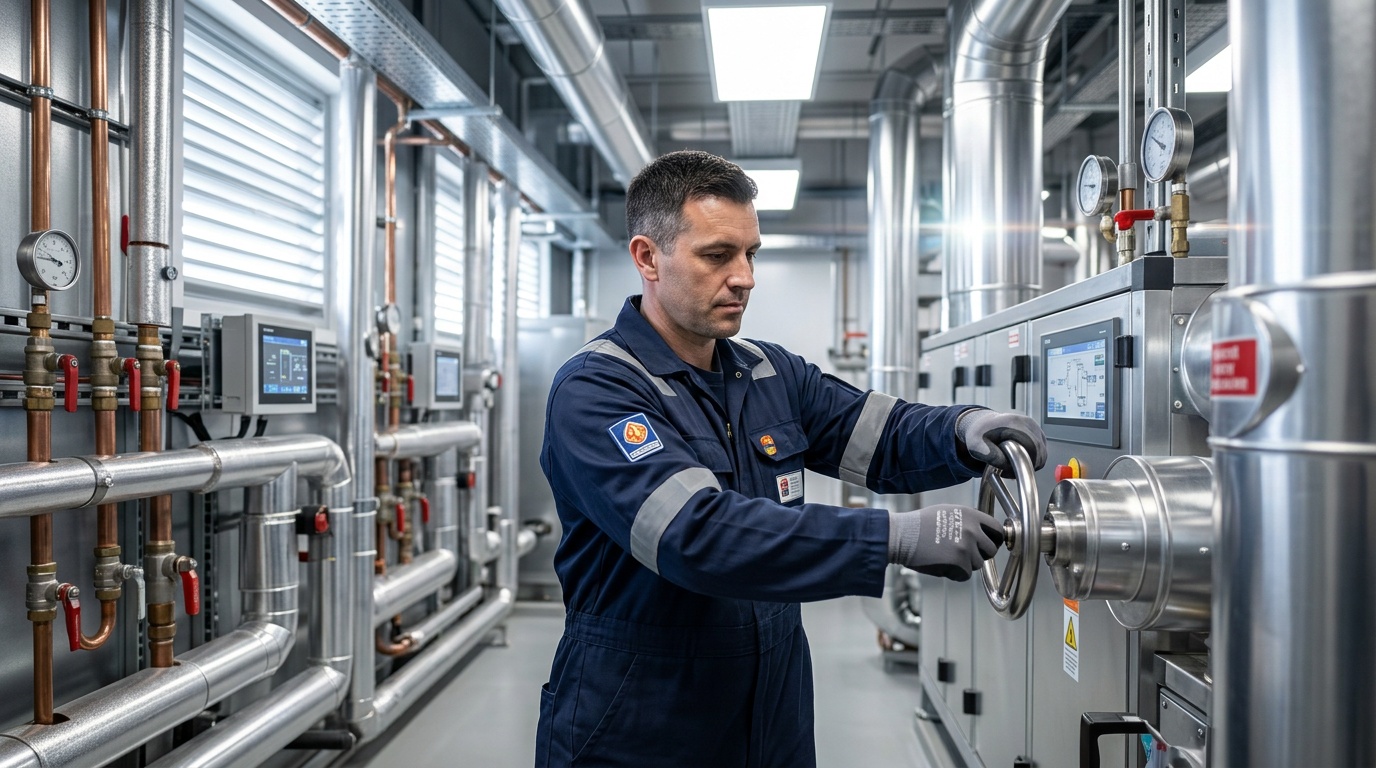
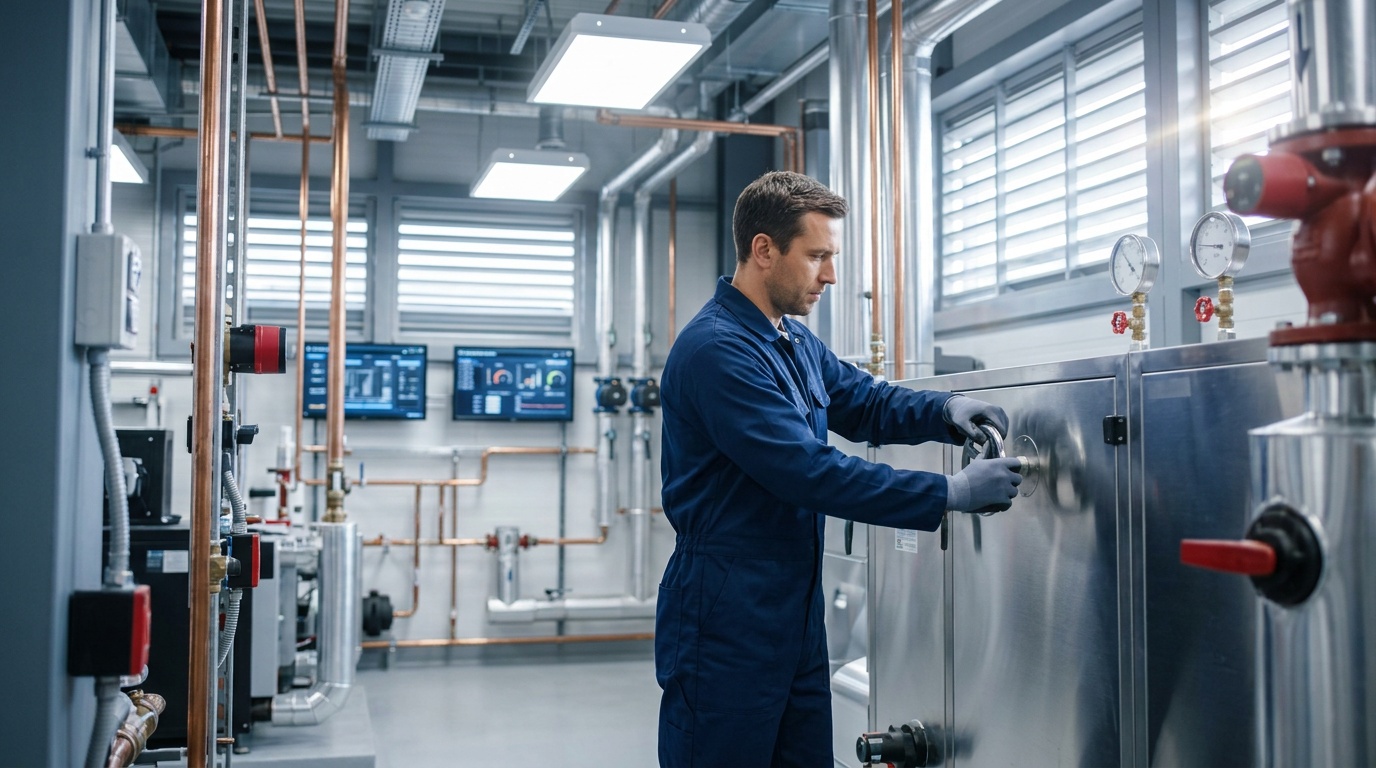
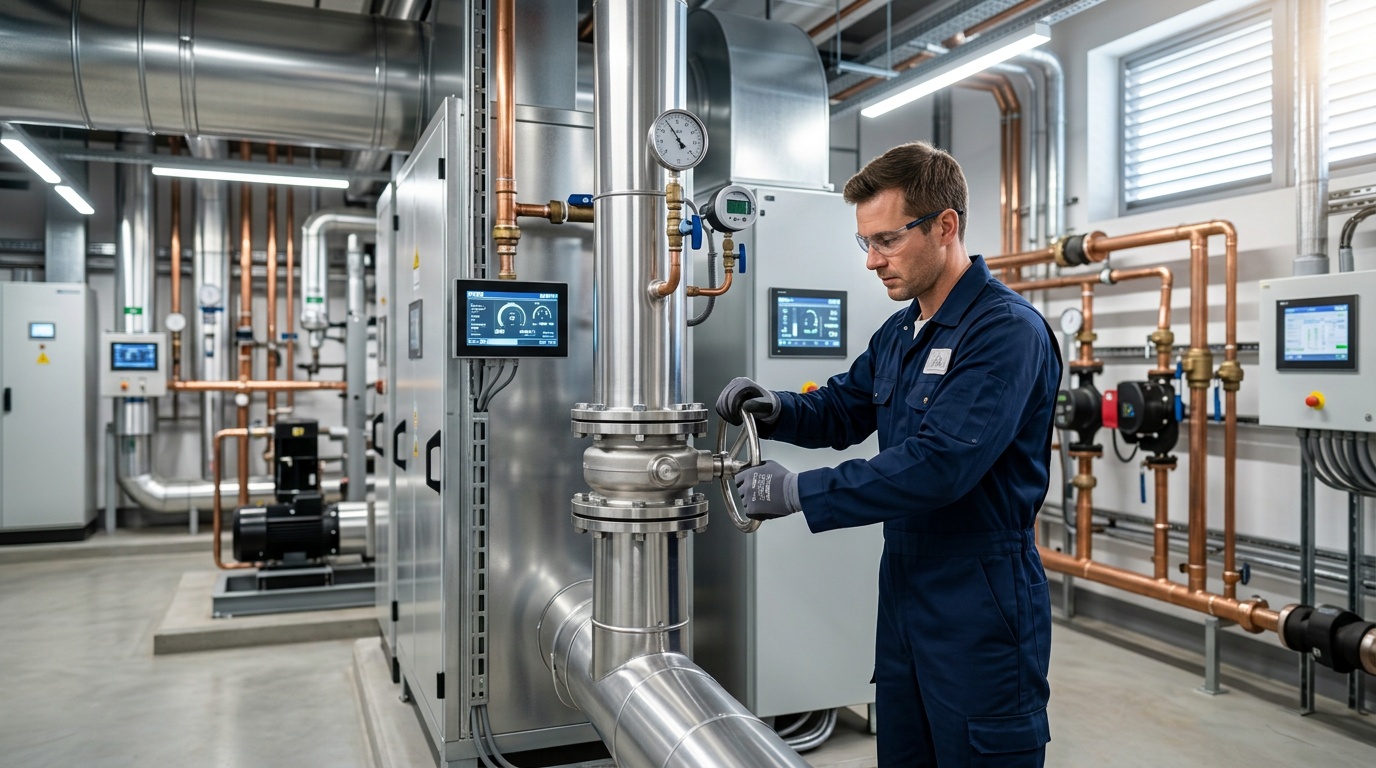
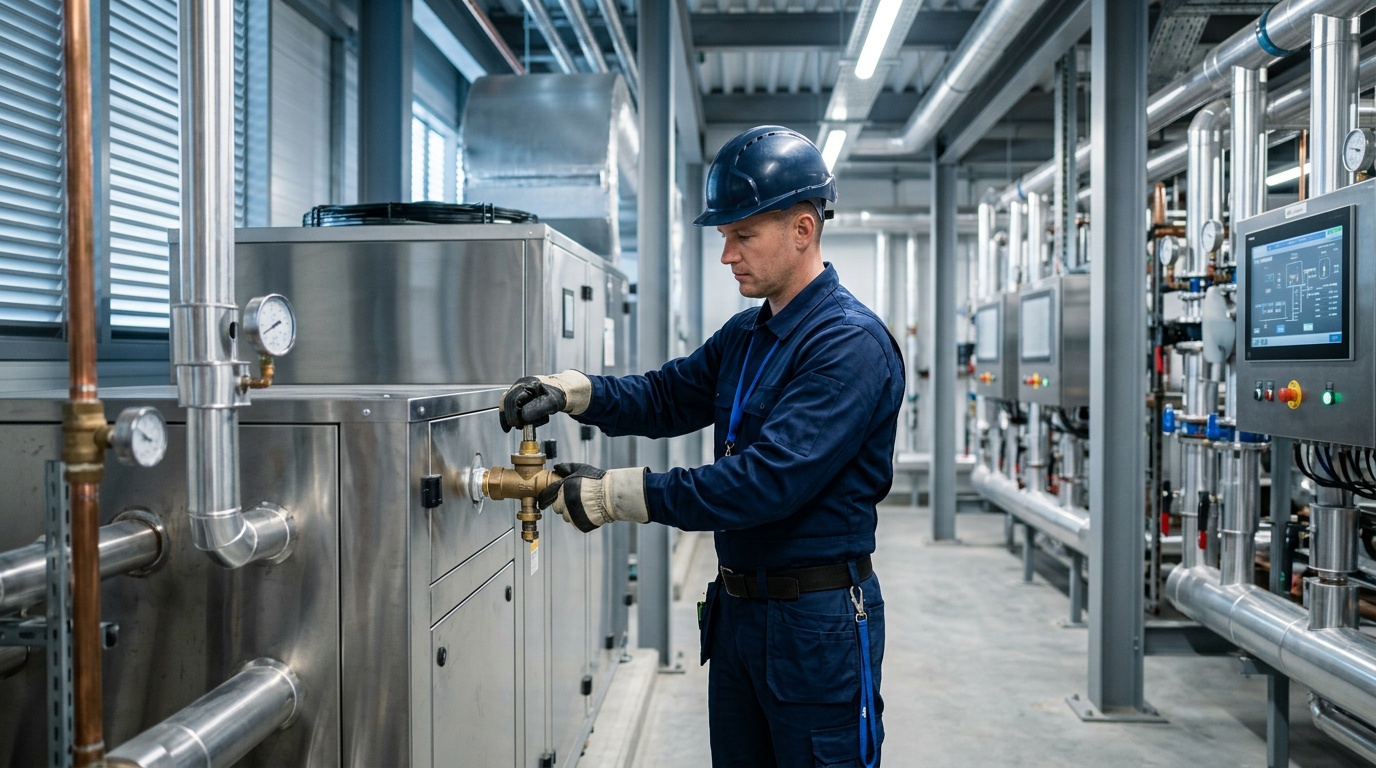
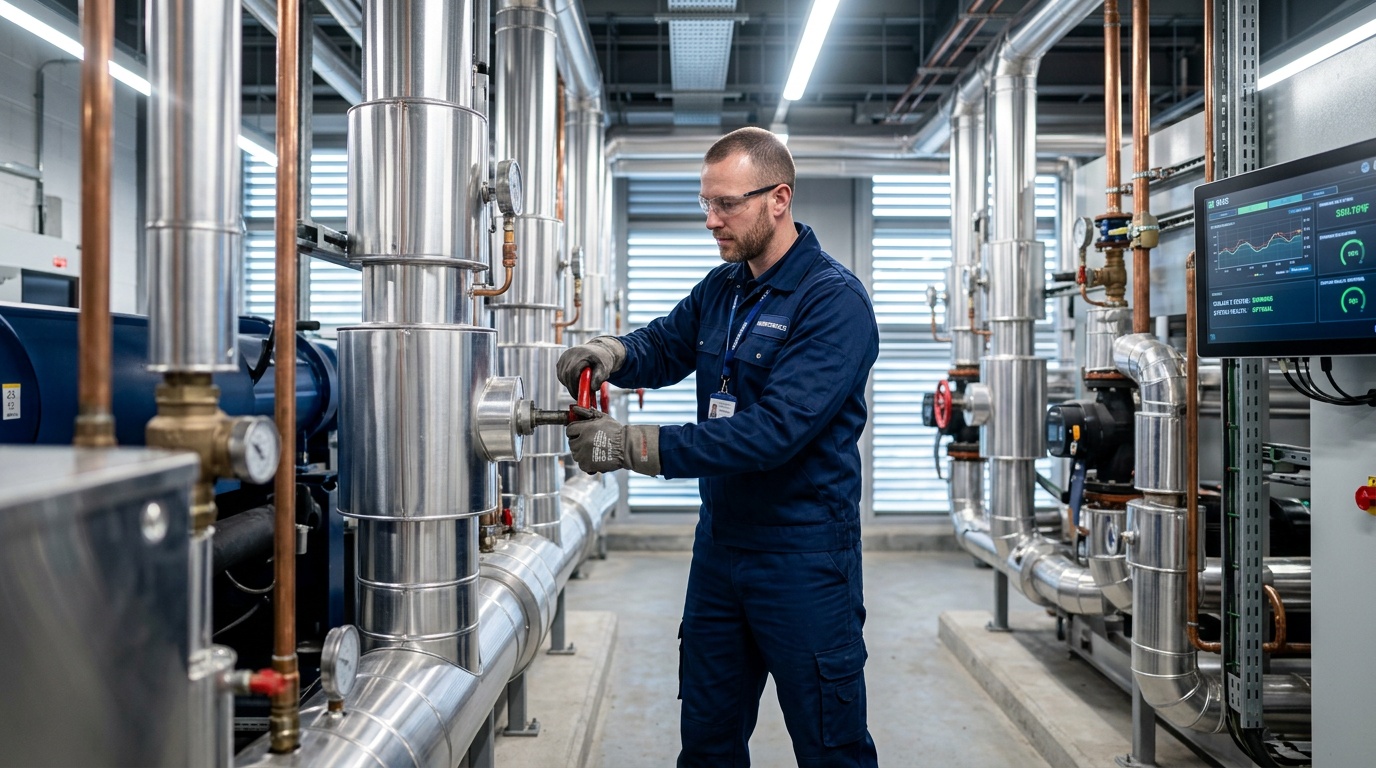
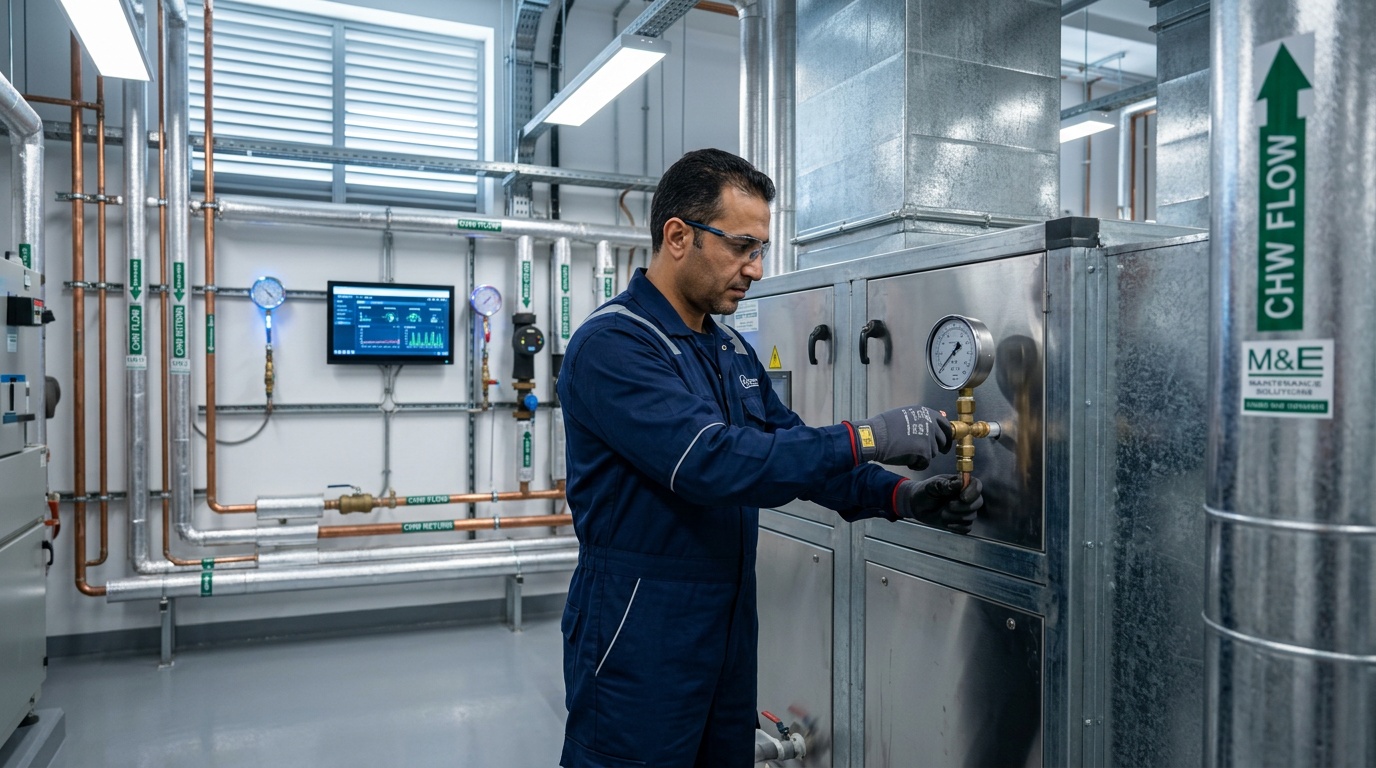
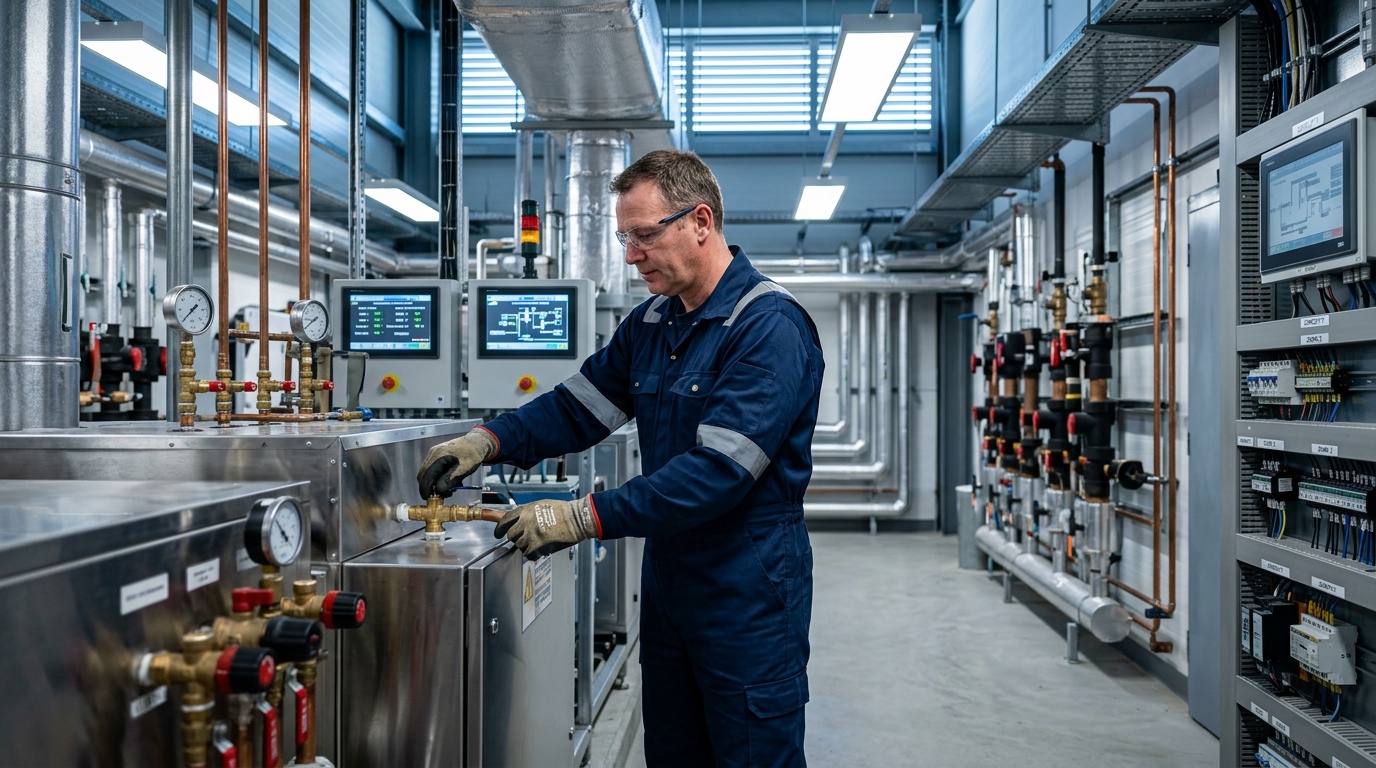
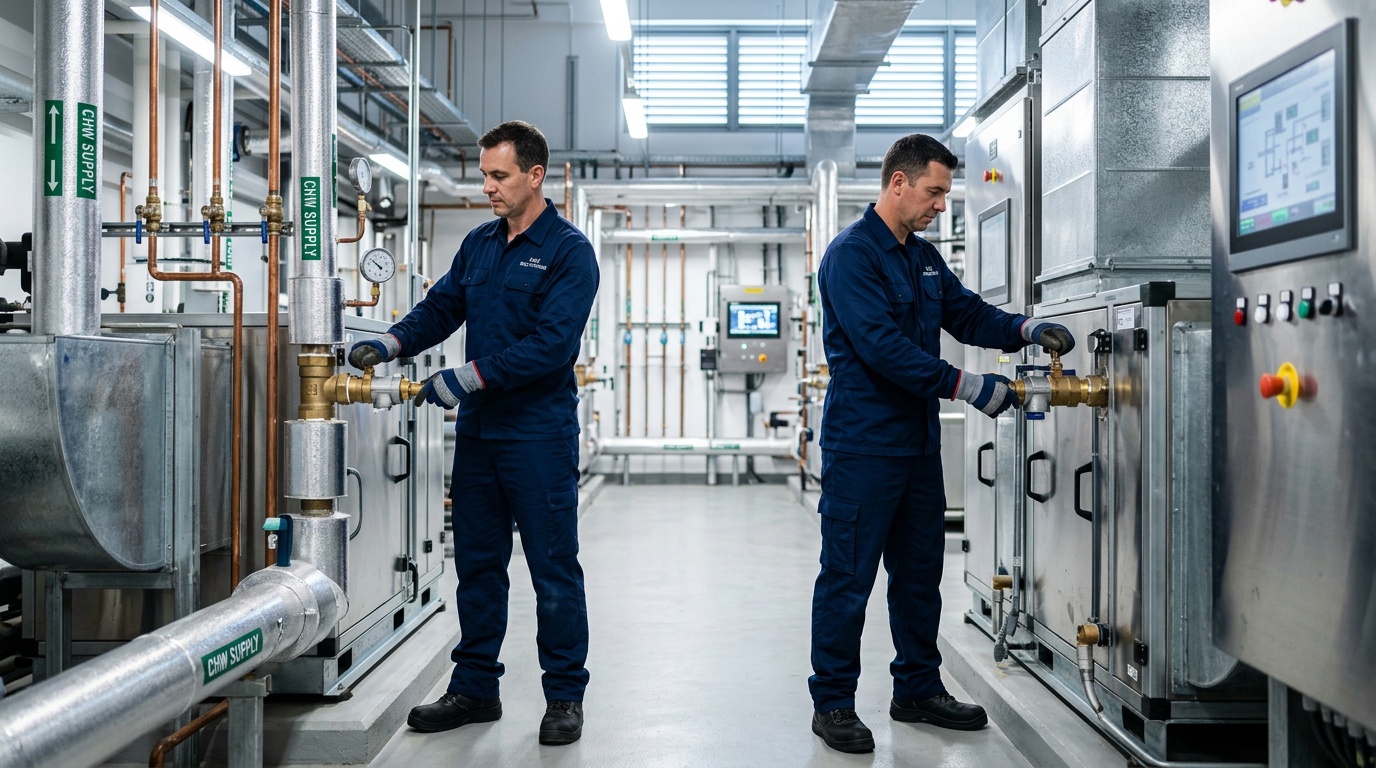
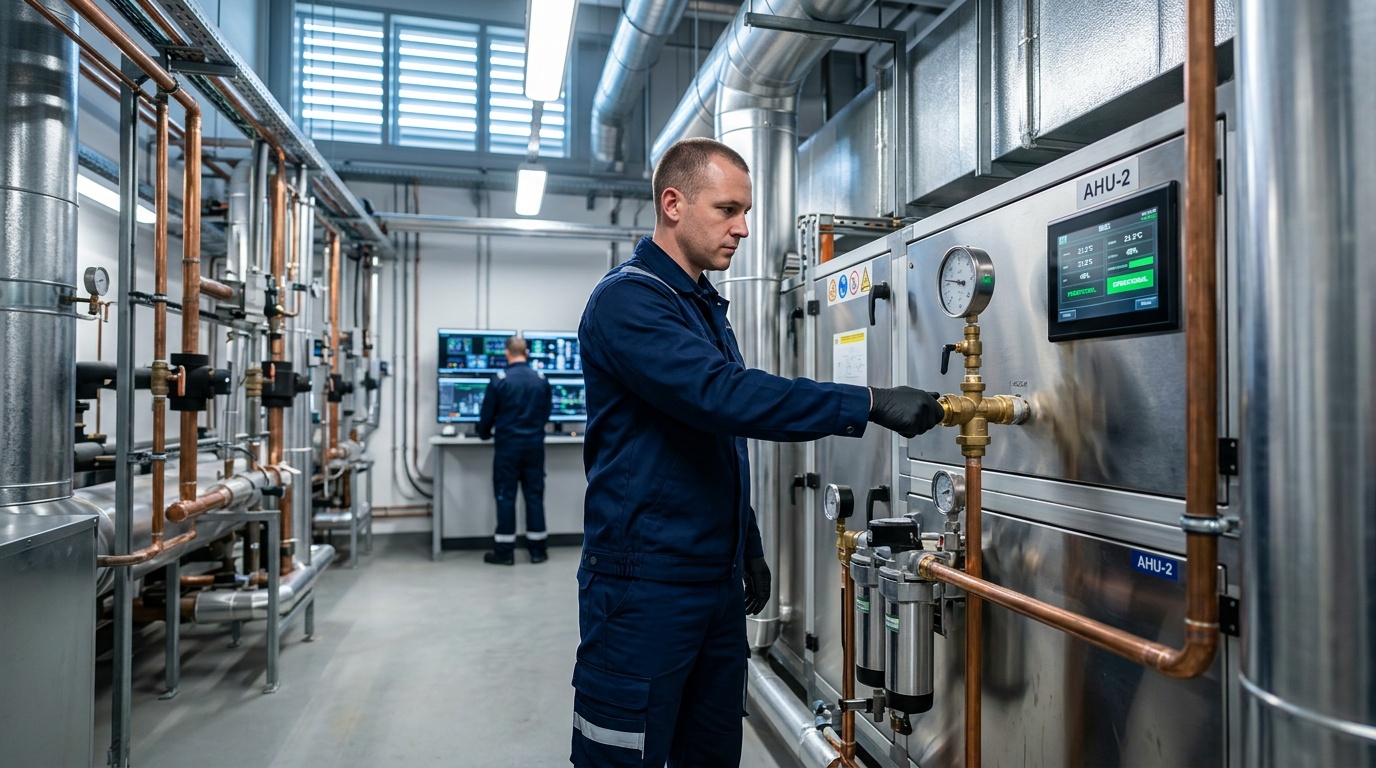
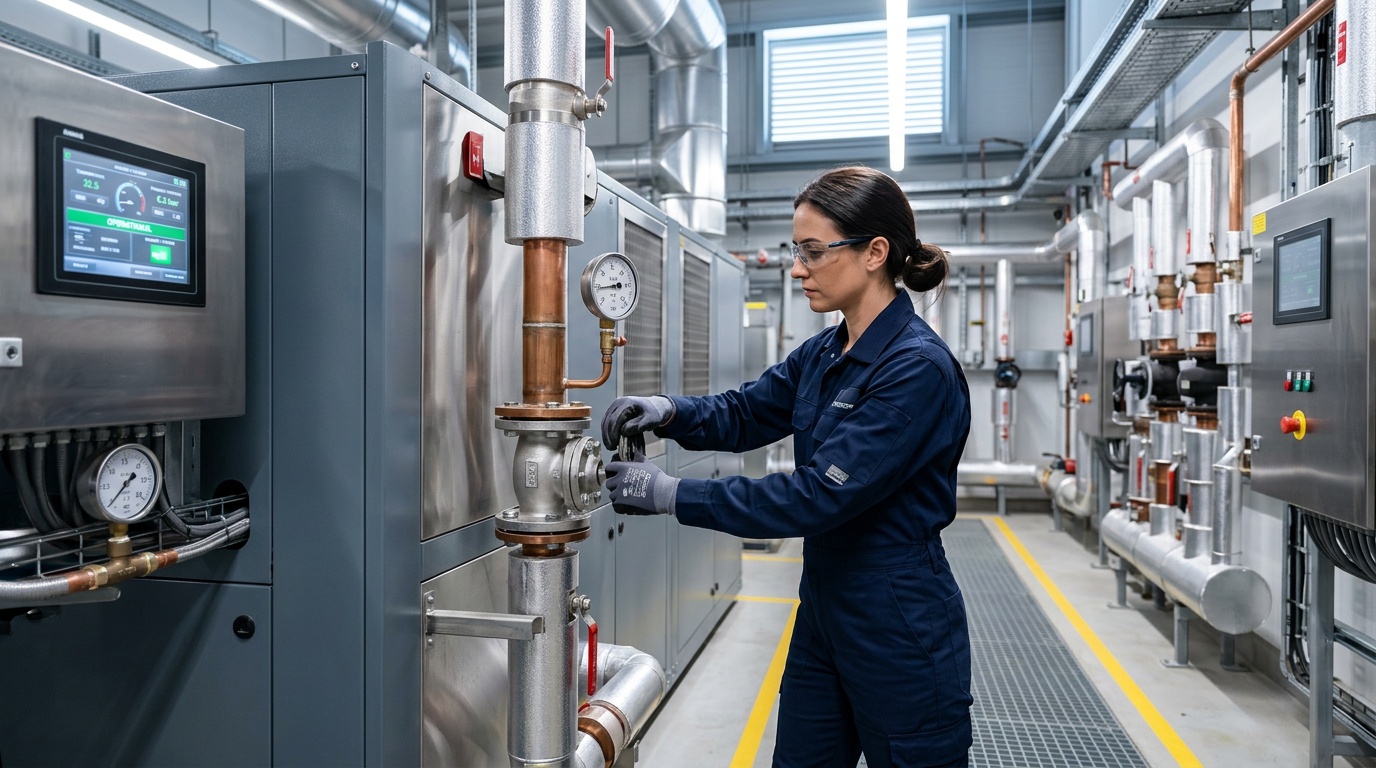
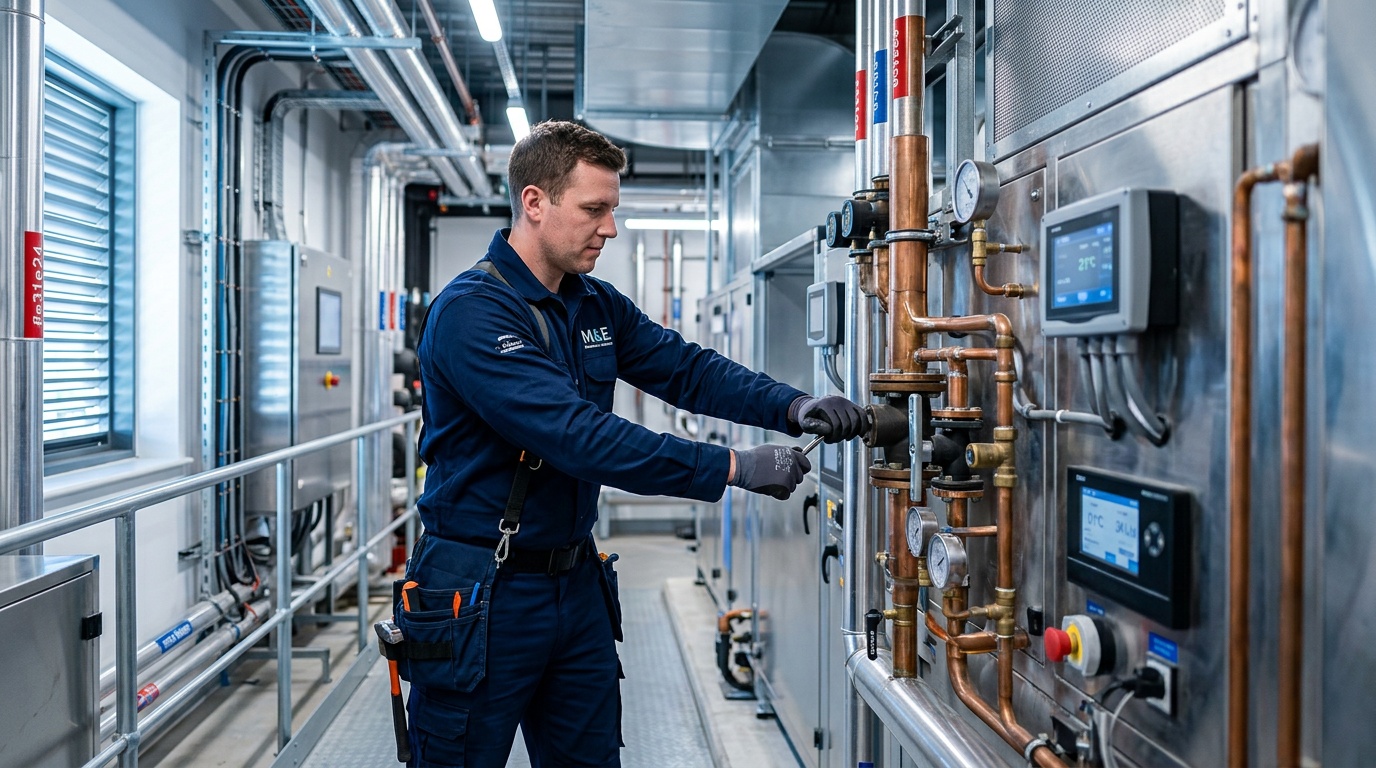
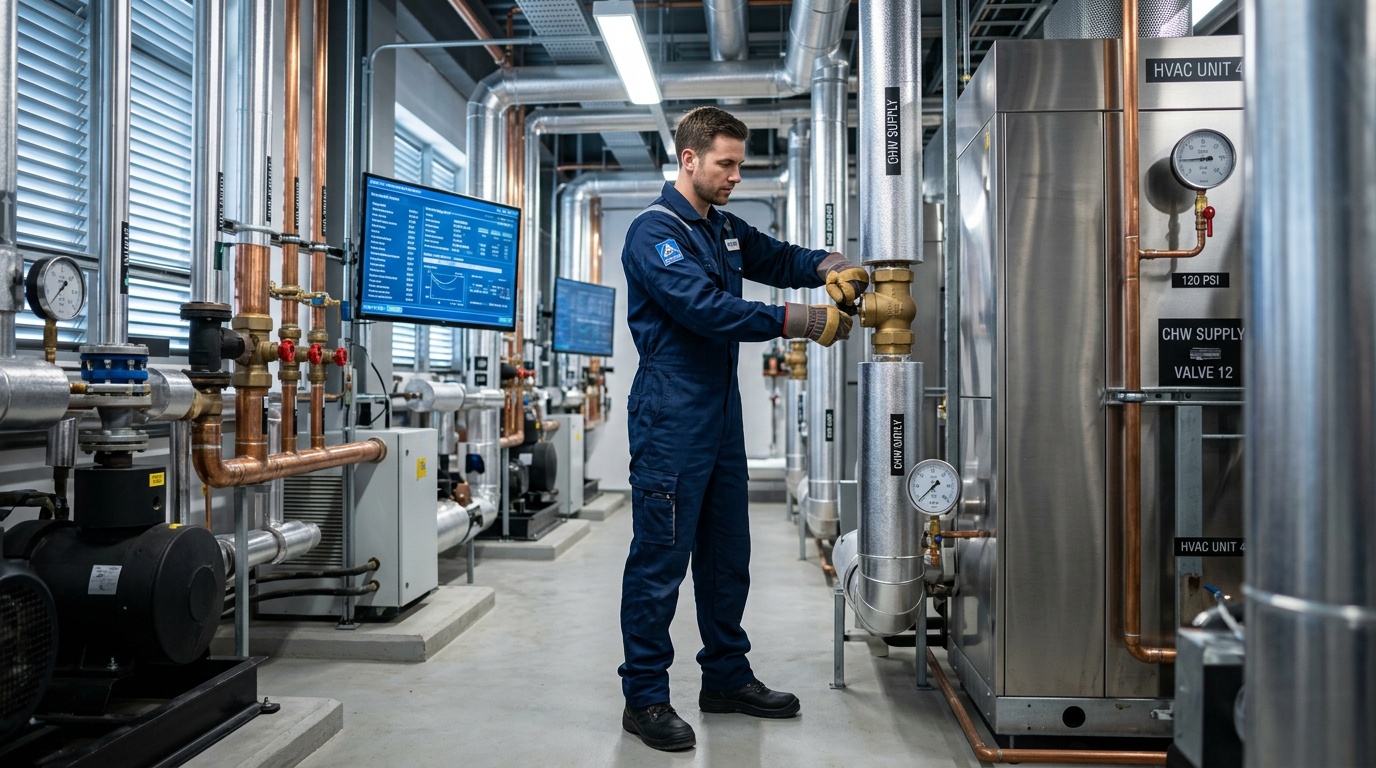
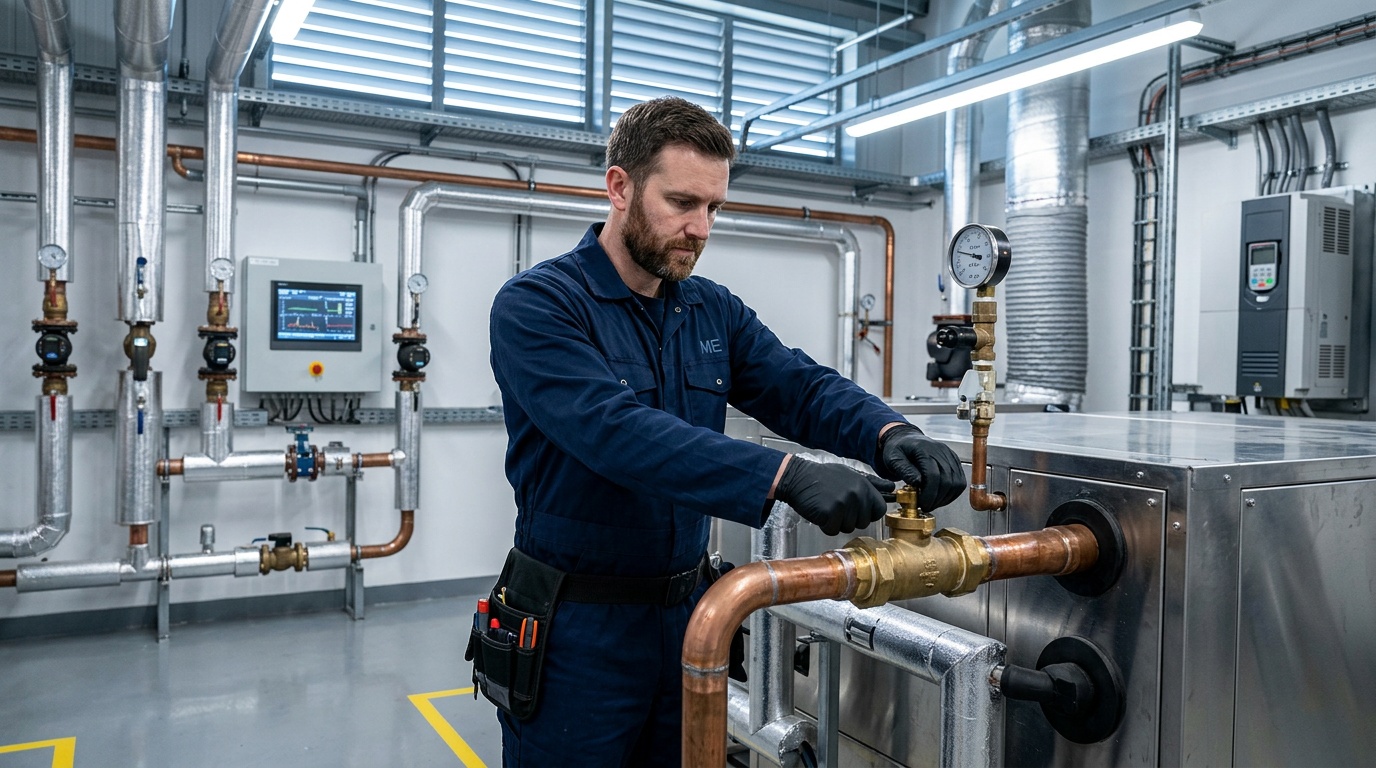
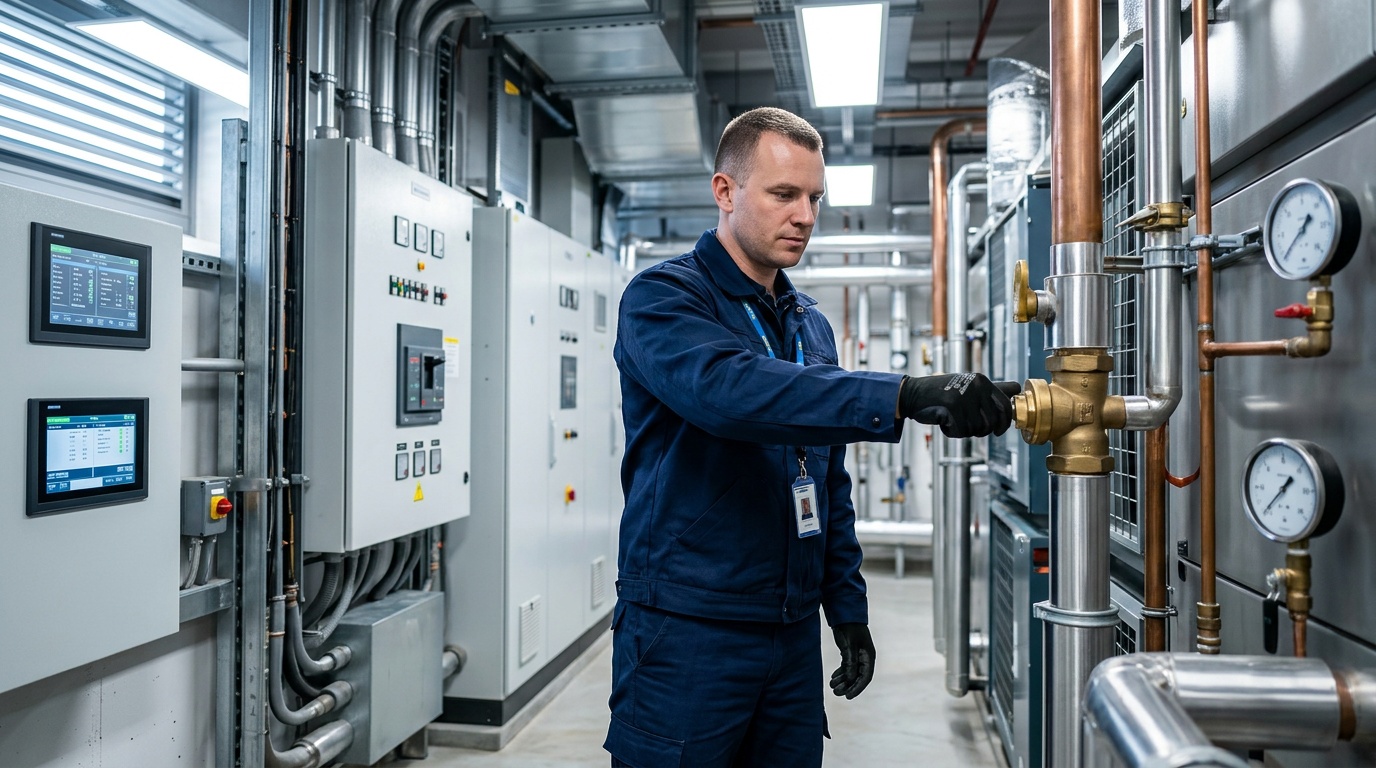
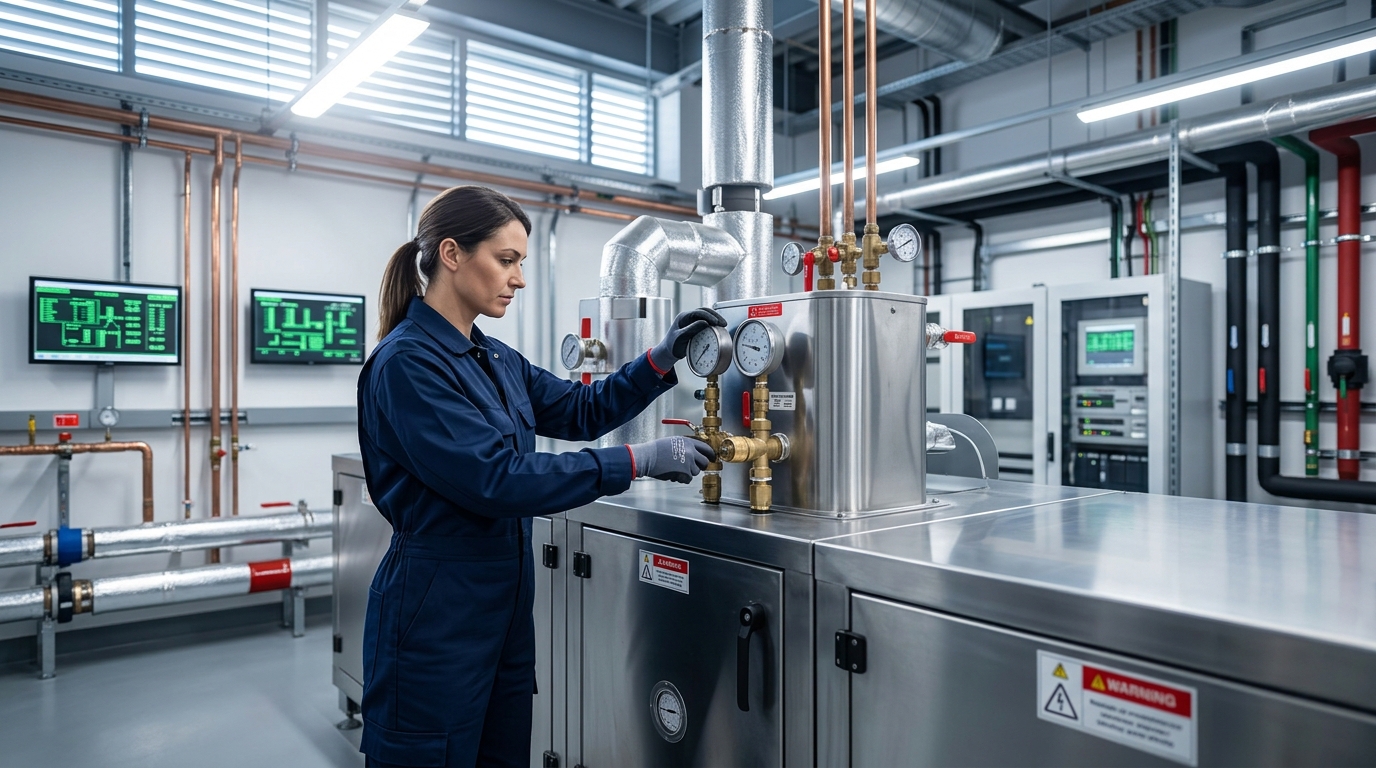
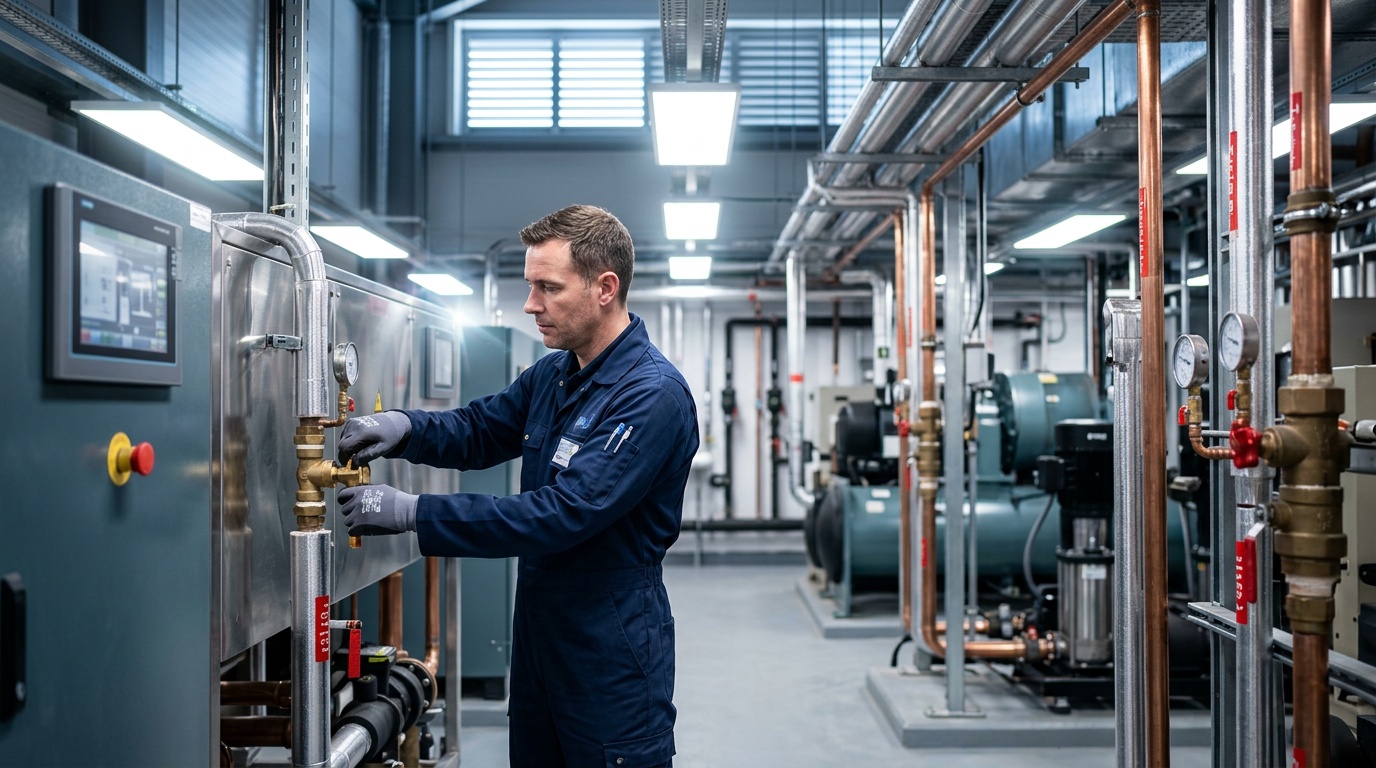
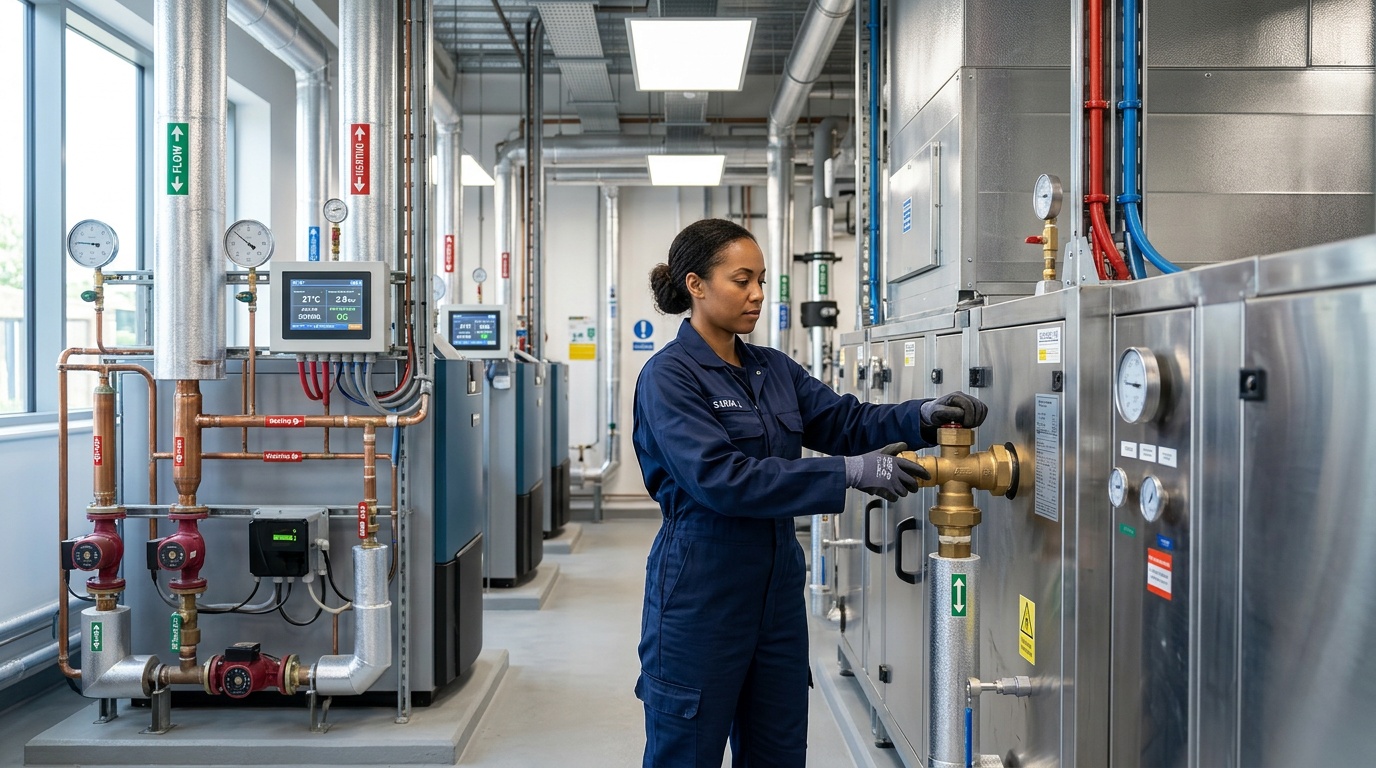
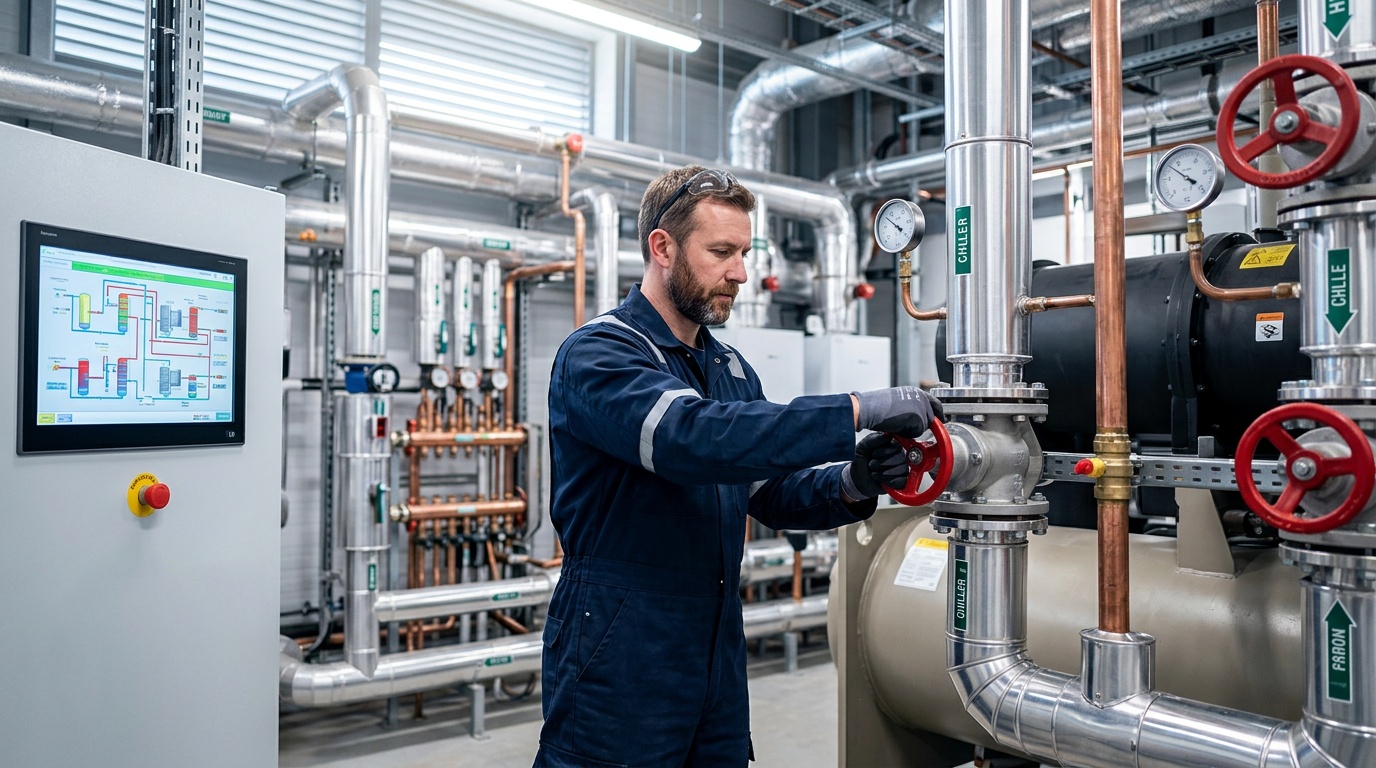
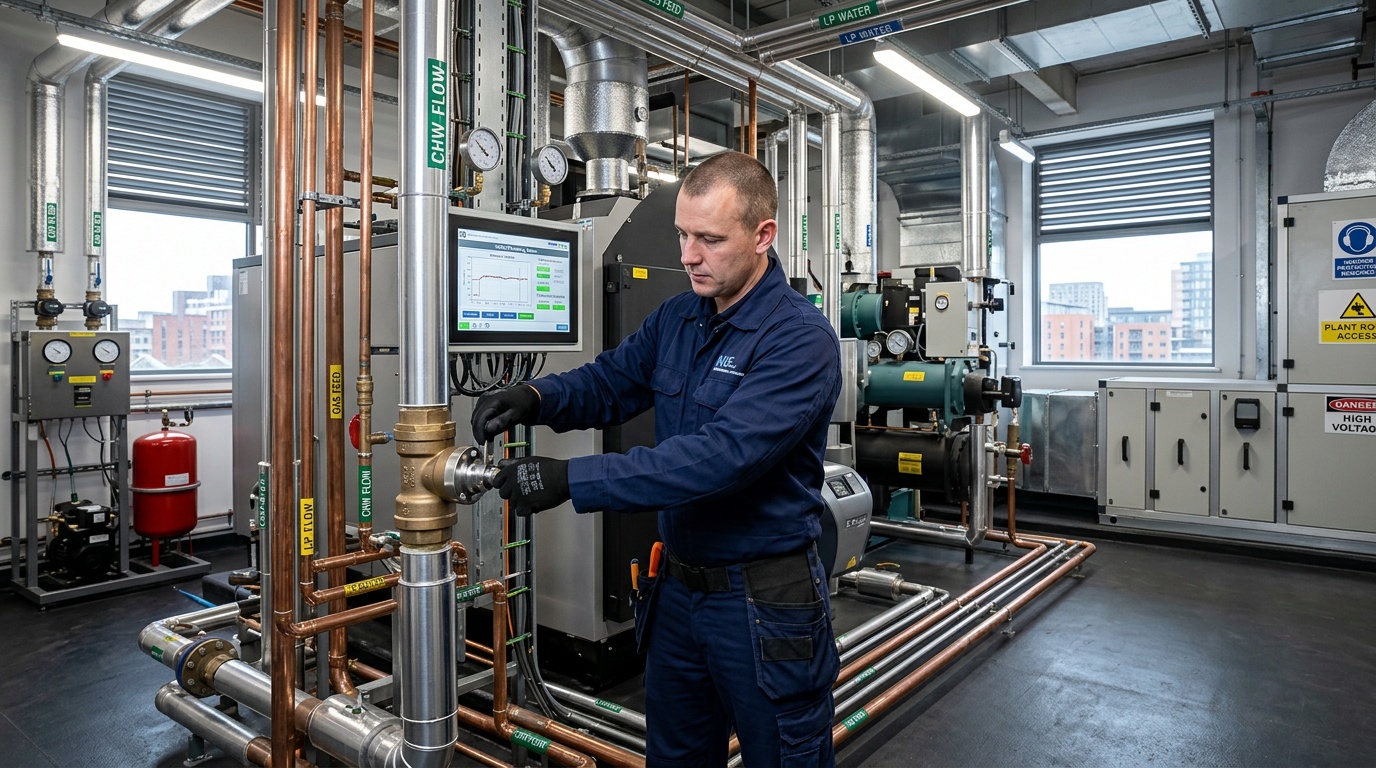
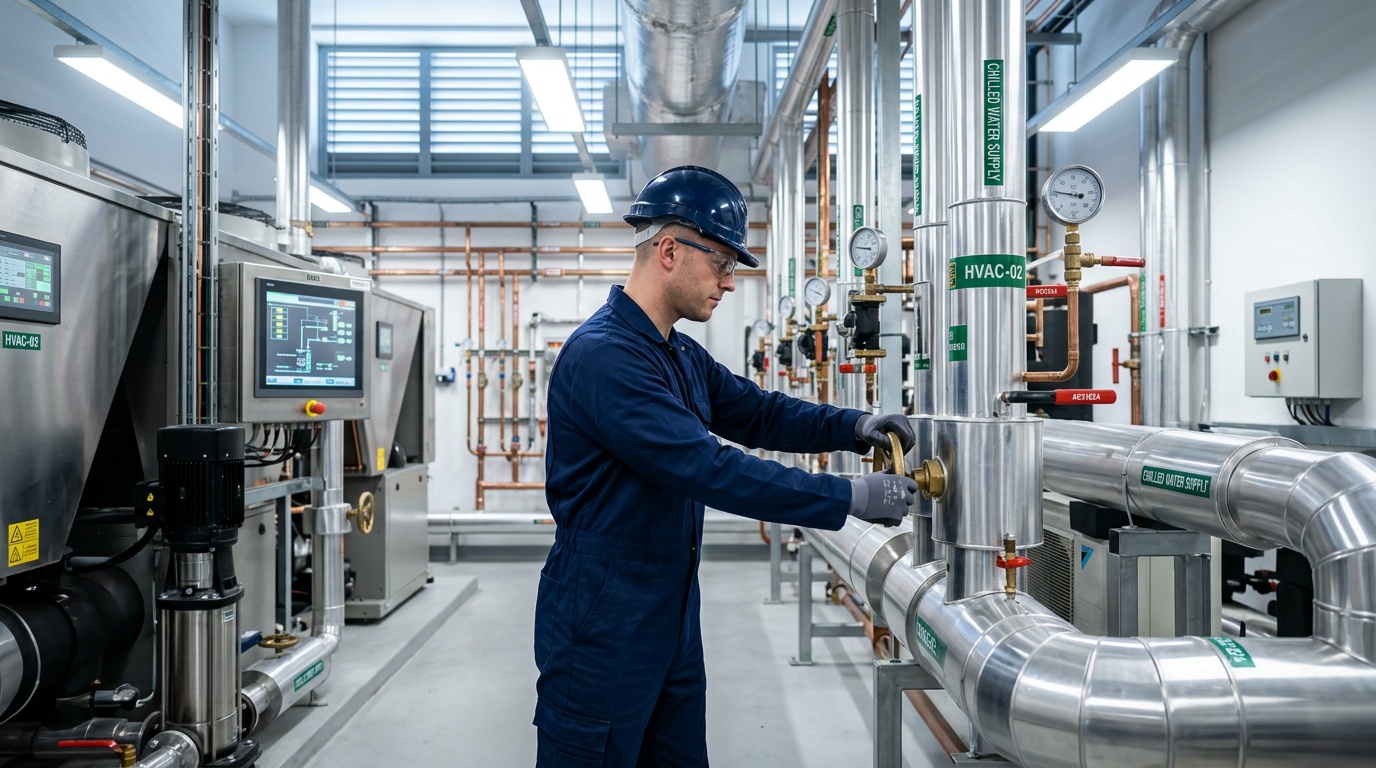
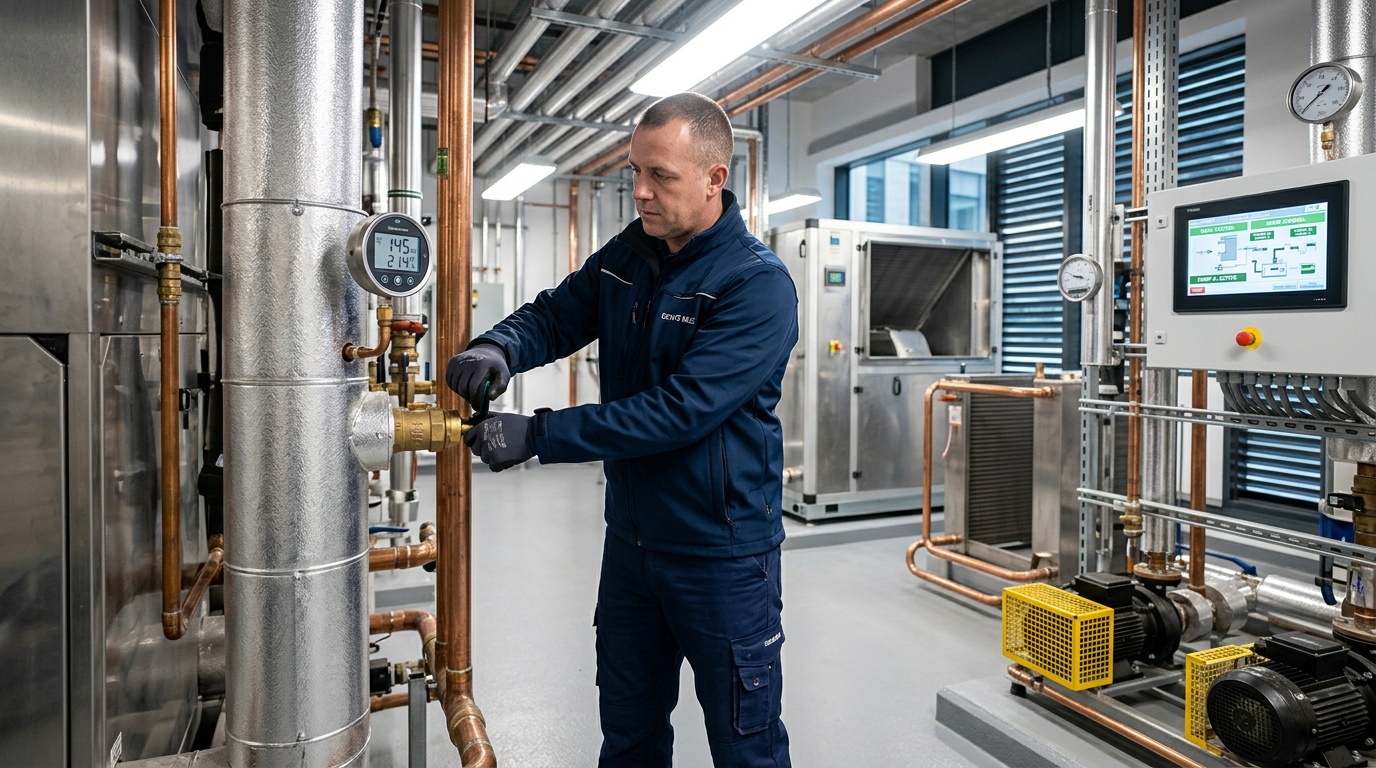
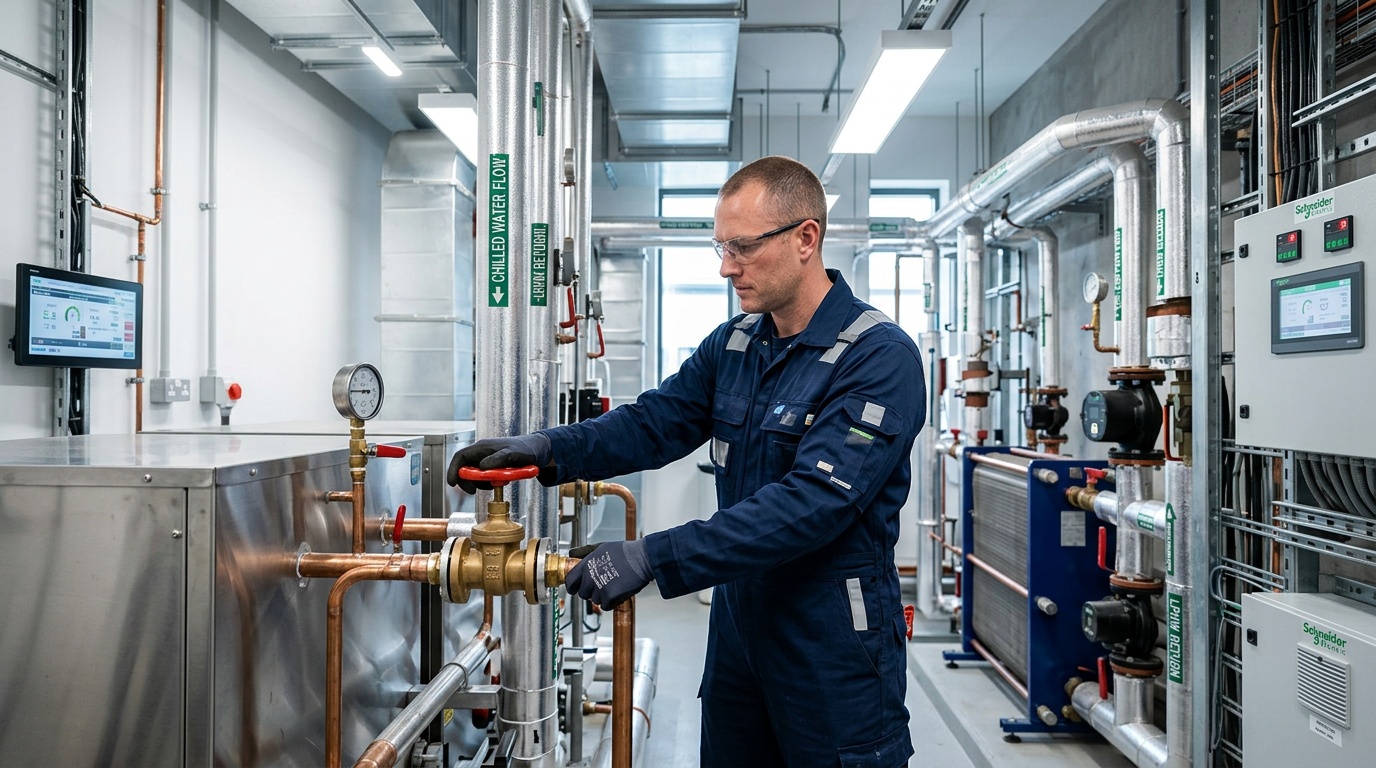
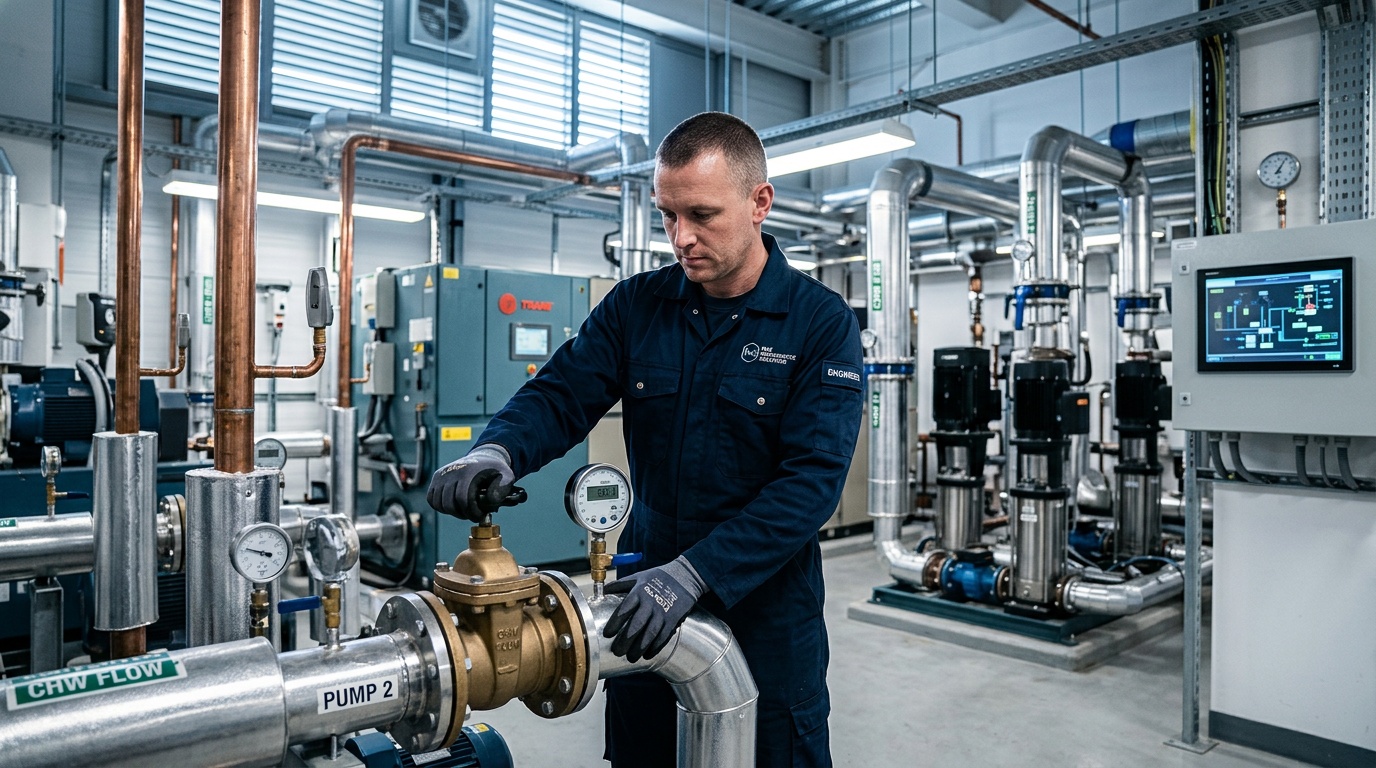
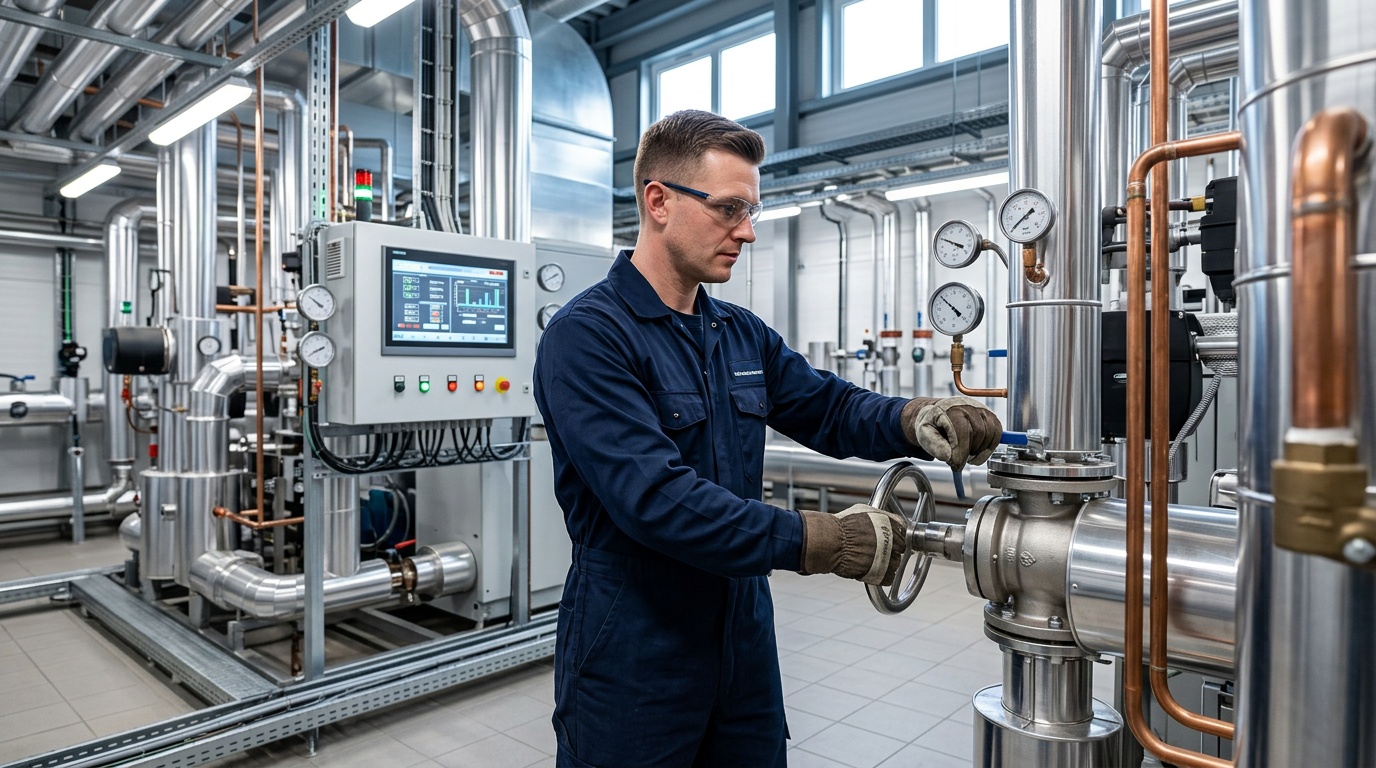
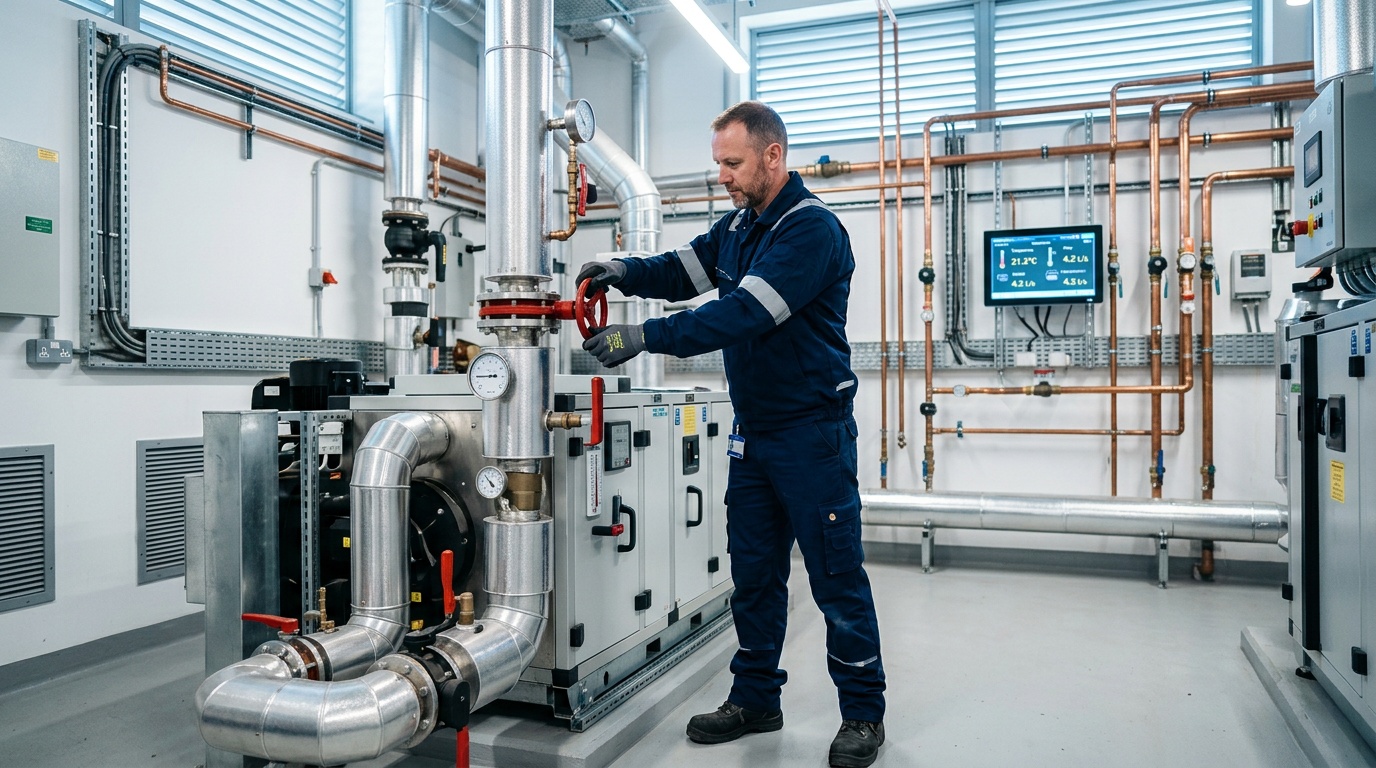
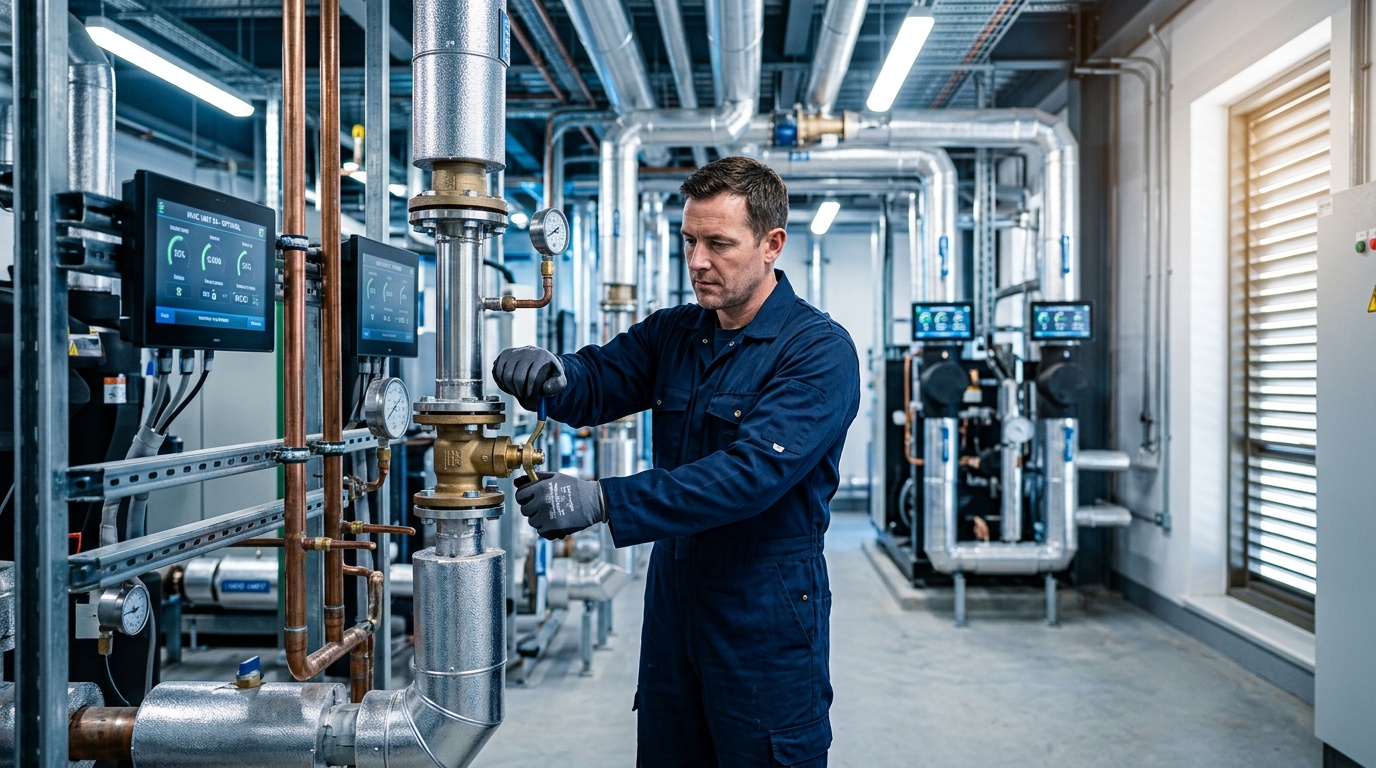
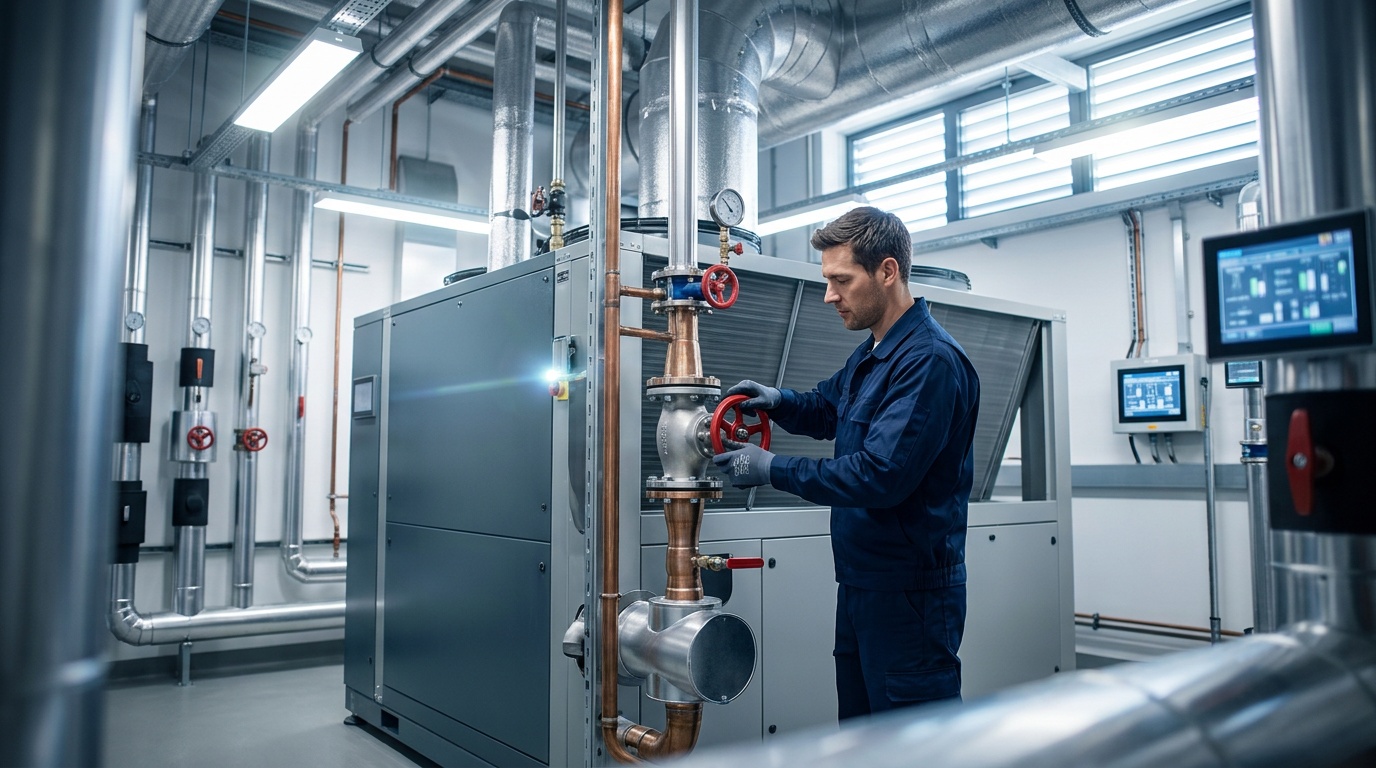
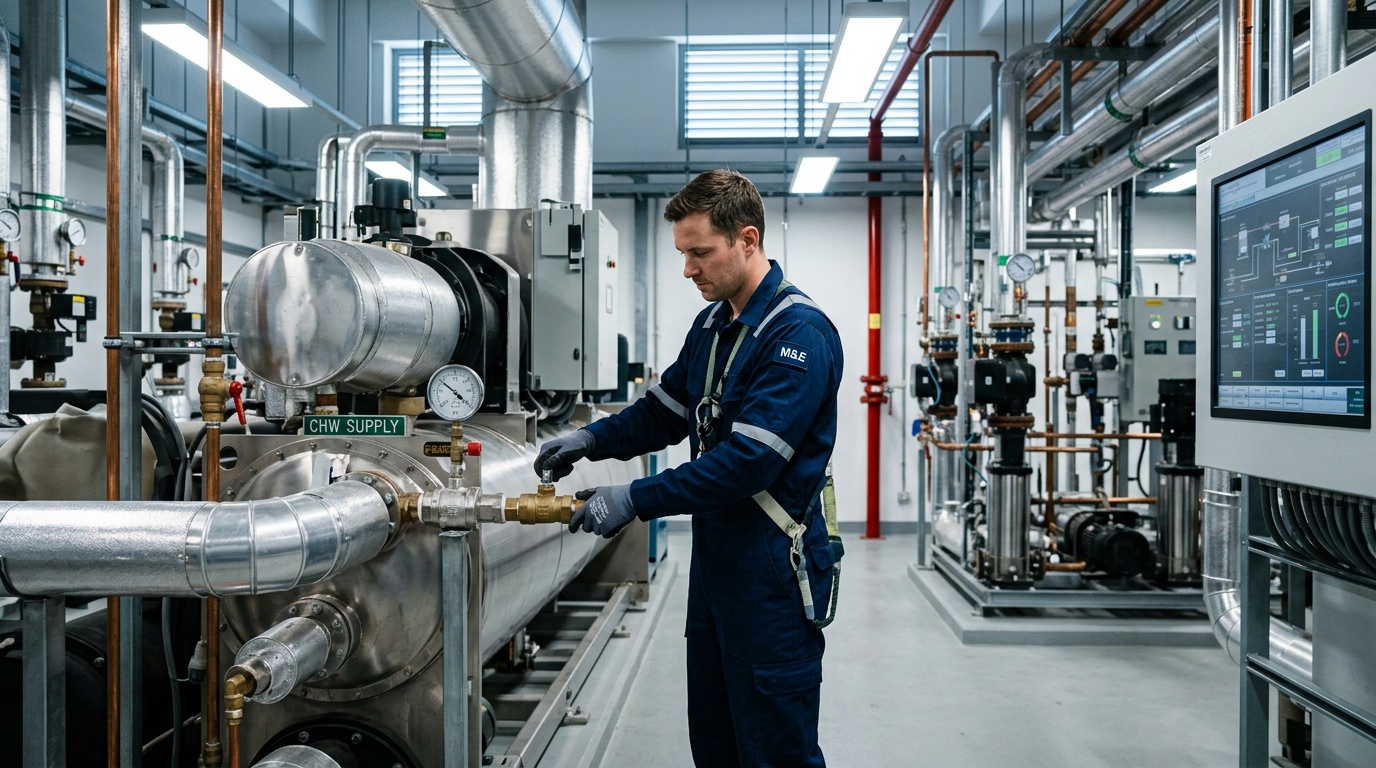
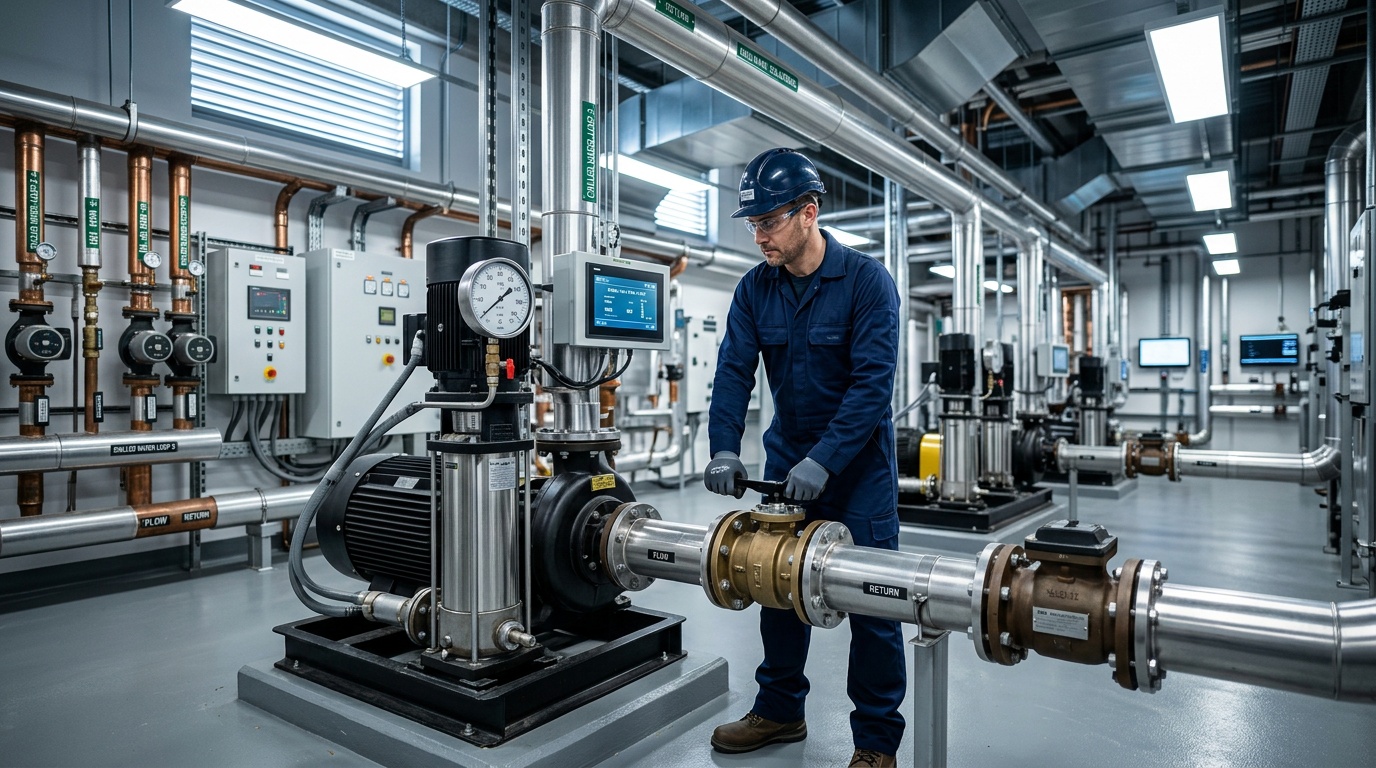
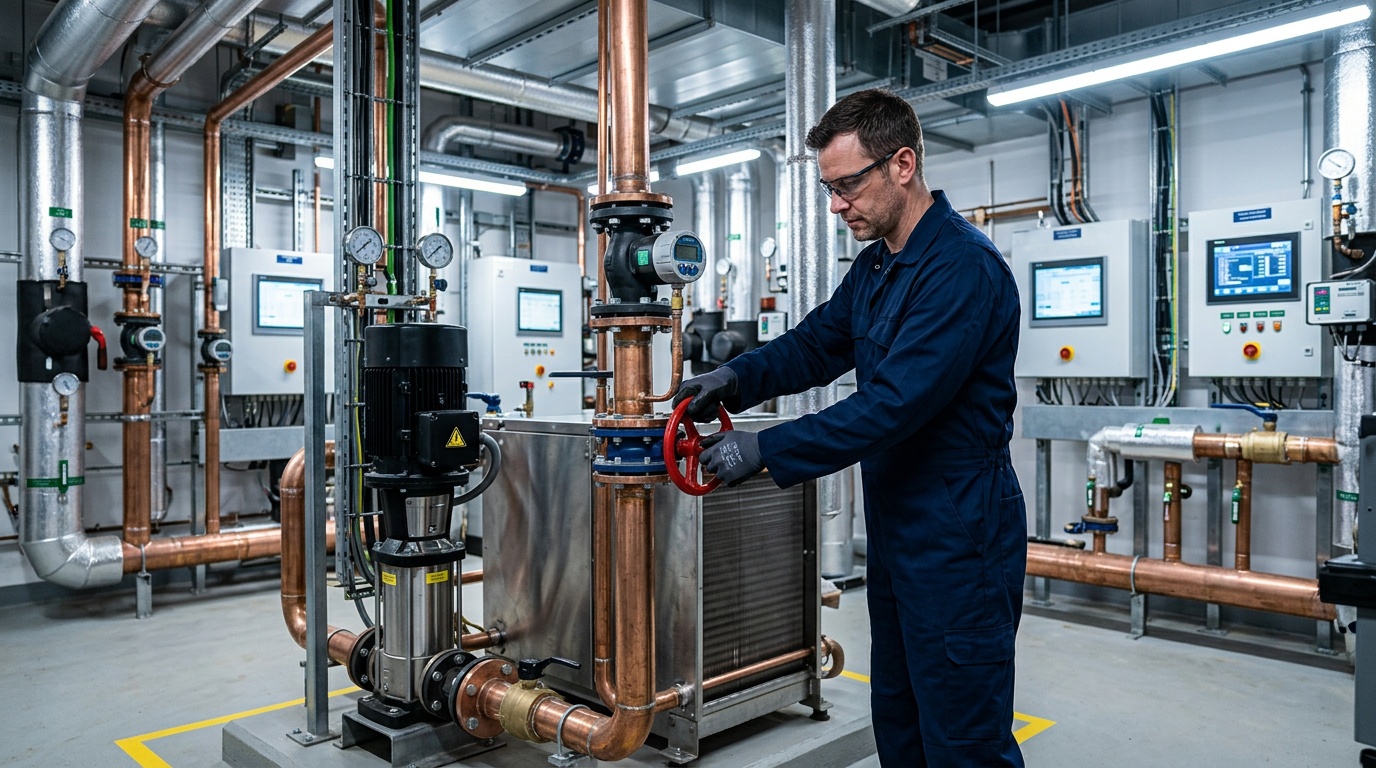
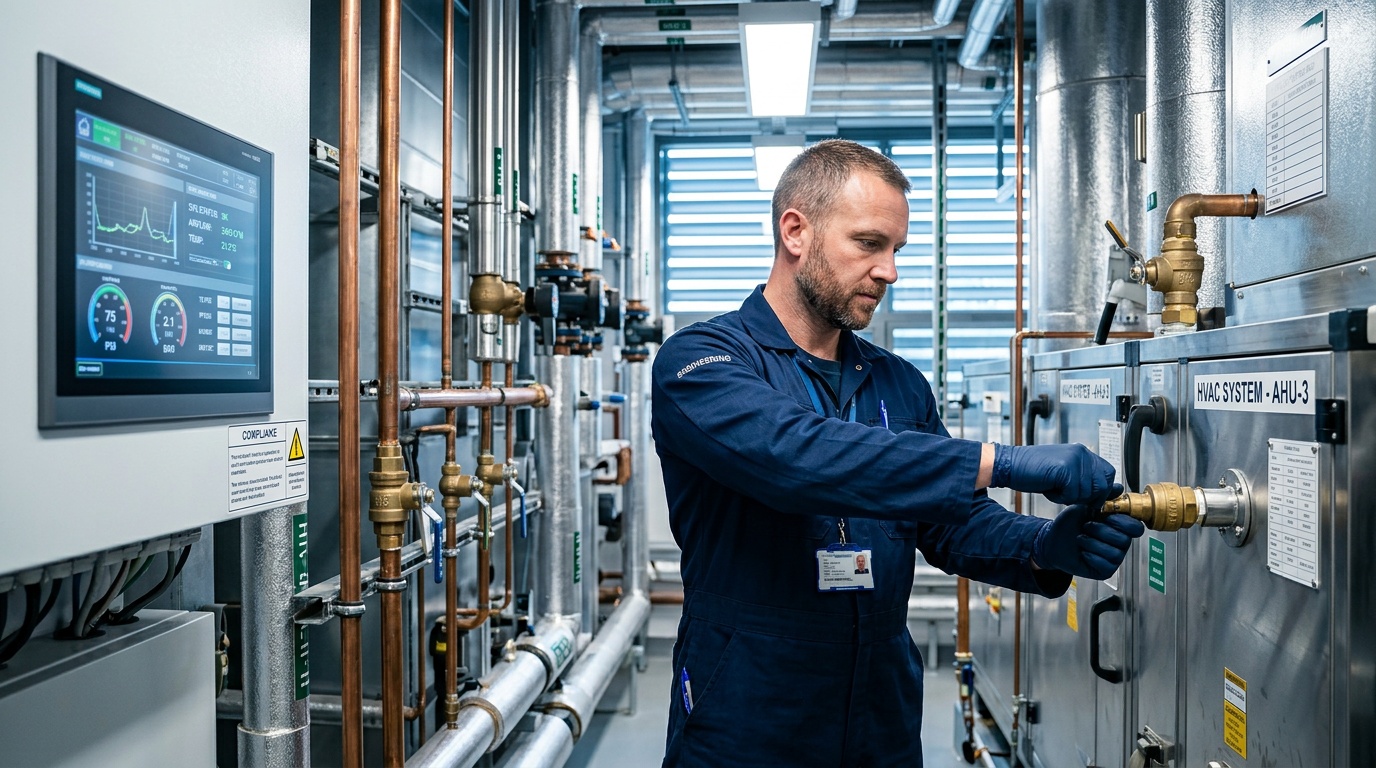
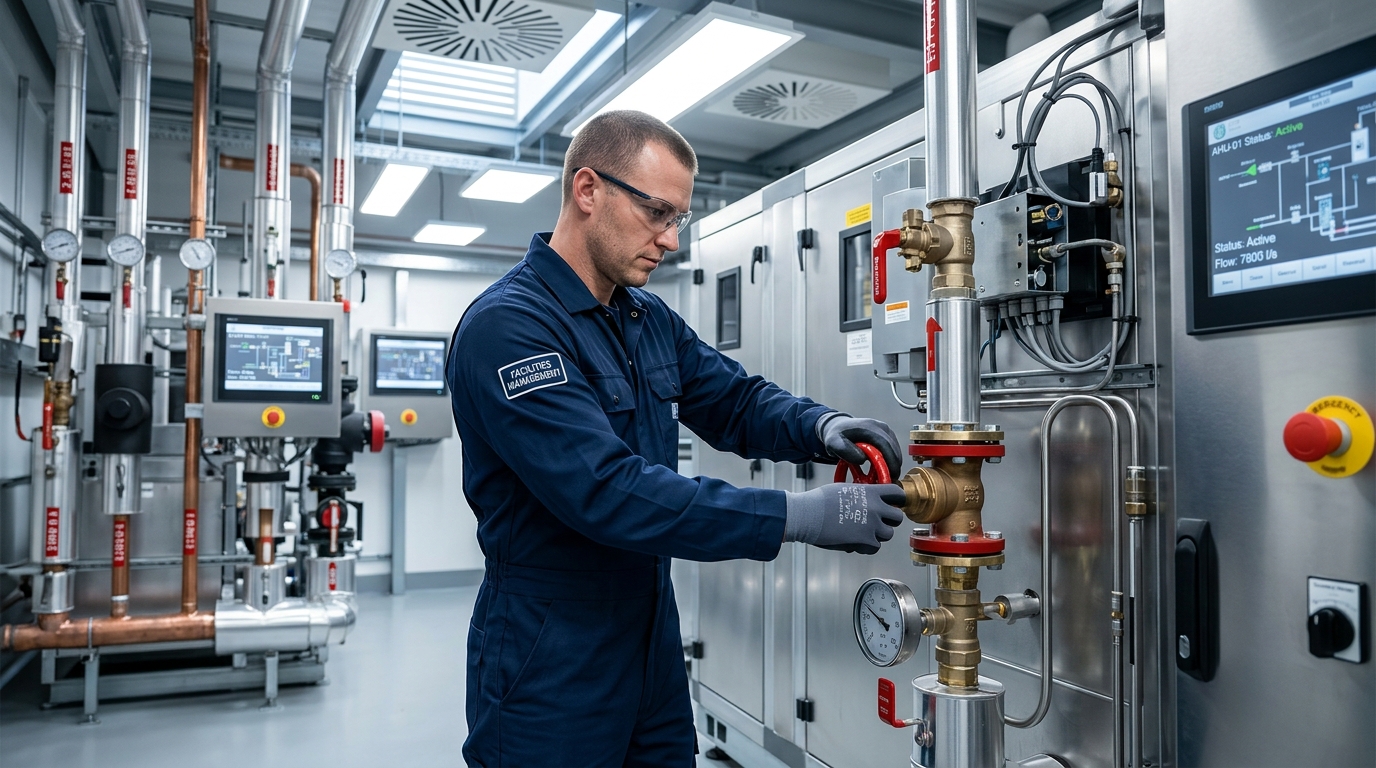
A renewable installation can look attractive on a brochure and still be the wrong decision for a commercial building. Before recommending panels or heat pumps, I assess the roof, electrical capacity, operating hours, heat distribution, plant-room space and maintenance access. The building comes first. The equipment follows.
Key Takeaways
A renewable installation can look attractive on a brochure and still be the wrong decision for a commercial building .
Before recommending panels or heat pumps, I assess the roof, electrical capacity, operating hours, heat distribution, plant-room space and maintenance access.
Renewable energy solutions use naturally replenished sources to provide electricity, heating or hot water.
Renewable energy solutions use naturally replenished sources to provide electricity, heating or hot water. Commercial options include solar photovoltaic panels, air-to-air heat pumps, air-to-water heat pumps and solar thermal equipment. The right choice depends on the building’s demand, space, insulation, electrical infrastructure, heating emitters, budget and expected asset life.
In my experience, the site assessment matters more than the sales brochure. A roof survey may identify structural limits, shading, restricted access or a membrane nearing the end of its service life. Electrical testing can reveal limited spare capacity, outdated distribution boards or the need for export limitation.
Renewable systems can reduce purchased energy and support lower-carbon operations. The financial outcome depends on measured demand, sound design and proper commissioning. An oversized system, poor controls or difficult service access can turn a promising project into an underperforming asset.
Solar PV often suits offices, warehouses, schools, retail premises and industrial units with usable roof space and steady daytime electricity demand. Heat pumps can reduce reliance on direct electric resistance heating where insulation, heat emitters and controls are suitable. A survey should confirm that before equipment is specified.
For businesses seeking a coordinated approach, the M&E Strategic Partner Programme can support wider maintenance and asset-management requirements.
Renewable equipment still needs Planned Preventative Maintenance (PPM). Solar arrays need inspection, inverter monitoring and electrical checks. Heat pumps need filter and coil cleaning, control checks, water-quality checks and appropriate refrigerant attention. These tasks belong in a documented PPM schedule alongside the site’s wider compliance plan.
How should you choose a renewable energy system?
Choose the system after measuring how the facility operates throughout the year. Review half-hourly electricity data, gas consumption, heating demand, occupancy, operating hours, seasonal peaks and existing plant performance before approving a design.
Check the building fabric. Review insulation, glazing, roof condition, shading, safe access and remaining roof life.
Assess the heating requirement. Inspect heat emitters, pipework, plant-room capacity and outdoor unit locations.
Confirm electrical capacity. Check the distribution board, incoming supply, protection, cable routes and inverter position.
Build a realistic budget. Include surveys, design, structural work, commissioning, metering, monitoring and staff training.
Specify handover and maintenance. Require asset registers, operating instructions, control schematics, warranties and PPM tasks.
Ask your contractor who will maintain the system after installation, which records you will receive and how faults will be handled outside normal working hours. Renewable technology should support uptime, not create another operational gap.
For ongoing support, facilities teams can review the commercial HVAC services available to help keep renewable and conventional HVAC systems safe, efficient and serviceable.
What renewable energy solution is best for a UK commercial facility? There is no single answer for every site. Solar PV and heat pumps should be selected after reviewing demand, building condition, infrastructure and operating patterns.
How should a renewable system be sized? Sizing should be based on measured demand, available generation, peak loads, future occupancy and the building’s electrical or heating infrastructure.
Will renewable equipment remain reliable? Reliability depends on correct design, competent installation, commissioning and planned maintenance.
"
"
"
"
"
"
About Stuart Butcher
Founder & Managing Director | M&E Maintenance Solutions
Stuart Butcher is the Founder and Managing Director of M&E Maintenance Solutions. A "boots-on-the-ground" leader, Stuart began his career as an apprentice combustion engineer, spending over 24 years mastering the trade before building a premier maintenance firm. He operates at the intersection of technical engineering precision and commercial asset management.
Driven by the philosophy that maintenance is cheaper than repair, Stuart works with Facility Managers and Building Owners across Birmingham, the Midlands, and the UK to ensure 24/7/365 compliance and uptime. He established M&E Maintenance Solutions to provide the technical capability of a large corporate provider while maintaining the personal accountability of a family-run business.
Last reviewed: August 2, 2026 by the M&E Maintenance Solutions Limited Team
Alternatives to standard electricians for rewiring in Birmingham homes?
A failed consumer unit, brittle insulation or an unexplained burning smell can turn an ordinary Birmingham commercial building into a serious safety risk. Before approving disruptive work, have the installation inspected and tested. The evidence may support a full rewire, but it could also point to a specialist repair, partial replacement or planned surface installation.
Key Takeaways
A failed consumer unit, brittle insulation or an unexplained burning smell can turn an ordinary Birmingham commercial building into a serious safety risk.
Before approving disruptive work, have the installation inspected and tested.
The evidence may support a full rewire, but it could also point to a specialist repair, partial replacement or planned surface installation.
A credible contractor should inspect the existing installation, identify immediate hazards, explain the available routes and provide a written scope. Surface-mounted cabling, partial rewiring, replacement of unsafe sections and a full rewire may all be suitable, but none should be recommended without evidence. Facility Managers and Estate Managers can also review professional plumbing and electrical services where several building systems need coordinated support.
What are the alternatives to standard electricians for rewiring in Birmingham commercial buildings?
The practical alternatives are specialist electrical engineering support, surface wiring in selected areas, partial replacement and a phased rewiring programme. Each option can address a defined risk without committing the building manager to a complete concealed rewire before the installation has been properly assessed.
Older commercial properties may contain cloth-insulated cable, degraded rubber insulation, poor earthing, outdated fuse boards or circuits without suitable protection. A visual inspection is only the starting point. Testing may include continuity, polarity, insulation resistance, earth fault loop impedance and verification of bonding, subject to the installation and the competent person’s assessment.
Surface wiring avoids extensive chasing into plaster and may suit lofts, utility rooms, workshops or selected occupied areas. It does not make defective concealed cable safe. The completed work should be tested and handed over with the appropriate electrical certification and records.
What are the benefits of alternatives to standard electricians for rewiring in Birmingham commercial buildings?
The main benefit is proportional work. Testing can show whether the fault sits in one circuit, accessory or section of cable rather than across the whole installation. That can limit disruption while still identifying repairs that would leave a genuine hazard in place.
Cost control starts with a clear quotation. Birmingham prices vary with property size, access, finish quality, circuit numbers and plaster repair. The proposal should separate labour, materials, testing, certification, making good and provisional items.
Rewiring may affect furniture, flooring, plasterwork, kitchen units, offices and occupied areas. A phased programme can reduce disruption, provided every stage is isolated safely, tested and documented before the area returns to use.
How should you choose a rewiring specialist in Birmingham?
Start with the inspection, not a preselected solution. The contractor should review the consumer unit, circuit routes, cable insulation, earthing, bonding, sockets, lighting points and signs of overheating. Testing should include polarity, continuity, insulation resistance and fault-loop readings where appropriate.
Ask who will carry out the work and who will certify it. Review the M&E HVAC compliance health check approach to see how documented checks and certification support accountable building maintenance.
Consider future demand before approving the design. An induction hob, electric vehicle charger, heat pump, workshop equipment or renewable energy system may change the load assessment. A design that ignores future demand can leave you paying for further alterations later.
Should I have a full rewire, or can surface wiring be used?
Surface wiring can be sensible in lofts, garages, utility rooms, workshops and selected occupied areas. The correct decision depends on inspection results.
Are short-programme rewiring specialists better than standard electricians?
A short programme is not automatically safer or better. Confirm the work schedule, circuits included, isolation arrangements, staged testing and handover process.
How do I know whether a full rewire is genuinely necessary?
Warning signs include repeated circuit tripping, scorch marks, buzzing accessories, burning smells, exposed conductors, rubber or cloth insulation, insufficient sockets and outdated fuse protection. A qualified person should complete visual checks and electrical testing before recommending a solution.
Choose demonstrated competence, transparent diagnosis and proper certification. The cheapest quote is not a saving if it leaves unsafe wiring, unclear responsibility or further disruption behind.
"
"
"
"
"
"
About Stuart Butcher
Founder & Managing Director | M&E Maintenance Solutions
Stuart Butcher is the Founder and Managing Director of M&E Maintenance Solutions. A "boots-on-the-ground" leader, Stuart began his career as an apprentice combustion engineer, spending over 24 years mastering the trade before building a premier maintenance firm. He operates at the intersection of technical engineering precision and commercial asset management.
Driven by the philosophy that maintenance is cheaper than repair, Stuart works with Facility Managers and Building Owners across Birmingham, the Midlands, and the UK to ensure 24/7/365 compliance and uptime. He established M&E Maintenance Solutions to provide the technical capability of a large corporate provider while maintaining the personal accountability of a family-run business.
Last reviewed: August 2, 2026 by the M&E Maintenance Solutions Limited Team
top 10 M&E Solutions
A failed air-conditioning system can close a trading floor, disrupt production, or leave staff working in unsafe temperatures. The top 10 M&E Solutions are practical mechanical and electrical measures that can help support uptime, manage energy use, support statutory compliance, and keep commercial property operating as intended.
Key Takeaways
A failed air-conditioning system can close a trading floor, disrupt production, or leave staff working in unsafe temperatures.
The top 10 M&E Solutions are practical mechanical and electrical measures that can help support uptime, manage energy use, support statutory compliance, and keep commercial property operating as intended .
Good M&E work starts with the building rather than a product catalogue.
The term describes commercial HVAC maintenance and the listed products and services. M&E Maintenance Solutions offers air-to-air heat pumps, air-to-water heat pumps, solar PV, LED lighting, and solar thermal. These measures can address different sources of cost or risk, from inefficient plant and excessive lighting demand to incomplete service records.
Good M&E work starts with the building rather than a product catalogue. Before recommending expenditure, engineers should assess plant condition, occupancy, operating hours, building fabric, controls, air quality, electrical demand, and maintenance history.
For many commercial sites, a sound starting point is a scheduled HVAC maintenance plan, followed by controls optimisation and an energy review. M&E Maintenance Solutions focuses on commercial HVAC maintenance and the listed HVAC products and services.
What benefits do the top 10 M&E Solutions provide?
The main financial benefit is better control of operating expenditure. Dirty filters, incorrect refrigerant charge, worn belts, blocked coils, poor scheduling, and faulty sensors can make HVAC plant run longer than required. Planned inspections can help identify these faults earlier and support equipment maintenance over its service life.
Commercial HVAC maintenance can also support business continuity. A heating or cooling failure can affect staff welfare, stock, production, tenants, and opening hours.
Compliance records are another practical benefit. Commercial operators may need evidence covering gas safety, refrigerant handling, inspection intervals, safe systems of work, and equipment condition. Commercial ventilation repair services can form part of an appropriate maintenance strategy.
Energy upgrades can support environmental targets and financial planning when they suit the building. Air-to-air and air-to-water heat pumps may reduce reliance on conventional heating in appropriate applications.
How should you choose the right M&E solution?
Choose an M&E partner by assessing the building’s actual risks before comparing prices. Review plant age, occupancy, operating hours, critical temperatures, refrigerant inventory, heating demand, ventilation, electrical load, access, and the commercial impact of failure.
Request a sample maintenance report rather than relying on a capability statement. It should show asset condition, readings, defects, recommendations, photographs where useful, engineer details, remedial priorities, and compliance documentation.
What are the top 10 M&E Solutions for commercial buildings? The right package depends on the building, its plant, occupancy, operating hours, and risk profile.
How do I confirm that a contractor can support compliance? Request copies of relevant credentials and establish which duties sit within the contract.
"
"
"
"
"
"
About Stuart Butcher
Founder & Managing Director | M&E Maintenance Solutions
Stuart Butcher is the Founder and Managing Director of M&E Maintenance Solutions. A "boots-on-the-ground" leader, Stuart began his career as an apprentice combustion engineer, spending over 24 years mastering the trade before building a premier maintenance firm. He operates at the intersection of technical engineering precision and commercial asset management.
Driven by the philosophy that maintenance is cheaper than repair, Stuart works with Facility Managers and Building Owners across Birmingham, the Midlands, and the UK to ensure 24/7/365 compliance and uptime. He established M&E Maintenance Solutions to provide the technical capability of a large corporate provider while maintaining the personal accountability of a family-run business.
Last reviewed: August 2, 2026 by the M&E Maintenance Solutions Limited Team
Renewable Energy Solutions alternatives
Energy costs can damage a commercial operation long before a boiler or air-conditioning unit finally fails. Volatile tariffs, ageing plant, poor controls and pressure to meet net-zero commitments all affect the monthly budget. For facility managers, the decision is not simply about installing solar panels or replacing a gas boiler. It is about selecting an energy system that supports uptime, compliance, asset value and predictable operating costs.
Key Takeaways
Energy costs can damage a commercial operation long before a boiler or air-conditioning unit finally fails.
Volatile tariffs, ageing plant, poor controls and pressure to meet net-zero commitments all affect the monthly budget.
For facility managers, the decision is not simply about installing solar panels or replacing a gas boiler.
Renewable Energy Solutions alternatives cover technologies that reduce dependence on fossil fuels. The right choice depends on the building fabric and maintenance requirements, heat demand, available roof area, electrical capacity, occupancy pattern and future refurbishment plans.
What is Renewable Energy Solutions alternatives?
Renewable Energy Solutions alternatives are practical systems that generate cleaner power or reduce the amount of energy a commercial building needs from the grid and fossil-fuel equipment. These include Solar PV, Solar Thermal, Air to Air heat pumps, Air to Water heat pumps and LED Lighting.
Solar PV converts sunlight into electricity. Solar Thermal supports hot-water production. Heat pumps move heat rather than creating it through combustion. LED Lighting supports efficient building operation.
The engineering assessment matters more than the equipment brochure. A heat pump may suit a well-insulated office with suitable emitters, yet require upgrades in a poorly insulated warehouse. Solar PV needs a structurally suitable roof, appropriate orientation and enough electrical capacity for connection.
Engineering reality: renewable technology performs best as part of a planned building-services strategy. General project considerations can include fabric improvements, heat recovery, zoning, weather compensation and correct commissioning, which can matter as much as the generation equipment itself.
Benefits of Renewable Energy Solutions alternatives
The first benefit is better control of operating expenditure. Solar generation can reduce electricity purchased during daylight hours, while heat pumps can reduce reliance on gas combustion. Actual savings depend on system design, occupancy, maintenance and controls.
There is also a compliance and asset-management benefit. Energy performance is closely tied to leasing, investment decisions and stakeholder reporting. A planned upgrade can support compliance while reducing the risk of rushed capital expenditure.
Technology costs and the financial case vary by project. Roof condition, access, inverter location, protection systems, maintenance access and export arrangements all affect payback.
Before selecting equipment, arrange an M&E HVAC compliance health check to identify controls, maintenance and compliance issues that may affect performance.
How to Choose Renewable Energy Solutions alternatives
Choosing Renewable Energy Solutions alternatives for a commercial building starts with a site assessment, not a sales brochure. Review heat demand, electricity consumption, occupancy hours, roof condition, insulation, plant-room space, existing distribution systems and available electrical capacity.
Gather electricity and gas bills, half-hourly meter data, EPC records, BMS trends, maintenance reports and details of existing boilers, air-conditioning equipment and ventilation systems. Check peak demand rather than annual consumption alone. This analysis can identify inefficient schedules, simultaneous heating and cooling, poor zoning and controls requiring attention.
Match the technology to the building’s demand
For on-site electricity generation, assess roof orientation, shading, structural loading, waterproofing, access routes, inverter location and the main intake. Solar PV can be valuable where the building consumes power during daylight hours. Storage and export arrangements should be based on actual load data and the local network requirements.
For heating, compare the required flow temperature with the capability of the proposed heat pump. Air to Air heat pumps can provide heating and cooling through indoor units. Air to Water heat pumps can feed radiators, underfloor circuits or other wet heating systems, though older emitters may need review.
Check installer competence and compliance
Ask contractors for evidence of relevant training, insurance, commissioning procedures and certification. Request method statements, risk assessments, design calculations, electrical test results, refrigerant records, warranty terms and handover documentation.
Planned maintenance should cover emergency response, spare-parts access, staff training and a clear route for resolving faults. Commercial HVAC maintenance services may also be needed where system performance affects energy use and indoor air quality.
Test the financial and operational case
Do not approve a project on payback alone. Review capital cost, design fees, structural works, electrical upgrades, access equipment, commissioning, planned servicing, replacement components, financing, energy-price assumptions and residual asset value. Model conservative, expected and adverse scenarios.
My buying test: assess a renewable project by considering how the system may operate on an ordinary weekday, during colder weather, during periods of low occupancy and during a grid interruption. Projects should have measurable performance targets, named responsibilities, documented compliance and a maintenance plan that supports uptime after handover.
References
IPCC Sixth Assessment Report, Working Group III: https://www.ipcc.ch/report/ar6/wg3/
Frequently Asked Questions
What is the best alternative to a gas boiler for a UK commercial building?
There is no single answer for every commercial property. Air to Water heat pumps can be a strong option where the building has suitable insulation, adequate electrical capacity and a wet heating system that can operate at an appropriate flow temperature. Air to Air heat pumps may suit offices, retail units and other premises requiring heating and cooling.
How much does it cost to install solar panels on a commercial building in the UK?
Commercial solar PV costs vary according to system size, roof access, structural condition, cable routes, inverter selection, scaffolding, electrical upgrades and grid-connection requirements. Request a fully itemised proposal including capacity, warranties, testing, commissioning, monitoring and planned maintenance.
Are heat pumps viable for existing commercial buildings?
Yes, heat pumps can work in existing commercial buildings, but preparatory work may be required. Insulation defects, air leakage, undersized radiators, poor zoning and inaccurate controls can prevent expected performance.
How do I choose a reliable renewable energy installer?
Look for commercial experience, relevant certification, suitable insurance, clear design responsibility and a documented handover process. The installer should explain fault handling, monitoring, maintenance and support outside standard working hours.
For a dependable project, choose an installer willing to test assumptions, explain limitations and remain accountable after handover. That is the standard required for any Renewable Energy Solutions alternatives project intended to protect uptime, operating budgets and asset value.
"
"
"
"
"
About Stuart Butcher
Founder & Managing Director | M&E Maintenance Solutions
Stuart Butcher is the Founder and Managing Director of M&E Maintenance Solutions. A "boots-on-the-ground" leader, Stuart began his career as an apprentice combustion engineer, spending over 24 years mastering the trade before building a premier maintenance firm. He operates at the intersection of technical engineering precision and commercial asset management.
Driven by the philosophy that maintenance is cheaper than repair, Stuart works with Facility Managers and Building Owners across Birmingham, the Midlands, and the UK to ensure 24/7/365 compliance and uptime. He established M&E Maintenance Solutions to provide the technical capability of a large corporate provider while maintaining the personal accountability of a family-run business.
Last reviewed: August 2, 2026 by the M&E Maintenance Solutions Limited Team
Recommended electricians for lighting installations West Midlands.
A failed lighting circuit can stop a retail unit trading, leave a warehouse unsafe, or create an avoidable fire risk in an office. Choosing Recommended electricians for lighting installations West Midlands. means looking beyond a low quotation. You need competent electrical design, safe isolation, correct testing, clear certification, and a contractor who turns up when promised.
Key Takeaways
A failed lighting circuit can stop a retail unit trading, leave a warehouse unsafe, or create an avoidable fire risk in an office.
Choosing Recommended electricians for lighting installations West Midlands.
You need competent electrical design, safe isolation, correct testing, clear certification, and a contractor who turns up when promised.
I started as an apprentice combustion engineer and have experience dealing with the practical consequences of poor building services work. Lighting is not just a fitting on a ceiling. It connects to distribution boards, protective devices, emergency systems, occupancy controls, external circuits, access equipment, and the daily operation of your premises.
What is Recommended electricians for lighting installations West Midlands.?
Recommended electricians for lighting installations West Midlands. are qualified, insured electrical professionals with a record of completing commercial lighting work safely across Birmingham and the wider region. A suitable electrician should understand applicable wiring regulations, hold relevant 18th Edition knowledge, provide inspection and testing, and issue appropriate electrical certification after the installation.
The work may involve replacing pendant lights, installing LED panels, wiring exterior floodlights, fitting automatic controls, upgrading emergency lighting, or designing a complete scheme for a new commercial space. Each job needs a different assessment. An electrician should inspect the existing cabling, circuit capacity, earthing, access conditions, switching arrangement, and the intended use of the room before giving a firm price.
This article provides general guidance on selecting an independent electrical contractor. M&E Maintenance Solutions focuses on commercial HVAC maintenance and sustainable HVAC solutions.
Cost also needs context. Straightforward fitting-only estimates should not be treated as a complete project budget. New circuits, high ceilings, containment, fault finding, external trenching, emergency lighting, control systems, and out-of-hours work can move the final price considerably.
Benefits of Recommended electricians for lighting installations West Midlands.
Using Recommended electricians for lighting installations West Midlands. reduces the chance that a visual improvement hides an electrical defect. Loose terminations, damaged insulation, overloaded circuits, unsuitable junction boxes, and incorrect protective devices can all create heat or arcing behind a finished installation. A competent electrician checks the circuit before connecting new equipment, confirms polarity and continuity, tests protective measures, and records the outcome.
Good lighting installation also supports business continuity. Correct lux levels help staff work safely, well-positioned task lighting reduces dark areas, and properly selected LED equipment can lower routine energy demand. Occupancy sensors, daylight controls, timers, photocells, and dimming systems may reduce unnecessary operation, provided they are specified and commissioned properly.
Where lighting upgrades form part of a wider energy project, they can also be considered alongside renewable energy solutions to support a more efficient building-services strategy.
Safer premises: inspection and testing identify faults before they become an incident.
Clear compliance records: certificates, test results, product information, and commissioning notes support facilities management.
Controlled expenditure: a defined scope separates installation labour, materials, access equipment, remedial work, and testing.
Less operational disruption: planned isolation and sensible phasing help keep offices, shops, schools, and industrial units functioning.
For a commercial client, the benefit is accountability. Recommended electricians for lighting installations West Midlands. should provide a named contact, written quotation, realistic programme, method statement where appropriate, and prompt communication if site conditions change. M&E Maintenance Solutions focuses on commercial HVAC maintenance, not an isolated call-out. Our commercial electrical and plumbing services support a coordinated approach.
How to Choose Recommended electricians for lighting installations West Midlands.
Finding Recommended electricians for lighting installations West Midlands. starts with checking competence, not simply choosing the first contractor who answers the telephone. Ask who will design, install, inspect, and test the work. A suitable electrician should understand applicable wiring regulations, current 18th Edition wiring regulations, safe isolation, circuit protection, cable selection, earthing, bonding, and inspection and testing.
Request evidence before agreeing to a start date. That should include a current public liability insurance certificate, company details, relevant qualifications, trade association membership where applicable, and examples of comparable projects.
For a commercial building, appoint a contractor who can work within your wider maintenance process. A broader M&E compliance health check can be useful where lighting alterations form part of commercial HVAC work.
How do I find a suitable electrician for lighting installation in the West Midlands?
Check qualifications, public liability insurance, recent customer feedback, and experience with the type of lighting required. Ask for a site visit, clear quotation, realistic programme, and details of testing and certification.
What qualifications should a lighting electrician have?
Look for current knowledge of the 18th Edition of the IET Wiring Regulations, applicable wiring regulations, safe isolation, circuit protection, earthing, bonding, and inspection procedures.
How much does lighting installation cost in the West Midlands?
The final cost depends on fittings, wiring, access, controls, circuit condition, testing, and working hours. Request an itemised breakdown before approval.
"
"
"
"
"
About Stuart Butcher
Founder & Managing Director | M&E Maintenance Solutions
Stuart Butcher is the Founder and Managing Director of M&E Maintenance Solutions. A "boots-on-the-ground" leader, Stuart began his career as an apprentice combustion engineer, spending over 24 years mastering the trade before building a premier maintenance firm. He operates at the intersection of technical engineering precision and commercial asset management.
Driven by the philosophy that maintenance is cheaper than repair, Stuart works with Facility Managers and Building Owners across Birmingham, the Midlands, and the UK to ensure 24/7/365 compliance and uptime. He established M&E Maintenance Solutions to provide the technical capability of a large corporate provider while maintaining the personal accountability of a family-run business.
Last reviewed: August 2, 2026 by the M&E Maintenance Solutions Limited Team
Recommended electrical maintenance companies for Birmingham homeowners?
A failed socket, repeated fuse trips or a burning smell from a consumer unit can indicate overheating, damaged wiring or an overloaded circuit. If you need electrical maintenance in Birmingham, check the electrician’s competence, the proposed work, the cost and the records you’ll receive before work starts.
Key Takeaways
A failed socket, repeated fuse trips or a burning smell from a consumer unit can indicate overheating, damaged wiring or an overloaded circuit.
If you need electrical maintenance in Birmingham, check the electrician ’s competence, the proposed work, the cost and the records you’ll receive before work starts.
A planned inspection can identify loose connections, deteriorated cables, poor earthing and defective protective devices before they become an emergency.
I’ve worked around mechanical and electrical systems, from apprentice-level engineering through to managing maintenance teams. Faults rarely become cheaper by being ignored. A planned inspection can identify loose connections, deteriorated cables, poor earthing and defective protective devices before they become an emergency.
What should Birmingham homeowners expect from an electrical maintenance company?
A suitable provider should be qualified for domestic work, explain the diagnosis clearly, confirm the scope in writing and provide testing records. Domestic installations should be assessed against BS 7671, commonly known as the IET Wiring Regulations. Registration with an appropriate competent person scheme may also apply, depending on the work.
An inspection can include visual checks, circuit testing, RCD operation, socket and switch condition, consumer unit assessment, cable condition, bonding, earthing and signs of heat damage. The property’s age, previous alterations and electrical demand determine the right scope.
Tell the electrician about nuisance tripping, flickering lights, warm accessories, buzzing, burning odours, water damage or previous DIY work. Those details can change the testing sequence and help locate the fault.
There’s a clear boundary around M&E Maintenance Solutions. Founded in 2007, the company specialises in commercial building maintenance, with a focus on HVAC. It is not a domestic electrical maintenance provider. Birmingham homeowners should appoint an appropriately qualified residential electrician; commercial landlords and facilities managers may need a wider planned maintenance partner.
Why arrange electrical maintenance for a Birmingham home?
Electrical maintenance helps identify defects before they cause injury, fire or an unexpected loss of power. Checks can reveal overloaded circuits, damaged insulation, loose terminals and unsuitable extensions before heat builds inside walls, sockets or distribution equipment.
The inspection should also separate urgent defects from work that can be planned. That distinction makes household spending easier to manage. Recommendations for LED lighting, timers, sensors or load management should be based on the property’s existing equipment and occupancy, not a generic promise of savings.
Engineering reality: maintenance is only useful when it produces evidence. Ask for test results, photographs where appropriate, a list of defects, recommended priorities and confirmation of remedial work. A verbal assurance that the installation is “fine” is not a reliable safety record.
Keep the records for future contractors, refurbishment, a property sale or projects involving a heat pump or solar photovoltaic system. For related sustainable technologies, explore renewable energy solutions.
Commercial premises require a different service. Facility and estate managers need Planned Preventative Maintenance (PPM), asset records, contractor controls, emergency response and compliance documentation. M&E Maintenance Solutions supports commercial clients across the UK with commercial HVAC maintenance services and related technologies. That capability should not be presented as domestic electrical provision.
How should you choose an electrical maintenance company in Birmingham?
Choose on competence, scope and evidence rather than proximity or the lowest call-out price. Before booking, ask who will attend, which qualifications apply, whether the business has suitable public liability insurance and which certificate or report you’ll receive.
Check qualifications and certification
Ask whether the electrician is registered with an appropriate competent person scheme for the work required. For alterations covered by Building Regulations, confirm whether the provider can issue the correct electrical installation certificate or arrange notification. Test results should support the assessment.
Ask what the inspection covers
A planned visit may include polarity, continuity, insulation resistance, earthing, bonding, RCD operation, circuit loading, consumer unit condition and signs of thermal damage. Mention extensions, loft conversions, outbuildings, electric vehicle charging, immersion heaters, electric showers, solar equipment and older alterations. For commercial properties, an M&E HVAC compliance health check can help identify maintenance and compliance priorities.
Demand a clear quotation
My buying rule: never accept a quotation that hides the diagnosis. It should state the attendance charge, labour basis, materials, VAT position, expected timescale, access requirements and treatment of unforeseen defects. If a consumer unit replacement or partial rewire is suggested, request the reason, the risks of postponement and a written breakdown. A second technical opinion is sensible for major expenditure.
Set the review frequency from the property’s condition
No single interval suits every home. A newer installation with sound records needs a different approach from an older property with repeated alterations, high electrical demand or visible deterioration. Arrange an assessment after major refurbishment, before buying an older property, after water damage or when warning signs appear.
Compare the real cost
A routine inspection may have a fixed fee, while corrective work depends on access, fault tracing, cable routes and replacement parts. Ask whether diagnostic time is included and whether evening or emergency attendance carries a premium.
Homeowners should use a suitably registered domestic electrician. Commercial property owners can also arrange an M&E HVAC compliance health check.
What should I look for when hiring an electrical maintenance company?
Start by checking that the electrician is suitably qualified for domestic work, carries appropriate insurance and can explain the proposed inspection clearly. Ask for a written quotation and the certificate or report supplied after the visit.
How often should I have my home's electrical system inspected?
There is no universal interval. Inspection frequency should reflect the installation’s age, condition, previous alterations and electrical demand.
What are the signs that I need professional electrical maintenance?
Warning signs include repeatedly tripping breakers, flickering lights, buzzing, warm accessories, scorch marks, a burning smell, damaged cables and unexplained power loss.
How much does an electrical maintenance contract cost in Birmingham?
Pricing depends on property size, circuit numbers, inspection scope, access, reporting requirements and whether remedial work is included.
Are there companies that specialise in both electrical and HVAC maintenance?
Some facilities maintenance providers coordinate multiple building services, but homeowners must check the exact scope before making an appointment. M&E Maintenance Solutions specialises in commercial building maintenance and does not provide residential electrical maintenance.
What records should I receive after an inspection?
Request a dated report identifying the equipment or circuits examined, test results, defects, risk priorities and recommended action.
"
"
"
"
"
About Stuart Butcher
Founder & Managing Director | M&E Maintenance Solutions
Stuart Butcher is the Founder and Managing Director of M&E Maintenance Solutions. A "boots-on-the-ground" leader, Stuart began his career as an apprentice combustion engineer, spending over 24 years mastering the trade before building a premier maintenance firm. He operates at the intersection of technical engineering precision and commercial asset management.
Driven by the philosophy that maintenance is cheaper than repair, Stuart works with Facility Managers and Building Owners across Birmingham, the Midlands, and the UK to ensure 24/7/365 compliance and uptime. He established M&E Maintenance Solutions to provide the technical capability of a large corporate provider while maintaining the personal accountability of a family-run business.
Last reviewed: August 2, 2026 by the M&E Maintenance Solutions Limited Team
Top providers for HVAC including plumbing in Birmingham estates?
A plant-room failure on a Birmingham estate rarely stays inside the plant room. A failed boiler can close occupied space, a leaking mains pipe can damage tenant areas, and poor ventilation can create complaints and compliance exposure. If you’re comparing providers for HVAC including plumbing in Birmingham estates, look beyond attendance times. You need a contractor that supports uptime, maintains reliable records and gives you a defensible maintenance plan.
Key Takeaways
A plant-room failure on a Birmingham estate rarely stays inside the plant room.
A failed boiler can close occupied space, a leaking mains pipe can damage tenant areas, and poor ventilation can create complaints and compliance exposure.
If you’re comparing providers for HVAC including plumbing in Birmingham estates , look beyond attendance times.
I started as an apprentice combustion engineer and have extensive experience working around commercial plant. My view is straightforward: the right contractor must understand the equipment and the commercial pressure around it. This comparison looks at combined mechanical capability, emergency response, statutory competence, planned maintenance and communication. It is a buying framework, not an independently sourced league table.
The Commercial Reality of HVAC and Plumbing Maintenance on Birmingham Estates
HVAC covers heating, ventilation and air conditioning. On a commercial estate, those systems rarely operate in isolation. A fault in one part of the building-services network can affect comfort, water supply, energy use, tenant operations and statutory records.
Providers to Consider
Providers worth assessing for commercial estates in Birmingham and the West Midlands include M&E Maintenance Solutions and other providers. The right choice depends on estate size, procurement requirements, local coverage, asset complexity and the expertise available within your own facilities team.
Why Combined HVAC and Plumbing Matters for Estate Managers
Heating, cooling, water services and electrical controls often share the same fault path. A pressure problem may involve the boiler, pumps, controls or water circuit. A ventilation complaint may trace back to filters, fan motors, sensors or the electrical supply.
One accountable contractor can coordinate Planned Preventative Maintenance (PPM), reactive repairs, leaks, plant-room inspections, temperature control and compliance records. M&E Maintenance Solutions HVAC services cover commercial HVAC repairs, maintenance and compliance checks, alongside electrical, plumbing, air conditioning, heating and ventilation services.
How We Evaluated Providers for Combined HVAC and Plumbing Services
Start with the estate itself. A contractor should inspect boilers, chillers, rooftop units, air handling units, pumps, extract systems, pressurisation equipment, sanitaryware, drainage and control panels. The asset list should then be matched to operating hours, criticality, age, manufacturer guidance and failure history.
What Should a Commercial PPM Contract Include?
A useful PPM contract sets out visit frequency, inspection tasks, exclusions, parts treatment, reporting standards and escalation routes. Engineers also need access to previous reports, asset history and known defects. Without that continuity, each visit starts from zero.
What Should You Check Before Appointing a Provider?
Compliance is part of the engineering work, not paperwork added afterwards. Check for suitable Gas Safe registration, F-Gas certification where refrigerant systems are serviced, and maintenance schedules aligned with SFG20 guidance where applicable. Records should show findings, remedial recommendations, test results and outstanding risks. The Conservation of fuel and power Approved Document L provides relevant government guidance.
Emergency cover must be specific. A “24/7” service should explain call handling, triage, attendance targets, incident updates and charges for labour, travel and parts. Pricing should separate included maintenance from additional works.
Why Birmingham-Specific Knowledge Matters
Birmingham estates may include mixed-use blocks, retail units, offices, warehouses and older buildings with several generations of plant. Local coverage can support site familiarity and practical coordination around access restrictions, landlord duties, tenant communication and trading hours.
Providers for HVAC and Plumbing on Birmingham Commercial Estates
The descriptions below identify potential fits, not verified rankings. Ask each provider for current service scope, local coverage, engineer competence, response terms and relevant references before making a procurement decision.
Indicative fit: Birmingham estates that want direct accountability, responsive engineering and one partner for commercial mechanical maintenance.
Founded in 2007, M&E Maintenance Solutions provides commercial building maintenance for facility and estate managers across the UK. Its services include commercial HVAC repairs, planned maintenance and compliance checks, with heating, air conditioning, ventilation, electrical and plumbing support.
For estates requiring joined-up support, the company’s plumbing and electrical services can help coordinate interconnected building-services requirements.
Other Providers
Indicative fit: Organisations assessing a contractor for planned projects and maintenance. Confirm the Birmingham team structure, plumbing scope and arrangements for out-of-hours work.
Other Providers
Indicative fit: Complex commercial or industrial sites. Confirm routine estate-maintenance coverage and the division between direct and subcontracted work.
Other Providers
Indicative fit: Larger estates and corporate portfolios. Confirm local response arrangements, escalation ownership and contract flexibility.
Other Providers
Indicative fit: National occupiers assessing facilities management options. Confirm who manages local HVAC and plumbing issues and how variation charges are handled.
Provider
Best fit
HVAC and plumbing position
Key point to verify
M&E Maintenance Solutions
Local commercial estates
Combined mechanical support with 24-hour emergency availability
Asset scope and PPM schedule
Other provider
Building services requirements
Confirm current service scope
Local team continuity
Other provider
Complex engineering and industrial sites
Confirm current service scope
Routine maintenance coverage
Other provider
Large corporate estates
Confirm current service scope
Subcontracting and escalation
Other provider
National FM portfolios
Confirm current service scope
Local response and variation charges
The deciding factor should be operational fit, not the size of the logo. M&E Maintenance Solutions may be suitable if your estate needs local accountability, direct engineering access and planned and reactive support from one team. Its commercial HVAC installation and maintenance service provides a starting point for that discussion.
Commercial Governance in Facilities Maintenance
Ownership structure does not prove engineering quality. Estate managers should assess technical evidence, scope, pricing, response arrangements and accountability for every provider. A contractor should show the failed component, explain the operational risk, state whether repair is reasonable and provide an itemised quotation.
How Can Estate Managers Keep Maintenance Decisions Evidence-Based?
A PPM contract should identify its scope, management charges, surveys, upgrades, parts and renewal conditions. Ask whether recommendations are supported by test results, photographs, asset history and a stated urgency.
How Should Estates Manage Maintenance Budgets?
An unnecessary repair or premature replacement can consume capital that would be better spent on a genuine safety issue, improved controls or another failing asset. Good lifecycle planning considers equipment age, operating hours, manufacturer instructions, failure history, access conditions and the cost of downtime. Ventilation requirements can also be checked against the Ventilation Approved Document F.
Estate Manager's Checklist and Frequently Asked Questions
A maintenance contract should give you more than an engineer’s visit and an invoice. It should provide evidence that the estate has been inspected, risks have been recorded, defects are controlled and urgent failures have a defined response.
Should You Bundle HVAC, Plumbing and Electrical Under One Provider?
For many estates, one accountable contractor can reduce gaps between trades. Heating controls depend on electrical supply, pumps support water circuits, and ventilation faults may involve motors, sensors or distribution boards. A single partner can coordinate diagnosis, permits, access arrangements and follow-up work.
Estate Manager's Provider Checklist
Confirm the contractor’s exact HVAC, plumbing and electrical scope.
Request the PPM schedule, asset register and reporting format.
Check Gas Safe and F-Gas competence where relevant.
Define emergency call handling, attendance targets and escalation.
Ask how defects are prioritised and priced.
Confirm who will attend the estate and how continuity is maintained.
Do HVAC companies also do plumbing for commercial estates in Birmingham?
Yes, commercial HVAC providers on Birmingham estates commonly handle plumbing as part of combined mechanical maintenance.
What makes a reliable HVAC and plumbing provider for Birmingham commercial estates?
A reliable provider understands both the equipment and the commercial pressure around it, offering combined mechanical capability, emergency response, statutory competence, planned maintenance, and clear communication.
How do you evaluate commercial HVAC and plumbing providers for Birmingham estates?
Estate managers should request sample service reports, example planned preventative maintenance schedules, and clear emergency escalation charts before signing.
"
"
"
"
"
"
"
About Stuart Butcher
Founder & Managing Director | M&E Maintenance Solutions
Stuart Butcher is the Founder and Managing Director of M&E Maintenance Solutions. A "boots-on-the-ground" leader, Stuart began his career as an apprentice combustion engineer, spending over 24 years mastering the trade before building a premier maintenance firm. He operates at the intersection of technical engineering precision and commercial asset management.
Driven by the philosophy that maintenance is cheaper than repair, Stuart works with Facility Managers and Building Owners across Birmingham, the Midlands, and the UK to ensure 24/7/365 compliance and uptime. He established M&E Maintenance Solutions to provide the technical capability of a large corporate provider while maintaining the personal accountability of a family-run business.
Last reviewed: August 2, 2026 by the M&E Maintenance Solutions Limited Team
top M&E HVAC Compliance Health Check
An air-conditioning failure, unsafe gas appliance or missing compliance record can disrupt a commercial building before anyone sees the warning signs. In my experience, the top M&E HVAC Compliance Health Check connects plant condition, legal duties, service history and business risk. It is an engineering review with a clear commercial purpose. Not a paperwork exercise.
Key Takeaways
An air-conditioning failure, unsafe gas appliance or missing compliance record can disrupt a commercial building before anyone sees the warning signs.
In my experience, the top M&E HVAC Compliance Health Check connects plant condition, legal duties, service history and business risk.
It is an engineering review with a clear commercial purpose.
At M&E Maintenance Solutions, we inspect commercial buildings with both the plant room and the business in mind. Founded in 2007, M&E supports Facility Managers and Estate Managers across the UK with commercial HVAC maintenance and compliance services.
What does an M&E HVAC compliance health check cover?
An M&E HVAC compliance health check reviews the condition, safety, service history and business importance of heating, cooling and ventilation assets. It also checks whether statutory inspections are current, records match the equipment on site and known faults are being managed before they interrupt operations.
The review should cover:
Asset condition, age, location and service history.
Safety controls, combustion performance and relevant gas appliances.
Refrigerant systems, leak-check records and recovery documentation.
Ventilation performance, filters, fans, controls and access for maintenance.
Certificates, risk assessments, method statements and commissioning records.
Breakdown history, occupant complaints and areas where failure would stop operations.
F-Gas records should support refrigerant leak checks, recovery work and evidence of engineer competence. Gas Safe requirements apply to relevant gas appliances, pipework, combustion analysis and safety controls. Maintenance tasks should reflect applicable SFG20 guidance and the risks created by the building’s use.
The assessment combines a physical inspection with a review of certificates, asset registers, service intervals, risk assessments and digital records. The finished report should include traceable evidence, useful photographs, clear risk priorities and actions assigned to named people.
The M&E HVAC Compliance Health Check is a free service. It takes five minutes to complete, and customers receive the report by email.
What should commercial HVAC compliance services deliver?
Commercial HVAC compliance services should produce decisions you can act on. A certificate on its own does not tell you whether an ageing pump, blocked filter or failing control is likely to affect the building next month. The useful question is: what does the evidence mean for safety, uptime and cost?
A competent engineer should be able to explain the condition of commercial ventilation equipment and its maintenance requirements. Findings should be grouped into four practical categories:
Immediate safety concern: control the risk and arrange the right repair without delay.
Reliability risk: plan corrective work before the asset causes a breakdown.
Energy-performance issue: investigate inefficient operation, poor control or deteriorating components.
Planned maintenance need: schedule the work within the building’s wider PPM programme.
This approach stops every defect being treated as an emergency while ensuring genuine hazards receive prompt attention. It also gives estate managers a sensible basis for budgeting.
How should you choose a commercial HVAC maintenance partner?
The right maintenance arrangement depends on asset criticality, building use and the consequences of failure. A suitable partner should understand the site, provide dependable communication and leave an accurate record after each visit. The plan should combine Planned Preventative Maintenance (PPM), HVAC maintenance, statutory checks and maintenance planning.
Before agreeing a programme, assess:
The age and condition of the plant.
Occupancy levels and critical rooms.
Tenant obligations and insurance conditions.
Refrigerant charge and the condition of cooling equipment.
Gas appliances and combustion systems.
Ventilation requirements and indoor comfort complaints.
Breakdown history, response times and repeat faults.
This creates a maintenance plan based on engineering evidence rather than a generic package. M&E can provide a strategic maintenance partner programme for that review.
What questions should you ask a contractor?
Ask the contractor to show engineer competence, insurance, relevant registration, maintenance schedules and reporting arrangements. Find out what happens after a defect is found. You should receive a prioritised action plan, realistic budget information and a defined response for safety-critical failures.
Are tasks aligned with the equipment manufacturer’s requirements and applicable SFG20 guidance?
Can you provide service certificates and photographs promptly after each visit?
Who owns each corrective action, and when will it be reviewed?
What response is available outside normal working hours?
Will the same team build knowledge of the site over time?
That last question matters. A contractor who knows the building can spot a change in noise, temperature, pressure or control response before it becomes a costly failure. The small detail is often the early warning.
How can you future-proof your building services strategy?
A compliance review should consider refrigerant phase-down requirements, ageing boilers, electricity costs, ventilation expectations and changes in occupancy. It should identify assets approaching the end of their useful life, while separating necessary maintenance from upgrades that lack a clear operational or financial case.
Do not replace equipment simply because a newer model exists. Compare the condition of the existing asset, expected repair costs, energy performance, availability of parts, compliance requirements and the effect of failure on the business. That comparison gives you a defensible investment decision rather than a sales-led recommendation.
What should facilities managers do next?
Request a documented review of your heating, air-conditioning and ventilation systems. Gather certificates, asset schedules, breakdown records, energy bills and tenant complaints before the visit. Then ask for immediate risk controls, prioritised actions and longer-term maintenance recommendations.
If your contractor cannot explain asset condition or produce reliable evidence of completed work, review the arrangement. Choose the M&E HVAC Compliance Health Check from a team that understands commercial HVAC maintenance, compliance and the cost of disruption. At M&E, the aim is straightforward: protect your assets and your people while preventing downtime before it happens.
Founder & Managing Director | M&E Maintenance Solutions
Stuart Butcher is the Founder and Managing Director of M&E Maintenance Solutions. A "boots-on-the-ground" leader, Stuart began his career as an apprentice combustion engineer, spending over 24 years mastering the trade before building a premier maintenance firm. He operates at the intersection of technical engineering precision and commercial asset management.
Driven by the philosophy that maintenance is cheaper than repair, Stuart works with Facility Managers and Building Owners across Birmingham, the Midlands, and the UK to ensure 24/7/365 compliance and uptime. He established M&E Maintenance Solutions to provide the technical capability of a large corporate provider while maintaining the personal accountability of a family-run business.
Last reviewed: August 2, 2026 by the M&E Maintenance Solutions Limited Team
As a business owner or facility manager, understanding the operational heart of your commercial property is paramount. It’s not just about keeping the lights on; it’s about ensuring continuity, compliance, and cost-efficiency. For those operating in or around Glasgow, the postcode g33 6fb represents a specific geographical locus, a hub of commercial activity that merits a closer look. My work at MEMS Facilities Maintenance, built on over two decades of hands-on engineering and strategic asset management, has shown me that knowing your location's commercial ecosystem is the first step to optimising its performance and security. This isn't about abstract data; it's about the tangible reality of where businesses thrive and how infrastructure supports them.
This guide aims to consolidate essential information about g33 6fb, cutting through the fragmented details often found across various online sources. We’ll examine its geographical identity, identify the types of businesses that call it home, and explore the advantages such a location offers. For professionals in Birmingham, the West Midlands, or indeed anywhere across the UK, understanding these local commercial centres provides valuable context for operations, supply chains, and potential growth.
What is g33 6fb?
The postcode g33 6fb precisely locates a commercial and business area within Stepps, East Dunbartonshire, just to the north-east of Glasgow. Geographically, it is situated at latitude 55.893854 and longitude -4.13078, with a corresponding Ordnance Survey grid reference of NS668687. This specific area is characterised by a concentration of commercial properties and business units, serving as a key operational point for various enterprises. Its strategic placement offers accessibility to major transport routes, making it an attractive spot for businesses that require efficient logistics and connectivity.
Within the g33 6fb postcode, a notable number of companies are registered and operate. Official records indicate that there are over 20 businesses listed in this postcode according to 192.com, and Endole’s explorer data shows 36 companies registered at this address. This density suggests a dynamic commercial environment. Key public sector organisations, such as Scottish Water, have a presence here, alongside a variety of private sector firms. The area is also home to significant commercial developments like Buchanan Gate, which hosts multiple office and industrial units. This diverse mix of occupants underscores the postcode’s role as a functional business district rather than merely a residential zone.
Accessibility is a defining feature of g33 6fb. Situated near major arterial roads, it provides straightforward access to Glasgow city centre and the wider motorway network, including the M80. This connectivity is essential for businesses reliant on transport and distribution. For personnel, public transport options are available, with bus routes serving the area and nearby train stations offering commuter links. This blend of location, business density, and transport infrastructure positions g33 6fb as a practical and commercially advantageous postcode for a range of industries.
Benefits of g33 6fb
The commercial benefits derived from operating within the g33 6fb postcode are significant, primarily stemming from its strategic location and well-developed infrastructure. For businesses requiring consistent logistical operations, the postcode’s proximity to major road networks like the M80 provides rapid transit links to Glasgow and beyond. This is a direct advantage for companies involved in distribution, supply chain management, or any sector where timely delivery and collection are critical. Reduced transit times translate directly into operational efficiency and can offer a competitive edge.
Also, the concentration of businesses within g33 6fb fosters a supportive commercial ecosystem. The presence of established office parks and industrial units, such as those found at Buchanan Gate, means that essential services and amenities are readily available. For example, the Premier Inn Glasgow Stepps, located within this postcode, offers accommodation and facilities for visiting clients or staff, alongside GeniePoint EV charging, indicating a modern infrastructure that supports contemporary business needs. This cluster effect can also lead to opportunities for collaboration, networking, and access to a skilled local workforce experienced in various commercial and technical fields.
Compliance and operational continuity are also key advantages. The area is known for its modern commercial properties that are designed to meet current building regulations and safety standards, which is particularly important for businesses with specific operational requirements. For my clients at MEMS Facilities Maintenance, ensuring that buildings meet stringent safety and efficiency standards is non-negotiable. A location like g33 6fb, with its professional business environment, often means properties are managed to a high standard, reducing the burden of compliance for tenants. The availability of services like 24/7 maintenance providers, essential for keeping complex building systems operational, is also more readily accessible in established commercial zones.
Key Insight: Location as a Commercial Asset
The postcode g33 6fb is more than just an address; it represents a strategic commercial asset. Its combination of excellent transport links, a concentration of diverse businesses, and modern infrastructure provides a tangible foundation for operational success. From efficient logistics to the availability of essential services and the potential for a skilled workforce, the benefits are clear for any organisation looking to optimise its commercial footprint. Understanding the specific advantages of such a location allows businesses to better plan for growth, manage operational costs, and ensure the smooth running of their facilities.
How to Choose Your Commercial Property in G33 6FB
Selecting the right commercial property is one of the most significant decisions a business owner or facility manager will make. It impacts operational efficiency, staff morale, client perception, and ultimately, your bottom line. When considering an area like Stepps, specifically within the g33 6fb postcode, the process requires a methodical approach. You aren't just looking for bricks and mortar; you're seeking a strategic location that aligns with your business objectives and provides a solid foundation for growth. My experience, honed over 24 years from the workshop floor to managing complex facilities, tells me that due diligence at this stage is paramount. It’s about understanding the tangible assets and the intangible advantages a location offers.
The postcode g33 6fb, as we've established, is a commercially active zone with excellent transport links and a concentration of business infrastructure. But, simply knowing this isn't enough. To make an informed choice, you must evaluate potential properties against your specific operational needs. This includes assessing the physical space, the surrounding amenities, the quality of the building management, and the long-term viability of the location for your industry. This guide is designed to help you navigate these considerations, ensuring you select a property that not only meets your current requirements but also supports your future ambitions.
Key Considerations for Property Selection in G33 6FB
When evaluating commercial spaces within the g33 6fb postcode, a structured approach is essential. Think beyond the listed price; consider the total cost of occupation and the operational benefits. For example, proximity to major road networks like the M80 is a clear advantage for logistics-dependent businesses, but does the specific property offer adequate parking or loading facilities? The presence of nearby amenities, such as the Premier Inn Glasgow Stepps, can be beneficial for client visits, but how accessible are they from the unit itself? Also, understanding the building's maintenance history and the landlord's commitment to upkeep is as important as the lease terms. A well-maintained building reduces unexpected repair bills and ensures business continuity, directly impacting your operational budget and compliance status.
Evaluating Property Suitability
The first step in choosing a commercial property is to define your needs precisely. What size of space do you require? What is your budget, including not just rent but also service charges, rates, and potential fit-out costs? Consider your operational requirements: do you need specific power supplies, ventilation systems, or high-speed internet connectivity? For businesses in technical fields, the building's existing infrastructure for HVAC, electrical, and plumbing systems is a significant factor. Properties within established business parks like Buchanan Gate, as listed on LoopNet, often come with pre-installed services that can be adapted, saving considerable time and expense compared to fitting out a shell unit.
Beyond the physical space, assess the property's location within the postcode. Is it easily accessible for your employees and clients? While the g33 6fb area benefits from good transport links, the specific unit's accessibility via public transport or its proximity to major routes can vary. Consider the immediate surroundings: are there necessary amenities like post offices, banks, or eateries that your staff might need? The concentration of businesses in this area, with over 36 companies registered according to Endole explorer data, suggests a supportive commercial environment, but it's important to ensure the immediate vicinity of your chosen unit is conducive to your specific business operations.
Assessing Infrastructure and Compliance
For any commercial operation, especially those reliant on machinery or sensitive equipment, the building's infrastructure is non-negotiable. When looking at properties in g33 6fb, pay close attention to the quality and condition of the HVAC systems, electrical supply, and water services. Are these systems modern, energy-efficient, and compliant with current regulations? For example, if your business requires specific temperature controls, a property with an outdated or poorly maintained air conditioning system will lead to increased energy bills and potential breakdowns, impacting your operational continuity. MEMS Facilities Maintenance frequently steps in when businesses have overlooked the importance of these foundational systems.
Compliance with health and safety regulations is another critical area. Ensure that any property you consider has up-to-date safety certifications, such as fire safety assessments and electrical installation condition reports. If the property is managed by a third party, ask to see their maintenance logs and compliance records. Understanding the building's adherence to standards like SFG20, which outlines industry-standard maintenance for building services, demonstrates a commitment to operational integrity. This is particularly relevant for commercial landlords who must ensure their tenants operate in a safe and compliant environment. Choosing a property where compliance is already a priority from the outset significantly reduces future risks and potential liabilities.
Understanding Lease Terms and Support
The lease agreement is the contractual framework for your occupation, and its terms can significantly affect your business. Thoroughly review all clauses, paying particular attention to the length of the lease, rent review periods, break clauses, and any restrictions on alterations or use. For commercial landlords, understanding the implications of these terms for their tenants' operational success is key to fostering a stable tenancy. It’s advisable to have a legal professional review the lease before signing.
Equally important is understanding the support structure available. Who is responsible for building maintenance and repairs? If you are leasing a unit in a managed business park, what level of maintenance is provided by the management company or landlord? At MEMS, we advocate for a proactive maintenance strategy, and selecting a property where the landlord or management provides a clear, responsive maintenance service can save businesses considerable future expense and hassle. Clarity on emergency repair procedures and response times is essential. A provider committed to 24/7 availability, like MEMS, ensures that any building system failure, from HVAC to plumbing, is addressed swiftly, minimising downtime and protecting your revenue streams.
Frequently Asked Questions about G33 6FB
As Stuart Butcher, founder of MEMS Facilities Maintenance, I understand that clarity and direct answers are paramount when dealing with commercial property and operational concerns. Many professionals I speak with across the UK, from the West Midlands to Glasgow, often have recurring questions about specific business locations and their implications. The g33 6fb postcode, situated in Stepps near Glasgow, is no exception. It represents a hub of commercial activity, and understanding its nuances can prevent costly oversights. Below, I address common queries to provide practical insights that bridge the gap between engineering reality and business continuity.
Where is G33 6FB Located?
The g33 6fb postcode is geographically situated within Stepps, a town in East Dunbartonshire, Scotland, lying to the north-east of Glasgow. Its precise coordinates are latitude 55.893854 and longitude -4.13078, with an Ordnance Survey grid reference of NS668687. This location places it strategically close to major transport arteries, facilitating access to Glasgow city centre and the wider Scottish motorway network, notably the M80. This positioning is a significant factor for businesses requiring efficient logistics and connectivity, making it a practical choice for commercial operations rather than a purely residential area.
What Types of Businesses Operate in G33 6FB?
The g33 6fb postcode is home to a diverse array of businesses, reflecting its status as a commercial centre. Data from 192.com indicates over 20 businesses are listed within this specific postcode, while Endole’s explorer data shows 36 companies registered there. This concentration includes significant entities such as Scottish Water, a key public sector organisation. The area also features commercial developments like Buchanan Gate, which hosts numerous office and industrial units. You'll find a mix of private sector firms, professional services, and potentially light industrial or distribution operations. This variety suggests a dynamic environment capable of supporting a wide range of commercial activities, from administrative functions to more specialised operational needs.
How Can I Access G33 6FB?
Accessibility is a strong point for the g33 6fb area. Road access is excellent, with its proximity to the M80 motorway providing direct routes to Glasgow and connecting to the M8 and other major trunk roads, which is invaluable for any business reliant on vehicular transport or distribution networks. For public transport users, bus services operate within Stepps, providing connections to surrounding areas and Glasgow. Nearby train stations, such as Stepps Station, offer regular services for commuters, further enhancing its accessibility for staff and visitors. This multi-modal transport infrastructure ensures that businesses located here can maintain efficient operations and connectivity.
Are There Commercial Properties Available in G33 6FB?
Yes, the g33 6fb postcode is known for its commercial property offerings. Listings on platforms like LoopNet and CBRE often feature office spaces, industrial units, and commercial premises within developments like Buchanan Gate. These properties typically range from smaller business units suitable for growing enterprises to larger commercial spaces designed for established companies. When assessing these properties, it is essential to look beyond the basic square footage. Consider the building's infrastructure. HVAC, electrical, and plumbing systems. As these are the unseen engines of your operation. My focus at MEMS is ensuring these systems are compliant and efficient, as their condition directly impacts operational continuity and energy expenditure. Properties in well-managed business parks often provide a higher standard of building services and maintenance, which is a significant advantage.
What Amenities Are Near G33 6FB?
The g33 6fb area benefits from a range of amenities that support its commercial function. A notable landmark is the Premier Inn Glasgow Stepps, which offers accommodation for visitors and business travellers. This hotel also features GeniePoint EV charging, indicating modern facilities are present. Within and around the Buchanan Gate development, you will find services catering to the business community, such as catering options and potentially other support services. For staff, the proximity to Stepps means access to local shops, eateries, and banking facilities. The well-connected nature of the postcode means that larger retail and service centres in Glasgow are also within easy reach, ensuring that both business needs and employee requirements can be met conveniently.
Why is Maintenance Important for Properties in G33 6FB?
For any commercial property, regardless of its postcode, proactive maintenance is not an option; it's a necessity for sustained operation and compliance. In a commercially active area like g33 6fb, where businesses rely on their facilities to function daily, system failures can be disastrous. Waiting for something to break is a strategy that leads to lost revenue, unexpected high repair costs, and potential legal liabilities. For example, a failure in an HVAC system during peak season can halt operations, while an overlooked electrical issue can pose serious safety risks. Adhering to standards such as SFG20 ensures that building services are maintained correctly, preventing breakdowns and optimising energy efficiency. At MEMS Facilities Maintenance, our 24/7 service is built on the principle that planned preventative maintenance (PPM) is a sound investment, safeguarding your assets and ensuring your business remains operational and compliant, thereby protecting your bottom line.
How Does G33 6FB Compare to Other Business Locations?
When comparing g33 6fb to other business locations, its strengths lie in its specific blend of accessibility, infrastructure, and concentrated commercial activity. Unlike sprawling industrial estates that might lack amenities or city-centre locations that come with higher overheads and traffic congestion, Stepps offers a balanced proposition. Its connectivity via the M80 is a significant advantage for logistics companies, often superior to more landlocked or congested areas. The presence of established business parks like Buchanan Gate means that modern facilities and a supportive business environment are readily available. While it may not offer the sheer scale of a major city centre, it provides a pragmatic, cost-effective base with excellent transport links and a solid presence of registered businesses. For many firms, this combination provides the ideal operational sweet spot, offering efficiency without the typical urban drawbacks.
As the Founder and Managing Director of M&E Maintenance Solutions, I’ve spent over 24 years working with buildings. From the deep hum of the boiler room as an apprentice combustion engineer to strategising asset management for commercial properties across the UK. I’ve seen firsthand how a building’s mechanical and electrical (M&E) systems can make or break a business. Too often, facility managers are bogged down by the sheer complexity of managing multiple specialist contractors, leading to inefficiencies, hidden costs, and unnecessary risks. It’s a problem I’m passionate about solving, which is why we champion a unified approach to M&E maintenance.
The question I often hear, especially from businesses in Birmingham and the surrounding areas, is about finding a reliable, comprehensive service. You need a partner who understands not just the plumbing or the wiring, but how these systems impact your bottom line, your compliance, and your day-to-day operations. This isn't about finding the cheapest quote; it's about securing the best overall value and ensuring your commercial property runs smoothly, safely, and efficiently. Let’s cut through the noise and look at what truly matters when selecting an M&E provider.
The Commercial Reality of Fragmented Maintenance
In my experience, the biggest headache for many facility managers isn’t a specific technical fault, but the sheer administrative burden and operational chaos caused by managing separate plumbing and electrical contractors. You’re not just coordinating two different companies; you might also have separate specialists for HVAC, gas, fire safety, and more. Each one has their own invoicing, their own scheduling, their own reporting methods. This fragmented approach creates silos of information and responsibility, often leading to delays when issues span multiple disciplines. It’s a recipe for inefficiency and, frankly, an unnecessary drain on your time and resources. My mission at MEMS is to bring clarity and control back to building maintenance, offering a single point of contact for all your critical M&E needs.
The Hidden Costs of Multiple Contractors
When you engage several different service providers, the apparent cost savings of choosing separate specialists quickly evaporate. Think about it: each contractor needs to be managed, their work verified, and their invoices reconciled. This administrative overhead is significant. More critically, when a problem arises that involves both plumbing and electrical systems. Perhaps a pump failure linked to an electrical control issue. You face the dreaded blame game. Who is responsible? While they’re arguing, your building systems are down, impacting productivity, customer access, or critical operations. The "hidden costs" include lost revenue due to downtime, increased energy consumption from inefficient, uncoordinated systems, and the significant time your team spends chasing disparate contractors. These aren't minor inconveniences; they are direct hits to your profitability and operational stability. For businesses in Birmingham, finding a provider that offers integrated Commercial HVAC Installation and Maintenance can dramatically simplify operations and reduce these hidden expenses.
The Engineer's Perspective: Why Silence in the Plant Room is a Warning
From my days as an engineer, I learned that a silent, well-maintained plant room is a sign of good health. But silence can also be deceptive. It often means systems are running, but it doesn’t tell you *how* they’re running. Are they running efficiently? Are they on the verge of a breakdown? I’ve seen too many facility managers feel they are saving money by deferring minor maintenance tasks. This is a dangerous fallacy. For example, a slightly blocked drain might not cause an immediate flood, but it can put undue strain on pumps, leading to premature failure. Similarly, a minor electrical fault, if left unaddressed, can escalate into a serious fire risk or a complete system shutdown. The silence before a major failure is the most expensive kind. It’s why we advocate for Planned Preventative Maintenance (PPM). It’s not just about fixing things when they break; it’s about understanding the engineering reality of your building’s assets and intervening *before* silence turns into a deafening, costly failure. Keeping your commercial building compliant and operational requires this proactive engineering mindset.
Selection Criteria: How We Rank Commercial M&E Providers
Choosing the right commercial M&E provider in Birmingham, or indeed anywhere in the UK, requires looking beyond the sales pitch. As someone who started on the tools, I know what separates a good service from a great one. It’s about demonstrable expertise, unwavering reliability, and a commitment to best practices that safeguard your business. When evaluating potential partners, I always stress the importance of a few key criteria. These aren’t just buzzwords; they are the pillars of dependable, high-quality maintenance that ensures your building’s systems function optimally, comply with regulations, and contribute positively to your operational efficiency. The right provider will not only fix problems but will actively work to prevent them, offering strategic advice and solutions tailored to your specific commercial needs.
SFG20 Compliance and Certifications
For maintaining commercial buildings, standards matter. SFG20 is the UK's national standard for planned preventative maintenance, providing a comprehensive framework for servicing and maintenance tasks across a wide range of building services, including M&E. A provider that adheres to SFG20 demonstrates a commitment to a structured, best-practice approach. This is essential for ensuring your systems are maintained correctly and consistently, reducing the risk of breakdowns and ensuring compliance. Beyond SFG20, look for relevant certifications such as Gas Safe Register for gas-related work, NICEIC or NAPIT for electrical installations and inspections, and F-Gas certification for refrigeration and air conditioning systems. These accreditations are not just badges; they are proof that a company has met rigorous standards and has qualified personnel carrying out the work. For any facility manager in Birmingham seeking a reliable M&E partner, verifying these credentials should be a non-negotiable first step. It’s a clear indicator of professionalism and technical competence.
24/7/365 Response Capabilities
Commercial operations don't adhere to a 9-to-5 schedule, and neither do building emergencies. A heating system failure in the dead of winter, a burst pipe during a busy trading period, or an electrical fault that risks data loss can happen at any hour, any day of the year. This is where a provider’s response capability is paramount. Can they offer genuine 24/7/365 emergency call-out services? And crucially, can they respond rapidly? Being able to contact a provider at 3 AM and have a qualified engineer on-site within a few hours, rather than days, can make the difference between a minor disruption and a catastrophic business failure. It’s not just about having an emergency number; it’s about having a team that is structured, staffed, and equipped to handle urgent situations effectively, minimising downtime and protecting your assets and revenue streams. This level of availability is a hallmark of a serious, dedicated M&E maintenance partner.
Integrated Sustainable Technology Offerings
In today's climate, sustainability is not just an environmental consideration; it's a commercial imperative. Energy efficiency directly impacts your operating costs, and forward-thinking businesses are increasingly looking to integrate sustainable technologies into their M&E strategies. The best M&E providers don't just maintain existing systems; they offer expertise in modern, energy-saving solutions. This includes advising on and installing technologies like air-to-water heat pumps, which can achieve efficiencies of 300-400% compared to traditional boilers, or upgrading lighting to energy-saving LEDs that use up to 75% less energy. They should also be knowledgeable about solar photovoltaic (PV) installations and smart building controls that optimise energy usage. The true value lies in a provider that can integrate these sustainable upgrades smoothly with your existing infrastructure, ensuring they work harmoniously to reduce your carbon footprint and, critically, your utility bills. This proactive approach to energy management represents a significant return on investment, often cited as reducing energy costs by 20-30% for commercial buildings, according to industry figures.
Top 5 Commercial Plumbing and Electrical Providers in Birmingham
Finding the right M&E partner in a busy city like Birmingham can feel like searching for a needle in a haystack. You need a company that combines technical prowess with commercial understanding, offering reliable service and genuine value. It’s not just about fixing pipes or wires; it’s about ensuring business continuity, compliance, and cost efficiency. After years of working on the ground and building M&E Maintenance Solutions from the foundations up, I’ve developed a keen eye for what truly makes a provider stand out. This list highlights some of the key players in the Birmingham area, focusing on those who demonstrate a commitment to quality, responsiveness, and a comprehensive service offering. While many firms can offer basic repairs, the truly exceptional ones provide a strategic partnership that supports your business objectives.
#1: M&E Maintenance Solutions (MEMS)
As the founder of MEMS, I’m biased, of course, but my perspective is rooted in 24+ years of hands-on engineering and business management. We pride ourselves on being "Big enough to cope, small enough to care." This means we possess the technical capability and infrastructure to handle complex commercial M&E challenges across Birmingham and the wider UK, yet we maintain the personal accountability and direct communication often lost in larger corporations. Our approach is built on honesty and engineering precision. We don't just offer a service; we offer a partnership. We vet technologies thoroughly before recommending them and provide transparent reporting and clear advice, bridging the gap between the boiler room and the boardroom. For businesses that value direct access to expertise and a commitment to doing things the right way, the first time, MEMS delivers unparalleled value. Our Commercial HVAC Installation and Maintenance service is designed for maximum uptime and efficiency.
Best for: Businesses seeking a highly responsive, accountable, and technically proficient M&E partner with a focus on long-term asset management and cost-effective solutions.
#2: Emcor UK
Emcor UK is a significant player in the facilities management sector, offering a broad range of services across the UK, including M&E maintenance. They have a substantial operational footprint and experience working with large commercial and industrial clients. Their strength lies in their scale, enabling them to manage complex, multi-site contracts and provide a wide array of integrated services. For organisations requiring a provider with extensive resources and a national reach, Emcor UK is a capable option. They typically offer planned preventative maintenance, reactive repairs, and project management for M&E systems.
Pros
Extensive national reach and resources.
Experience with large-scale commercial and industrial contracts.
Wide range of integrated FM services available.
Cons
May lack the personalised, direct-from-MD attention smaller firms offer.
Response times for smaller or less critical issues might be longer.
#3: Integral UK
Integral UK is another large facilities management provider known for its comprehensive service delivery, including mechanical and electrical maintenance. They focus on integrated service solutions, aiming to manage a building's entire lifecycle efficiently. Their service portfolio often includes planned maintenance, compliance checks, and emergency repairs for M&E systems. Integral UK works with a variety of commercial sectors and aims to deliver efficient, reliable building services. They highlight their commitment to client satisfaction and operational excellence as key differentiators.
Pros
Offers a broad spectrum of integrated facilities management services.
Strong focus on planned preventative maintenance programs.
Experience across diverse commercial property types.
Cons
As a large organisation, client service can sometimes feel less personal.
Potential for less flexibility in bespoke service arrangements.
#4: Medlock FRM
Medlock FRM specialises in mechanical, electrical, and refrigeration services, primarily for the retail and commercial sectors. They have a strong reputation for delivering planned maintenance and reactive repair services, often with a focus on critical systems such as HVAC and refrigeration. Their approach typically involves ensuring operational continuity for their clients, many of whom operate in fast-paced retail environments where downtime is particularly costly. Medlock FRM emphasises technical expertise and efficient service delivery to maintain building systems and ensure compliance.
Pros
Specialised expertise in M&E and refrigeration.
Strong focus on retail and time-sensitive commercial environments.
Emphasis on operational continuity and rapid response.
Cons
Service offering may be more specialised, potentially less comprehensive than broader FM providers.
Client experience might vary depending on the specific sector focus.
#5: Samsic UK
Samsic UK provides a wide array of facilities management services, including technical services like mechanical and electrical maintenance. They operate across various sectors and aim to deliver integrated solutions that support building performance and occupant well-being. Their M&E services typically encompass planned maintenance, compliance, and responsive repairs designed to keep commercial properties running smoothly. Samsic UK often highlights its commitment to quality, safety, and client satisfaction, positioning itself as a reliable partner for businesses seeking to outsource their facility management needs.
Pros
Offers a comprehensive suite of facilities management solutions.
Commitment to quality and client satisfaction is a stated focus.
Experience across a broad range of commercial clients.
Cons
May not have the same depth of specialised M&E engineering background as firms solely focused on technical services.
The breadth of services could mean less specialised attention to detailed M&E details compared to niche providers.
Your Building's Health is Your Business's Health. Don't let fragmented maintenance or reactive repairs compromise your operations. Discover the efficiency and peace of mind that comes with integrated M&E services. CLICK TO CALL US NOW for a consultation and learn how MEMS can be your trusted partner in Birmingham and beyond.
The Financial Impact: Single-Provider Efficiency vs. Reactive Repairs
In my 24 years navigating the engineering realities of commercial buildings, I’ve seen countless businesses learn the hard way that “if it ain’t broke, don’t fix it” is a dangerous and expensive mantra. The true cost of maintaining a commercial property isn't just the visible expenditure on repairs; it's the hidden drain of inefficiency, lost productivity, and compliance risks that stem from fragmented maintenance strategies. When you’re juggling multiple contractors for plumbing, electrical, and HVAC systems, you’re not just managing different companies; you’re managing potential breakdowns, miscommunications, and escalating costs. The question for any facility manager in Birmingham looking for the Best comprehensive plumbing and electrical for commercial buildings Birmingham? is whether they’re investing wisely for long-term operational stability or simply reacting to crises.
The difference between a proactive, integrated approach and a reactive, fragmented one is stark, particularly when viewed through the lens of financial performance. Reactive repairs are, by their nature, unpredictable and costly. They often occur at the worst possible times. During peak business hours, critical operational periods, or extreme weather conditions. Leading to significant downtime. This downtime translates directly into lost revenue, decreased employee productivity, and potential damage to your brand reputation. Conversely, Planned Preventative Maintenance (PPM) represents a strategic investment. By systematically identifying and addressing potential issues before they escalate, PPM minimises unexpected failures, extends the lifespan of your assets, and ensures systems operate at optimal efficiency. This proactive stance is not an overhead; it's a revenue protection strategy.
Asset Lifecycle Management: Preventing Downtime Before it Happens
At its core, effective building maintenance is about Asset Lifecycle Management. This means understanding that your building’s mechanical and electrical systems have a finite lifespan and require ongoing care to perform optimally throughout that period. Reactive maintenance, where you only call for service when something fails, drastically shortens this lifespan and increases the frequency of costly breakdowns. It’s akin to only changing the oil in your car when the engine seizes. By contrast, a comprehensive PPM schedule, managed by a single, integrated provider, allows for systematic inspections, cleaning, lubrication, and component replacements. This prevents the gradual degradation that leads to sudden, catastrophic failures.
Consider the impact on your plant room. A slightly worn seal on a pump, unnoticed in a reactive scenario, can lead to a slow leak. This leak might go undetected for weeks, causing water damage, mould growth, and eventually, pump failure. An integrated M&E provider, but, would identify this during a routine inspection as part of their Commercial HVAC Installation and Maintenance service. By addressing the seal proactively, they prevent the leak, the water damage, and the expensive emergency pump replacement. Industry figures suggest that strong preventative maintenance can reduce emergency callouts by up to 50%, directly cutting costs associated with urgent repairs, overtime labour, and lost business operations. This strategic foresight is the hallmark of efficient asset management, ensuring your building serves your business reliably for years to come.
The ROI of Sustainable M&E Upgrades (Heat Pumps & Solar PV)
Beyond preventing breakdowns, an integrated M&E provider offers a strategic advantage by guiding you through the adoption of sustainable technologies. These aren't just environmental initiatives; they are sound financial investments that yield significant returns. For example, modern air-to-water heat pumps can achieve efficiencies of 300-400%, meaning they generate three to four times more heat energy than the electrical energy they consume. This dramatically reduces reliance on fossil fuels and lowers heating bills. Similarly, upgrading to LED lighting can slash lighting energy costs by up to 75% compared to traditional incandescent or fluorescent systems. These upgrades, when planned and implemented as part of a cohesive M&E strategy, contribute to substantial operational savings.
The UK’s building regulations, such as Part L (Conservation of Fuel and Power) and Part F (Ventilation), increasingly mandate higher standards of energy efficiency. A forward-thinking M&E partner can help you not only meet these requirements but exceed them, turning compliance into a competitive advantage. Research indicates that integrated M&E upgrades can lead to overall commercial building energy cost reductions of 20-30%. For a business in Birmingham, this saving is not trivial. It frees up capital that can be reinvested in core operations or other growth initiatives. The return on investment (ROI) for technologies like heat pumps or solar PV can be realised through reduced energy expenditure over a relatively short period, often making them more financially attractive than traditional systems over their lifecycle. By partnering with a provider that understands both the engineering and the commercial benefits of these technologies, you ensure your building operates efficiently, compliantly, and cost-effectively.
Frequently Asked Questions About Commercial M&E Services
What are the advantages of hiring a combined plumbing and electrical contractor?
Managing separate contractors for plumbing and electrical work in a commercial building often leads to coordination headaches, delays, and increased costs. Engaging a combined plumbing and electrical contractor streamlines communication and scheduling by providing a single point of contact. This unified approach reduces the risk of disputes over responsibility when issues overlap, such as an electrical fault affecting pump operation. Additionally, a combined contractor typically offers integrated maintenance plans that cover all critical systems, optimising asset lifecycle management and ensuring regulatory compliance under standards like SFG20.
For businesses in Birmingham, partnering with a provider who delivers both disciplines reduces downtime and administrative overhead. This cohesion is particularly beneficial in emergency situations, where rapid diagnosis and repair require knowledge of how plumbing and electrical systems interact. Our Commercial HVAC Installation and Maintenance service exemplifies this comprehensive approach, ensuring your building’s critical systems remain operational and compliant around the clock.
How do I ensure my commercial building complies with UK regulations?
Compliance with UK building regulations for plumbing and electrical systems is non-negotiable, both for legal reasons and operational safety. Key standards include SFG20 for planned preventative maintenance, Part L (Conservation of Fuel and Power) and Part F (Ventilation) of the Building Regulations, and Gas Safe Register requirements for gas appliances. Ensuring compliance means regular scheduled inspections, timely maintenance, and keeping up-to-date with changing legislation.
A trusted M&E provider will maintain detailed records, issue digital compliance certificates promptly, and proactively advise on necessary upgrades to meet evolving standards. Failure to comply exposes your business to fines, insurance issues, and risks to occupant safety. With our Commercial HVAC Installation and Maintenance, we provide comprehensive compliance management, combining technical expertise with clear, accessible reporting to keep your commercial property in line with all applicable regulations.
Can sustainable technologies be integrated into older commercial buildings?
Integrating sustainable technologies such as air-to-water heat pumps, solar photovoltaic (PV) systems, and LED lighting into older commercial buildings is entirely feasible and often delivers substantial cost savings. While older infrastructure may present challenges, experienced M&E providers assess the existing systems to design tailored upgrades that coexist effectively with legacy equipment. For example, air-to-water heat pumps can replace or supplement traditional boilers, achieving efficiencies of 300-400%, significantly reducing energy consumption and operational costs.
Upgrading to LED lighting can cut electricity usage by up to 75%, and solar PV can offset grid electricity demand, improving the building’s energy profile and helping meet Part L requirements. Our team at MEMS has trialled these technologies extensively before recommending them and integrates them into maintenance programmes that ensure smooth operation and compliance. Such upgrades not only reduce your environmental impact but can also deliver a return on investment through lower utility bills and potential government incentives.
Get in touch
We're here to help
Speak to our maintenance team. Mon to Fri, 8am to 6pm.