Recommended facility management electrical services Birmingham UK?
A failed distribution board, a dark retail unit or a tripped circuit in a production area can stop trading within minutes. Facility managers in Birmingham need more than a contractor who arrives after failure. They need planned inspections, documented compliance, responsive fault finding and a clear route to emergency support.
Key Takeaways
- Proactive inspections and documented compliance are necessary to prevent electrical failures from halting business operations.
- Facility managers require a responsive partner capable of rapid fault finding to minimize downtime during critical outages.
- Establishing a clear route to emergency support ensures that power is restored quickly and safely in any situation.
I started as an apprentice combustion engineer and have spent more than 24 years working around commercial plant, controls and building services. From the boiler room to the boardroom, the commercial reality is straightforward: electrical maintenance protects people, equipment, insurance cover and business continuity.
What should facility management electrical services in Birmingham include?
Recommended facility management electrical services in Birmingham are coordinated engineering services that keep commercial buildings safe, compliant and operational. They may include electrical installation condition reports, fixed wire testing, emergency lighting inspections, distribution board checks, fault diagnosis, power quality testing, lighting maintenance, containment repairs and support for generators or uninterruptible power supplies.
The work should sit within the wider facilities plan, not operate as a series of isolated call-outs. A competent provider will review the asset register, identify high-risk circuits, schedule planned preventative maintenance and issue traceable records after each visit. Checks should reflect BS 7671, the Electricity at Work Regulations and relevant fire safety duties. Building alterations may also require a review of the site’s control procedures and duties under the Building Safety Act.
Electrical and mechanical faults often meet at the plant-room door. A failed motor starter can stop ventilation, heating or cooling, while poor controls can leave air-handling equipment running unnecessarily. Our Commercial Ventilation Repair Services can support electrical fault finding where a building-services failure crosses disciplines. The job is to find the cause, not replace a fuse and leave the defect waiting for its next opportunity.
What are the benefits of planned electrical maintenance?
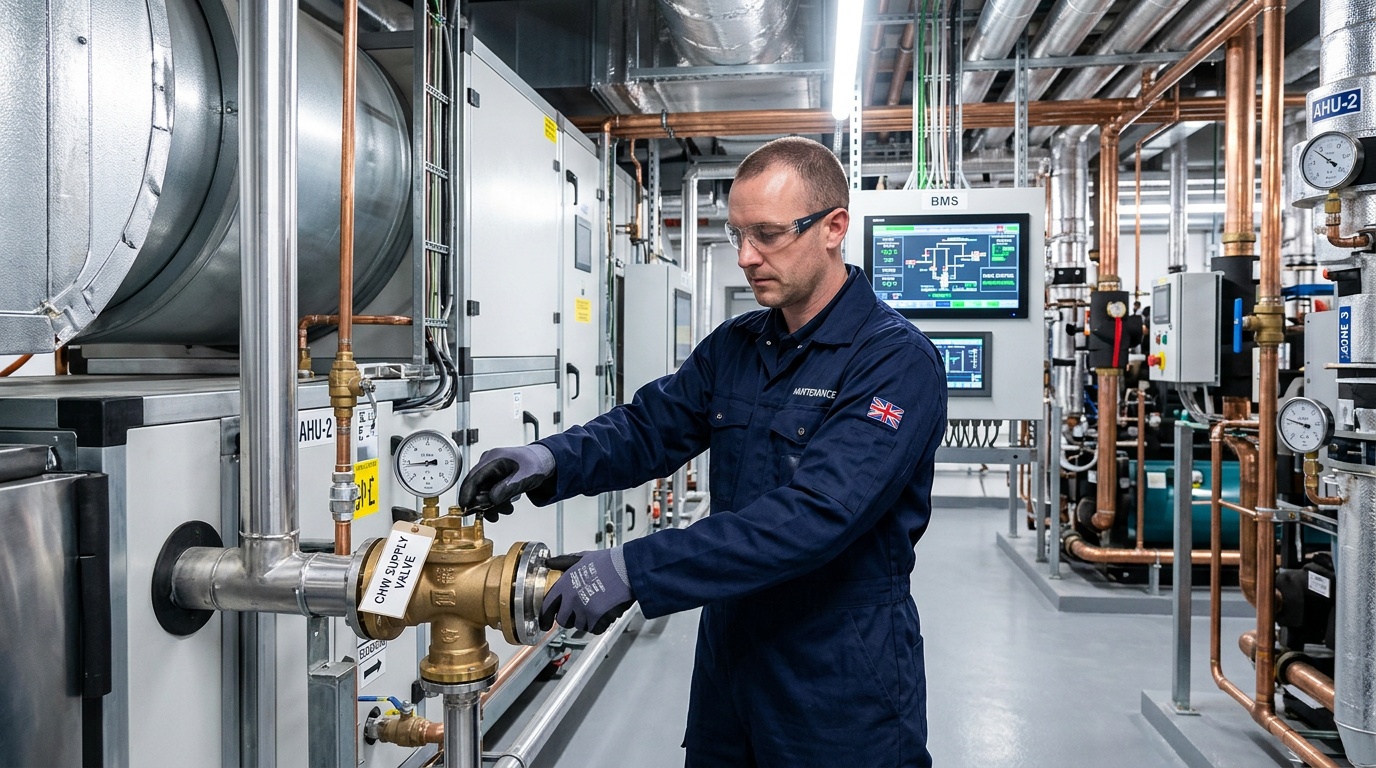
Planned electrical maintenance reduces the chance that a small defect becomes an outage. Engineers inspect cable terminations, test protective devices, check thermal damage and assess ageing components before they threaten the building. For an office, warehouse, school, care setting or retail site, that early intervention can protect occupants and keep essential operations running.
It also gives facility managers better control over cost and scheduling. Planned visits reduce reliance on emergency labour, rushed parts orders, spoiled stock, cancelled appointments and lost production. No maintenance programme prevents every fault, but it gives the team a clearer view of asset condition and a safer way to deal with known defects.
- Compliance evidence: inspection certificates, test results, remedial records and asset histories provide an auditable trail.
- Safer premises: tested circuits, emergency lighting and protective equipment reduce exposure to electric shock and fire.
- Better resilience: generator servicing, UPS checks and changeover testing help maintain power for servers, security, refrigeration and life-safety equipment.
- Lower energy demand: LED lighting, occupancy controls and properly maintained equipment can reduce avoidable consumption.
- Clearer communication: a named engineer and defined escalation process give the facilities team useful updates during an outage.
Electrical readings can also reveal overloaded circuits, poor power factor, heat build-up and inefficient plant operation. Those findings may support decisions about lighting controls, occupancy sensors, motor condition and voltage monitoring. Where ventilation equipment is involved, our Commercial Ventilation Repair Services follow the same principle: record the defect, repair it properly and check the effect on building performance.
How should you choose an electrical maintenance provider in Birmingham?
Choose a provider that can manage risk before failure, not just attend after a circuit trips. Start with a scope covering fixed wire testing, emergency lighting, distribution boards, fault diagnosis, power quality, lighting controls, standby generation and UPS systems. The contractor should review your asset register, site access, critical loads, operating hours and fault history before proposing a programme.
Competence must be evidenced. Check whether the electrical contractor holds suitable NICEIC Approved Contractor or NAPIT certification, carries appropriate insurance and can provide engineer qualifications for the work required. Ask how testing aligns with BS 7671, the Electricity at Work Regulations and relevant fire safety responsibilities. If your premises fall within a higher-risk building process, confirm how records and remedial actions support duties under the Building Safety Act.
Questions to ask before appointing a provider
A serious facilities partner should explain response times, escalation routes and communication during an incident. Ask who monitors emergency calls outside normal hours, how often updates are issued, whether engineers carry common replacement parts and how temporary measures are controlled. A refrigeration failure may threaten food stock within hours. A UPS fault can interrupt servers, access control and communications. The service plan must reflect those consequences.
- Planned maintenance: confirm visit frequency, inspection points, thermal imaging, protective-device testing and review of recurring defects.
- Reporting: require digital certificates, photographs, test readings, defect classifications and a named person responsible for remedial quotations.
- Resilience: ask whether generator servicing, automatic transfer switches, battery systems and load-bank testing are included or coordinated.
- Coverage: check that the team can support lighting, controls, motors, containment and plant interfaces across the building.
- Commercial control: establish call-out rates, labour terms, parts approval limits and the authorisation process for urgent works.
Ask how the contractor manages the boundary between electrical and mechanical systems. A fan motor, control panel or air-handling unit may fail through an electrical defect, while the operational impact appears as poor ventilation or loss of heating and cooling. Our Commercial Ventilation Repair Services can support this wider assessment where air movement equipment forms part of the fault.
Stuart’s buying test: Request a sample service report before signing. It should show the asset tested, inspection result, instrument reading, defect priority, recommended action and completion evidence. If the paperwork is vague, the maintenance process is likely to be vague as well.
Finally, check whether the programme fits the site. Visits may need to take place during quiet trading periods, planned shutdowns or overnight access. Confirm RAMS, permits to work, isolation procedures and communication with occupants. The right partner combines qualified engineers, documented inspections, 24/7 attendance and honest remedial advice. That is how you protect your assets and your people while preventing downtime before it happens.
References
- https://www.hse.gov.uk/electricity/
- https://www.gov.uk/guidance/energy-savings-opportunity-scheme-esos
- https://en.wikipedia.org/wiki/Facility_management
Frequently Asked Questions
What electrical services should facility managers in Birmingham look for?
A commercial maintenance plan should cover fixed wire testing, electrical installation condition reports, emergency lighting, distribution boards, protective devices, lighting controls, power quality and fault diagnosis. Sites that depend on refrigeration, servers, security systems or production equipment should also review generator, UPS, battery and automatic changeover arrangements. Ask the contractor to map each asset against operational risk, inspection frequency and replacement priority. Electrical support may also need to connect with mechanical plant, controls and ventilation equipment. Our Commercial Ventilation Repair Services are relevant where a fan motor, control panel or air-handling unit is affected by an electrical fault.
How do I ensure my facility’s electrical systems are compliant?
Start with a current asset register and a documented inspection schedule. Use a suitably qualified contractor to assess installations against BS 7671, the Electricity at Work Regulations and applicable fire safety requirements. Retain certificates, test readings, photographs, defect classifications and evidence of completed remedial work. Compliance is not established by holding one old certificate. It depends on managing defects, recording decisions and reviewing systems after alterations, equipment changes or changes in occupancy. Ask whether the provider holds appropriate NICEIC Approved Contractor or NAPIT certification, and confirm that engineers are competent for the specific installation. An M&E HVAC compliance health check can also help identify wider building-services risks.
What are the benefits of planned preventative maintenance for electrical systems?
PPM allows engineers to identify heat damage, loose terminations, overloaded circuits, insulation deterioration and failing protective devices before they cause an outage. It also gives the facilities team a predictable maintenance budget and a clear record of asset condition. Testing standby power systems can protect critical operations during a utility interruption, while scheduled lighting and control checks can reduce unnecessary energy use. A good programme includes planned shutdowns, isolation procedures, risk assessments and communication with building occupants, not just a visit followed by a generic checklist.
How can sustainable electrical upgrades reduce operational costs?
Begin with evidence from energy bills, lighting surveys, occupancy patterns and power-quality readings. LED fittings, presence controls, daylight sensors, efficient motors and improved scheduling can reduce wasted consumption, while sub-metering helps identify abnormal demand. The business case should include installation cost, maintenance requirements, expected service life, disruption and payback. The energy savings opportunity should still meet lighting levels, emergency requirements and equipment compatibility. Where ventilation plant is consuming excessive power because of a control or motor defect, Commercial Ventilation Repair Services can address the engineering fault before replacement is considered.
What should I ask an electrical services provider before appointment?
Ask who provides out-of-hours cover, the expected response process, how often updates are issued and which engineer has authority to escalate a safety issue. Confirm pricing, parts approval, reporting standards, RAMS, permits and isolation controls. Request a sample service report and check that it identifies the asset, finding, test result, risk level and recommended action. The provider should understand the consequences of downtime at your site, including stock loss, access failure, lost production and disruption to occupants. Reliable maintenance is measured by safe work, useful communication and evidence that defects are properly closed. A wider facility management approach can help coordinate these responsibilities.