Recommended sustainable AC solutions for estates?
The Estate Manager's Dilemma: Why Traditional AC Just Doesn't Cut It Anymore
Your estate's air conditioning system is silently draining your budget while failing to meet modern sustainability standards. In my 24 years working across commercial properties, I've watched countless facility managers battle the same frustrating cycle: soaring energy bills, compliance headaches, and occupant complaints about inconsistent temperatures. Traditional AC systems weren't designed for today's environmental regulations or energy costs. Simple as that.
The Hidden Costs of Inefficient Cooling
That monthly electricity bill only tells part of the story. Traditional systems waste 30-40% of their energy through poor zoning control and outdated refrigerants. Add frequent breakdowns, emergency call-outs, and the productivity losses from uncomfortable working environments. You're looking at a total cost of ownership that's eating into your bottom line.
When M&E Maintenance Solutions audits estate cooling systems, we regularly find annual waste equivalent to 15-20% of total energy spend. That's not a margin of error. That's money walking out the door.
The Growing Pressure
F-Gas regulations are tightening. Carbon reporting requirements are expanding. Your tenants expect comfortable, sustainable environments. Traditional R410A refrigerant systems face phase-out pressures, while older equipment struggles to meet current efficiency standards.
Estate managers need sustainable AC solutions that address these multiple pressures simultaneously. Not next year. Now.
Why 'One-Size-Fits-All' Fails for Estates
Estate-Specific Requirements
- Multiple building types requiring different cooling strategies
- Varying occupancy patterns across zones
- Heritage building constraints
- Diverse tenant requirements
Traditional System Limitations
- Fixed capacity regardless of actual demand
- Single-zone control for multi-use spaces
- High refrigerant charges increasing leak risks
- Limited integration with renewable energy
Estates demand flexible, scalable cooling solutions that adapt to changing needs while delivering consistent performance across diverse building types. M&E Maintenance Solutions specialises in designing bespoke sustainable cooling strategies that address these complex requirements through our proven assessment and implementation process.
The Top Sustainable AC Technologies for UK Estates
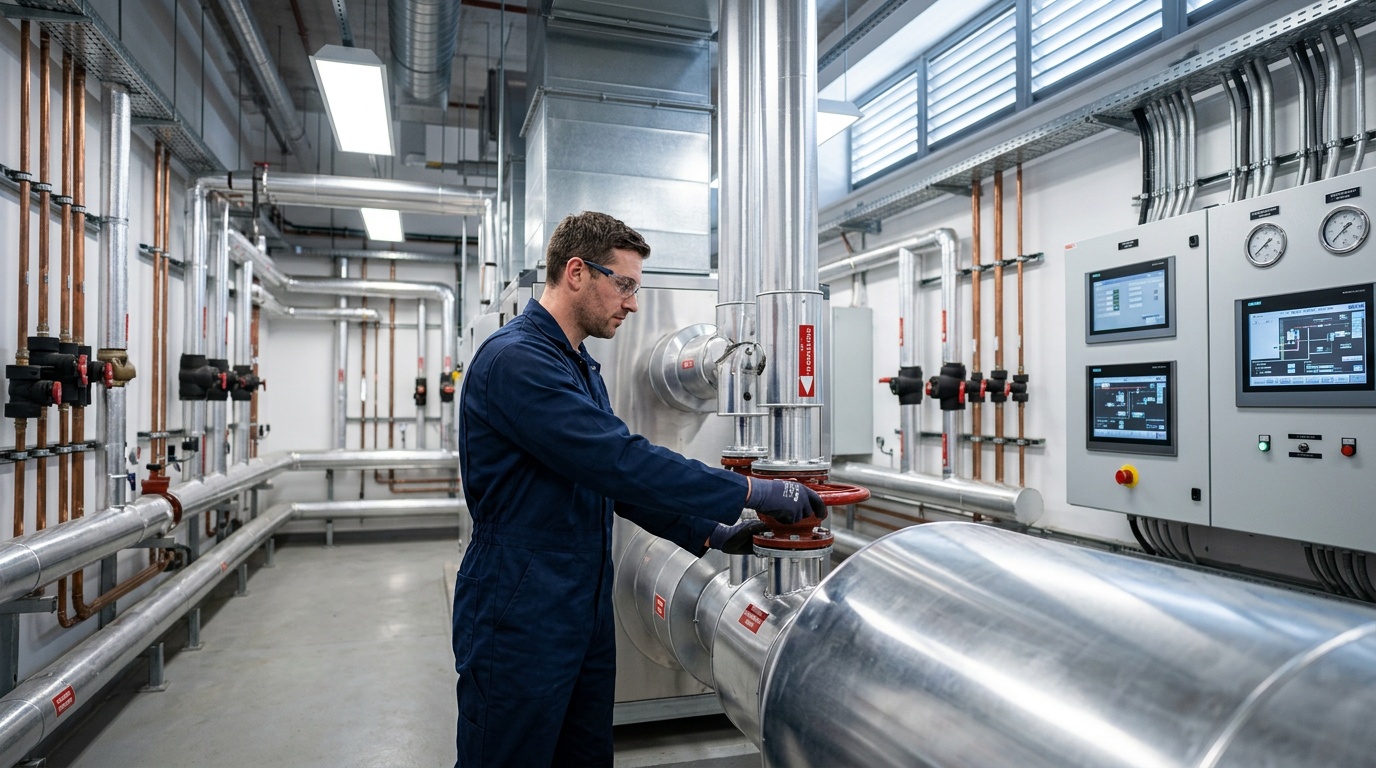
The sustainable cooling market offers several proven technologies. After extensive field testing and client deployments, three solutions consistently deliver optimal performance for UK commercial properties.
Air-to-Water Heat Pumps: The Versatile Workhorse
Air-to-water heat pumps provide both heating and cooling through existing water-based distribution systems. These units achieve seasonal efficiency ratings of 300-400%. Every kilowatt of electricity produces three to four kilowatts of thermal energy.
For estates with radiator systems or underfloor heating, air-to-water integration requires minimal infrastructure changes while delivering year-round climate control. Modern units operate effectively down to -20°C. Perfect for UK weather patterns.
Variable Refrigerant Flow (VRF) Systems
VRF technology excels in estates requiring precise temperature control across multiple zones with varying occupancy patterns. These systems use advanced inverter technology to modulate refrigerant flow based on real-time demand. They achieve part-load efficiencies exceeding traditional systems by 30-50%.
Individual zone control means unoccupied areas consume minimal energy while occupied spaces maintain optimal comfort. Heat recovery VRF units simultaneously heat and cool different zones, capturing waste heat from server rooms or south-facing offices to warm north-facing spaces.
Solar PV Integration
Solar PV integration cuts the operational cost of sustainable AC systems by offsetting grid electricity use. Peak cooling demand typically coincides with peak solar generation. Natural synergy.
A well-designed solar array offsets 60-80% of annual cooling energy consumption. Excess generation feeds back to the grid or charges battery storage for evening operation. M&E Maintenance Solutions designs integrated systems where solar output directly powers heat pump compressors, maximising renewable energy use while reducing grid dependency.
Other Viable Options for Specific Estate Needs
| Technology | Best Application | Key Benefit | Efficiency Rating |
|---|---|---|---|
| Ground Source Heat Pumps | Large estates with available land | High efficiency, stable performance | 400-500% seasonal efficiency |
| Hybrid Heat Pumps | Retrofits with existing gas boilers | Gradual transition, backup heating | 200-300% average efficiency |
| Absorption Chillers | Estates with waste heat sources | Uses waste heat, low electricity use | 70-80% thermal efficiency |
| Evaporative Cooling | Industrial estates, warehouses | Low energy consumption in suitable conditions | Can use significantly less energy than traditional AC |
Each technology addresses specific estate requirements, from heritage building constraints to industrial cooling demands. The key lies in matching system capabilities to your estate's unique operational patterns and infrastructure limitations.
The M&E Advantage: Our Proven Process for Estate Sustainability
Selecting sustainable AC solutions for estates requires more than browsing manufacturer brochures. At M&E Maintenance Solutions, we've developed a rigorous evaluation process that protects our clients from costly mistakes while ensuring optimal performance from day one.
The 'Open Door' Innovation Policy
Every technology we recommend has undergone real-world testing in our own facilities or partner sites. We don't sell untested equipment to clients. Period.
Our innovation policy means manufacturers must demonstrate actual performance data, not laboratory claims. Recent trials included advanced VRF systems operating through winter conditions and hybrid heat pumps managing variable loads across mixed-use developments. This hands-on approach removes guesswork and ensures you invest in proven solutions.
Assessing Your Estate's Unique Cooling Demands
Technical specifications tell only part of the story. Our assessment process examines occupancy patterns, existing infrastructure, future expansion plans, and operational constraints. We analyse historical energy data, conduct thermal surveys, and map heat loads across different building types within your estate.
This approach identifies opportunities for heat recovery, optimal equipment placement, and integration with existing systems that generic consultants typically miss.
Sizing It Right
Key Sizing Insight
Oversized systems cycle frequently, reducing efficiency by 20-30% while increasing wear rates. Undersized systems struggle to maintain comfort while consuming excessive energy. Our detailed load calculations account for thermal mass, solar gains, and operational diversity factors to specify systems that operate in their optimal efficiency range throughout varying conditions.
Proper sizing requires understanding your estate's thermal behaviour throughout different seasons and occupancy scenarios. We model peak demands, partial loads, and transition periods to ensure selected systems maintain high efficiency across all operating conditions.
Installation Excellence
The best equipment fails without proper installation. Our certified engineers follow manufacturer specifications while applying decades of field experience to avoid common pitfalls. Refrigerant charging, electrical connections, and control calibration receive particular attention. These areas directly impact system performance and longevity.
We provide detailed commissioning reports and performance verification to ensure your investment delivers expected results.
Post-installation support includes performance monitoring, seasonal adjustments, and proactive maintenance scheduling aligned with SFG20 standards. This approach ensures your sustainable cooling systems maintain peak efficiency while meeting all compliance requirements throughout their operational life.
Maximising ROI: Cost Savings and Long-Term Value of Sustainable AC
Investment in sustainable AC solutions for estates delivers measurable returns through reduced operational costs, improved asset values, and better tenant satisfaction. Understanding these financial benefits justifies the initial investment and supports long-term value planning.
Quantifying Savings
Modern sustainable systems typically reduce cooling energy consumption by 40-60% compared with traditional equipment. Air-to-water heat pumps achieve 300-400% efficiency, translating into substantial savings on utility bills. VRF systems with heat recovery can reduce total HVAC energy consumption by up to 50% in mixed-use estates.
These savings compound annually, creating significant value over system lifecycles of 15-20 years.
Understanding Payback Periods
Typical payback periods range from 3-7 years depending on existing system efficiency and energy costs. Estates with older, inefficient equipment often see faster returns, while properties with recent installations require longer payback calculations.
Government incentives, including improved capital allowances and potential future carbon credits, can reduce effective payback periods by 12-24 months.
Lifecycle Cost
Sustainable systems generally require less maintenance than traditional equipment due to improved component design and reduced operating stress. Variable-speed compressors experience less wear, advanced controls prevent damaging operating conditions, and updated refrigerants reduce system degradation.
Total lifecycle costs favour sustainable solutions by 20-35% when maintenance, energy, and replacement costs are considered over 20-year periods.
Grants and Incentives
Improved capital allowances allow 100% first-year tax relief on qualifying sustainable equipment. Local authorities increasingly offer grants for commercial sustainability improvements. The Green Finance Institute provides access to favourable lending rates for verified sustainable projects.
M&E Maintenance Solutions assists clients in identifying and securing available incentives, reducing net investment costs while accelerating project approval processes.
Combined with operational savings, these mechanisms strengthen the investment case for estate sustainability upgrades that deliver both environmental and commercial benefits.
Frequently Asked Questions
What is the most environmentally friendly air conditioning system for estates?
For estates, air-to-water heat pumps and Variable Refrigerant Flow (VRF) systems are consistently proving to be highly sustainable. Air-to-water heat pumps offer both heating and cooling with high seasonal efficiency, while VRF systems provide precise, multi-zone control, significantly reducing energy waste. Integrating these with solar PV further cuts down on grid electricity use, making the entire solution even greener.
Does setting the AC to 72 instead of 70 degrees make it cheaper for commercial properties?
Absolutely, every degree you raise the thermostat can lead to noticeable energy savings in commercial properties. Traditional systems often waste 30-40% of energy, and even with sustainable solutions, optimising your set points directly reduces the load on the system. This translates into lower operational costs and a smaller carbon footprint for your estate.
What is the 20-degree rule for HVAC systems in commercial settings?
While there isn't a strict "20-degree rule" universally applied, the principle behind it highlights the importance of not overworking your HVAC system. Setting your internal temperature too far below the outside ambient temperature forces the system to consume significantly more energy. For commercial estates, focusing on smart zoning, real-time demand modulation with systems like VRF, and maintaining a reasonable differential is key to efficiency and cost control.
What are the biggest issues with traditional AC systems in estates today?
Traditional AC systems are a drain on estates, hitting budgets with soaring energy bills and failing to meet modern sustainability standards. They often waste 30-40% of energy due to poor zoning and outdated refrigerants, leading to compliance headaches with tightening F-Gas regulations. This results in inconsistent temperatures and unhappy occupants, driving up total cost of ownership.
Which sustainable AC technologies are proving most effective for UK estates?
For UK estates, air-to-water heat pumps and Variable Refrigerant Flow (VRF) systems are consistently delivering optimal performance. Air-to-water heat pumps provide efficient heating and cooling, often integrating with existing water-based systems. VRF technology offers precise, multi-zone temperature control, achieving significant part-load efficiencies. Integrating these with solar PV further maximises renewable energy use.
How does solar PV integration contribute to sustainable cooling for estates?
Solar PV integration significantly cuts the operational cost of sustainable AC systems by offsetting grid electricity use. Peak cooling demand often aligns perfectly with peak solar generation, creating a natural synergy. A well-designed solar array can offset a substantial portion of annual cooling energy consumption, reducing grid dependency and your estate's carbon footprint.