Top emergency ventilation fix services West Midlands?
When a commercial ventilation system stops, the problem may extend beyond an uncomfortable room. Air quality can deteriorate, extract rates can fall, production areas may become unsafe, and landlords or facilities managers may face workplace welfare questions. If you are assessing Top emergency ventilation fix services West Midlands?, begin with diagnosis, statutory duties and first-time repair capability rather than a sales pitch for complete replacement.
Key Takeaways
- Always start with a proper diagnosis to find the root cause before agreeing to any replacement work.
- Choose a service provider that understands your statutory duties for workplace air quality and safety.
- Look for a contractor with first-time repair capability to get your ventilation running again with minimal downtime.
- Reject any sales pitch for a full system replacement when a targeted fix can solve the immediate problem.
- Emergency ventilation failures can create safety hazards and legal exposure for facilities managers and landlords.
I have spent more than 24 years working from plant rooms to boardrooms. My advice is direct: treat ventilation failure as an operational risk, record what changed, isolate unsafe equipment and obtain a properly qualified commercial engineer. MEMS also provides Plumbing and Electrical Services for associated building faults, with accurate quotes and upfront pricing where electrical or plumbing work affects the response.
The Cost of Silence: Why Ventilation Emergencies Hit West Midlands Businesses Hard
Downtime's Ripple Effect: Beyond Comfort to Business Continuity
A failed air handling unit, extract fan or controls panel can affect manufacturing processes, warehouse conditions, retail footfall, staff attendance and tenant satisfaction, not only occupant comfort. In a busy Birmingham property, one failed fan may increase demand on unaffected equipment, electrical consumption, heat or condensation in enclosed areas.
The commercial cost includes lost working hours, cancelled appointments, spoiled stock, emergency attendance, access arrangements and reputational damage. A building can appear operational while running below its designed ventilation rate, so a temporary restart is not a completed repair. The engineer should identify the fault, test the system under load and document belts, filters, motors, capacitors, inverters, dampers and controls.
The Hidden Dangers: Air Quality, HSE Compliance, and Legal Risks
The Health and Safety Executive’s Workplace (Health, Safety and Welfare) Regulations 1992 require enclosed workplaces to have an adequate supply of fresh or purified air. HSE guidance commonly refers to fresh air rates of around 8 to 10 litres per second per person, subject to the building, activity and ventilation design. A failed supply system can leave a business unable to demonstrate that its workplace remains suitable.
Managers should consider carbon dioxide, airborne contaminants, dust extraction, humidity, temperature, fire damper position and safe escape routes. A contractor should provide test readings, useful photographs, electrical safety observations and a clear isolation record. Poor terminations, floating neutrals and incorrect earthing are not acceptable temporary fixes because they can expose staff, visitors, tenants and the business to injury and enforcement action.
West Midlands Focus: Understanding Regional Commercial Pressures
West Midlands facilities often combine offices, workshops, retail units, logistics areas and older industrial buildings. Birmingham, Coventry, Wolverhampton, Walsall, Dudley and surrounding estates may contain mixed plant, ageing ductwork and controls added in stages. Access can involve loading bays, security desks, roof plant, tenant coordination or out-of-hours restrictions.
Ask whether the engineer understands commercial air handling, mechanical extraction, electrical controls and site safety, not only whether someone can attend. A firm able to coordinate ventilation work with Plumbing and Electrical Services can identify linked faults such as a failed isolator, damaged supply cable or water ingress near plant.
Emergency Ventilation: Diagnosing the Crisis vs. the Inconvenience
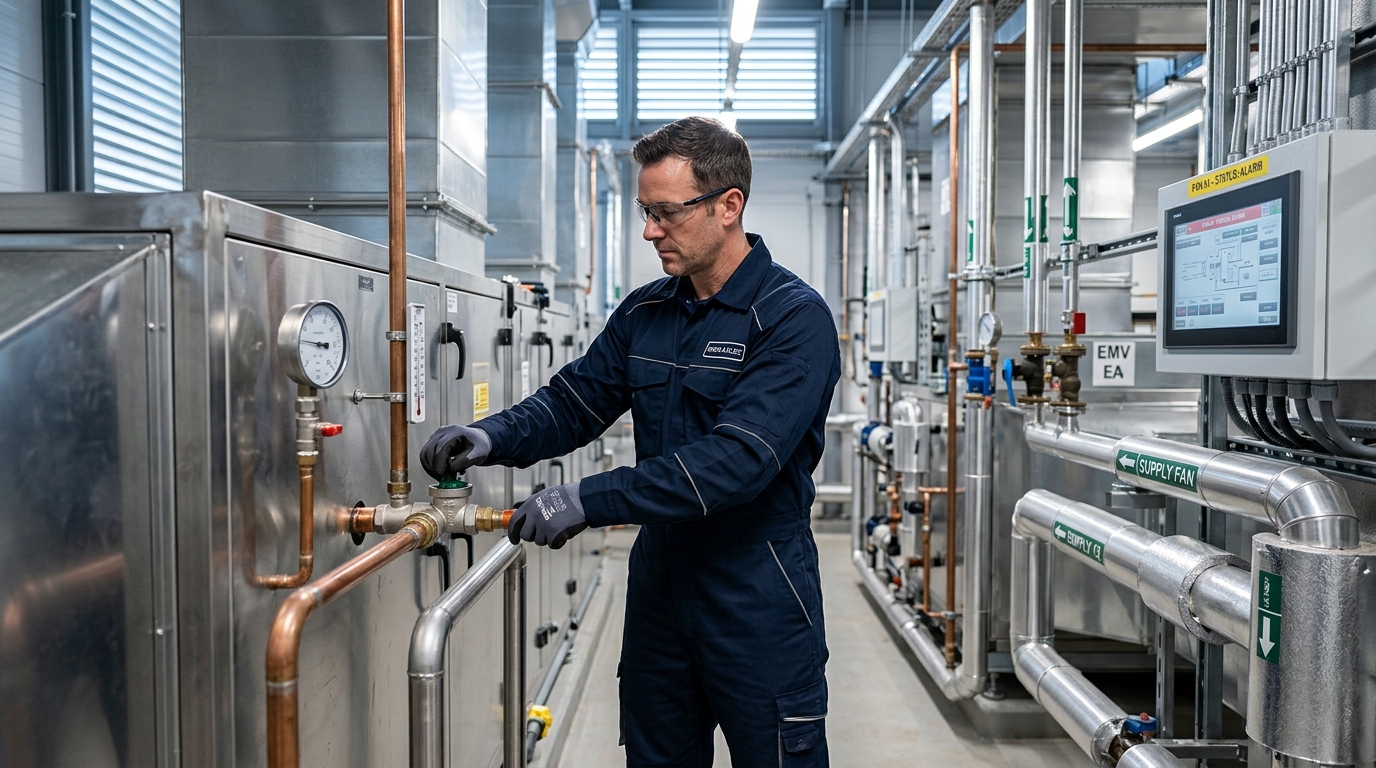
A commercial ventilation breakdown is an emergency when it creates an unsafe workplace, removes required extraction, affects a high-risk process, causes overheating or raises smoke-control concerns, or prevents operation within documented risk controls. A warm office with working fresh-air provision may need planned maintenance. A silent extract system in a toilet block, laboratory, kitchen, workshop or enclosed production area needs prompt assessment.
Critical Failure Scenarios: AHU Burnout, Extract System Collapse, and Fire Damper Trips
An air handling unit burnout may involve a motor, fan assembly, contactor, inverter, sensor or control board. Replacing the motor without checking airflow resistance and filter condition can cause another failure. Extract systems may stop through worn drive belts, seized bearings, failed capacitors, blocked grilles or lost electrical supply. A fire damper trip needs investigation because it may relate to temperature, smoke detection, actuator operation or the building’s fire strategy.
Do not repeatedly reset protective devices. A competent engineer should isolate equipment, confirm safe access, inspect the supply, test insulation and continuity where appropriate, and verify operation after repair. Daikin, Mitsubishi Electric and Vent-Axia use different control arrangements, so generic trial-and-error repairs are poor practice.
The HSE Workplace (Health, Safety and Welfare) Regulations 1992: Your Compliance Checklist
Record the following checks in the site log and pass them to the responsible person, landlord or duty holder.
- Fresh air: Is occupied space receiving an adequate supply of outside air?
- Extraction: Are fumes, dust, vapour, heat or moisture removed from the source?
- Occupancy: Has the affected area been reduced, closed or segregated where ventilation is inadequate?
- Temperature: Is heat build-up affecting staff welfare, equipment or stock?
- Controls: Are sensors, time clocks, alarms, interlocks and variable speed drives functioning?
- Fire safety: Are fire dampers, smoke controls and associated interfaces in their correct condition?
- Records: Is there an engineer’s report showing the fault, isolation, repair and test outcome?
Spotting the Early Warning Signs: Proactive Triage for Facility Managers
Before calling an engineer, gather information without opening panels or interfering with live equipment. Record the asset reference, location, alarm code, failure time, affected rooms, recent works and unusual noise or odour. Check whether the local isolator is on, whether a breaker has tripped once and whether other plant operates. Do not repeatedly reset a breaker or bypass an interlock.
- Compare supply and extract operation with the normal schedule.
- Check visible filters and grilles for severe blockage without removing guarded components.
- Listen for belt slap, bearing noise, motor humming or repeated starts.
- Ask occupants about stale air, headaches, condensation, fumes or unusual heat.
- Tell the engineer whether the system serves a process, kitchen, workshop, laboratory or fire-control function.
These details separate a comfort complaint from a safety and continuity event and reduce misdiagnosis. A credible emergency service should explain the failed component, show test evidence, identify any temporary restriction and state whether repair or replacement is technically justified.
The West Midlands Emergency Fix: Logistics, Response, and the 'First-Time Fix' Imperative
Beyond the M6: Realistic Response Times Across Birmingham and the Black Country
When assessing Top emergency ventilation fix services West Midlands?, ask how response promises work in practice. Birmingham, the Black Country, Coventry, Solihull, Walsall, Wolverhampton and Dudley present different access, traffic and security challenges. A service level agreement should state the attendance target, escalation process and engineer availability rather than offering a vague “rapid response”. For high-risk premises, a two-to-four-hour emergency threshold may be appropriate, subject to access, traffic and information supplied during the call.
Dispatch should record the asset type, manufacturer, fault code, plant-room location, electrical supply, access restrictions and whether the equipment supports a process or fire safety function. A local engineer familiar with roof-mounted air handling units, warehouse extraction, kitchen canopies and office mechanical ventilation can spend more time testing plant. Attendance is only one measure: safe isolation, accurate fault-finding and a documented operational test determine success.
Critical Van Stock: Why 4-Hour Fixes Depend on Preparedness, Not Promises
A vehicle carrying suitable parts can shorten a shutdown. Research indicates that first-time fix performance for regional reactive maintenance rises above 85% when engineers carry standardised three-phase fan belts, run capacitors and universal contactors. These parts address common faults without waiting for a supplier. Up to 65% of commercial ventilation call-outs are linked to preventable mechanical or electrical failures, including worn belts, failed capacitors and clogged intake filters.
Ask what the engineer normally carries and how specialist items are escalated. A replacement belt must match the fan arrangement and tension requirements; a capacitor needs the correct rating; and a contactor must suit the load and control circuit. The repair record should state the part fitted, test readings, protection settings and remaining defects.
The 'Repair-First' Protocol: Avoiding Predatory Upselling of Full System Replacements
A failed ventilation system does not automatically require a new air handling unit or complete extract installation. The engineer should establish whether the fault is in the power supply, isolator, motor protection, capacitor, belt drive, inverter, sensor, actuator, fan motor or control panel. Explain the diagnosis in plain language and support it with photographs or test results. If replacement is recommended, request the reason, the condition of related components, expected service life and risks of repairing the existing asset.
A report saying only “unit obsolete” does not identify the failed part. Obsolescence can affect controls, spares and efficiency, but does not prove immediate replacement is the only safe route. Replacement may be justified where the motor is beyond economic repair, casing unsafe, heat exchanger damaged or control system unsupported. The decision should come from engineering evidence.
| Observed fault | Diagnostic checks | Potential repair route | Replacement concern |
|---|---|---|---|
| Fan hums but does not start | Capacitor rating, winding condition, shaft movement and supply voltage | Replace the failed capacitor or motor where testing supports it | Do not specify a complete unit before testing the drive assembly |
| Fan runs with poor airflow | Belt tension, pulley alignment, filter blockage and fan rotation | Renew belt, clean or replace filters, correct alignment | Low airflow may be a maintenance fault, not an equipment failure |
| Inverter alarm or intermittent trip | Fault history, motor insulation, cooling, parameters and control signal | Correct the underlying motor, wiring or parameter issue | Changing the inverter alone may cause another trip |
| Extract system is silent | Protective devices, contactor, isolator, controls and motor circuit | Repair the failed electrical or mechanical component | Request evidence before authorising a new extract system |
Component Deep Dive: Diagnosing Capacitors, Belts, and Inverters Correctly
Run capacitors can lose capacity through age, heat and repeated starting duty, causing humming, overheating or failure to reach speed. A belt can split, stretch, glaze or come off after pulley misalignment. Replacing it without checking bearings, tension and fan resistance leaves the cause in place. Inverter assessment includes alarm history, motor compatibility, drive cooling, cable condition, earthing, control signal and parameters. Dangerous terminations, floating neutrals and poor earthing must be corrected by a competent electrical engineer, not concealed by a reset.
For facility managers searching for Top emergency ventilation fix services West Midlands?, ask whether the provider can explain the failed component, show evidence and restore the system safely. MEMS also offers Plumbing and Electrical Services when a ventilation fault involves an isolator, supply cable, water ingress or another building-services issue.
Securing Compliance and Cost-Effectiveness: What to Demand from Your Ventilation Emergency Service
The True Cost of Emergency Ventilation Repair in the West Midlands: Transparency is Key
Emergency repair pricing should separate call-out, labour, travel, materials, out-of-hours rates and follow-on work. Confirm whether attendance includes diagnosis and how approval will be obtained before additional parts are fitted. A report should distinguish a temporary measure from a completed repair, preventing an unclear invoice after plant is opened.
Request a written estimate with photographs, test results and the condition of related equipment. MEMS provides accurate quotes and upfront pricing through its Plumbing and Electrical Services. Agree scope, exclusions and test information for the building file.
Engineer Qualifications: Beyond 'Certified' , What Matters for Commercial Ventilation?
“Certified” is not enough information. Ask who will attend, what commercial ventilation experience they have and whether the work requires mechanical, electrical or controls expertise. The engineer should understand safe isolation, motor circuits, variable speed drives, contactors, sensors, fire damper interfaces and manufacturer-specific systems from Daikin, Mitsubishi Electric and Vent-Axia. Electrical work should be completed by a suitably competent technician with inspection and testing appropriate to the task.
A credible provider explains repair limits, residual risks and records another competent engineer can follow. Ask for named escalation support, emergency contact arrangements and a process for unsafe equipment.
SFG20 and BESA Standards: The Benchmark for Commercial Maintenance
SFG20 provides a recognised structure for planned maintenance tasks, frequencies and records. BESA guidance, including TR19 where ductwork hygiene is relevant, helps set inspection and cleanliness expectations. HSE Approved Code of Practice L24 provides practical guidance connected with workplace welfare duties. These references do not replace a site-specific risk assessment, design review or manufacturer instructions, but help managers check whether maintenance is complete and defensible.
Building Long-Term Reliability: Planned Preventative Maintenance (PPM) as an Asset Protection Strategy
After the emergency, place the asset on a planned preventative maintenance schedule. A useful PPM visit checks filters, belts, bearings, capacitors, motor current, electrical connections, controls, dampers, airflow, alarms and access safety. Trend vibration, current draw and pressure readings over time so deterioration can be identified before the fan stops.
PPM supports workplace welfare, energy control, maintenance budgets, tenant confidence and business continuity. The provider should offer a clear service plan, traceable reports and sensible renewal advice when repair is no longer economical.
Your Partner for Ventilation Resilience in the West Midlands
When Breakdowns Strike: The MEMS Difference
When commercial ventilation failure threatens operations, you need a team that can assess the asset, protect people, communicate clearly and make sound engineering decisions under pressure. MEMS provides 24-hour emergency plumbing and electrical services, seven days a week, 24 hours a day for emergency services. Engineers focus on safe diagnosis, practical repair and a clear work record rather than treating every fault as a reason for wholesale replacement.
Where a ventilation problem involves a failed isolator, damaged cable, water ingress or another building-services issue, our recommended Plumbing and Electrical Services can coordinate the response and reduce handover delays.
Proactive Compliance, Guaranteed Uptime
Emergency attendance is only part of resilience. A stronger approach combines responsive repair with planned inspections, asset records, service-level agreements and checks on filters, belts, motors, controls, dampers and electrical connections. MEMS works towards 100 percent compliance with regulations for all electrical jobs regardless of size, while maintenance records help facility managers demonstrate responsible control of workplace systems.
For a Birmingham office, warehouse, retail unit or industrial site, choose a provider that explains the fault, confirms the repair scope and helps prevent recurrence. If you are still assessing Top emergency ventilation fix services West Midlands?, prioritise qualified engineers, transparent communication and dependable follow-through.
Expertise You Can Trust: From Apprentice to MD
I started as an apprentice combustion engineer and have spent more than 24 years working with equipment that keeps commercial buildings operating. I understand the pressure faced by a facilities manager when a plant-room fault becomes a business continuity problem. MEMS is big enough to cope, small enough to care, and committed to doing the repair properly rather than taking shortcuts.
For associated electrical and plumbing requirements, Plumbing and Electrical Services supports new installations, routine maintenance and emergency repairs. CLICK TO CALL US NOW for practical guidance, accurate quotes and upfront pricing from a team focused on keeping your building safe, compliant and open.
Frequently Asked Questions
How quickly should a commercial ventilation failure be assessed in the West Midlands?
Commercial ventilation failures in the West Midlands should be assessed promptly when extraction stops, indoor air quality falls, heat builds up or a process becomes unsafe. MEMS Facilities Maintenance recommends recording the change, isolating unsafe equipment and arranging a qualified commercial engineer to diagnose the cause. A restart should be tested under load before the system is returned to normal operation.
What should a West Midlands emergency ventilation engineer check first?
A West Midlands emergency ventilation engineer should first check the electrical supply, motor protection, belts, filters, capacitors, dampers, controls and airflow. MEMS Facilities Maintenance also checks safe isolation, visible damage, sensors, inverters and control signals before selecting a repair. Test readings and photographs help the responsible person understand the fault and the work completed.
Can a failed extract fan make a commercial workplace unsafe?
A failed extract fan can make a commercial workplace unsafe by allowing fumes, dust, vapour, heat or moisture to remain in occupied areas. MEMS Facilities Maintenance advises reducing occupancy or closing the affected area where ventilation is inadequate, especially in kitchens, workshops, laboratories and production spaces. The engineer should confirm extraction performance after repair.
Do emergency ventilation repairs cover air handling units and control panels?
Emergency ventilation repairs can cover air handling units, extract fans, motors, inverters, sensors, control panels and related electrical faults. MEMS Facilities Maintenance diagnoses the complete system rather than replacing one component without checking filters, airflow resistance and controls. This approach helps identify why the failure occurred and supports a properly tested repair.
How can businesses prepare for an emergency ventilation engineer in Birmingham?
Businesses in Birmingham can prepare by recording when the ventilation changed, identifying affected areas and making safe access available to plant rooms, roof equipment and controls. MEMS Facilities Maintenance benefits from information about alarms, recent works, tenant restrictions and process risks. Site managers should not repeatedly reset protective devices or allow unsafe equipment to run.
Can ventilation faults be linked to plumbing or electrical problems?
Ventilation faults can be linked to electrical problems such as a failed isolator, damaged supply cable or poor termination, and may also involve water ingress near plant. MEMS Facilities Maintenance provides commercial ventilation support alongside Plumbing and Electrical Services for associated building faults. Upfront pricing and accurate quotes help clarify work required beyond the ventilation equipment itself.