security solutions business
Beyond Alarms: Building a Resilient Security Framework for Your Business
A resilient security framework protects commercial premises by integrating physical defences, digital access controls, and environmental monitoring into a single managed network. Relying on standalone local alarms leaves your premises vulnerable to delayed emergency responses and high false-alarm costs. For UK commercial properties, securing operations requires a joined-up system that aligns with British Standards and your building management strategy.
The Commercial Reality: When “Security” Means More Than Just an Alarm
In my 24 years of managing commercial plant rooms and facilities, I have seen many business owners treat physical security as an afterthought. They install a basic local alarm panel, mount a few visible sensors, and assume their premises are safe. The commercial reality is that security is not just about stopping a break-in. True security means protecting your business continuity, your intellectual property, and your staff. When an incident occurs, the cost of property damage is often dwarfed by the financial impact of operational downtime, lost data, and rising insurance premiums.
For any commercial facility, a security breach is an operational disaster. If a server room is accessed by unauthorised personnel or a water pipe bursts undetected overnight, your business stops. A modern M&E Maintenance Solutions approach treats security as a core component of your building’s infrastructure. We look at how physical access, environmental factors, and building services work together to keep your doors open and your assets protected.
My Take: Why a Siloed Security Approach is a False Economy
Operating with disconnected security systems is a significant financial risk. When your intruder alarm, access control, and CCTV systems do not communicate, you create blind spots. A motion sensor might trigger an alert, but without automatic camera verification, your team cannot confirm the threat. This leads to wasted time, expensive keyholder call-outs, and potential fines for false police dispatches. Investing in a fragmented setup is a false economy because you pay multiple maintenance bills for systems that do not share data.
A unified system ensures that when an entry point is breached, nearby cameras immediately focus on the area, lock down adjacent zones, and alert your monitoring centre. This level of coordination is what turns a simple alarm into a professional security solutions business asset. It reduces response times from hours to seconds, protecting your bottom line from catastrophic losses.
Defining Your Security Needs: A Holistic Facility Manager’s Checklist
To help you evaluate your current security posture, I have compiled a checklist based on our engineering and maintenance experience. This tool helps facility managers identify vulnerabilities before they are exploited.
Facility Security Audit Checklist
- Access Control Integration: Do your access logs match your employee database automatically, and can you revoke access instantly?
- CCTV Coverage and Quality: Are your cameras positioned to capture clear facial images at all entry points under low-light conditions?
- Environmental Alerting: Does your security system monitor for water leaks, extreme temperatures, and power failures in critical areas?
- Power Redundancy: Will your security systems remain fully operational during a mains power outage?
- Compliance and Standards: Do your systems meet BS 8243 and BS EN 50131 standards for insurance validity?
The Evolution of Business Security: From Static Cameras to Smart, Integrated Systems
Understanding the Core Components: Intrusion, Access Control, and Video Surveillance
The days of grainy, analogue security footage are gone. Modern commercial security systems rely on high-definition IP cameras, smart access control readers, and addressable intrusion detection panels. These systems use digital networks to transmit data, allowing for remote monitoring and real-time alerts. High-resolution business security systems with cameras now feature onboard analytics that can distinguish between a human intruder and a blowing leaf, virtually eliminating false alarms.
Access control has also moved beyond physical keys, which are easily lost or copied. Smart systems use encrypted fobs, mobile credentials, or biometric scanners to control entry. This technology allows facility managers to restrict access to sensitive zones, track staff movement, and generate audit trails for compliance purposes.
The Often-Overlooked Pillars: Environmental Monitoring and Data Security
Many business owners forget that environmental hazards often cause more damage than human intruders. A burst pipe in a ceiling void or a cooling failure in a server room can destroy equipment and halt operations in hours. Integrating environmental sensors into your commercial security framework provides early warning of water ingress, humidity spikes, and temperature fluctuations. This proactive monitoring is essential for protecting expensive plant equipment and maintaining business continuity.
Additionally, because modern security systems are connected to the internet, they must be protected from cyber threats. Unsecured IP cameras and access control panels can serve as entry points for hackers targeting your business network. Ensuring your security hardware uses encrypted communication protocols and receives regular firmware updates is a non-negotiable part of modern facility management.
MEMS’ “Open Door” Approach to Vetted Security Technology
At M&E Maintenance Solutions, we maintain an open door policy towards evaluating and testing new technologies before we recommend them to our clients. We do not believe in using our customers’ buildings as testing grounds. Our engineering team rigorously tests hardware and software in-house to ensure reliability, ease of integration, and compliance with British Standards. This disciplined vetting process means that any technology we deploy will perform reliably under demanding commercial conditions.
Integrated Security Technology Evaluation
Pros of Integrated Security
- Centralised management of access, cameras, and alarms
- Real-time verification of intrusion alerts via video
- Automated lockouts during security incidents
- Reduced long-term maintenance overheads
Cons of Integrated Security
- Higher initial installation and configuration costs
- Requires professional network design to prevent bottlenecks
- Dependency on local network stability and power backup
The Unseen Costs: Why Cheap Security Systems End Up Costing More
The True Price of Downtime: Beyond Stolen Goods
When evaluating security solutions business options, looking only at the initial installation cost is a major mistake. Cheap, domestic-grade security hardware often fails under the demands of a commercial environment. The true cost of a system failure is not the price of replacing a broken sensor; it is the cost of the downtime that follows. If your security system malfunctions and prevents staff from entering the building, or fails to alert you to a weekend break-in, the financial damage accumulates rapidly.
Lost productivity, missed customer orders, and emergency repair fees can quickly add up to thousands of pounds. A commercial building requires commercial-grade hardware designed for continuous operation and backed by rapid-response maintenance agreements.
Compliance Minefields: GDPR, Fire Safety, and Insurance Pitfalls
Operating a commercial property in the UK requires strict adherence to legal standards. Cheap security setups often fail to meet these requirements, leaving you legally exposed. For example, commercial CCTV systems must comply with GDPR guidance on data storage, signage, and privacy masking. If your system stores footage insecurely or records public spaces unnecessarily, your business may face substantial fines from the Information Commissioner’s Office.
In addition, your access control systems must integrate correctly with your fire alarm systems. During a fire emergency, electronic locks must fail-safe to allow immediate evacuation. If a system fails to release the doors during a drill or an actual fire, you risk enforcement action for breaching fire safety regulations. Insurance providers also specify standards for intruder alarms; failing to meet these criteria can invalidate cover.
The Hidden Maintenance Bill: Why Your “Free” System Is Not Free
Many low-cost security providers lure businesses in with cheap hardware bundled with expensive, long-term monitoring contracts. These systems are often proprietary, meaning you are locked into their service network for repairs and modifications. When a component fails, you are forced to pay premium rates for replacement parts and service calls. Over a five-year lifecycle, these hidden costs can make the cheap system more expensive than a professionally engineered solution.
Choosing open-protocol hardware allows any qualified engineer to service and maintain your system. This flexibility keeps maintenance competitive and ensures you are never held hostage by a single supplier when you need urgent support.
MEMS’ “Right First Time” Philosophy Applied to Security
Our business was built on the principle of doing things properly the first time. We apply the same engineering discipline to every commercial system we maintain. We do not cut corners, and we do not use substandard components to win jobs on price. By designing and maintaining systems to high standards, we protect our clients from unexpected failures, compliance penalties, and premature equipment replacement. This commitment to quality is a key reason our reputation is built on long-term partnerships and customer referrals.
| Feature | Commercial-Grade Security Systems | Domestic-Grade Retail Systems |
|---|---|---|
| Hardware Durability | Heavy-duty, vandal-resistant metal casings | Lightweight plastic housings |
| Power Backup | Dedicated standby batteries with 8+ hour runtime | Basic battery backups or mains power only |
| Compliance | Designed to support BS EN 50131 requirements and GDPR-aligned operation | Often lacks necessary commercial compliance features |
| Integration | Integrates with fire alarms and building management systems | Standalone operation with limited connectivity |
Integrating Security with Your Building’s Brain: Efficiency, Compliance, and Peace of Mind
Beyond Security: How Integrated Systems Impact Building Operations
A smart security system does more than protect your perimeter; it improves the overall efficiency of your building. By linking your access control system with your heating, ventilation, and air conditioning systems, you can control energy consumption based on actual occupancy. When the final employee arms the security system at night, the building’s brain can automatically lower the heating, turn off the lighting, and shut down non-essential ventilation units. This integration reduces energy waste and lowers your utility bills.
Similarly, occupancy data from your access control system can help you optimise cleaning schedules and maintenance visits. If certain zones of your building are rarely used, you can adjust service intervals accordingly, saving money without compromising hygiene or operational standards.
The MEMS Advantage: Our Approach to Facility-Wide Solutions
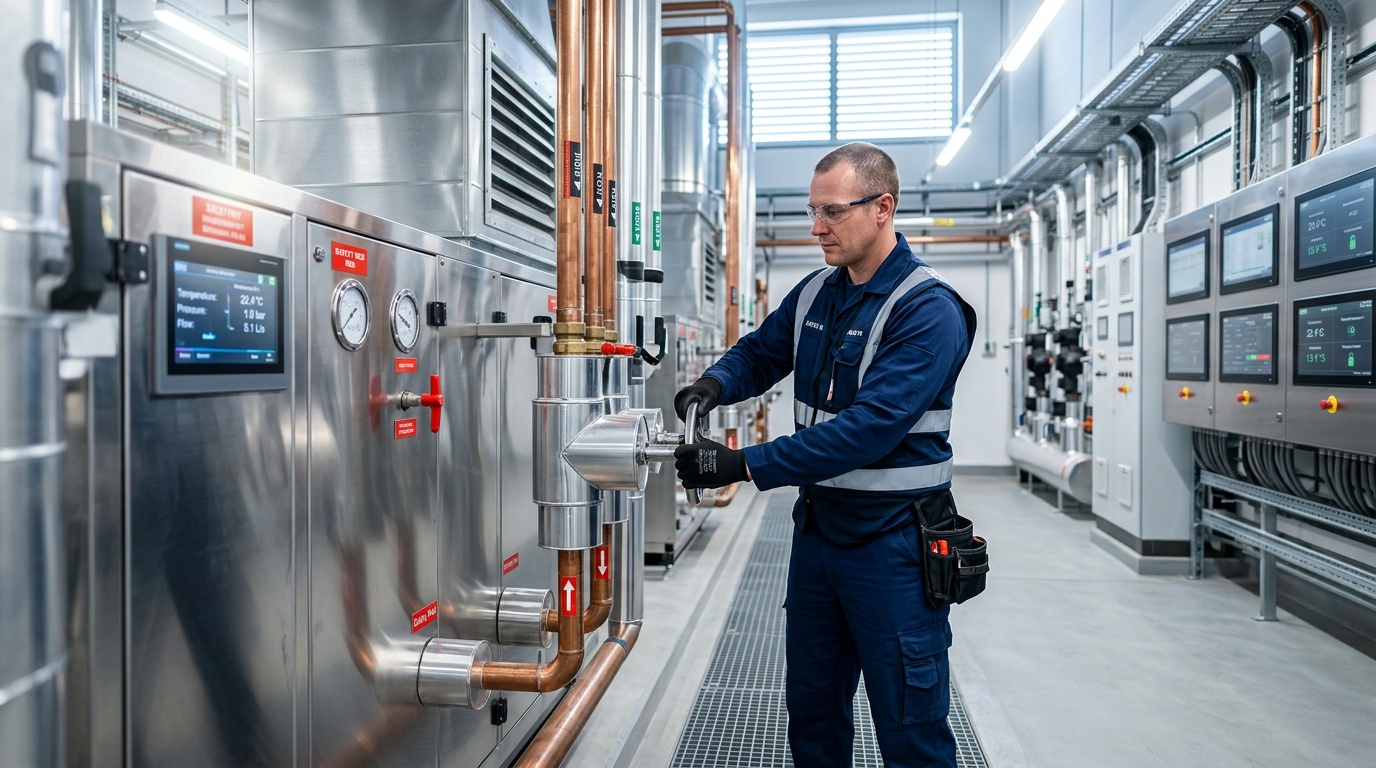
At M&E Maintenance Solutions, we understand that your building is a complex, interconnected system. We specialise in the maintenance of commercial buildings with a focus on heating, ventilation, and air conditioning. Because we understand how air handling units, boilers, and electrical systems operate, we are well placed to support sensible integration across building services. We look at the big picture so that mechanical systems, electrical infrastructure, and security controls work together to support efficiency and compliance.
Questions to Ask Your Security Provider (and Your FM Partner)
Before signing a contract with any security solutions business, ask these questions to check that the provider can meet your operational and compliance needs:
- Are your systems open-protocol, allowing us to choose a maintenance partner in the future?
- How do your access control systems interface with existing fire alarm and building management systems?
- Do you provide digital, traceable compliance certificates within 24 hours of completing a maintenance visit?
- What certifications do your engineers hold, and are they vetted to BS 7858 standards?
Taking the Next Step: Securing Your Business with Confidence
Securing a commercial facility requires a partner who understands the relationship between physical security, building services, and regulatory compliance. Do not leave business continuity to chance with fragmented, low-cost systems. Speak with our team to discuss how we can help you build a resilient, compliant facility strategy that protects your assets and your staff over the long term.
Frequently Asked Questions
What does a resilient security framework mean for my commercial business?
A resilient security framework goes beyond basic alarms. It integrates physical defenses, digital access controls, and environmental monitoring into one managed network for your commercial premises. This joined-up system protects your business continuity, intellectual property, and staff from various threats.
Why are standalone local alarms not enough for commercial security?
Relying solely on local alarms leaves your commercial premises vulnerable. They often lead to delayed emergency responses and can incur high false-alarm costs, which is a drain on your bottom line. True security means protecting your business continuity, not just reacting to a break-in.
What are the problems with disconnected security systems for a business?
Operating with disconnected security systems creates significant financial and operational risks. You end up with blind spots, where an alarm might trigger without automatic camera verification, leading to wasted time and costly call-outs. This fragmented approach is a false economy, as you pay multiple bills for systems that do not communicate or protect your assets effectively.
What components are part of a modern commercial security system?
Modern commercial security systems move beyond old analogue setups. They use high-definition IP cameras with analytics, smart access control with encrypted credentials or biometrics, and advanced intrusion detection panels. We also integrate environmental monitoring and ensure the system's data security to protect your entire operation.
Why is environmental monitoring important for business security?
Many business owners overlook how environmental hazards impact security, but a burst pipe or cooling failure can cause more damage than an intruder. Integrating environmental sensors into your security framework provides early warning for water leaks, extreme temperatures, or power failures in critical areas. This proactive monitoring is essential for protecting expensive plant equipment and maintaining your business continuity.
How does MEMS ensure the security technology they recommend is reliable?
At MEMS, we have an 'open door' policy for evaluating new security technologies. Our engineering team rigorously tests hardware and software in-house to ensure reliability, ease of integration, and compliance with British Standards. We believe in proving technology works before recommending it for your commercial premises.
What British Standards should commercial security systems meet in the UK?
For commercial properties in the UK, it's important that your security systems meet specific British Standards for insurance validity and proper operation. You should ensure your systems comply with BS 8243 and BS EN 50131. These standards help confirm your security framework is up to scratch and provides the protection your business needs.