Compare HVAC maintenance providers in West Midlands.
Navigating Your West Midlands HVAC Maintenance Options: A Facility Manager's Checklist
When your commercial building temperature fluctuates, your phone rings immediately. As a facility manager, you understand that a heating or cooling failure is never just a mechanical issue; it is a direct threat to your business continuity, staff productivity, and regulatory compliance. If you need to Compare HVAC maintenance providers in West Midlands, you must look beyond the lowest price on a tender sheet. You require a technical partner who understands how building assets directly impact your bottom line.
The True Cost of "Fix It When It Breaks" Thinking
Operating on a reactive basis is the most expensive way to run a commercial facility. Waiting for a chiller to seize or a commercial boiler to lock out before calling an engineer results in emergency call-out rates, premium parts pricing, and lengthy delivery delays. This approach accelerates asset depreciation, forcing you to replace expensive plant equipment years before its natural end of life.
A lack of regular servicing also causes energy drift. When filters clog, heat exchangers scale up, and sensors lose calibration, your systems work harder to achieve the same output. This inefficiency can silently increase your monthly energy bills by up to fifteen per cent without your knowledge.
Why Proactive Maintenance is Your Financial and Operational Lifeline
Planned Preventative Maintenance (PPM) is an investment that protects your operating budget. By scheduling regular inspections, engineers identify and rectify minor issues, such as worn belts or minor refrigerant leaks, before they escalate into catastrophic failures. This structured approach keeps your systems running at peak efficiency, lowering your carbon footprint and energy consumption.
Understanding Your Legal Obligations: F-Gas, SFG20, and Beyond
Compliance is a legal necessity for commercial building operators. Under UK law, you must adhere to strict regulations regarding F-Gas record-keeping, gas safety inspections, and legionella control. Failing to produce valid maintenance records during an audit or insurance claim can result in severe financial penalties, voided insurance policies, and personal liability for directors.
Key Questions to Ask Potential HVAC Maintenance Providers
To protect your facility, you must ask direct questions during the procurement process. Use this checklist to evaluate potential partners:
The Facility Manager's Evaluation Checklist
- Do your engineers hold direct, individual F-Gas and Gas Safe registrations?
- Can you provide digital, traceable compliance certificates within twenty-four hours of a site visit?
- Is your maintenance delivery aligned with the SFG20 standard?
- How do you calculate your emergency response times, and are they contractually guaranteed?
Beyond the Basics: Essential Criteria for Choosing Your West Midlands HVAC Partner
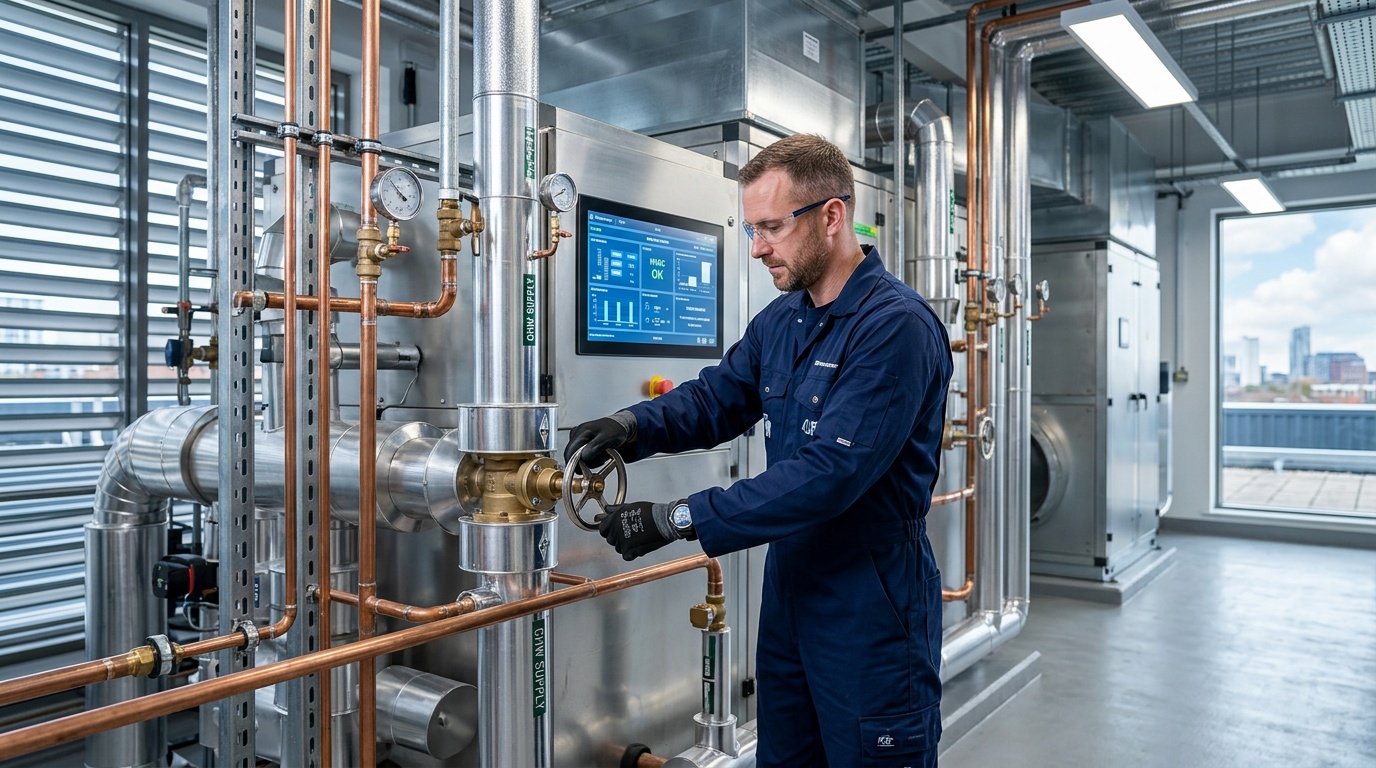
Selecting the right partner requires looking closely at operational standards. When you Compare HVAC maintenance providers in West Midlands, verify that they have the scale to manage your infrastructure while keeping accountability clear.
Certifications and Accreditation: The Non-Negotiable Foundation
Never accept verbal assurances regarding technical capability. A reputable HVAC firm should hold corporate certifications, including SafeContractor, Refcom F-Gas Certification, Gas Safe Register, and ISO 9001. These credentials show that the provider undergoes external audits, maintains strict safety procedures, and employs qualified professionals who handle refrigerants and combustion equipment safely.
Response Times and 24/7/365 Availability
Heating and ventilation systems do not wait for business hours to fail. A critical server room cooling failure on a Sunday morning needs immediate intervention. Ensure your provider offers a genuine, round-the-clock emergency response service backed by a dedicated helpdesk, rather than an answering service that routes calls to an on-call engineer's mobile phone.
Technical Expertise vs. Generic Service
Many general facilities management companies offer HVAC servicing as an add-on and outsource the actual work to third-party subcontractors. This adds unnecessary margins and dilutes accountability. Working directly with a specialist commercial engineering firm helps to ensure that the technician on site has deep diagnostic expertise in complex climate control systems.
The Role of SFG20 Compliance in Ensuring Best Practice
SFG20 is the industry standard for building maintenance specifications. It sets out the maintenance tasks required for each type of building asset, along with the frequency of those tasks. A provider that utilises SFG20 helps you avoid over-maintaining low-risk assets and under-maintaining critical equipment, supporting compliance and safe operation.
| Service Feature | Standard FM Contractor | Specialist HVAC Partner |
|---|---|---|
| Core Technical Focus | General building fabric and cleaning | Specialist heating, ventilation, and air conditioning |
| Compliance Reporting | Manual paper sheets, prone to delay | Digital, real-time certification and asset tracking |
| Direct Labour | Often outsourced to third-party subcontractors | Directly employed, qualified combustion and refrigeration engineers |
| Maintenance Standard | Generic visual checks | Rigorous SFG20-aligned technical procedures |
The MEMS Difference: Innovation, Transparency, and Long-Term Asset Care
At M&E Maintenance Solutions Limited, we have spent years refining our approach to commercial building care. Founded in 2007, our business specialises in the maintenance of commercial buildings, with a focus on heating, ventilation, and air conditioning. We employ over 20 core staff and work with a growing number of strategic partners to support facility managers and estate managers throughout the UK.
Our "Open Door" Innovation Policy
The heating and cooling industry is evolving rapidly with the transition towards low-carbon technologies. We maintain an open door policy for evaluating and testing new HVAC technologies before offering them to customers. This testing helps us recommend reliable, sustainable options that can help clients save money, improve working environments, and maintain compliance with current legislation.
Our portfolio includes Air to Air heat pumps, Air to Water heat pumps, Solar PV, LED Lighting, and Solar Thermal systems. We can support plans to upgrade away from ageing gas plant at a pace that suits your capital expenditure programme.
From Reactive Repairs to Proactive Partnerships
We focus on long-term working relationships, not one-off call-outs. Our aim is to operate as an extension of your internal team, providing practical guidance that protects your budget and supports compliance. Once we understand your operational demands, we can shape maintenance schedules that suit site usage, risk, and system criticality.
The "Right First Time" Ethos
An engineer arriving without the correct tools, diagnosing a fault, then leaving without resolving it wastes time and increases disruption. Our team targets strong first-time fix performance by carrying common diagnostic spares and using detailed asset histories. When a return visit is needed, we aim to keep it planned and controlled, with minimal disturbance to occupants and operations.
Unpacking HVAC Maintenance Contracts: What's Included, What's Not, and How to Avoid Hidden Costs
Before signing any service agreement, you should understand exactly what your payment covers. When you Compare HVAC maintenance providers in West Midlands, you will see a range of contract structures, and some include exclusions that can inflate annual spend.
Decoding Standard Maintenance Agreements
A contract should clearly outline the number of planned preventative visits per year, the assets covered, and the agreed response times for emergency calls. It should also confirm whether consumables such as drive belts, filters, and basic lubricants are included in the base cost or billed separately.
The Pitfalls of Vague Contracts
Be cautious of agreements that use ambiguous language about repairs. Some providers set a low entry-level contract price, then charge premium hourly rates for diagnostic work outside a basic visual inspection. Ensure the contract defines the boundary between routine maintenance and remedial works, including authorisation steps and reporting.
Understanding Pricing Structures
Most providers offer three main contract types: basic preventative contracts, semi-inclusive contracts, and fully inclusive agreements. A basic contract covers scheduled visits, while parts and reactive labour are billed separately. A fully inclusive contract can support predictable budgeting, since call-outs, labour, and replacement parts are included, subject to the contract scope.
Evaluating HVAC Maintenance Contract Types
Match the contract type to the age of your plant, how critical the systems are, and how predictable you need your costs to be. If you are assessing multiple tenders, compare the same asset list and response assumptions, otherwise it is easy to compare a full service to a basic inspection package.
PPM Only Contracts
- Lower initial annual contract cost
- Covers essential statutory compliance checks within the agreed scope
- Allows you to plan and approve remedial works as needed
PPM Only Contracts
- Exposure to unplanned call-out fees
- Replacement parts and remedial labour are billed separately
- Budgeting can be less predictable on older, high-use systems
How Transparency in Quoting Protects Your Budget
A transparent provider should offer a detailed quotation that itemises planned visits, inclusions, exclusions, labour rates, and any likely additional charges. You should be able to see what is included in the contract price, what would trigger an extra cost, and how authorisation works. Ask for a full breakdown and challenge unclear terms before you sign. If you need to Compare HVAC maintenance providers in West Midlands on a like-for-like basis, insist that each bidder prices the same asset register and service levels.
Frequently Asked Questions
What is the $5000 rule for HVAC?
While there isn't a universal '$5000 rule,' many facility managers consider the cost of a repair against the remaining lifespan and replacement cost of an HVAC asset. If a repair approaches a significant percentage of a new unit's price, it often signals that reactive maintenance is becoming uneconomical. Our approach at MEMS focuses on planned preventative maintenance to avoid reaching these costly repair-or-replace dilemmas prematurely, extending your asset life and saving your budget.
What is the 20 rule for HVAC?
The '20% rule' in HVAC is a common guideline suggesting that if a repair costs more than 20% of the price of a new system, replacement might be the more financially sound decision. This often applies to older equipment where efficiency losses and frequent breakdowns make continued repairs unsustainable. Proactive maintenance, as we champion at MEMS, aims to keep your systems running efficiently for their full intended lifespan, reducing the chances of needing to apply such a rule.
What is the most reliable HVAC company in the West Midlands?
The most reliable HVAC company in the West Midlands for commercial maintenance will demonstrate clear technical expertise, hold corporate certifications like Refcom F-Gas and Gas Safe Register, and offer genuinely round-the-clock emergency response. They should also align their maintenance delivery with SFG20 standards and provide digital, traceable compliance certificates. At MEMS, we pride ourselves on meeting these rigorous criteria, ensuring your commercial building's systems are in expert hands.
What is HVAC called in the UK?
In the UK, HVAC is the widely accepted acronym for Heating, Ventilation, and Air Conditioning. This term covers all the systems responsible for maintaining indoor environmental comfort and air quality in commercial buildings. As specialists in this field, we at MEMS focus on ensuring these critical systems operate efficiently and compliantly for facility managers across the UK.
What is the 2 foot rule for HVAC?
The '2-foot rule' typically refers to maintaining at least two feet of clear space around outdoor HVAC units to ensure proper airflow and optimal system efficiency. Blocked airflow can force your system to work harder, leading to increased energy consumption and accelerated wear. Our planned preventative maintenance includes checks to ensure your equipment has adequate clearance and is operating under the best possible conditions.